
You’re drafting an email about a shifted meeting and you freeze on one tiny word. Should it say “rescheduled to Thursday” or “rescheduled for Thursday”? If you’ve ever wondered about Reschedule To or For, you’re not alone.
Both versions show up constantly in real business writing, and both are grammatically sound. This guide breaks down exactly when each preposition fits, backed by real dictionary definitions instead of guesswork.
Quick Answer
Use “to” when you’re pointing at the exact new date or time replacing the old one. Use “for” when you’re describing the period an event is planned to happen, or even the reason behind the change.
- “The meeting was rescheduled to 3 p.m.” — points straight at the new slot.
- “The meeting was rescheduled for Friday.” — describes when it’s now set to happen.
- “We rescheduled for everyone’s convenience.” — here “for” explains the reason, and “to” wouldn’t work at all.
If you’re stuck deciding, “for” is the safer, more conversational default.
What Does “Reschedule” Mean?
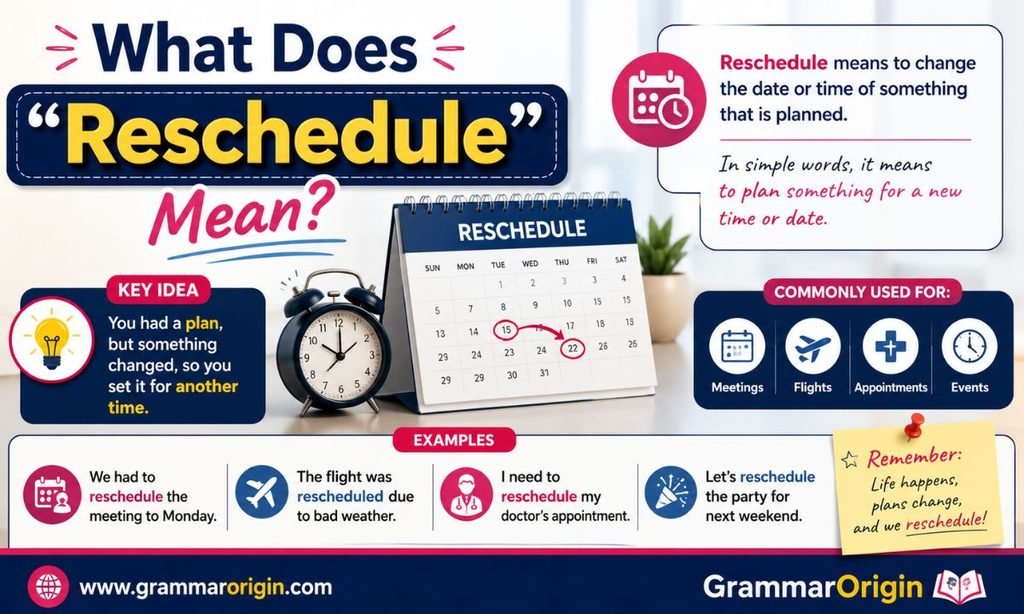
Reschedule means arranging something for a different time than what was originally planned. Cambridge Dictionary defines it simply as agreeing on a new, later date for something to happen.
People reschedule meetings, flights, interviews, deadlines, and appointments constantly. The verb itself never changes — it’s the small word that follows it that carries the extra meaning.
When to Use “Reschedule To”
Reach for “to” when your sentence needs to name the exact new time or date replacing the old plan.
Examples
- Can we reschedule to tomorrow afternoon?
- I’ve rescheduled the call to 4 p.m. instead of 2.
- She rescheduled her flight to next Thursday.
- Let’s reschedule to a day that works better for both of us.
Why “To” Works
“To” signals movement from one point toward another, the same way you’d say “moved from Monday to Tuesday.” It draws a straight line to the new destination in time.
That’s why it feels so natural whenever you’re highlighting the shift itself, not just the outcome.
Also Read This Any Problem or Any Problems?
When to Use “Reschedule For”
Reach for “for” when you’re describing the timing an event is now set for, or explaining the reason behind the change.
Examples
- The interview has been rescheduled for next Monday.
- Our appointment is now set for early afternoon.
- We had to reschedule for budget reasons.
- The workshop was rescheduled for a date later in the quarter.
Why “For” Works
“For” often expresses purpose or intended timing rather than pure movement — think “planned for Friday” or “arranged for next week.” Since “reschedule” shares roots with “schedule,” this pairing feels instinctive to most speakers.
It’s also the only option when you’re naming a reason instead of a date: you’d reschedule for convenience, never to convenience.
Reschedule To vs Reschedule For: Comparison Table
| Feature | Reschedule To | Reschedule For |
| Core focus | The exact new date/time | The planned period, or the reason |
| Feels like | Movement toward a target | Arrangement or purpose |
| Common in | Precise scheduling, calendar changes | Everyday speech, business emails |
| Can express a reason? | No | Yes |
| Example | Rescheduled to 10 a.m. | Rescheduled for Monday |
Which One Sounds More Natural?
Most people naturally reach for “for” because it echoes the familiar phrase “scheduled for,” as in “the meeting is scheduled for Friday.” That existing pattern makes the plural version feel automatic.
That said, “to” is just as accepted and shows up constantly in professional writing when the exact new time matters more than the general timeframe.
Either one lands fine in most everyday conversations — native speakers rarely notice a mix-up.
Common Mistakes to Avoid
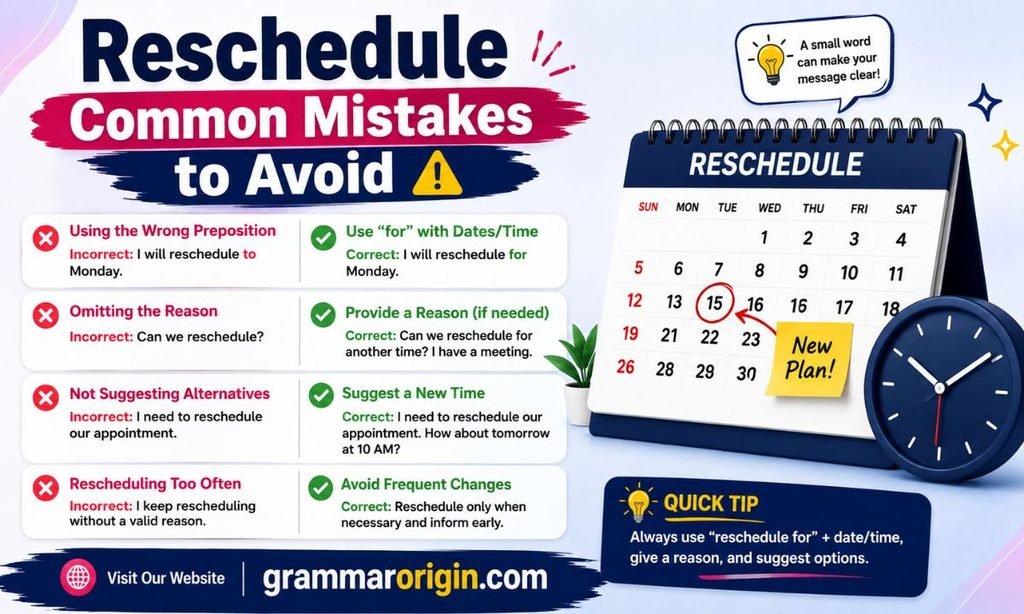
Most slip-ups come from stacking prepositions or leaving the sentence unclear about what actually changed.
1. Using the Wrong Time Expression
Wrong: “The meeting was rescheduled to next week on.” Right: “The meeting was rescheduled to next week.”
2. Adding Unnecessary Prepositions
Wrong: “The meeting was rescheduled for to Friday.” Right: “The meeting was rescheduled for Friday.”
3. Mixing Old and New Dates Unclear
Vague: “The meeting was rescheduled Friday.” Clearer: “The meeting was rescheduled to Friday.”
4. Forgetting the New Time
Unhelpful: “The meeting was rescheduled.” Better: “The meeting was rescheduled for Thursday morning.”
Examples in Business Communication
Email Example 1
“Due to a scheduling conflict, your appointment has been rescheduled to 2 p.m. on Thursday.”
Email Example 2
“We’re writing to confirm your interview has been rescheduled for next Tuesday.”
Email Example 3
“The quarterly review has been rescheduled to June 18th.”
Email Example 4
“Please note that the training session has been rescheduled for the following week.”
Both forms read as equally professional — the choice comes down to whether you’re naming a precise slot or a general period.
American vs British English
Grammatically, both regions accept either preposition without issue.
American English
American writers use both forms interchangeably, though “for” tends to dominate casual and customer-facing messages.
- “Your order pickup was rescheduled to 5 p.m.”
- “Your order pickup was rescheduled for tomorrow.”
British English
British speakers lean slightly toward “for” in everyday speech, though “to” appears often enough in formal or written contexts to sound completely normal.
- “The train service has been rescheduled for tomorrow.”
- “The appointment has been rescheduled to next Wednesday.”
Alternative Phrases You Can Use
Repeating the same verb-preposition pair throughout a document gets repetitive fast. A few natural swaps:
- Moved to / moved back to
- Postponed until
- Rearranged for
- Shifted to
- Pushed back to
- Set for a new date
Example: “The launch was pushed back to early next month.”
Also Read This Any Problem or Any Problems?
When Both Are Correct
In the vast majority of ordinary sentences, either preposition works and native speakers won’t blink at either choice.
- “The meeting was rescheduled to Friday.” ✔
- “The meeting was rescheduled for Friday.” ✔
The one exception: once you’re explaining a reason rather than a time, only “for” fits.
Reschedule To or For Tomorrow
Both work here — “rescheduled to tomorrow” points at tomorrow as the new specific slot, while “rescheduled for tomorrow” frames tomorrow as the day the event is now planned for.
Example: “Can we reschedule to tomorrow morning instead?” and “The call has been rescheduled for tomorrow” both read naturally in everyday use.
Reschedule For Tomorrow Meaning
This phrasing simply means an event that was originally set for one day has been moved so that it now falls on tomorrow instead. It doesn’t specify an exact hour — just the day itself.
Example: “Your delivery has been rescheduled for tomorrow” tells you the day changed, not necessarily the time.
Has Been Rescheduled To” or For
Both passive forms are correct and appear constantly in official notices, confirmation emails, and calendar updates. “Has been rescheduled to [specific time]” leans toward precision, while “has been rescheduled for [day/period]” leans toward general planning.
Example: “Your flight has been rescheduled to 6:45 p.m.” versus “Your flight has been rescheduled for the next available slot.”
Wording to Reschedule a Meeting
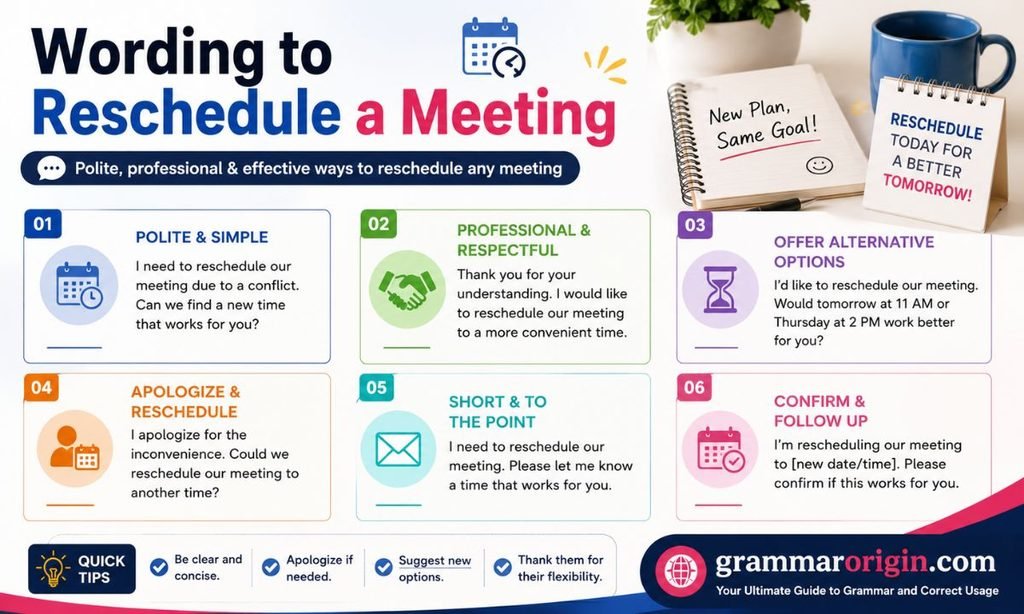
A few ready-to-use lines make rescheduling requests sound polished without overthinking the preposition every time.
- “I need to reschedule our meeting — would Thursday afternoon work instead?”
- “Apologies for the short notice; can we move this to next week?”
- “Due to a conflict, I’d like to reschedule for a later time this week.”
- “Would it be possible to push our call back to Friday?”
Pick whichever phrasing matches whether you’re naming an exact slot or just a general timeframe.
Reschedule to a Later Date Meaning
This phrase means an event is being pushed further into the future than originally planned, without necessarily naming the exact new day yet. It’s a common placeholder phrase used before a specific date has been confirmed.
Example: “The launch has been rescheduled to a later date” tells readers the timeline shifted, even before all the details are finalized.
Reschedule to Next Week
This exact phrase points to the upcoming week as the new timeframe for an event, without pinning down a specific day within it. It’s one of the most common ways people announce a short delay.
Example: “We’ve decided to reschedule the workshop to next week to allow more people to attend.”
Rescheduled to Monday
This phrase confirms that an event now falls on Monday instead of its original date. It’s precise enough to avoid confusion while still sounding natural in both speech and writing.
Example: “The client call has been rescheduled to Monday at 10 a.m.”
Final Thoughts
Both “reschedule to” and “reschedule for” are correct, and the real difference comes down to what you’re emphasizing: the exact new time, or the general period and reason behind the change. “To” points directly at a new slot, while “for” covers timing and purpose alike.
When in doubt, “for” is the safer, more natural-sounding choice in most everyday and business writing.
Frequently Asked Questions
Is “reschedule to” grammatically correct?
Yes. It’s correct whenever you’re naming the exact new date or time replacing the original one.
Is “reschedule for” also correct?
Yes. It’s equally correct and often sounds more natural in casual speech, especially when echoing the phrase “scheduled for.”
Which one is more common in business emails?
Both appear regularly, though “for” slightly edges out “to” in everyday professional messages because it mirrors familiar scheduling language.
Can I use “reschedule at” instead?
Generally, no. English speakers stick with “to” or “for” after “reschedule” — “at” doesn’t fit the usual pattern.
Does “for” ever mean something other than timing?
Yes. “For” can also express a reason, as in “we rescheduled for budget reasons,” where “to” wouldn’t work at all.
Is there a real grammar rule that favors one over the other?
Not a strict one. Cambridge Dictionary confirms both prepositions fit “reschedule” naturally, with “for” covering a slightly wider range of uses, including purpose.
What should English learners default to if unsure?
Default to “for” — it mirrors the common phrase “scheduled for” and rarely sounds out of place in everyday English.

Muhammad Waqas is an English language teacher and grammar expert with over 8 years of experience helping students and professionals improve their writing skills. He specializes in English grammar, vocabulary, communication, and practical language learning. Through GrammarOrigin, Waqas shares clear, easy-to-understand content that helps readers write and speak English with confidence.