
You’re typing an email, and you pause right before hitting send. Should it be “let me know if you have any problem” or “any problems”? That tiny letter “s” suddenly feels like it matters a lot more than it should.
Here’s the short version: both phrases are correct, but they don’t mean quite the same thing. This guide breaks down when to use the singular form and when the plural fits better, with real examples, grammar rules, and the mistakes most people make without realizing it.
Quick Answer
The singular form points to one specific or hypothetical issue. The plural version covers multiple issues, or an unknown number of them.
| Form | Number | Typical Verb | Example |
| Any problem | Singular | is / was | Is there any problem with the invoice? |
| Any problems | Plural | are / were | Are there any problems with the invoice? |
Neither one is “more correct” than the other. The right choice just depends on whether you’re talking about one thing or several.
Any Problem or Any Problems Examples
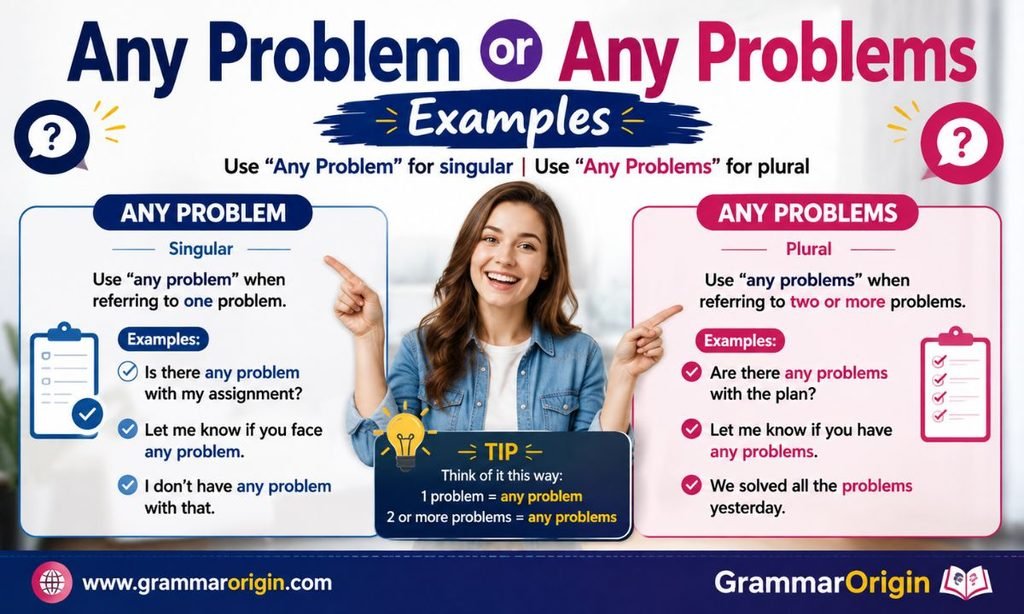
Seeing both forms side by side makes the pattern click faster than any rule ever could.
Singular framing:
- “If there’s any problem, text me right away.”
- “I don’t see an issue with the schedule.”
- “Call the front desk if a problem comes up.”
Plural framing:
- “Did you run into any problems on the drive over?”
- “Let us know if there are any problems with the shipment.”
- “Are there any issues I should flag before the meeting?”
Notice how the plural version tends to show up when the speaker genuinely doesn’t know how many things might go wrong.
Any Problem or Any Problems Answer
The direct answer: pick the singular for one issue, and the plural when you mean more than one, or when the number is uncertain. Both are grammatically valid English.
Most native speakers actually lean toward the plural in everyday speech, even when only one issue eventually turns up. It’s simply the more open, all-purpose phrasing. The singular survives mostly in formal or careful writing, where precision matters more than casual flow.
Also Read This Momma or Mama?
Any Problem or Any Problems Grammar
“Problem” is a countable noun, so it can take a singular or plural form depending on what you mean. “Any” acts as a quantifier or indefinite determiner that works with both — it doesn’t force a grammatical number on its own; the noun after it decides that.
Subject-verb agreement is where people slip up most:
- Singular: Is there a problem? ✔
- Plural: Are there any problems? ✔
- Wrong: Is there any problems? ✘
Keep the verb matched to the noun’s grammatical number and this pair stops being confusing almost immediately.
Any Problem Meaning
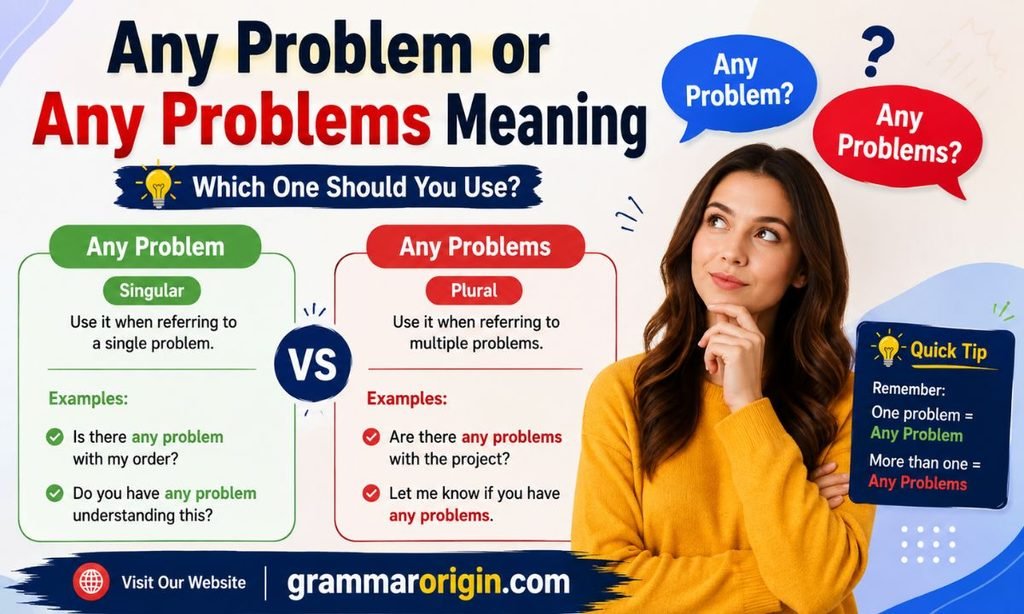
This singular phrase refers to one unspecified issue, real or hypothetical. It’s the wording you reach for when you’re not pointing to a particular fault — just acknowledging that one might exist.
Think of a warranty card that reads, “Should any fault occur, contact the manufacturer.” It’s not predicting a specific defect; it’s covering the general possibility of one.
Is There Any Problem Meaning
This is a direct, singular-focused question asking whether a single issue exists right now. It’s often used to check in briefly, sometimes with a slightly formal or even confrontational edge depending on tone.
A manager asking a team member “Is there any problem with the deadline?” is checking for one clear obstacle — not fishing for a whole list of complaints.
Any Issue Meaning
“Issue” works as a close synonym for “problem,” and it follows the exact same singular logic when paired with “any.” It signals one unspecified difficulty, often used when someone wants to sound a bit more neutral or diplomatic.
Customer support teams frequently prefer this softer wording: “Please reach out if you have any issue with your order.”
Meaning Explained
Picture the singular version as asking, “Is there a single obstacle here?” and the plural as asking, “Are there several potential obstacles?” That mental image alone solves most of the confusion.
The countable nature of “problem” is what allows this flexibility in the first place. English lets you zoom in on one instance or zoom out to a broader set, and the context-dependent meaning shifts entirely with that one letter.
Examples in Context
Formal writing:
- “Should any problem arise during the trial period, notify us within 48 hours.”
Everyday speech:
- “Any problems getting here? Traffic was rough today.”
Customer service:
- “We’re happy to help if you’re experiencing difficulties with the app.”
Workplace email:
- “Please flag any concern with the report before Friday’s review.”
Text message:
- “All good? Anything come up?”
Each setting nudges the choice slightly, but the underlying singular-vs-plural logic never changes.
Common Mistakes to Avoid
Most errors come down to mismatched verbs or unnecessary extra words.
- ❌ “Is there any problems with the order?” → ✅ “Are there any problems with the order?”
- ❌ “If there’s any problems, call us.” → ✅ “If there are any problems, call us.”
- ❌ “Do you have a any problem?” → ✅ “Do you have a problem?” (drop the extra article)
- ❌ Using the plural for one clearly single issue in formal writing → sounds vague instead of precise.
A quick trick: read the sentence aloud. If the verb feels off, the number probably doesn’t match.
Also Read This Momma or Mama?
American vs British English Differences
Both dialects follow the same core grammar rules here, but usage habits shift slightly.
| Feature | American English | British English |
| Everyday speech | Strong preference for the plural | Plural is common too, but less dominant |
| Formal writing | Plural still favored in support contexts | Singular appears more often in official notices |
| Typical phrasing | “Do you have any problems?” | “Is there any problem with this arrangement?” |
Neither version will sound “wrong” across the Atlantic — the difference is closer to a stylistic accent than a hard rule.
Related Terms and Synonyms
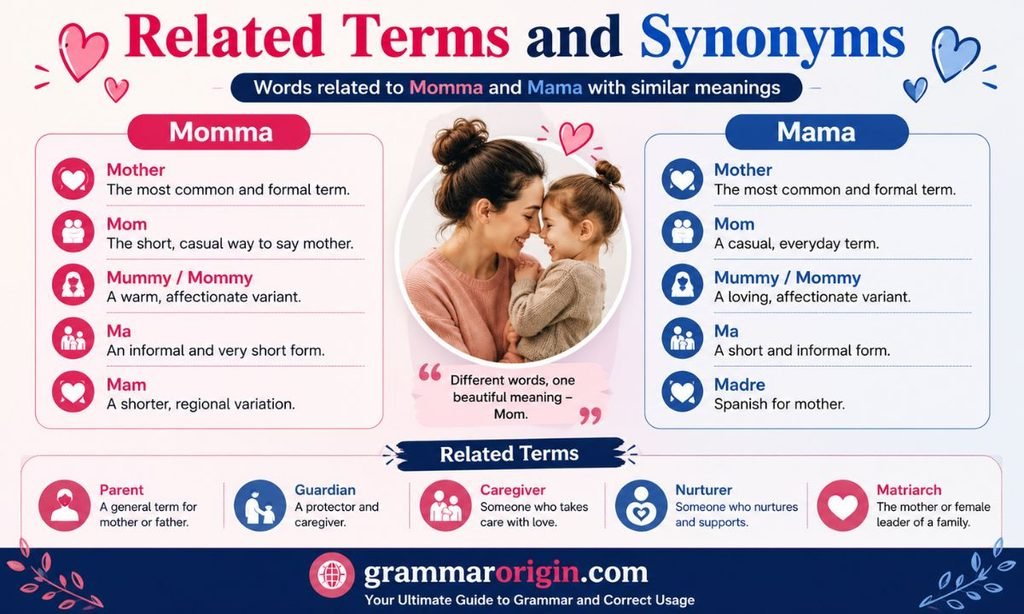
Several words swap in for “problem” depending on tone and formality.
- Issue / Issues — a softer, more neutral alternative. “Any issues with the delivery?”
- Obstacle / Obstacles — leans business or project-focused. “Are there any obstacles to launch?”
- Complication / Complications — implies something has gotten more tangled than expected. “We don’t foresee any complications.”
- Difficulty / Difficulties — a general term for challenges. “Let us know if you face any difficulties.”
Swapping in one of these can make repetitive writing sound more natural without changing the underlying grammar rule at all.
Idiomatic Expressions
A handful of fixed phrases don’t follow the usual counting logic and just need to be memorized.
- “No problem” — the standard, idiomatic reply meaning “it’s fine.” The plural version exists but sounds far less natural as a response.
- “…at all?” tacked onto the plural form — an emphatic, casual question, often used to sound extra reassuring.
- “Any chance…?” — pairs a singular noun with “any” the same way the singular form here works, showing the pattern extends beyond just this one word.
These set expressions are worth learning by ear rather than by rule, since native speakers rarely swap the number in them.
Any Problem or Any Problems Meaning
Put simply, the singular means one possible issue, while the plural means multiple or an unknown number of possible issues. The shift is small on paper but changes how specific or open-ended a sentence sounds.
Choosing between them comes down to one question: are you asking about a single thing, or leaving the door open for several?
Quick Practice
Try filling in the blank before checking the answer:
- “Let me know if you face any ______.” (traveling for a week)
- “Is there any ______ with this invoice?” (one billing line)
- “Did you have any ______ setting up the account?”
Answers: 1. problems 2. problem 3. problems — because two of the three situations clearly involve more than one thing that could go wrong.
Final Thoughts
Both forms are grammatically sound — the choice simply reflects whether you mean one issue or several. Matching your verb to the noun’s number is the one rule that prevents almost every mistake people make with this pair.
Next time you pause mid-sentence, ask yourself: am I talking about a single problem, or leaving space for more than one? That question alone will point you to the right word every time.
Frequently Asked Questions
Is it “any problem” or “any problems”?
Both are correct. Use the singular for one issue, and the plural when multiple or unknown ones are possible.
Which one is more common in spoken English?
The plural shows up far more often in casual, spoken English, since most everyday questions leave room for more than one thing to go wrong.
Is the singular form grammatically incorrect?
No. It’s fully correct — just less common than the plural, and typically reserved for formal or careful writing.
Can the singular be used in a question?
Yes. “Do you have a problem with that approach?” is a perfectly natural, if slightly formal, question.
What’s the difference between this phrase and “any issue”?
They mean almost the same thing. “Any issue” often sounds a touch more neutral or polite, which is why customer support teams favor it.
Does British English handle this differently than American English?
Not dramatically. British formal writing leans singular slightly more often, while American speech leans plural — but both forms are understood and accepted in either dialect.
How do I decide which form fits my own writing?
Ask whether you’re referring to one specific issue or leaving room for several. One issue points to the singular; several or unknown issues point to the plural.

Muhammad Waqas is an English language teacher and grammar expert with over 8 years of experience helping students and professionals improve their writing skills. He specializes in English grammar, vocabulary, communication, and practical language learning. Through GrammarOrigin, Waqas shares clear, easy-to-understand content that helps readers write and speak English with confidence.