
Refer or reffer? The correct spelling is refer, always, with just one f. Reffer is a common typing slip, not a real word in any dictionary or grammar checker.
The confusion usually comes from how the word sounds when spoken. This guide walks you through the spelling rule, the history, real examples, and every related form, so you never have to second-guess it again during your written communication.
Refer
Refer means to direct someone’s attention to something, mention a source, or send a person elsewhere for help. It’s spelled with one f and one r in its base form, and every major dictionary, including Merriam-Webster and Cambridge, lists it exactly this way.
You’ll see it constantly in emails, medical notes, school assignments, and everyday conversation. It is one of those everyday English words that shows up so often that getting the spelling wrong can quietly hurt your credibility in professional writing.
Reffer
Reffer isn’t a real English word. It’s a spelling mistake that happens because people expect the consonant to double, the same way it does in words like referred or referring.
No dictionary, spellchecker, or style guide accepts reffer as correct, in any context. Even a quick search through Merriam-Webster or Oxford turns up nothing under that spelling. Most modern grammar checkers will flag it instantly as a misspelling.
Refer or Reffer: Quick Answer
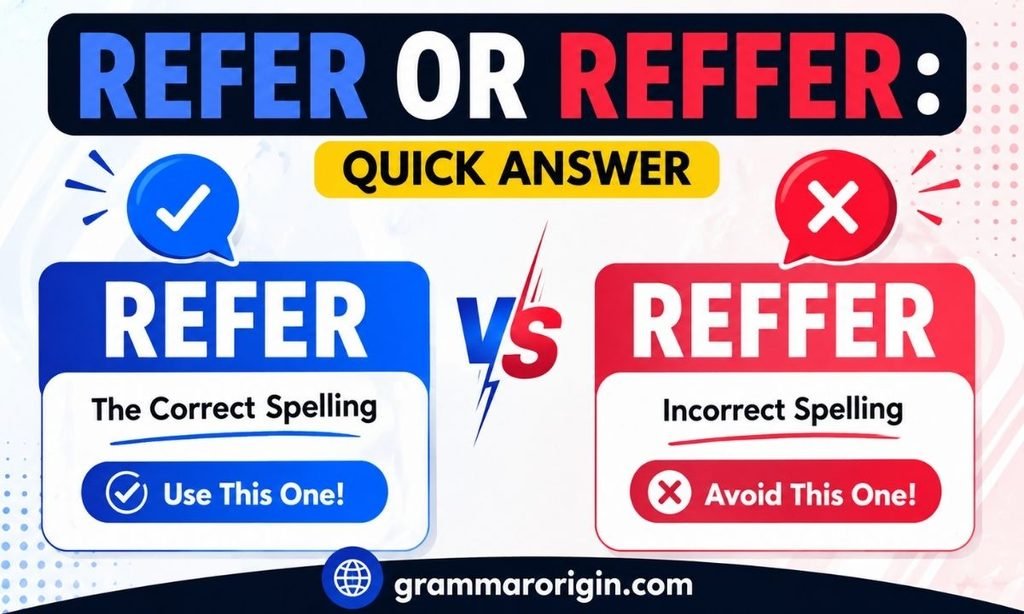
Refer is correct. Reffer is always wrong, no matter the region, tone, or context.
- Correct: I will refer you to a specialist.
- Correct: Please refer to the attached file.
- Wrong: I will reffer you to a specialist.
- Wrong: Please reffer to the attached file.
The rule stays simple: one f in refer, and that never changes.
The Origin of Refer or Reffer
Refer comes from the Latin verb referre, built from re- (meaning back) and ferre (meaning to carry). Together, they originally meant something close to “to carry back.”
The word passed through Old French before settling into English during the late Middle Ages. Its meaning grew from a literal sense of carrying something back into the broader idea we use today: pointing someone toward information, a person, or a source.
Reffer has no history like this at all. It’s simply a spelling slip based on how the word sounds, not an older form or regional variant.
Also Read This 31st or 31th: Which One Is Correct?
British English vs American English Spelling
Refer is spelled the same way in both British and American English. There’s no split here like there is with words such as colour and color.
| Form | British English | American English |
| Base verb | refer | refer |
| Past tense | referred | referred |
| Present participle | referring | referring |
| Noun form | referral | referral |
Neither dialect accepts reffer in any form, formal or casual.
Which Spelling Should You Use?
Use refer, no matter who you’re writing for or where they live. This isn’t a regional spelling choice like many other English words.
- Writing for a US audience? Use refer.
- Writing for the UK, Australia, or Canada? Still refer.
- Writing formal, academic, or business content? Refer is the only accepted form.
- Writing a quick text or casual email? Refer stays the same.
There’s no version of English where reffer becomes acceptable.
How to Spell “Refer” Correctly (Common Search Questions)
The correct spelling is R-E-F-E-R, with a single f and a single r in the base form. People search this often because the pronunciation makes doubling the f feel natural, even though it isn’t.
- Is it refer or reffer? Always refer.
- How do you spell refer? R-E-F-E-R.
- Why does refer sound like it needs two f’s? Because English stress patterns often trick people into expecting a doubled consonant where there isn’t one.
What about “refers”?
Refers is the form used with he, she, or it, as in “the manual refers to chapter three.” It keeps the single f, just like the base word.
The only doubling in this entire word family happens to the r, and only in the past tense and -ing forms.
Common Mistakes with Refer
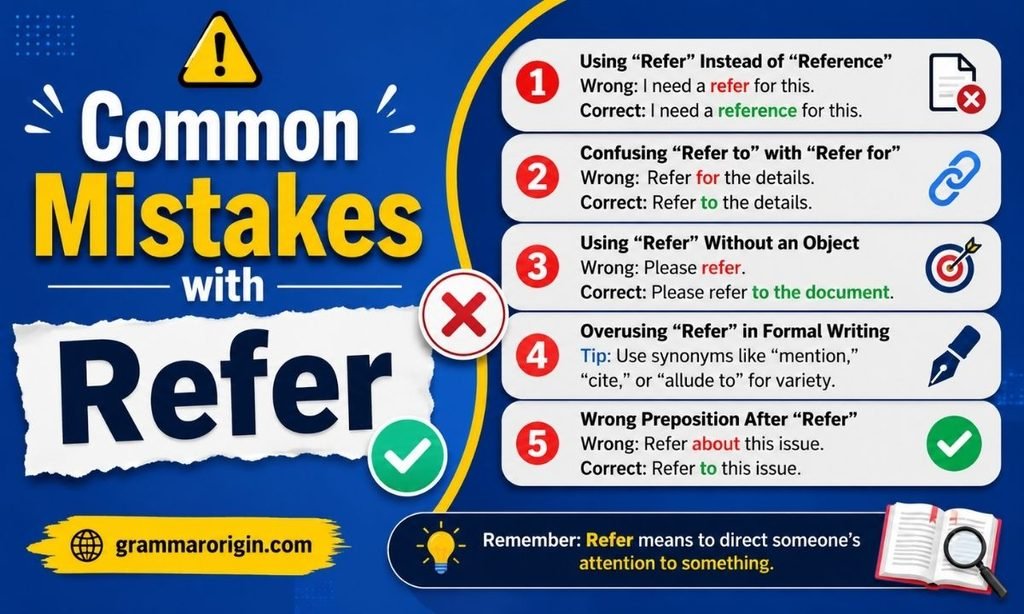
Even confident writers slip up with this word family. Here are the errors that show up most often.
- Doubling the f instead of the r: writing reffer, reffered, or reffering.
- Forgetting to double the r: writing refered or refering without the second r.
- Assuming British English allows reffer as a variant, similar to colour versus color. It doesn’t.
- Confusing refer with referee or referral, which carry different meanings entirely.
- Trusting pronunciation over the actual spelling rule, since refer sounds like it should double the wrong letter.
A quick proofreading pass, or running your sentence through a spelling and grammar checker, usually catches this mistake right away.
Refer in Everyday Examples
Seeing refer used correctly across different settings makes the spelling easier to remember for good. Here are natural examples from daily life.
- Please refer to the instructions before starting the setup.
- The doctor referred her to a specialist last week.
- He often refers to old case studies in his lectures.
- Our app rewards you when you refer a friend.
- The report refers to data collected over five years.
- She is referring students to extra reading material.
Refer: Google Trends and Usage Data
Search data shows people look up both refer and reffer constantly, usually while trying to confirm which spelling is correct. Refer dominates search volume by a wide margin.
- United States: high search volume tied to work emails, resumes, and school assignments.
- United Kingdom: frequent searches among students and content writers.
- India and Pakistan: strong search interest linked to English learning and professional writing.
- Reffer searches exist mainly from people actively checking the spelling, not using it as an accepted form.
Keyword Variations Comparison Table
| Word Form | Correct Spelling | Common Mistake | Status |
| Base form | refer | reffer | Reffer always wrong |
| Past tense | referred | reffered, refered | Only referred is correct |
| Present participle | referring | reffering, refering | Only referring is correct |
| Noun form | referral | reffural, referal | Only referral is correct |
| Third person | refers | reffers | Reffers always wrong |
Refer, Referring, or Referred: Spelling Rules Explained
The confusion comes down to one English spelling rule: consonant doubling. When a short verb ends in a single vowel plus a single consonant, and the stress falls on that final syllable, the consonant doubles before a suffix like -ed or -ing.
Refer fits this pattern exactly. The stress lands on the second syllable, “re-FER,” so the r doubles in referred and referring. The f never doubles, because the rule only touches the very last consonant before the suffix.
Correct Forms
- Refer
- Refers
- Referred
- Referring
- Referral
Incorrect Forms
- Reffer
- Reffers
- Reffered, refered
- Reffering, refering
- Reffural, referal
Why does the spelling change?
The change happens because of stress placement, not pronunciation habits. Compare refer to offer: offer is stressed on the first syllable, “OF-fer,” so its consonant never doubles, giving you offered, not offerred.
The same stress-based logic explains why words like occur, admit, and begin double their final consonant, while words like happen, listen, and offer do not. It also explains why refer’s close relatives, prefer, confer, transfer, and defer, all double the r in the same way, becoming preferred, conferred, transferred, and deferred, since they share the same Latin root and the same stress pattern. Understanding this one grammar rule makes several other tricky English spellings easier too.
Common search variations covered
- refer or reffer
- referred or refered
- referring or refering
- how to spell refer correctly
- is reffer a word
Refer or Reefer (Weed): Not the Same Word
Reefer and refer are two completely different words that just happen to sound alike. Reefer is a slang term for a marijuana cigarette, with roots in 1920s jazz culture, and it has nothing to do with the verb refer.
If you meant to write refer (to direct or mention something) but typed reefer, you’ve landed on an unrelated slang word instead of a misspelling. Keeping the two separate avoids some genuinely confusing sentences.
Refer or Referral
Refer is a verb, while referral is the noun form of the same idea. You refer someone, and the result of that action is called a referral.
- Verb: The doctor referred me to a specialist.
- Noun: I got the appointment through a referral.
Both are spelled with a single f, and referral never becomes “reffural” or “referal” in standard English.
Refer or Reffer Synonym
If you want to avoid repeating refer, or you’re just unsure about the spelling mid-sentence, several synonyms work well depending on context.
- Direct, point, send, or route someone toward a resource or specialist.
- Mention, cite, or allude to something in writing or conversation.
- Recommend or forward a case, request, or document.
- Consult a source in academic or research contexts.
For example, “the doctor referred the patient to a specialist” could become “the doctor recommended a specialist” without losing the meaning.
Also Read This 31st or 31th: Which One Is Correct?
Refer or Reffer in a Sentence
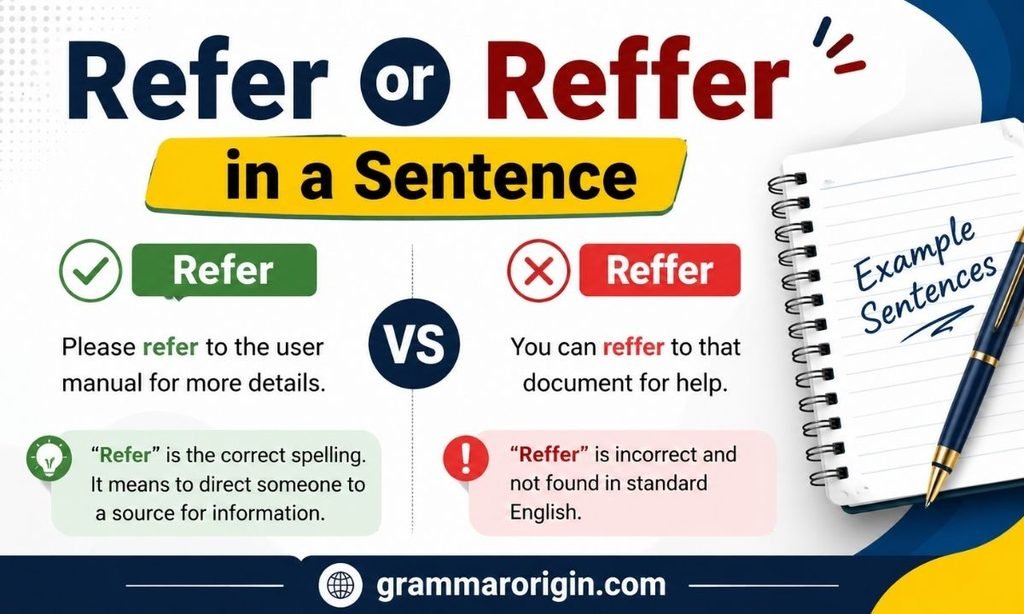
Refer is the only correct choice in a sentence, in any tense or form. Here are a few natural examples across different settings.
- Please refer to page five for the full details.
- She referred her colleague to the HR department.
- The teacher is referring students to additional resources.
- Kindly refer your query to our support team.
Reffer never fits correctly in any of these, no matter how the sentence is styled.
Refer vs Reference vs Referral vs Referee
These four words share a root but serve different jobs in a sentence. Mixing them up is a common source of awkward writing.
| Word | Part of Speech | Meaning |
| Refer | Verb | To direct attention to something or send someone elsewhere |
| Reference | Noun or verb | A citation, source, or the act of citing one |
| Referral | Noun | The result of referring someone, often to a service or specialist |
| Referee | Noun | A person who officiates a match or reviews academic work |
Knowing which one fits keeps your writing clear and avoids clunky, confusing sentences.
Final Thoughts
Refer is the only correct spelling, in every English dialect and every writing style. Reffer never becomes acceptable, no matter how natural the double f might feel while typing.
Once you remember that the r doubles in referred and referring, but the f never doubles anywhere, this word stops being a spelling worry for good.
Frequently Asked Questions
Is reffer ever correct?
No. Reffer is always a misspelling, in every form of English and every writing context.
Do I double the f in refer?
No. Only the r doubles, and only in the past tense and -ing forms, referred and referring.
Is refer different in British and American English?
No. Both dialects spell it the same way in every form, including referred and referring.
What’s the difference between refer and reference?
Refer is a verb, while reference works as a noun or a verb with a slightly different meaning, usually pointing to a citation or source.
Is reefer the same word as refer?
No. Reefer is an unrelated slang term for a marijuana cigarette, while refer means to direct attention to something or send someone elsewhere.
How do I remember the correct spelling of refer?
Remember one rule: single f in the base word, and the r only doubles when you add -ed or -ing.
Can refer be used in casual writing?
Yes. It fits naturally in emails, texts, and social media, just as well as in formal or academic writing.

Muhammad Waqas is an English language teacher and grammar expert with over 8 years of experience helping students and professionals improve their writing skills. He specializes in English grammar, vocabulary, communication, and practical language learning. Through GrammarOrigin, Waqas shares clear, easy-to-understand content that helps readers write and speak English with confidence.