
You’re typing a date, and your fingers hesitate right at the ending. Is it 31st or 31th? This exact hesitation is one of the most common ordinal number questions in English writing.
There’s a clear, consistent rule behind it, and once you see it, you won’t second-guess this number again. This guide breaks down the rule, the reasoning, and real examples across dates, birthdays, and rankings.
31st or 31th: Quick Answer
31st is correct. 31th isn’t a recognized spelling in standard English.
- Correct: Her birthday party is on the 31st.
- Correct: He finished 31st in the race.
- Incorrect: Her birthday party is on the 31th.
- Incorrect: He finished 31th in the race.
Ordinal Suffix Rule at a Glance
- Numbers ending in 1 → add -st (1st, 21st, 31st)
- Numbers ending in 2 → add -nd (2nd, 22nd, 32nd)
- Numbers ending in 3 → add -rd (3rd, 23rd, 33rd)
- Every other number → add -th (4th, 30th, 100th)
- Exceptions: 11, 12, and 13 always take -th, no matter what.
31st or 31th in Dates: Correct Usage Examples
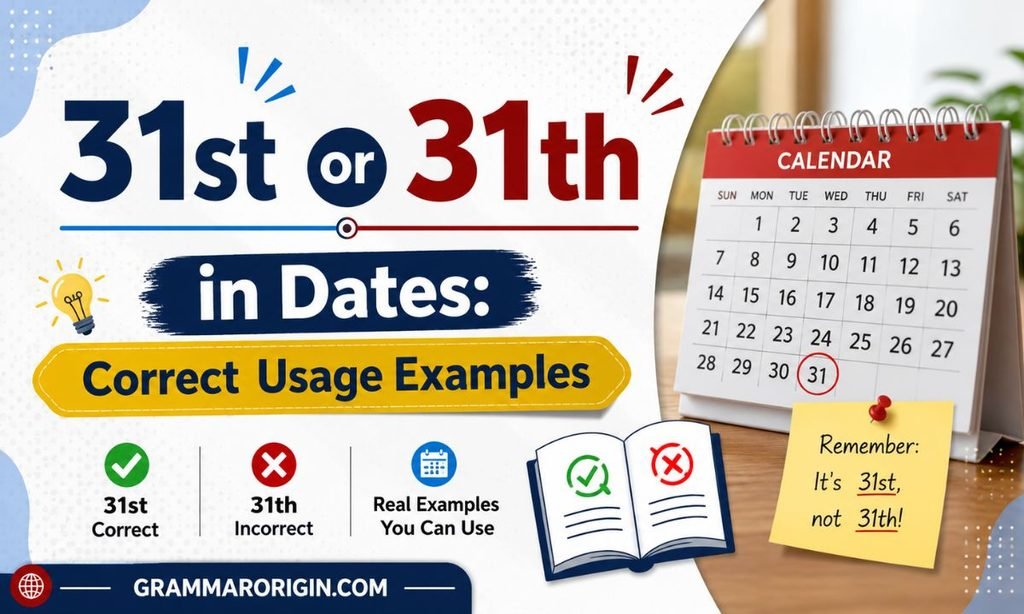
31st is the correct form no matter which month you’re writing about — the rule doesn’t shift based on context.
- January 31st marks the last day of the month.
- The lease ends on March 31st.
- School holidays often start around July 31st.
- Many fiscal years close on August 31st.
- Halloween always lands on October 31st.
- The year wraps up on December 31st.
- Contracts frequently list the 31st as a renewal or expiry date.
- Payroll and billing cycles often reset on the 31st of the month.
Only seven months actually reach a 31st day — January, March, May, July, August, October, and December — but the spelling rule applies identically to all of them.
A quick formatting note worth remembering: there’s no space between the number and its ending. “31 st” is just as incorrect as “31th.”
Also Read This Triple or Tripple? Only One Spelling Is Correct
The Origin of 31st or 31th
Ordinal numbers mark position or rank, not quantity — first, second, third, and so on, rather than one, two, three. English builds these endings from how the number is actually spoken.
Thirty-one is said as “thirty-first,” and that final word — “first” — is what decides the ending. Since “first” takes -st, the written form becomes 31st, following the exact same logic as 1st, 21st, and 41st.
This is why 31th never took hold as a real spelling. It doesn’t match how anyone pronounces the number, and English ordinal endings are built around sound, not a single fixed formula.
The same logic carries through the rest of the number line. 51st, 61st, 71st, 81st, and 91st all follow this exact pattern, since each one ends in the spoken word “first.” Grammar authorities and style editors treat this as settled, foundational English — not an open question.
British English vs American English Spelling
There’s no spelling difference here at all. Both British and American English write the ordinal the same way: 31st.
What does differ is date order. American writing usually puts the month first (“December 31st”), while British writing typically places the day first (“31st December”). The ordinal itself stays untouched either way.
British writing also tends to insert “of” between the ordinal and the month — “the 31st of December” — while American writing usually drops it. Neither habit changes the spelling of 31st itself.
Comparison Table
| Feature | American English | British English |
| Ordinal spelling | 31st | 31st |
| Typical date order | Month, Day, Year | Day, Month, Year |
| Example | December 31st, 2026 | 31st December 2026 |
| Regional spelling variant | None | None |
Which Form Should You Use?
Use 31st in every context — dates, rankings, ages, and anniversaries all follow the same rule.
- Calendar dates: “the 31st of any 31-day month”
- Rankings: “she placed 31st overall”
- Birthdays: “his 31st birthday party”
- Anniversaries: “their 31st year together”
There’s also a numeral-versus-word choice worth knowing. “31st” works fine in everyday writing, while “thirty-first” sometimes reads better at the start of a formal sentence.
Style guides like AP and Chicago mostly weigh in on when to spell ordinals out versus using the numeral form — not on whether 31th is acceptable, since none of them recognize it at all.
Common Mistakes with 31st or 31th
Most people who write “31th” aren’t careless — they’re following a mental shortcut that doesn’t quite hold up for this number.
1. Assuming Every Ordinal Ends in “-th”
Since so many ordinals do end in -th (4th, 15th, 30th), it’s easy to assume that’s the default rule for every number, including 31.
2. Typing “31th” from Muscle Memory
Fast typing sometimes lets a familiar -th ending slip in automatically, even when the writer knows the correct form.
3. Confusing 31st with 30th
Thirty correctly takes -th (thirtieth), so some writers assume the very next number follows the same pattern. It doesn’t — the rule resets with each new final digit.
4. Adding a Space Before the Suffix
Writing “31 st” or “31 th” is its own separate mistake. The suffix always attaches directly to the number with zero space.
A couple of related slips are worth a quick mention too. Some writers overcorrect into “31rd,” assuming any fix away from -th must be -rd, and others simply say “thirty-oneth” in their head, which pushes the wrong ending into the written form. Saying the number out loud before writing it catches both.
Also Read This Triple or Tripple? Only One Spelling Is Correct
31st or 31th in Everyday Examples
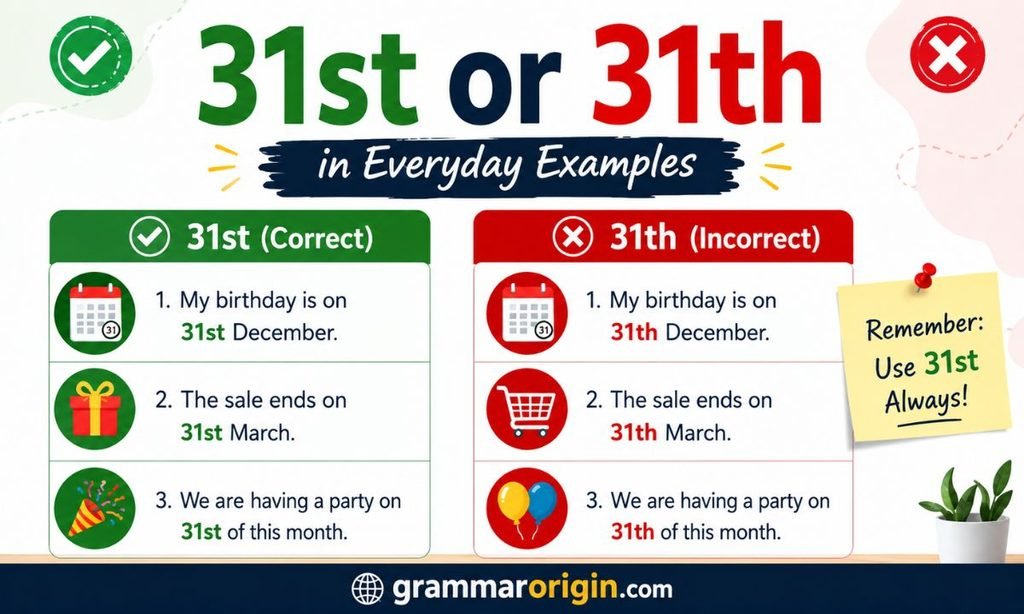
Seeing the correct form across real contexts makes the rule easier to remember for good.
October 31st or 31th
October 31st is Halloween, and it’s one of the most commonly written dates of the year — always 31st, never 31th. Costume parties, event invites, and countdown posts all rely on getting this date right.
August 31st or 31th
Many companies close out fiscal periods on August 31st, which makes this a frequent date in business writing and reports. It also shows up often in academic calendars marking the end of summer term.
31st or 31th Years Old
“Turning 31st years old” isn’t quite right either way — the natural phrasing is “turning 31” or “celebrating her 31st birthday,” with the ordinal attached to the milestone, not the age itself. The same pattern applies to anniversaries: “their 31st year of marriage,” not “31th year.”
31st or 31th March
“31st March” follows the British date-order style, while “March 31st” follows the American one. Either order works, as long as the ordinal reads 31st.
31st or 31th of July
“The 31st of July” is a common phrasing in British English and formal writing, and it never becomes “the 31th of July.” American writing would more often render the same date as “July 31st.”
31st or 31th May
Just like March and July, May 31st keeps the same ordinal ending regardless of which format or region you’re writing for. It’s a date that shows up often in end-of-month deadlines and school-year calendars.
32nd or 31th
These two numbers sometimes get mixed up simply because they’re neighbors. Thirty-two takes -nd (it’s “thirty-second”), while thirty-one takes -st — two different endings for two different final digits.
31st Pronunciation
31st is pronounced “thirty-first,” written phonetically as /ˌθɜːrti ˈfɜːrst/. Saying it out loud is often the fastest way to confirm the spelling, since the written ending simply mirrors the spoken one.
American speakers tend to pronounce the r sound clearly in “first,” while British English often softens or drops it. Either way, the written form stays 31st — only the accent shifts.
Final Thoughts
The question of 31st or 31th comes down to one consistent rule: ordinal endings follow pronunciation, and since thirty-one is spoken as “thirty-first,” the written form has to end in -st.
Once that connection clicks, there’s no more guessing — 31st is the only form to reach for, whether you’re writing a date, a rank, or a birthday message.
Frequently Asked Questions
Is 31th ever correct in any style of English?
No. Formal, informal, British, and American English all treat 31st as the only standard spelling.
Why does 31 take “-st” instead of “-th”?
Because the number is spoken as “thirty-first,” and the final word “first” determines the ending — the same logic applies to 21st and 41st.
Is “31rd” ever used instead?
No, and it’s a separate error. The -rd suffix belongs only to numbers ending in 3, like 3rd and 23rd — thirty-one has no connection to that pattern.
Does the month change how 31 is spelled?
No. Whether it’s January 31st or December 31st, the ordinal form stays exactly the same.
Do style guides treat “31th” as acceptable in any context?
No major style guide lists 31th as an alternate form. Guides may differ on when to spell ordinals out in full, but none accept 31th as valid.
Is there a difference between formal and casual writing?
No. The 31st or 31th question has the same answer everywhere — formal reports, casual texts, and everything in between all use 31st.
How can I remember the correct form quickly?
Say the number out loud. “Thirty-first” clearly ends in “first,” and that spoken ending is your fastest confirmation that the written form is 31st, not 31th.

Muhammad Waqas is an English language teacher and grammar expert with over 8 years of experience helping students and professionals improve their writing skills. He specializes in English grammar, vocabulary, communication, and practical language learning. Through GrammarOrigin, Waqas shares clear, easy-to-understand content that helps readers write and speak English with confidence.