
“Starring” means playing the lead role in a film or show, while “staring” means looking fixedly at something for a while. One extra letter changes the whole meaning, which is exactly why so many writers pause mid-sentence over these two words.
You’ll see both words in captions, school essays, movie credits, and casual texts almost every day. This guide breaks down starring or staring in plain terms, with real examples, so you never have to second-guess it again.
Starring
Starring is the -ing form of the verb “star,” and it describes someone taking the lead role in a movie, drama, or stage production. When a poster says a film is “starring” someone, that person carries the show.
The word points to performance, credit, and recognition. It belongs in sentences about casts, trailers, and entertainment news rather than everyday observation.
Staring
Staring is the -ing form of “stare,” and it simply means fixing your eyes on someone or something for longer than usual. It has nothing to do with acting or performance.
You’ll find staring in ordinary moments, like a kid watching a fish tank or a coworker studying a spreadsheet. It’s about attention, not fame.
Starring or Staring : Quick Answer
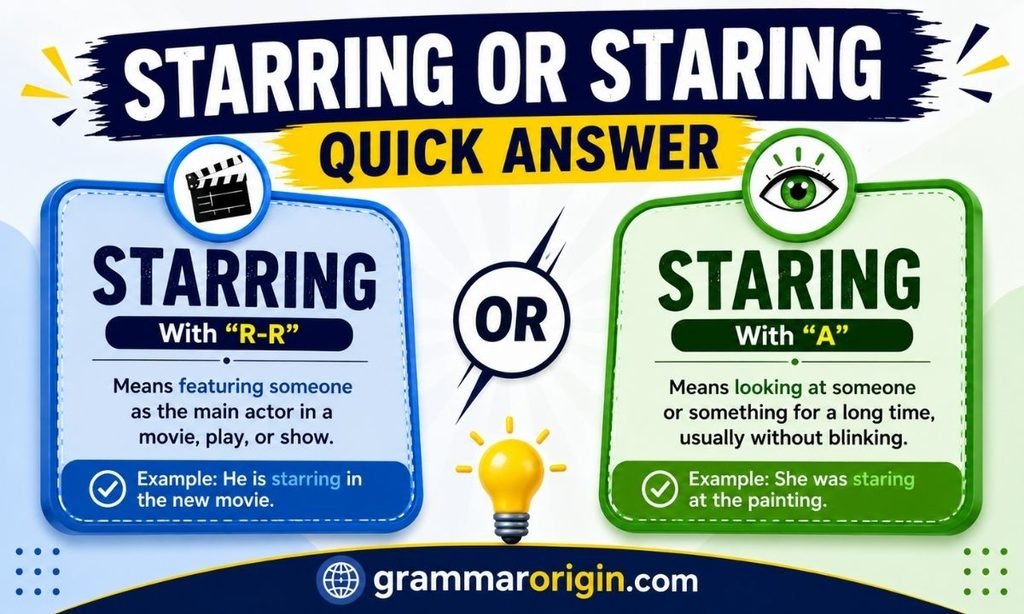
Starring refers to a lead acting role, and staring refers to a fixed, prolonged look. The two never overlap in meaning.
Main Difference:
- Starring means playing the main character or lead role in a film, drama, or play.
- Staring means looking steadily at someone or something, often without blinking.
Examples:
- She’s starring in a new drama this year.
- He kept staring at his phone during dinner.
- The film is starring two rising actors from a local theatre scene.
Starring or Staring : Definitions with Examples
Starring (Definition)
Starring means being featured as the lead performer in a movie, series, or stage production. It’s the word directors and studios use when announcing who’s carrying a project.
Examples:
- He’s starring alongside a well-known actress in his debut film.
- The drama serial is starring a fresh, young cast this season.
- Her first starring credit came after years in supporting roles.
Staring (Definition)
Staring means fixing your gaze on something for an extended period, often out of curiosity, shock, boredom, or deep thought.
Examples:
- The cat sat by the window, staring at birds for hours.
- She caught him staring and quickly looked away.
- I was staring at the ceiling, unable to sleep.
Simple Meaning
Think of it this way. Starring is about a role you play, and staring is about where your eyes land. One is a career milestone, and the other is just a habit of attention.
What Does “Starring” Mean in Movies and Films?
In film and TV, “starring” tells the audience who the lead performers are before they’ve even watched a single scene. It’s the word used on posters, trailers, and streaming thumbnails to highlight top billing.
When a listing reads “starring” followed by a name, that actor is central to the plot, not a background face. Casting news, award nominations, and box-office reports all lean on this exact term.
This is different from a “supporting” or “guest” credit, which signals a smaller part. Understanding “starring” this way helps you read entertainment headlines more accurately.
Also Read This Fairing or Faring? The Correct Word, Meaning & Examples Explained
The Origin of Starring or Staring
Both words trace back centuries, but from completely unrelated roots. That’s exactly why their meanings never cross paths despite the similar spelling.
Starring:
Starring comes from “star,” originally referring to a celestial body. The entertainment sense, a performer who shines above the rest of the cast, became common once early cinema began giving certain actors top billing.
Staring:
Staring comes from Old English “starian,” meaning to gaze fixedly. This meaning has stayed almost unchanged for over a thousand years, long before movies or theatre credits existed.
Pronunciation: How to Say “Starring” and “Staring” Correctly
Starring is pronounced “STAR-ing,” with a short, punchy first syllable that matches the word “star.” Staring is pronounced “STAIR-ing,” with a longer vowel sound closer to “stair” or “chair.”
Say them side by side, and the difference becomes clear. Starring is quick and clipped, while staring stretches out slightly. This small vowel shift is often the easiest way to tell the words apart in speech, not just in writing.
Why Do Both Words Double the “R”?
The doubled “r” in each word follows a standard English spelling rule, though for slightly different reasons underneath.
“Star” is a one-syllable word ending in a single consonant after a single vowel, so English doubles that consonant before adding “-ing.” The same pattern shows up in “run” becoming “running” or “swim” becoming “swimming.” That’s how star becomes starring.
“Stare” already ends in a silent “e,” and dropping that “e” before “-ing” would normally leave a single “r.” But since the pronunciation calls for a lengthened vowel sound, the spelling keeps the double “r” to match how the word is actually spoken. Once you know this rule, the spelling of both words stops feeling random.
Starring or Staring : Usage Differences
Context decides everything here. Starring shows up almost exclusively around entertainment, while staring belongs to everyday descriptions of behavior or attention.
Comparison Table:
| Feature | Starring | Staring |
| Root Word | Star | Stare |
| Meaning | Playing a lead role | Looking fixedly |
| Typical Setting | Movies, dramas, theatre | Daily life, social settings |
| Tone | Professional, celebratory | Neutral or sometimes awkward |
| Grammar Role | Verb, describes acting | Verb, describes observing |
UK vs US English: Any Difference?
No. Both British and American English use “starring” and “staring” the exact same way, with identical spelling and meaning in each. There’s no regional variation to worry about here, unlike words such as “colour” and “color.”
Whether you’re writing for a UK audience or a US one, the rule stays the same: starring for roles, staring for looks. That consistency makes this one of the more straightforward word pairs in English, once the meanings are clear.
Which Word Should You Use?
Ask yourself a simple question first. Are you talking about a performance, or about someone’s eyes? That answer decides the word every time.
Use “Starring” When:
- Announcing a film, drama, or play’s lead cast
- Writing entertainment news or reviews
- Describing someone’s breakout acting role
Use “Staring” When:
- Describing someone’s fixed gaze or attention
- Writing about body language or reactions
- Talking about everyday observation, not performance
Easy Memory Trick
Picture a star on a red carpet. That’s your cue for starring. Now picture a stare-down, eyes locked and unmoving. That’s staring. Roles get the star, and eyes get the stare.
Synonyms for Starring & Staring
Starring has a few close synonyms depending on context: featuring, headlining, and leading all work when talking about a cast or main performer. Headlining fits concert or event contexts especially well.
Staring, on the other hand, pairs with words like gazing, gawking, and glaring, though each carries a slightly different tone. Gawking suggests rudeness, glaring suggests anger, and plain staring stays neutral.
Common Mistakes with Starring or Staring
1. Mixing Both Words
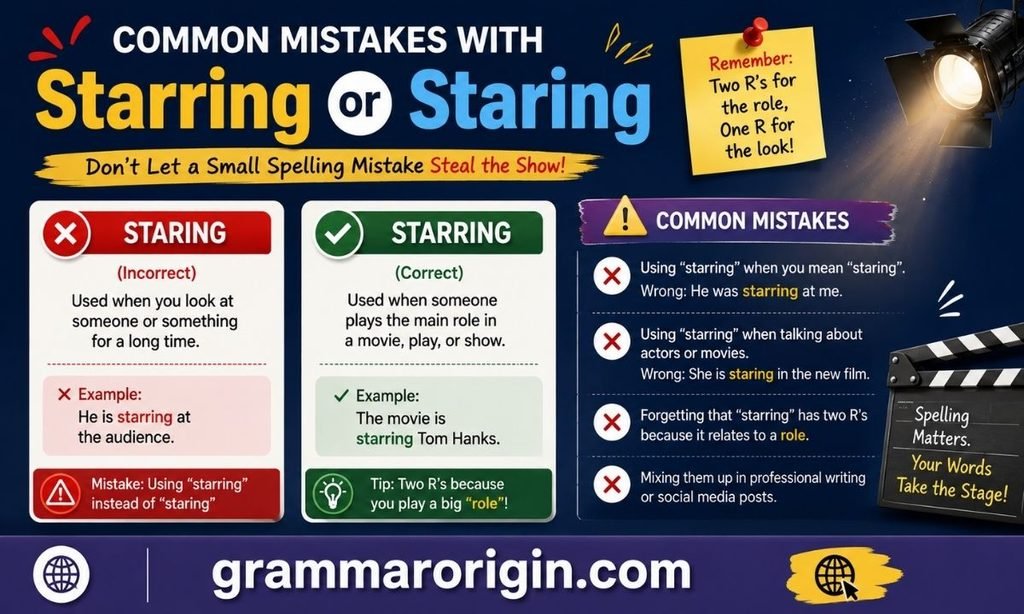
Wrong: He is starring at me. Right: He is staring at me.
2. Wrong Context
Wrong: She is staring in a movie. Right: She is starring in a movie.
3. Spelling Confusion
Dropping a letter changes the meaning completely, so always double-check the “r” count before publishing anything.
4. Ignoring Meaning
Reading a sentence too fast often causes writers to pick the wrong word out of habit rather than context. Slow down and check what’s actually being described.
Difference Between Staring and Starring
The confusion between these two words almost always comes down to how similar they sound out loud, not how they’re actually used. Once you separate the sound from the meaning, the mix-up mostly disappears.
Staring lives in the world of eyes, attention, and everyday behavior. Starring lives in the world of credits, casts, and performance recognition.
Examples:
- She kept staring at the old photograph on the wall.
- He’s starring in his first feature film next spring.
A quick way to remember it for good: if someone’s eyes are involved, it’s staring. If a screen credit or spotlight is involved, it’s starring.
Real Conversation Examples (Mini Dialogues)
Even fluent speakers slip up sometimes, so here’s how the mix-up plays out in casual chat.
Dialogue 1 Ahsan: “Bro, why’s your sister starring at her phone all day?” Zara: “It’s staring, not starring. She’s just scrolling.”
Dialogue 2 Maria: “Who’s staring in the new superhero movie?” Bilal: “You mean starring, and it’s a whole new cast this time.”
Dialogue 3 Hina: “Stop starring at my notebook, it’s rude!” Sana: “That’s staring, silly. Starring would mean you’re famous.”
Starring or Staring in Everyday Examples
Daily Life
- He was staring blankly at the ceiling before falling asleep.
- She’s starring in the school’s annual drama this year.
Social Media
- “Why is everyone staring at their screens instead of talking?”
- “New trailer dropped, starring my favorite actor this time!”
School
- The essay described a character staring silently out the classroom window.
- A student mentioned his cousin starring in a local theatre production.
Professional Use
- The press release confirmed the film is starring two award-winning leads.
- During the meeting, he noticed his manager staring at the sales chart for a while.
Starring or Staring : Usage Trends & Popularity
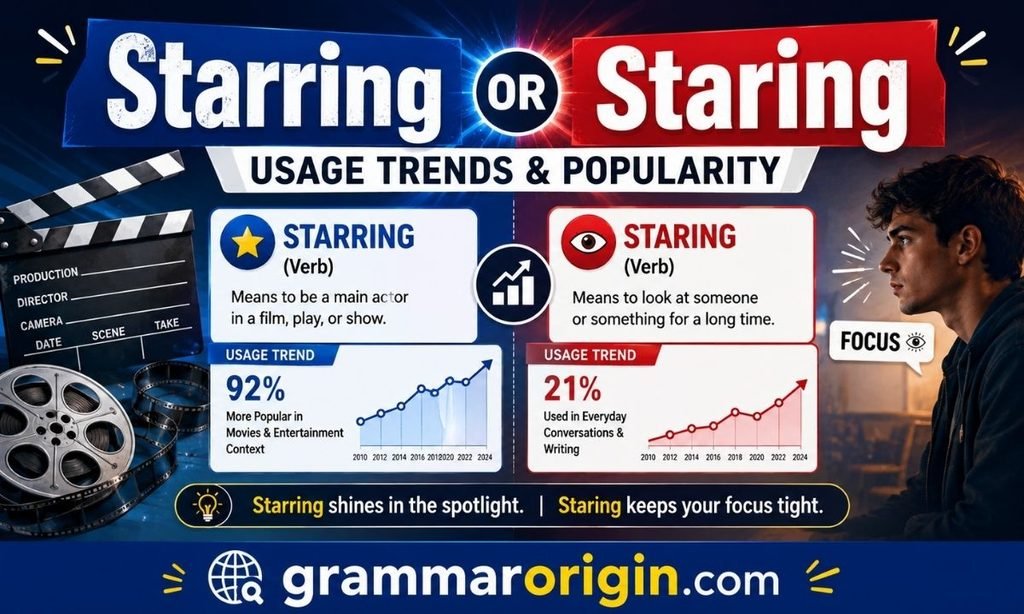
Trend Insight:
Search interest for “starring” spikes around major movie releases and award season, while “staring” stays fairly constant year-round since it’s tied to everyday language rather than entertainment cycles.
Streaming platforms and social captions have pushed “starring” into more casual use lately, especially in playful posts like “me, starring in my own disaster movie.” Staring, meanwhile, keeps showing up in conversations about screen time, body language, and social awkwardness.
Also Read This Fairing or Faring? The Correct Word, Meaning & Examples Explained
Comparison Table
| Aspect | Starring | Staring |
| Best Used For | Cast announcements, film credits | Describing a fixed look or gaze |
| Common Synonym | Featuring, leading | Gazing, gawking |
| Search Trend | Peaks with new releases | Fairly steady year-round |
| Common Error | Confused with “staring” in movie context | Confused with “starring” when describing eyes |
Common User Queries
- Starring or staring in a movie: It’s always “starring in a movie” when referring to the lead cast.
- Staring at me: This always uses “staring,” describing someone’s fixed gaze on you.
- Starring example: “The show is starring a first-time actor” is a correct usage example.
- Staring pronunciation: Pronounced STAIR-ing, with a longer vowel sound than “starring.”
- Starring synonym: Featuring, headlining, and leading are close synonyms.
- Staring in a show: This is incorrect; it should be “starring in a show” unless a character is literally staring at something on screen.
- Staring at someone: The correct phrase for describing a fixed, prolonged look.
- Staring at strangers: A common phrase used to describe awkward or unintentional eye contact in public.
- Staring meaning: To look fixedly or intently at something for an extended time.
Frequently Asked Questions
Is it “starring” or “staring” in a movie credit?
It’s always “starring” in a movie credit, since it refers to the lead performer’s role, not anyone’s gaze.
Why do starring and staring sound almost the same?
They sound similar purely by coincidence. “Star” and “stare” are unrelated words that happen to share letters, and adding “-ing” makes them look even closer.
Can staring ever describe an actor’s role?
No, staring never refers to acting or performance. It strictly describes looking at something, regardless of the setting.
What’s an easy way to remember the difference?
Link “star” with fame and screen credits, and link “stare” with eyes and attention. That mental split usually settles the confusion instantly.
Is “staring” considered rude?
It can be, depending on context. A prolonged, unblinking look at a stranger is often read as impolite, while staring at art or scenery isn’t.
Does British English spell these words differently?
No, British and American English spell and use both words identically, with no regional variation.
What’s the correct phrase, “starring at” or “staring at”?
“Staring at” is correct. “Starring at” is always a mistake, since “starring” never takes the preposition “at” in standard usage.
Final thoughts
Starring and staring might look like near-twins on paper, but their meanings sit worlds apart. One belongs to movie credits, and the other belongs to everyday eye contact. Once you connect star with performance and stare with looking, the mix-up stops happening for good.
Keep the pronunciation difference and the memory trick in mind, and you’ll pick the right word without even pausing to think about it.

Muhammad Waqas is an English language teacher and grammar expert with over 8 years of experience helping students and professionals improve their writing skills. He specializes in English grammar, vocabulary, communication, and practical language learning. Through GrammarOrigin, Waqas shares clear, easy-to-understand content that helps readers write and speak English with confidence.