
Its self or itself: if you’ve ever paused mid-sentence over this pair, you’re dealing with one of English’s sneakiest small-word traps. The gap between them is one tiny space, but it can make a sentence look either polished or off. This guide walks through exactly when each form is right, and when the other one simply isn’t.
For nearly every sentence you’ll ever write, itself is the form you want. Its self survives only in a narrow set of specialized contexts, and once you see the pattern, you won’t second-guess it again. Below you’ll find the rule, the rare exceptions, a comparison table, and a quick test you can run on any sentence.
Understanding “Its Self or Itself”: Why People Mix Them Up
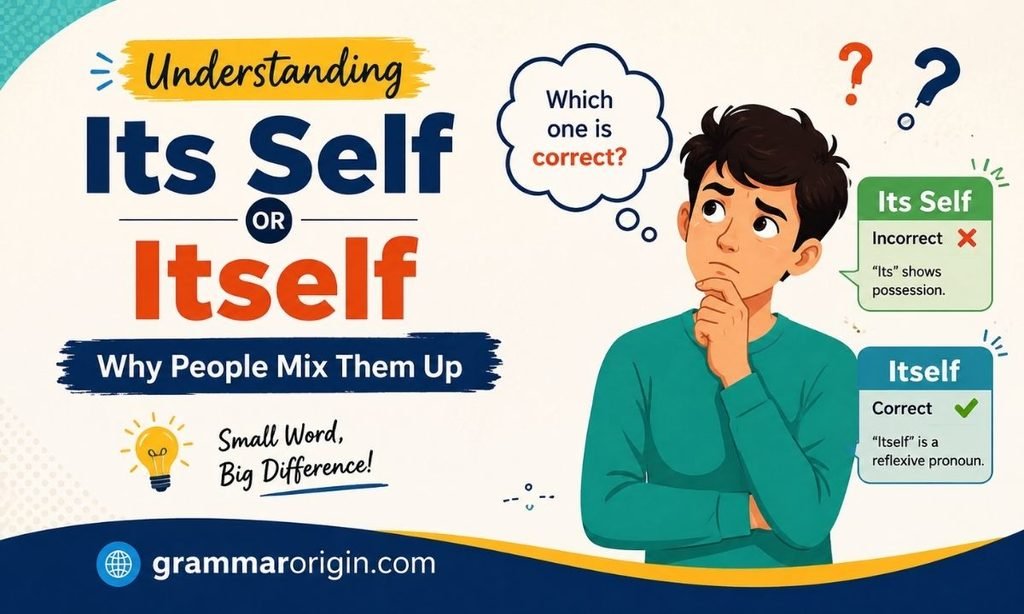
People confuse its self and itself because English usually builds reflexive pronouns from two recognizable pieces, a possessive-looking word plus “self.” That pattern makes “its self” feel like it should work the same way “your self” or “him self” once did.
A few things drive the confusion:
- Both phrases start with the letters “its”
- “Self” reads like a noun that could pair with almost any possessive
- The apostrophe question in “its” vs. “it’s” bleeds into this decision too
- Older texts genuinely did write reflexives as two separate words
Once you separate the grammatical reflexive pronoun from the philosophical noun “self,” the confusion mostly disappears.
What “Itself” Actually Means (And Why It’s the Standard Form)
Itself is the standard, single-word reflexive and intensive pronoun for “it” in modern English, used whenever the subject and object are the same thing, or when a sentence needs emphasis. It’s the form you’ll reach for in almost every situation.
What Are Reflexive Pronouns?
A reflexive pronoun sends the action of a sentence back onto its own subject. English has one for every person and number:
| Subject | Reflexive Pronoun |
| I | myself |
| You | yourself |
| He | himself |
| She | herself |
| It | itself |
| We | ourselves |
| They | themselves |
You reach for a reflexive pronoun when the subject and the object are identical, or when you want to underline a point without changing the meaning.
Key Features of “Itself”
“Itself” shows up when:
- Something completes an action on its own
- An action loops back onto the same thing that started it
- A writer wants extra emphasis on a non-human or ungendered subject
- The sentence needs one clean word instead of a clunky phrase
A few working examples:
- The oven switched itself off after the timer ran out.
- The startup rebuilt itself twice before finding a working model.
- The app updates itself overnight without any input from the user.
“Itself” as an Intensive Pronoun (Not Just Reflexive)
Here’s a distinction most guides skip entirely: “itself” isn’t only reflexive, it also works as an intensive pronoun, adding weight to a noun that’s already been named.
Compare these two roles side by side:
- Reflexive: The machine repaired itself. (the action loops back onto the machine)
- Intensive: The machine itself was the problem, not the software. (no action loops back; “itself” just adds emphasis)
Spotting this difference matters because an intensive “itself” can usually be deleted without breaking the sentence, while a reflexive one can’t.
How “Itself” Works in Real Sentences
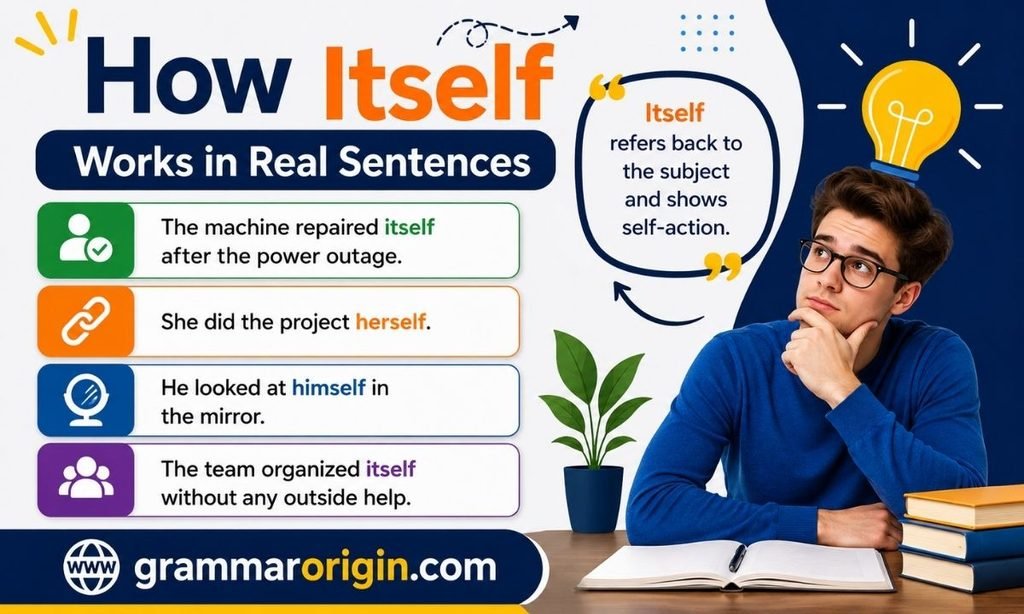
“Itself” adapts across everyday speech, formal writing, and emphatic statements without ever changing form. That consistency is exactly why it’s the standard choice.
Everyday Usage
- The kettle turns itself off once the water boils.
- The puppy shook itself dry after the rain.
Formal Usage
- The board agreed to review the merger by itself before consulting outside counsel.
- The report evaluates the policy itself, separate from its funding.
Emphatic Usage
- The building itself survived the flood, even though the surrounding streets didn’t.
- The idea itself wasn’t flawed; the timing was.
Read any of these aloud and “itself” slots in without friction, which is a good sign you’re using it correctly.
Why “Its Self” Is Not Standard in Modern Grammar
“Its self” isn’t a recognized reflexive pronoun in modern English; dictionaries and style guides list only “itself.” Splitting it into two words treats “self” as an ordinary noun, which changes what the phrase actually means.
Why “Its Self” Is Grammatically Wrong Today
Modern English settled on a single compound reflexive form for “it,” the same way it did for every other pronoun. “Its self” breaks that pattern because:
- “Self” doesn’t combine with a possessive to build a reflexive pronoun
- English reflexive pronouns are fixed, closed compounds, not open phrases
- “Its” functions as a possessive, not a base for a reflexive form
Outside of a narrow set of exceptions covered next, using “its self” in ordinary writing will read as a typo, not a stylistic choice.
Also Read This Starring or Staring: Correct Usage, Meaning & Examples
When “Its Self” Does Appear (Rare but Valid Situations)
“Its self” is valid only when “self” stands alone as a noun meaning identity, essence, or inner being, not as part of a reflexive verb structure. This shows up mainly in philosophy, psychology, and religious writing.
Examples from philosophical, psychological, or religious writing
- The mind spends a lifetime trying to understand its self.
- Every institution eventually confronts its self, its purpose, and its limits.
- The soul, tradition says, eventually returns to its self.
In each case, “self” carries a weight that “itself” can’t replicate. It’s naming a concept, not describing an action.
Historical Examples
Older English once wrote several reflexives as two separate words:
- him self
- her self
- your self
- my self
Over centuries, these gradually fused into single words through a process linguists call lexical fusion. “Itself” followed the same path, which is exactly why “its self” can feel oddly correct even though it isn’t anymore.
Clear Examples of Correct “Its Self” Usage
Here are sentences where “its self” genuinely works, because “self” is functioning as a standalone noun:
- The company spent a decade searching for its self before the rebrand finally clicked.
- The village lost its self once the factory closed and half the town moved away.
- The species evolved so quickly it seemed to outgrow its self entirely.
Common Myths About “Its Self”
Myth 1: “Its self” is just an old-fashioned spelling of “itself.” Not quite. Older English separated reflexives generally, not specifically to mean the same thing “itself” means today.
Myth 2: The two forms are interchangeable. They aren’t. Swapping one for the other in a business email or an essay usually reads as an error, not a stylistic flourish.
Myth 3: “Its self” sounds more formal, so it’s safer to use. In most writing, it does the opposite. It signals a mistake unless the topic is genuinely about identity or consciousness.
Clearing Up a Related Confusion: “Its” vs. “It’s”
“Its” shows possession, while “it’s” is a contraction of “it is” or “it has.” They’re never interchangeable, despite sounding identical.
“Its” = Possessive Pronoun
“Its” means belonging to “it,” and like other possessive pronouns (his, her, their), it never takes an apostrophe.
- The company raised its prices in January.
- The dog buried its favorite toy in the yard.
“It’s” = Contraction
“It’s” always stands in for “it is” or “it has.”
- It’s already past noon. → It is already past noon.
- It’s been a rough quarter. → It has been a rough quarter.
Common Mistakes
- Incorrect: Its been a long week. Correct: It’s been a long week.
- Incorrect: The cat drank it’s water. Correct: The cat drank its water.
Its / It’s / Itself: One Master Comparison Table
| Word | Function | Quick Test | Example |
| Its | Possessive pronoun | Can you replace with “his” or “her”? | The team changed its schedule. |
| It’s | Contraction | Can you expand to “it is” or “it has”? | It’s raining again. |
| Itself | Reflexive / intensive pronoun | Does the subject act on itself, or need emphasis? | The engine cooled itself down. |
Why “Its” Has No Apostrophe in Possession
“Its” skips the apostrophe because English possessive pronouns as a group never use one. “His,” “her,” and “their” follow the exact same rule.
| Pronoun | Possessive | Reflexive |
| he | his | himself |
| she | her | herself |
| they | their | themselves |
| it | its | itself |
Apostrophes in this family of words are reserved strictly for contractions, never for ownership.
Where “Itself” Comes From (Quick Etymology Note)
“Itself” traces back to Old and Middle English forms like “hit self,” where reflexives were written as two words rather than one. As the language standardized, these compounds fused into one word. The same pattern shows up in “himself” and “herself,” as noted in historical grammar references like the Cambridge Dictionary and Merriam-Webster.
Also Read This Starring or Staring: Correct Usage, Meaning & Examples
Quick Tests to Avoid Errors
Three short checks will settle almost any “its self or itself” doubt in seconds.
Substitution Test
Swap in “it is.” If the sentence still makes sense, you need “it’s,” not “its” or “itself.”
Ownership Test
Ask whether something belongs to “it.” If so, reach for “its,” never “it’s.”
Reflexive Test
Check whether the subject is acting on itself or getting extra emphasis. If yes, “itself” is your word.
Examples to Strengthen Your Grammar with “Itself”
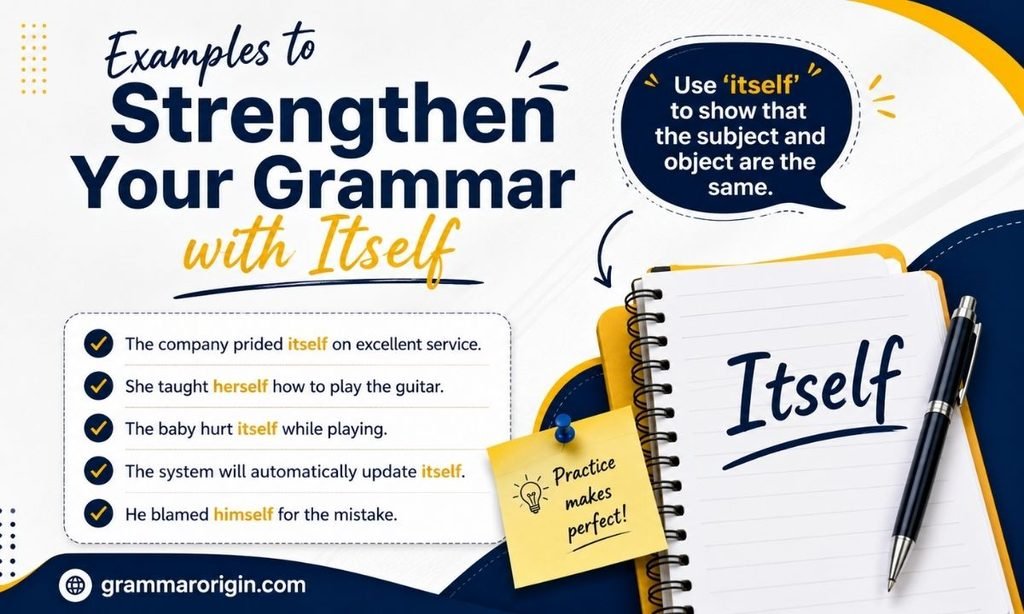
Correct sentences
- The project finished itself, more or less, once the automation kicked in.
- The mirror seemed to reflect itself endlessly in the narrow hallway.
Incorrect sentences
- The project finished its self. (wrong)
- The mirror reflects it’s self. (wrong)
Lining these up side by side makes the distinction almost impossible to forget.
Practice Exercises
Choose the right word: its, it’s, or itself
- The printer jammed and fixed ______ somehow.
- I heard ______ supposed to snow tonight.
- The company doubled ______ revenue this year.
- The robot vacuum charges ______ automatically.
- The band changed ______ lineup twice.
Answers
- itself
- it’s
- its
- itself
- its
Case Study: How One Misused Word Changed a Brand Message
A fintech company once rolled out a slogan reading: “Reinventing Its Self for Every Customer.” Within days, comment sections were pointing out the error instead of discussing the product.
Readers assumed the copywriting team had rushed the launch. A few even questioned whether the company could handle their finances if it couldn’t handle basic grammar. The brand quietly swapped the line to “Reinventing Itself for Every Customer,” and the complaints stopped almost overnight.
One missing space had shifted the entire read of the campaign, from confident to careless, without changing a single other word.
Expert Grammar Tip
If your sentence isn’t about identity, essence, or inner being, skip “its self” entirely and use “itself.” That one filter resolves nearly every real-world case you’ll run into.
Final Thoughts
The choice between its self or itself comes down to one question: is “self” acting as part of a reflexive pronoun, or standing alone as a noun about identity? Nearly every sentence you write will call for “itself,” and the rare exception belongs almost entirely to philosophy, psychology, and reflective writing.
Keep the possessive “its,” the contraction “it’s,” and the reflexive “itself” straight using the tests above, and this pair stops being a guessing game. Once the pattern clicks, you’ll pick the right word without even pausing to think about it.
Frequently Asked Questions
What does “its self” mean?
“Its self” means the identity, essence, or inner being of something. It’s only correct when “self” is functioning as a standalone noun, not as part of a reflexive verb structure.
How is “itself” used in a sentence?
“Itself” is used whenever a subject acts on itself or needs emphasis, as in “the system corrected itself” or “the design itself was the real innovation.”
Is there a plural form of “itself”?
No. “Itself” doesn’t have a plural form. For plural subjects, English switches to “themselves,” which fills the same reflexive role for “they.”
What does “in itself” mean?
“In itself” means considered alone, apart from anything else, as in “the idea, in itself, wasn’t bad,” which isolates the idea from how it was executed.
Is “itself” one word or two?
Anyone Googling its self or itself is usually asking exactly this. “Itself” is always written as one word in modern English; writing it as “it self” or “its self” outside of the rare philosophical-noun use is considered incorrect.
How do you spell “itself” correctly?
“Itself” is spelled i-t-s-e-l-f, with no apostrophe and no space. A common slip is inserting an apostrophe as if it were a contraction, which it isn’t.
What are some synonyms for “itself” in emphatic use?
When “itself” is being used for emphasis rather than reflexively, phrases like “in and of itself,” “by itself,” or “on its own” can carry a similar emphatic weight.

Muhammad Waqas is an English language teacher and grammar expert with over 8 years of experience helping students and professionals improve their writing skills. He specializes in English grammar, vocabulary, communication, and practical language learning. Through GrammarOrigin, Waqas shares clear, easy-to-understand content that helps readers write and speak English with confidence.