
Shown vs showed trips up even confident English speakers, and the mix-up usually comes down to one missing rule. Showed is the simple past tense of “show,” used alone. Shown is the past participle, and it always needs a helper verb like has, have, or had standing next to it.
This guide breaks down the show past tense and past participle system with clear examples, a pronunciation guide, common mistakes, and a quick self-test, so you can use both forms correctly without second-guessing yourself.
Definition
Showed and shown both come from the base verb “show,” but they serve different grammar jobs. Showed stands alone in the simple past, while shown only works alongside a helping verb.
- She showed me the invoice. (simple past, no helper needed)
- She has shown me the invoice. (past participle, helper required)
The core rule stays this simple across every sentence you’ll ever write: no helper, use showed; helper present, use shown.
Understanding the Verb “Show”
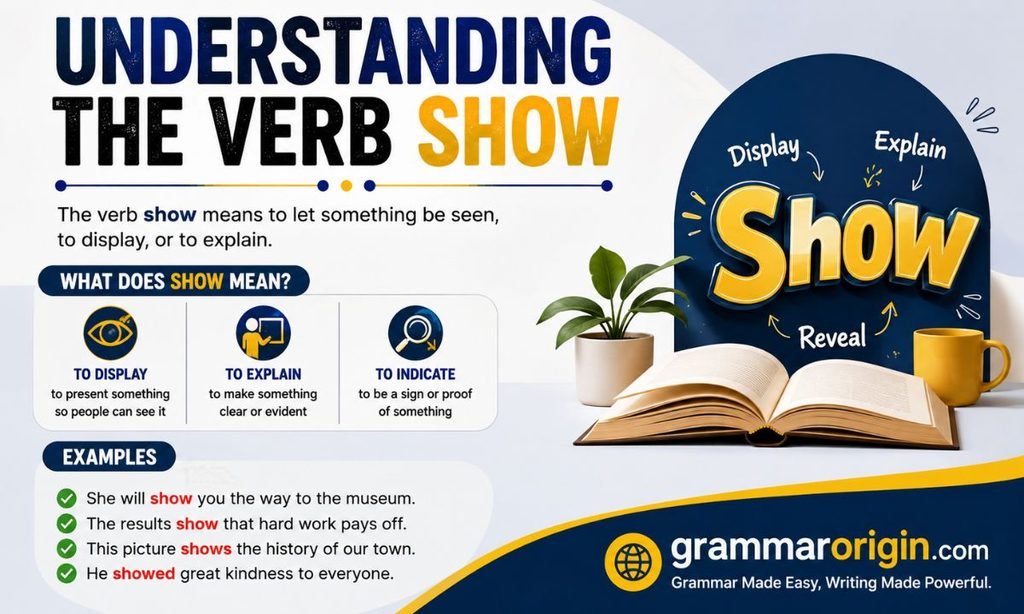
“Show” is an irregular verb, which is exactly why show showed shown irregular patterns confuse so many learners. Regular verbs just add “-ed” for both past forms, but “show” splits into two separate paths instead.
| Form | Role | Example |
| show | Base / present | I show my badge at the door. |
| shows | Present, third person | He shows real patience. |
| showed | Simple past | I showed my badge yesterday. |
| shown | Past participle | I have shown my badge before. |
| showing | Present continuous | She is showing the new design. |
Word Origin of Show
“Show” traces back to the Old English word “sceawian,” which meant to look at or observe something closely. Over centuries, the meaning shifted from looking to displaying, which is how English ended up with today’s sense of presenting something for others to see.
When to Use “Showed”: The Simple Past Tense
Use showed when an action happened in the past and is already finished, with no helping verb attached. This is the answer to the common show past tense question: showed is the form you want for a completed, standalone action.
Examples
- I showed my ID at the checkpoint.
- The intern showed us the new dashboard.
- They showed real commitment during the audit.
When to Use It
Reach for showed whenever a clear time marker sits in the sentence, since that signals a finished, standalone event.
- Words like yesterday, last week, in 2023, or earlier today
- No has, have, or had anywhere nearby
- A story or report describing something already over
When to Use “Shown”: The Past Participle
Shown never stands on its own; it needs a helper verb such as has, have, had, was, or been sitting right in front of it. This single rule solves most of the confusion around i have shown meaning and similar phrases.
Examples
- I have shown my manager the figures.
- The proposal was shown to the board.
- She had shown patience long before the promotion came through.
How to Spot It
A fast way to check: scan the sentence for has, have, had, was, were, or been.
- If one of those words appears, shown is correct.
- If none appear, switch to showed instead.
Why “Shown” Matters in Perfect Tenses
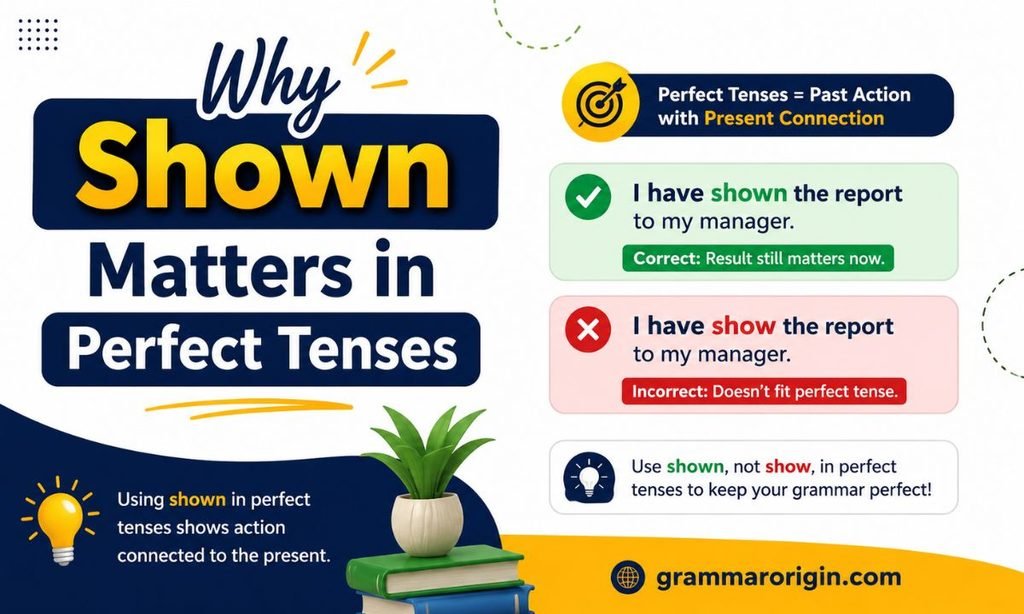
Perfect tenses connect a past action to another point in time, whether that’s now or a different past moment, and shown is the only form that fits there. Swapping in showed breaks the sentence immediately.
Studies have shown that spaced repetition improves memory retention, and notice how that sentence would sound off with “have showed” instead.
Also Read This Onsite Or On Site: What Is the Difference & Which Is Correct?
Breaking Down Perfect Tenses (with “Shown”)
Each perfect tense pairs a specific helper with shown, and the pattern stays consistent no matter which tense you’re building.
| Tense | Structure | Example |
| Present perfect | has/have + shown | She has shown strong results this quarter. |
| Past perfect | had + shown | He had shown the report before the meeting started. |
| Future perfect | will have + shown | They will have shown the final draft by Monday. |
A common learner question is whether it’s had showed or had shown, and the answer is always had shown; the simple past form never follows a helper verb.
“Have Showed” vs “Have Shown”: The Grammar Test
Have shown is correct, and have showed is a grammar error that shows up constantly in casual writing. The moment “have,” “has,” or “had” appears in a sentence, the verb after it needs to switch to its past participle form.
- Correct: I have shown you the contract twice.
- Incorrect: I have showed you the contract twice.
If you’ve ever typed you have showed or shown and paused, run the same check: look for the helper, then pick shown.
Pronunciation Flow
Showed is pronounced /ʃoʊd/, rhyming with “road,” while shown is pronounced /ʃoʊn/, rhyming with “own.” Both share the same long “oh” sound at the start, which is exactly why they’re so easy to mix up when speaking quickly.
In fast conversation, “have shown” often blends into something close to “uhv-shohn,” but the written form should always keep both words distinct.
Real-Life Examples and Common Usage Notes
Grammar rules land better with everyday context, so here’s how showed and shown show up across different settings.
- Email: I have shown the client our latest pricing sheet.
- Conversation: She showed me the venue this afternoon.
- Report: Sales figures were shown in the quarterly summary.
Regional Note
American and British English follow the identical rule for shown vs showed, with no regional split in the standard grammar. You’ll sometimes hear “have showed” in casual speech on either side of the Atlantic, but formal writing everywhere still calls for “have shown.”
Synonyms of Showed and Shown
Repeating “showed” or “shown” throughout a document can feel stiff, so a handful of alternatives keep writing varied without losing meaning.
- Displayed
- Demonstrated
- Revealed
- Presented
- Exhibited
“The chart displayed a steady rise in traffic” works as a natural substitute for “The chart showed a steady rise in traffic,” especially in reports where repetition stands out.
Side-by-Side Comparison: “Shown” vs “Showed”
| Feature | Showed | Shown |
| Verb type | Simple past | Past participle |
| Stands alone | Yes | No |
| Needs a helper verb | No | Yes |
| Works in passive voice | No | Yes |
| Example | She showed the results. | She has shown the results. |
Quick Reference Summary Table
| Situation | Correct Form | Example |
| Finished past action, no helper | showed | I showed the map yesterday. |
| Present perfect (has/have) | shown | I have shown the map already. |
| Past perfect (had) | shown | I had shown the map before leaving. |
| Passive voice (was/were/been) | shown | The map was shown to the team. |
Quick Memory Tips to Remember
A short mental checklist clears up almost every mix-up between these two words.
- No helper verb nearby means showed.
- Has, have, or had nearby means shown.
- Passive sentences (was, were, been) always take shown.
- Say it aloud; “have showed” sounds noticeably off once you’re listening for it.
Common Mistakes and How to Avoid Them
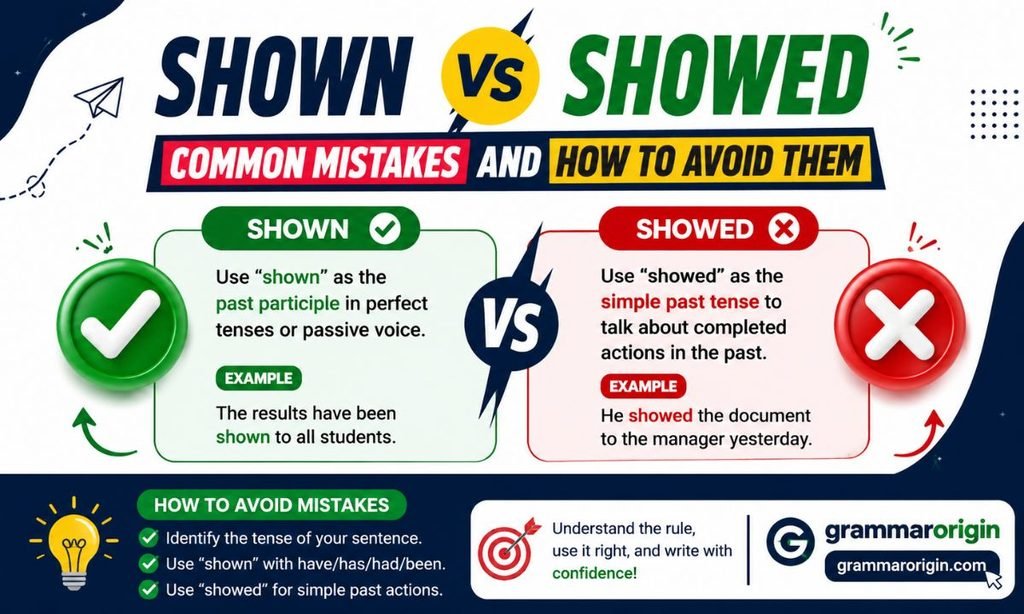
Most errors with these two words fall into one of three patterns, and each one has a quick fix.
- Mistake: “I have showed the file.” Fix: “I have shown the file.”
- Mistake: “She shown me the report.” Fix: “She showed me the report.”
- Mistake: “The results was showed on screen.” Fix: “The results were shown on screen.”
These slips happen most often when writing quickly, so a second read-through catches nearly all of them.
Show and Other Irregular Verbs
“Show” belongs to a larger family of irregular verbs that shift form between past tense and past participle, and seeing them together makes the pattern click faster.
| Base | Simple Past | Past Participle |
| show | showed | shown |
| know | knew | known |
| grow | grew | grown |
| write | wrote | written |
| break | broke | broken |
Notice how several past participles end in “-n,” a pattern that “shown” follows too. That shared shape is a handy memory anchor when you’re unsure which form a sentence needs.
Case Study: A Common Workplace Mix-Up
A project coordinator once sent a client update that read: “We have showed the revised timeline to the stakeholders.” A colleague flagged it before it went out, and the line was corrected to: “We have shown the revised timeline to the stakeholders.”
The fix took seconds, but it mattered. Client-facing documents get read closely, and small grammar slips can quietly undercut an otherwise solid message.
Linguistic Insight & Expert Opinion
Grammar instructors consistently point to the same rule: showed belongs to simple past sentences, and shown belongs everywhere a helper verb or passive construction shows up. Native speakers occasionally blur this in fast, casual speech, but written English holds the line.
Editors reviewing business and academic writing treat “have showed” as an error worth catching every time, since it’s one of the more visible irregular-verb slips in professional documents.
Also Read This Onsite Or On Site: What Is the Difference & Which Is Correct?
Self Assessment Section
Try filling in each blank before checking the answers.
- She ___ me the results yesterday. (showed/shown)
- I have ___ my portfolio to three clients. (showed/shown)
- The evidence was ___ during the trial. (showed/shown)
- He ___ up late to the meeting. (showed/shown)
- They had ___ interest before the deal closed. (showed/shown)
Answer Key:
- showed
- shown
- shown
- showed
- shown
Final Conclusion on Shown vs Showed
Shown vs showed comes down to one dependable rule: showed works alone for finished past actions, and shown always needs a helper verb like has, have, had, or a form of be. Once that pattern is familiar, the choice stops requiring any real thought.
Keep an eye out for helper verbs, lean on the irregular pattern show, showed, shown, and this mix-up will stop showing up in your writing for good.
Frequently Asked Questions
Is “showed” ever wrong?
Yes, it’s wrong whenever a helper verb like has, have, or had sits next to it. “I showed the picture” is correct, but “I have showed the picture” is not; that sentence needs “have shown” instead. Getting shown vs showed right in this exact spot is where most learners slip up.
Is showed a word?
Yes, is showed a word is an easy one to answer: showed is a fully standard, dictionary-recognized simple past tense form of “show.” It just can’t be paired with has, have, or had.
What is the past tense of show?
The simple past tense of show is showed. Example: The teacher showed the class a diagram.
What’s the difference between “showed up” and “shown up”?
Showed up or shown up depends on whether a helper verb is present. “He showed up late” is correct on its own, while “He has shown up late three times” needs the helper “has” before shown.
Can “shown” be used without a helping verb?
No. Shown always needs has, have, had, or a form of be nearby. Saying “I shown it” is incorrect in standard English; “I have shown it” is the correct version.
Why does “have showed” sound wrong?
Because showed is the simple past form, not the past participle. English grammar requires shown after have, has, or had, so “have shown” is the only correct pairing.
Are there other verbs that follow the same show, showed, shown pattern?
Yes. Verbs like know-knew-known, grow-grew-grown, and write-wrote-written follow a similar irregular pattern, where the past participle often ends in “-n.”

Muhammad Waqas is an English language teacher and grammar expert with over 8 years of experience helping students and professionals improve their writing skills. He specializes in English grammar, vocabulary, communication, and practical language learning. Through GrammarOrigin, Waqas shares clear, easy-to-understand content that helps readers write and speak English with confidence.