
Onsite or on site trips up even confident writers, and the mix-up shows up everywhere from job ads to client emails. The short answer: “onsite” is an adjective that sits before a noun, while “on site” is a location phrase that usually follows a verb.
Once you see the pattern, you will stop guessing. This guide breaks down the grammar, shows real sentence examples, and settles the onsite or on site question for good, including UK usage, AP style, and common workplace terms like onsite work and onsite interviews.
Comparison Overview
Both words point to the same physical idea, something happening at a specific location, but they play different grammatical roles. “Onsite” describes a noun, while “on site” tells you where an action takes place.
Getting this right matters most in job descriptions, client-facing emails, and formal reports, where a misplaced word can make a sentence feel off. The confusion is common because the two forms sound identical when spoken aloud. Only the sentence structure gives away which one you actually need.
Definition of Onsite
Onsite is an adjective. It sits directly before a noun and describes a service, team, or feature tied to a location.
You will see it in phrases like onsite support, onsite training, onsite parking, and onsite manager. Each time, onsite answers the question “what kind?” rather than “where?” That is the core test. If you can swap it for “in-house” or “at-location,” you are using it correctly.
Companies lean on this word heavily in HR and marketing copy because it reads cleanly and does not interrupt sentence flow. A job posting that says “onsite team” sounds sharper than a clunky alternative.
Definition On Site
On site is a two-word phrase that works as a prepositional or adverbial expression. It tells you where someone is or where something is happening, and it typically follows a verb.
Sentences like “The electrician is on site” or “We are meeting on site tomorrow” use the phrase to answer “where,” not “what kind.” That distinction is the entire difference between onsite or on site in a nutshell.
Because it behaves like phrases such as “at work” or “in the office,” on site rarely sounds natural directly before a noun. That is usually a sign you need the adjective form instead.
Main Differences Between Onsite and On Site
The core difference comes down to sentence position and function. Onsite modifies a noun; on site describes a location or action.
| Feature | Onsite | On Site |
| Part of speech | Adjective | Prepositional or adverbial phrase |
| Typical position | Before a noun | After a verb |
| Answers | “What kind?” | “Where?” |
| Example | onsite technician | technician is on site |
| Common context | Services, job titles, features | Physical presence, attendance |
If you remember only one rule from this whole article, make it this one: describing a noun means onsite, describing a location means on site.
Why This Confusion Happens
English regularly compresses two-word phrases into single closed compound words over time, and this pair is mid-transition. That is the short version of why so many writers second-guess themselves here.
You can see the same pattern in “online” versus “on line,” or “setup” versus “set up.” A phrase gets used so often before nouns that writers eventually drop the space, and dictionaries slowly catch up to real-world usage.
Onsite is following that exact path. It is already accepted as a standalone adjective in most style guides, even though the open two-word form “on site” has not fully merged when used as a location phrase.
Also Read This Tying or Tieing: What Is the Difference & Which Is Correct?
Comparison Table with Sentence Examples
Seeing both forms side by side in real sentences makes the rule click faster than any explanation. Here is a quick reference table you can bookmark.
| Usage | Example Sentence |
| Onsite before a noun | We run onsite safety inspections every quarter. |
| On site after a verb | The inspector arrived on site at 9 a.m. |
| Onsite as a job feature | The clinic offers onsite lab testing. |
| On site describing presence | Staff must stay on site during the audit. |
Notice how swapping the forms in these examples would sound wrong right away. That awkwardness is your built-in grammar check.
Grammar Guide
This section walks through exactly how each form behaves in a sentence, the mistakes learners make most often, and simple rules you can apply without overthinking it.
How Each Term Is Used in Sentences
Onsite consistently sits before the noun it modifies, acting like any other descriptive adjective. On site consistently follows a linking or action verb, describing location rather than a thing.
Compare these two sentences: “The onsite coordinator called me” and “The coordinator is on site right now.” Both sentences are correct. They simply serve different grammatical jobs.
Common Mistakes Learners Make
The most frequent error is writing “onsite” after a verb, as in “The manager is onsite today.” Many businesses accept this informally, but traditional grammar still favors “on site” in that position.
The reverse mistake is writing “on site” before a noun, like “on site support team.” This reads as broken English in formal writing. Swap it for “onsite support team” instead.
Simple Rules to Remember
Before a noun, use onsite. After a verb, use on site. If the phrase answers “where,” pick on site. If it answers “what kind,” pick onsite.
These four checks cover nearly every real-world sentence you will write, from emails to job postings.
Quick Tips for Writing and Speaking
In formal or academic writing, lean toward “on site” whenever you are describing a location, since it is the more traditionally accepted form. In business and marketing copy, onsite as an adjective is now completely standard.
When in doubt, read the sentence aloud and ask what job the word is doing. Is it describing a thing, or describing a place?
When to Use Each One
Use onsite whenever you are naming a service, department, or feature connected to a physical location. This covers job descriptions, facility listings, and product or service pages.
Examples include onsite consultation, onsite parking, and onsite event management. Each one modifies a noun directly.
Use on site whenever you are stating where a person or activity actually is. This covers attendance updates, workplace instructions, and status reports.
Examples include “Visitors must remain on site” and “The auditor is on site until Friday.” Both describe presence, not a feature.
When NOT to Use Each One
Do not use onsite when your sentence is purely about someone’s location and nothing else. “The team is onsite” is common in casual speech, but “The team is on site” reads better in polished writing.
Do not use on site directly in front of a noun, either. “On site technician” looks unfinished compared to “onsite technician,” which reads as a complete, natural adjective phrase.
Which One to Use (Decision Guide)
Ask yourself one question first: is this word describing a noun, or describing where something happens? That single question resolves almost every onsite or on site decision you will face.
If you are naming a service or job title, onsite is very likely correct. Think onsite trainer or onsite repair. If you are stating a person’s whereabouts, on site is the safer, more traditional choice. Think “she is on site now.”
When you are still unsure, try replacing the phrase with “at the location.” If it fits smoothly before a noun, use onsite. If it fits after a verb, use on site.
Also Read This Persue or Pursue: Which Spelling Is Correct?
Real World Practical Examples
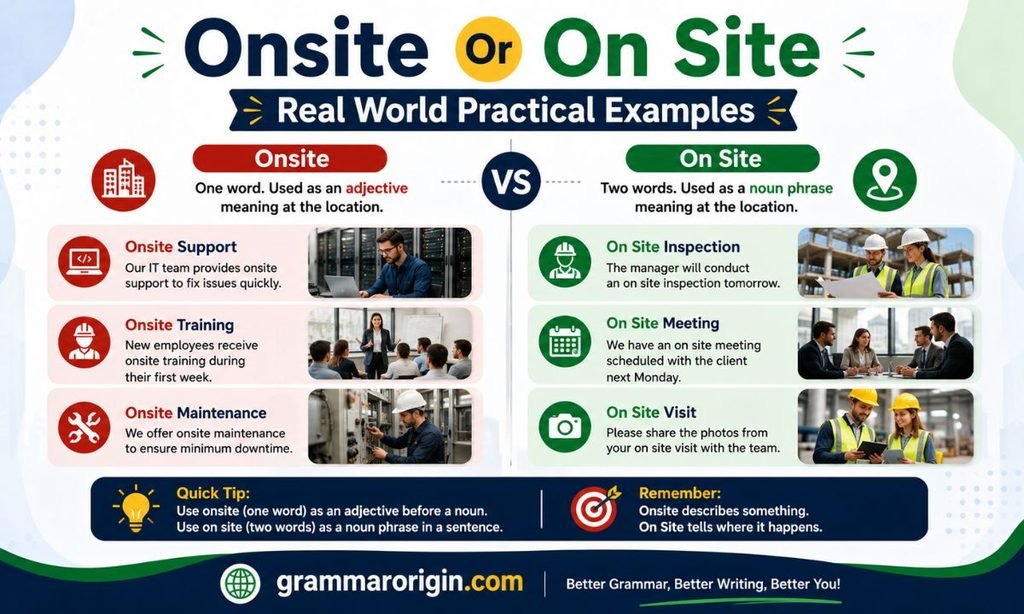
Seeing the words used across different industries helps the rule stick better than isolated grammar drills. Below are onsite and on site examples grouped by real context.
Onsite Examples
- Education: The university offers onsite tutoring for first-year students.
- Business: We scheduled an onsite audit for next Tuesday.
- Technology: The vendor includes onsite installation with every contract.
- Daily life: Our building has onsite laundry facilities.
- Healthcare: The clinic runs onsite diagnostic testing.
On Site Examples
- Education: The principal has been on site since early morning.
- Business: The consultant is on site reviewing the contracts today.
- Technology: Our engineer is on site fixing the server outage.
- Construction: The safety officer stayed on site through the storm.
- Healthcare: The specialist stayed on site through the entire procedure.
Onsite or On-Site (UK Usage)
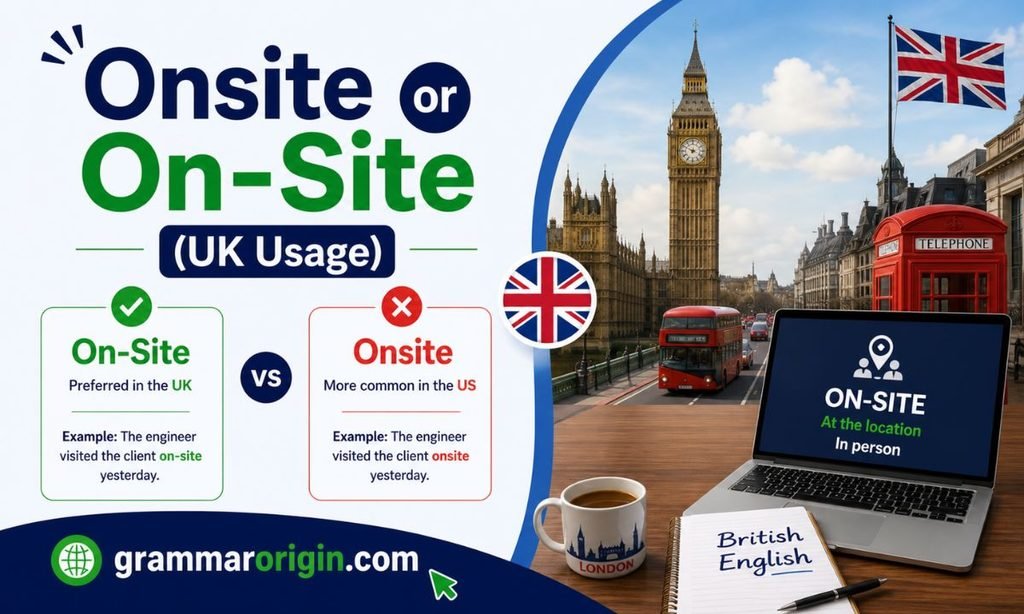
In UK English, the hyphenated “on-site” is generally the preferred adjective, appearing more often than the closed compound “onsite” in edited British publications. American English, by contrast, has shifted heavily toward the closed form.
So a British job posting is more likely to read “on-site parking,” while an American one leans toward “onsite parking.” Neither is wrong. It is a regional style preference, not a grammar rule, so consistency within one document matters more than picking a correct side.
If you are writing for a UK audience or following a British style guide, defaulting to “on-site” as your adjective will feel more natural to readers there.
Onsite or On Site for Work, Meetings & Interviews
For onsite work, onsite meetings, and onsite interviews, the adjective form is almost always correct because each phrase directly modifies a noun. “Onsite work,” “onsite meeting,” and “onsite interview” all describe a type of arrangement, not a location on its own.
You would write “This role requires onsite work three days a week” or “We scheduled an onsite interview for Thursday.” These contrast directly with remote or hybrid arrangements, which is exactly why recruiters lean on this word so often.
The moment you shift to describing where someone physically is during that meeting or interview, switch to “on site.” For example: “The panel is on site waiting for you.”
Onsite or On-Site: AP Style & Dictionary Rulings

AP Style does not include a dedicated entry for this term, which is why many editors default to checking a standard dictionary instead. Most major dictionaries, including Merriam-Webster, list “on-site” as the established hyphenated adjective.
That means in strict AP-adjacent or journalistic writing, “on-site” is the safer choice before a noun, even though “onsite” has become extremely common in business and tech writing. When you are describing location rather than modifying a noun, dictionaries consistently treat “on site” as two separate words.
For most everyday and business writing, either onsite or on-site is acceptable. The real requirement is picking one and staying consistent throughout your document.
Self Assessment (Fill in the Blanks)
Test yourself before checking the answers below. Fill each blank with either “onsite” or “on site.”
- We offer ______ training for new hires.
- The technician is ______ right now.
- The company provides ______ tech support.
- All workers must remain ______ during the drill.
- Our office has ______ parking.
- The auditor is ______ this week.
- They requested an ______ inspection.
- The team stayed ______ overnight.
- We arranged an ______ meeting.
- Security must stay ______ at all times.
Answers
- onsite
- on site
- onsite
- on site
- onsite
- on site
- onsite
- on site
- onsite
- on site
Summary
Choosing between onsite or on site comes down to one habit: check whether the word is describing a noun or describing a location. Onsite belongs before nouns; on site belongs after verbs.
Once that pattern feels automatic, you will write with more confidence in job posts, emails, and reports, and you will never second-guess this pair again.
Frequently Asked Questions
Is onsite one word or two words?
Both forms exist and are correct in different situations. “Onsite” is one word used as an adjective before a noun, while “on site” is two words used as a location phrase after a verb.
What does onsite mean?
Onsite means located, provided, or happening at a specific physical location. It is used as an adjective, as in “onsite support” or “onsite training.”
Is onsite or on-site correct for a resume?
Either spelling is acceptable on a resume as long as you use it consistently throughout the document. US readers tend to expect “onsite,” while UK readers often expect “on-site.”
Onsite or on site for work, which is right?
Use “onsite work” when describing a type of job arrangement, since it modifies the noun “work.” Use “on site” only when describing where someone physically is during that work.
What does onsite or on site support mean?
Onsite support refers to technical or service help delivered in person at your location, as opposed to remote assistance handled over the phone or online.
Does Merriam-Webster prefer onsite or on-site?
Merriam-Webster and most major dictionaries list the hyphenated “on-site” as the established adjective, though “onsite” is now widely accepted in modern business and tech usage.
Onsite or on site for a meeting, how do I choose?
“Onsite meeting” is correct when naming the type of meeting, since it modifies the noun “meeting.” Use “on site” instead if you are describing where attendees currently are.

Muhammad Waqas is an English language teacher and grammar expert with over 8 years of experience helping students and professionals improve their writing skills. He specializes in English grammar, vocabulary, communication, and practical language learning. Through GrammarOrigin, Waqas shares clear, easy-to-understand content that helps readers write and speak English with confidence.