
To fast or too fast sounds like one confusing choice, but it’s really two completely different phrases that happen to sound alike. To fast meaning is about skipping food, while too fast meaning is about excessive speed. Once you separate the two ideas, the mix-up disappears for good.
This guide breaks down the grammar behind both phrases, walks through real examples, and clears up why even confident writers still pause over this one. You’ll also get a quick pronunciation note, a memory trick, and a short quiz to test yourself.
Definition
To fast is a verb phrase meaning to go without eating, and too fast is an adverb phrase meaning excessively quick. That single distinction solves almost every mix-up between the two.
- She chose to fast before the appointment.
- You’re driving too fast for this road.
If the sentence is about skipping meals, reach for “to fast.” If it’s about speed, reach for “too fast,” and nothing in between.
The Real Difference Between “To” and “Too”
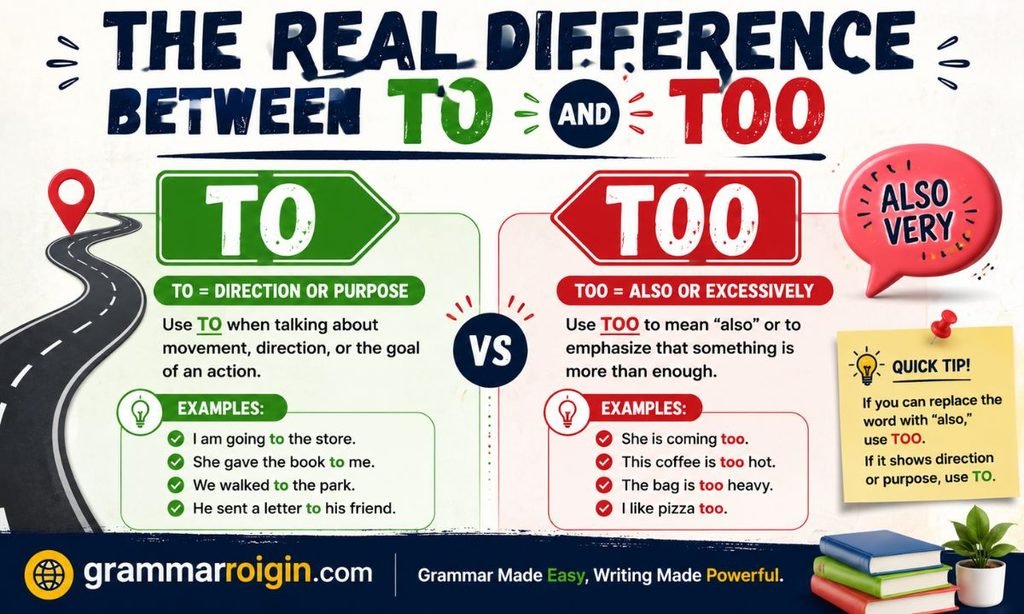
“To” points toward direction or purpose, while “too” points toward excess or addition. That’s the entire difference in one line.
- To: I’m heading to the office.
- Too: It’s too early to leave.
Pronunciation of To and Too
Both words are pronounced the same way, /tuː/, which is exactly why they get swapped so often in writing. Speech doesn’t show the spelling difference, so your ear can’t catch the mistake the way your eyes can.
Saying a sentence out loud slowly, then checking the spelling afterward, catches far more errors than reading silently ever does.
What “To” Really Means
“To” works as either a preposition showing direction, or as a marker that introduces the base form of a verb. Neither role has anything to do with speed.
As a Preposition
As a preposition, “to” connects an action to a destination, a person, or a purpose.
- She walked to the station.
- This letter is addressed to my manager.
As an Infinitive Marker
As an infinitive marker, “to” sits directly before a base verb to form phrases like “to run” or “to eat.”
- I want to learn Spanish.
- He forgot to lock the door.
What “Too” Really Means
“Too” is an adverb that signals more than what’s needed, or it can mean “also.” Both senses share the same word, just different contexts.
- Excess: The coffee is too hot to drink.
- Addition: I’m coming along too.
What “Fast” Means in Grammar
“Fast” shifts roles depending on the sentence: it’s an adjective describing a noun, an adverb describing an action, or a verb meaning to abstain from food. Context alone decides which one you’re looking at.
- Adjective: a fast train
- Adverb: she types fast
- Verb: they plan to fast
Word Origin of Fast
The verb sense of “fast” traces back to Old English “fæstan,” meaning to hold firm or observe strictly, which is where the modern sense of abstaining from food comes from. The speed-related sense of “fast” developed separately, originally meaning firmly fixed before shifting toward quick movement.
Also Read This Shown vs Showed: What’s the Correct Grammar Rule?
When “To Fast” Is Correct
Use “to fast” whenever the sentence describes the choice to go without food, typically for religious, medical, or personal reasons. This is the standard to fast meaning across nearly every context you’ll encounter.
- Many families choose to fast during religious observances.
- Her doctor asked her to fast for twelve hours before the test.
Examples (To Fast)
Real to fast examples tend to show up in health, faith, or lifestyle writing.
- He decided to fast for the entire day.
- She agreed to fast before the procedure.
- Students sometimes fast briefly during religious holidays.
Case Study: Intermittent Fasting
Intermittent fasting has become a common health topic, and the phrase to fast sits at the center of it. People following a 16:8 schedule choose to fast for sixteen hours and eat within an eight-hour window each day.
A nutrition coach explaining this method to a client would say something like: “You’ll fast overnight and break your fast at noon.” Notice how “fast” works cleanly as a verb here, with no confusion about speed anywhere in the sentence.
When “Too Fast” Is Correct
Use “too fast” whenever a sentence describes something moving, happening, or progressing at an excessive pace. This covers the too fast meaning in nearly every practical situation you’ll run into.
- The car was going too fast for the icy road.
- He read the instructions too fast and missed a step.
Examples (Too Fast)
Everyday too fast examples show up constantly in casual and professional writing alike.
- She’s driving too fast on this street.
- The presentation moved too fast for the audience to follow.
- My heart was racing too fast after the run.
Real-Life Context: “Too Fast” and Everyday Rules
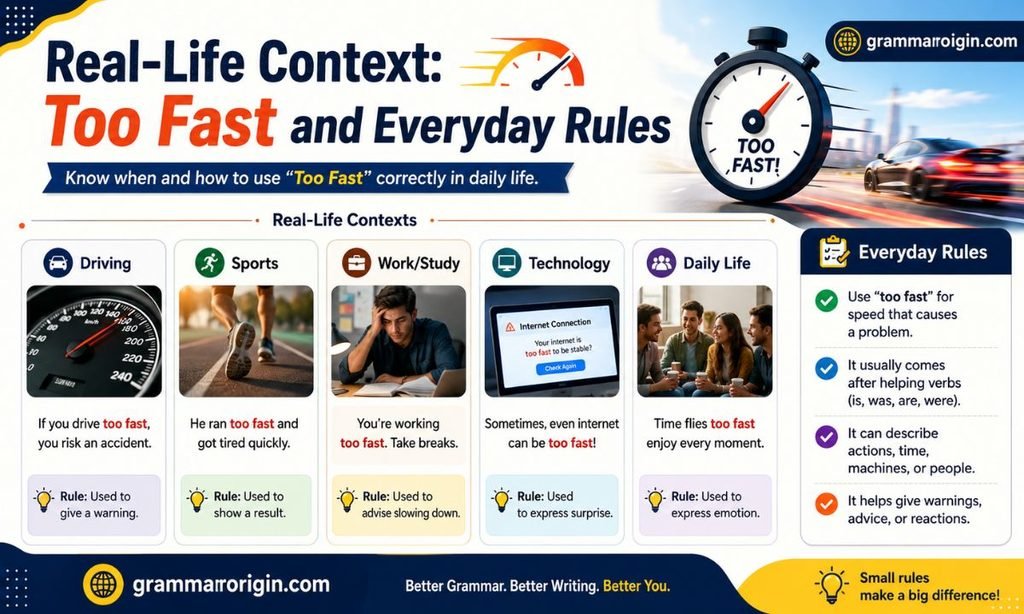
“Too fast” shows up anywhere speed becomes a problem, whether that’s on the road, in sports, or in daily life.
In Traffic Laws
Driving too fast breaks posted speed limits and raises the risk of an accident. Traffic tickets exist specifically because of this exact phrase.
- She got pulled over for going too fast in a school zone.
In Sports
Athletes who move too fast without proper form often risk injury instead of gaining an advantage. Coaches repeat this warning constantly during training.
- The sprinter started too fast and lost energy before the finish.
In Life Situations
Life sometimes genuinely feels too fast, especially during major transitions like a new job or a big move. This is a common, informal use of the phrase outside strict grammar contexts.
- He felt like everything was happening too fast after the promotion.
Idiomatic Expressions with Too Fast
A few fixed phrases pair naturally with “too fast” and show up often in casual conversation. “Too fast to stop” and “too fast for his own good” are two of the most common.
The phrase “too fast, too furious” also gets used playfully in everyday speech as a humorous way to describe reckless speed, borrowing its rhythm from a well-known movie title without needing any connection to the film itself.
- The train was going too fast to stop safely.
- He drives too fast for his own good.
Common Mistakes and Why They Happen
Most errors between these two phrases come down to writing quickly without pausing to check meaning.
Common Errors
- Incorrect: He drives to fast on the highway.
- Correct: He drives too fast on the highway.
- Incorrect: I will too fast tomorrow morning.
- Correct: I will fast tomorrow morning.
Why It Happens
“To” and “too” are homophones, so the ear can’t distinguish them the way the eye can. Fast typing and autocorrect only make the confusion worse.
Quick Fixes: How to Catch and Prevent These Errors
A fast mental test clears this up in seconds: swap in “very” where “too” would go. If the sentence still makes sense, “too” is correct.
- He talks very fast becomes He talks too fast. That swap works.
- She chose very fast does not work, so “to fast” belongs there instead.
Simple Trick to Remember
Think of the extra “o” in “too” as extra speed; the second letter is a visual reminder of excess. “To” has no extra letter, which matches its simpler, more direct role.
Synonyms for Too
Repeating “too fast” throughout a piece of writing can start to feel stiff, so a few alternatives keep the tone varied.
- Overly fast
- Excessively fast
- Too quickly
- Way too fast
“The driver was moving excessively fast for the conditions” reads just as naturally as “The driver was moving too fast,” and it breaks up repetition in longer pieces.
Quick Reference Table
| Phrase | Function | Meaning | Example |
| To fast | Verb phrase | Not eating | She plans to fast tomorrow. |
| Too fast | Adverb phrase | Excessive speed | He’s driving too fast. |
| To | Preposition / infinitive marker | Direction or purpose | We’re heading to the park. |
| Too | Adverb | Excess or “also” | It’s too loud in here. |
Mini Quiz: Test Your Understanding
Fill in each blank with the correct word.
- I need ___ fast before the surgery.
- You’re typing ___ fast for me to read.
- They chose ___ fast for religious reasons.
- The car was moving ___ fast for the curve.
Answers: 1. to, 2. too, 3. to, 4. too
Advanced Usage: When Both Appear in the Same Sentence
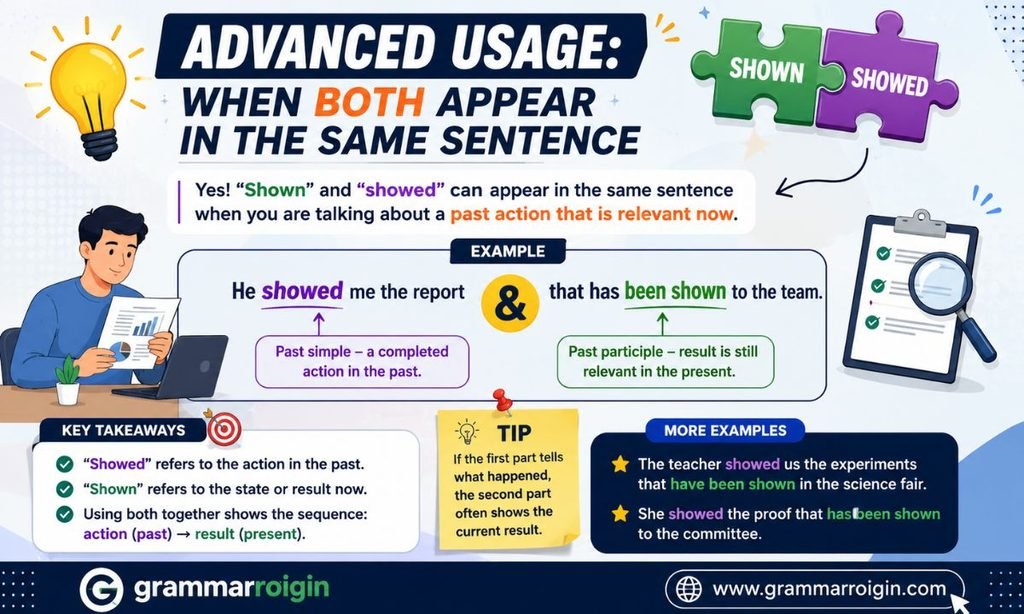
Sometimes both phrases show up together, and each one keeps its own separate meaning. Reading slowly is the only real trick here.
- He chose to fast for health reasons, but he ate too fast once the fast ended.
The first “to fast” describes the choice to skip food, and “too fast” afterward describes the rushed pace of eating once the fast was over.
Related Confusing Word Pairs
“To,” “too,” and “two” form a classic homophone trio that trips up writers well beyond this one phrase. Once “to fast or too fast” makes sense, the same logic carries over to other mixed-up pairs.
| Word | Role | Example |
| To | Preposition or infinitive marker | Go to bed. |
| Too | Adverb (excess or also) | It’s too late. |
| Two | Number | I have two tickets. |
A related distinction worth knowing is “so fast,” which describes surprising or remarkable speed rather than excess: “She finished so fast that nobody expected it.” That’s a different shade of meaning from “too fast,” which always implies a problem.
Also Read This Shown vs Showed: What’s the Correct Grammar Rule?
Linguistic Insight
“To” and “too” are true homophones, meaning they share identical pronunciation but come from different grammatical roots. English keeps the spelling distinct even though speech doesn’t, which is exactly why the confusion survives in writing but rarely in conversation.
Expert Opinion
Editors who review student and professional writing consistently point to the same fix: slow down and check meaning before checking spelling. Reading a sentence aloud one more time catches nearly every to/too slip before it reaches a reader.
Final Thoughts on To Fast or Too Fast
To fast or too fast becomes simple once you separate the two ideas completely. To fast is about the choice to skip food, and too fast is about speed that’s gone beyond what’s safe or reasonable.
Keep the extra “o” trick in mind, read your sentences aloud when you’re unsure, and this mix-up will stop showing up in your writing for good.
Frequently Asked Questions
What does “to fast” mean?
To fast meaning is straightforward: it means to go without eating for a set period, usually for religious, medical, or personal reasons. Example: She decided to fast for the entire day.
What does “too fast” mean?
Too fast meaning describes something happening at an excessive or unsafe speed. Example: He was driving too fast for the wet road.
Is “to fast” ever wrong?
Yes, it’s wrong whenever the sentence is actually about speed rather than eating. In that case, “too fast” is the only correct choice.
What are some too fast synonyms?
Common too fast synonyms include overly fast, excessively fast, and way too fast. These work well when you want to avoid repeating the same phrase in longer writing.
What’s the difference between “too fast” and “so fast”?
“Too fast” always signals a problem caused by excess speed, while “so fast” usually expresses surprise at how quick something was, without implying anything went wrong.
Why do people sometimes search for “to fast or too fast cast”?
That search usually comes from a simple typo or autocomplete mix-up rather than an actual question about a cast list; the grammar topic and any unrelated media title just happen to share similar wording.
How can I remember the difference quickly?
Picture the extra “o” in “too” as extra speed. If a sentence is about excess or addition, use “too.” If it’s about direction, purpose, or not eating, use “to.”

Muhammad Waqas is an English language teacher and grammar expert with over 8 years of experience helping students and professionals improve their writing skills. He specializes in English grammar, vocabulary, communication, and practical language learning. Through GrammarOrigin, Waqas shares clear, easy-to-understand content that helps readers write and speak English with confidence.