
Quieter vs more quiet is one of those comparisons that sounds simple until you try to explain it. Quiet sits right on the edge between short adjectives and longer ones, and that is exactly why so many writers hesitate.
This guide breaks down the real grammar rule behind quieter and more quiet, the quieter meaning and more quiet meaning in everyday use, when each form is acceptable, and how native speakers actually use them.
Definition Quieter Vs More Quiet
Quieter is the standard comparative form of quiet, and it is the one you should use in almost every sentence. More quiet is not incorrect, but it is a secondary option used mainly for emphasis or a slower rhythm.
- Quiet has two syllables, but it acts like a short adjective for comparison
- Quieter follows the regular -er pattern and is the natural, everyday choice
- More quiet exists and is grammatically valid, just far less common
- Both forms describe reduced noise or a calmer state
Understanding “Quiet” as an Adjective
Quiet describes a state with little or no sound, or a calm, undisturbed mood. The quieter meaning always ties back to this same idea: less noise, more calm. It is a gradable adjective, so it can shift in degree. Something can be a little quiet, very quiet, or the quietest place you have ever been.
- Describes sound levels: a quiet room, a quiet street
- Describes temperament or mood: a quiet person, a quiet afternoon
- Can apply to places, people, sounds, and even situations
Examples:
- The office goes quiet after 6 PM.
- He has a quiet, steady way of speaking.
- It was a quiet Sunday with nothing planned.
The Grammar Behind Comparatives
English forms comparatives in two main ways, and the adjective’s length usually decides which rule applies.
- One-syllable adjectives take -er: fast becomes faster, small becomes smaller
- Longer adjectives, three or more syllables, take more: comfortable becomes more comfortable
- Two-syllable adjectives sit in a grey zone. Some take -er, some take more, and a few accept both
Quiet falls into that grey zone. It technically has two syllables (qui-et), but because it is short and easy to say with -er attached, English treats it almost like a one-syllable word for comparison. That is the real reason quieter wins over more quiet.
| Adjective | Comparative | Rule Type |
| quiet | quieter | short adjective, add -er |
| tall | taller | one-syllable, add -er |
| happy | happier | two-syllable ending in -y |
| careful | more careful | longer adjective, use more |
“Quieter”: The Standard Comparative Form
Quieter is correct because quiet behaves like a short adjective, and short adjectives take -er in standard English grammar. It is the form you will find in textbooks, style guides, and everyday conversation. This is also the standard answer whenever someone asks about the comparative and superlative of quiet.
- Matches the regular comparative pattern for short adjectives
- Flows naturally in speech without sounding forced
- Accepted in formal writing, casual writing, and spoken English alike
Examples:
- The gym is quieter early in the morning.
- Try to keep your voice quieter near the nursery.
- This engine runs quieter than last year’s model.
When “More Quiet” Can Be Grammatically Acceptable
More quiet is not a mistake. It is a stylistic alternative that shows up when a writer wants extra weight on the idea of quietness, rather than a quick, automatic comparison. A common more quiet synonym in this sense is “calmer” or “more subdued,” since the phrase often leans toward mood as much as sound.
- Used in reflective or descriptive writing to slow the pace
- Appears occasionally in poetry, fiction, or formal prose
- Sometimes chosen simply because it fits the rhythm of a sentence better
Examples:
- The valley grew more quiet as the storm passed overhead.
- After the announcement, the room felt more quiet than before.
Outside of these deliberate stylistic choices, quieter remains the safer, more natural pick.
Quieter vs More Quiet in Real-World Usage
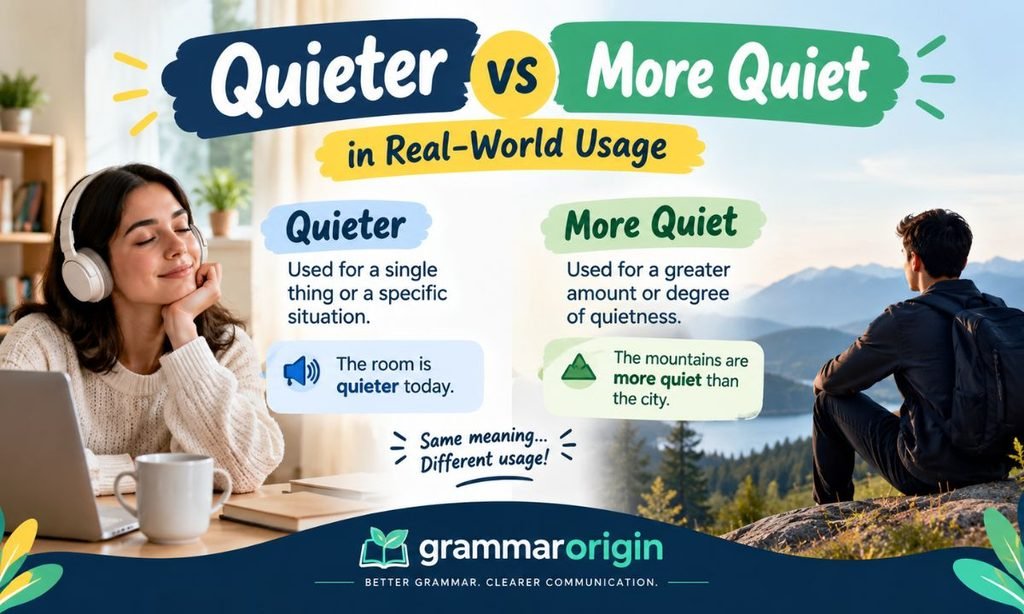
In day-to-day English, quieter shows up far more often than more quiet. Ask any native speaker to compare two rooms, and “quieter” is almost always the word that comes out first.
- Quieter dominates casual conversation, emails, and everyday writing
- More quiet tends to cluster in literary, formal, or emotionally loaded writing
- Search behavior mirrors this too. People search “quieter than” far more than “more quiet than”
Examples:
- Can you turn the TV quieter, please?
- The new apartment is so much quieter than my old one.
Comparison Table: Quieter vs More Quiet
| Feature | Quieter | More Quiet |
| Grammar pattern | short adjective + -er | more + adjective |
| Typical use | everyday speech and writing | emphasis, formal or literary tone |
| Naturalness | high | can sound slow or deliberate |
| Best fit | conversations, articles, exams | reflective or descriptive passages |
The real difference is not correctness. It is how automatic versus how deliberate the sentence feels.
Also Read This To Fast or Too Fast: What’s the Correct Phrase?
“Quietest” vs “Most Quiet” — The Superlative Forms
The superlative form of quiet is quietest, following the same short-adjective logic as quieter. Most quiet exists but is rarely the natural choice.
- One-syllable and short adjectives take -est for the superlative
- Quietest is standard. Most quiet is uncommon
- Avoid mixing the two forms in the same sentence
Examples:
- This is the quietest café on the block.
- Of all the classrooms, hers was the quietest.
| Form Type | Preferred Form | Rare Alternative |
| Comparative | quieter | more quiet |
| Superlative | quietest | most quiet |
Quieter vs Less Noisy — Meaning Comparison
Quieter and less noisy overlap but are not identical. Quieter is a broad comparison of calmness or sound level, while less noisy points directly at a drop in disruptive or unwanted sound.
- Quieter: general. Covers overall calm, tone of voice, atmosphere
- Less noisy: specific. Points to a reduction in unwanted sound
Examples:
- This neighborhood is quieter than downtown. (overall calm)
- The new AC unit is less noisy than the old one. (specific noise reduction)
Common Usage Constructions
Quiet appears in a few fixed comparative patterns beyond the basic quieter and more quiet choice.
- Comparative + than: quieter than, more quiet than
- Intensifiers: much quieter, far quieter, a little quieter
- Equal comparisons: as quiet as
“As Quiet As” — Equal Comparisons
Use as + adjective + as when two things are equally quiet, with no difference in degree.
Examples:
- The office was as quiet as a library.
- Try to stay as quiet as you can during the interview.
Common Idioms and Expressions
A handful of set expressions use quiet in fixed phrasing that should not be changed.
- Quiet as a mouse
- Keep quiet
- Dead quiet
- A quiet word
Examples:
- She crept in quiet as a mouse.
- He asked to have a quiet word after the meeting.
Quieter Or More Quiet British English
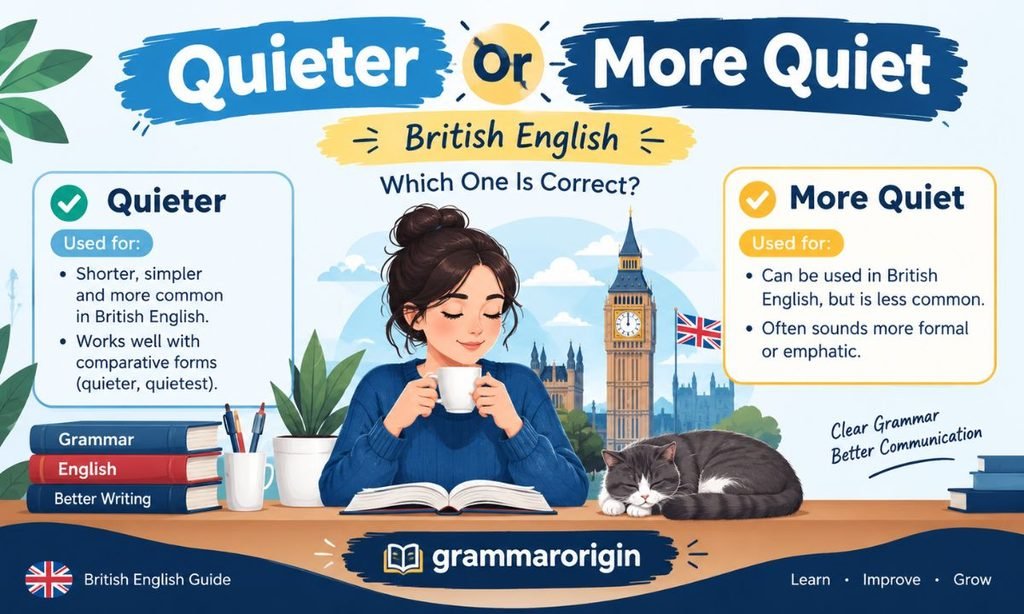
Quieter is the leading form in both American and British English, but the gap is a little narrower in the UK, where more quiet shows up slightly more in polite requests and casual speech.
- American English: quieter is used almost by default in speech and writing
- British English: quieter still leads, but more quiet feels natural in polite or conversational requests
- Neither dialect treats more quiet as wrong. It is a matter of frequency, not correctness
Examples:
- US: “Could you be quieter, please?”
- UK: “Could you be a bit more quiet, please?” (sounds natural in casual British English)
Quieter Pronunciation Guide
Getting the pronunciation right also explains why quieter feels more natural than more quiet in fast speech.
- Quieter: /ˈkwaɪ.ə.tər/. Stress falls on the first syllable, and the word flows as one smooth unit
- More quiet: /mɔːr ˈkwaɪ.ət/. Two separate stressed words, which slows the rhythm down
Because quieter is said as a single flowing word, it is easier to say quickly in conversation. That small pronunciation edge is part of why it became the default comparative.
Linguistic Insight & Expert Opinion
English tends to favor shorter comparative forms when a word is easy to say with -er attached. This is often called language economy: speakers naturally prefer the option that takes less effort to say and hear. Quiet fits this pattern closely enough that -er became the default, even though the word technically has two syllables.
- Shorter forms are easier for listeners to process
- Speakers naturally lean toward the option that takes less effort
- The same pattern explains why words like “simple” and “narrow” also flex between -er and more
Common Mistakes and Misunderstandings
A few recurring errors show up around quieter and more quiet, especially among learners.
- Saying “more quieter.” This is a double comparative and is always incorrect
- Using “most quiet” instead of “quietest” in the superlative
- Assuming more quiet is wrong, when it is actually just less common
Incorrect: This room is more quieter than the last one. Correct: This room is quieter than the last one.
How to Choose Between “Quieter” and “More Quiet”
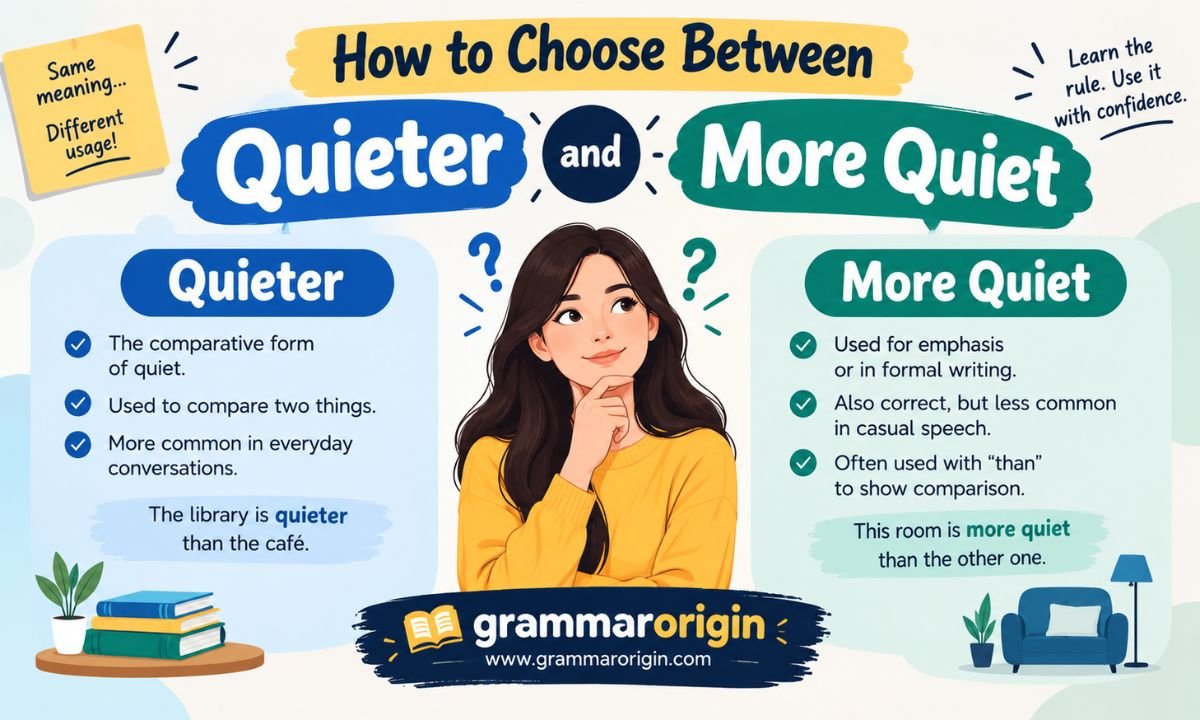
A simple decision process works for almost every sentence.
- Default to quieter unless you have a specific reason not to
- Reach for more quiet only when you want a slower, more deliberate tone
- Read the sentence aloud. If quieter sounds smooth, use it
Example: “Quieter” sounds effortless in almost any sentence. “More quiet” should feel like a deliberate choice, not a habit.
Also Read This To Fast or Too Fast: What’s the Correct Phrase?
Quick Summary Rules
- Quieter is the standard comparative of quiet
- More quiet is valid but reserved for emphasis or style
- Quietest is the standard superlative form of quiet. Most quiet is rare
- Never combine both forms. Avoid “more quieter”
- When unsure, quieter is almost always the safer choice
Real-World Examples in Context
Daily conversation: “Can you keep it quieter? The baby’s sleeping.”
Academic writing: “The revised testing environment was quieter than the original setup, reducing measurement error.”
Professional usage: “The updated model runs quieter under full load, improving user comfort.”
Self-Assessment Quiz
- This street is ______ than the highway.
- Is “more quieter” grammatically correct?
- Choose the correct superlative: quietest / most quiet
- The library is ______ than the cafeteria.
- Rewrite this correctly: “This fan is more quieter.”
Answer Key
- quieter. Short adjective, standard comparative
- No. It is a double comparative and always incorrect
- quietest. The standard superlative form
- quieter. Matches the everyday, natural pattern
- “This fan is quieter.” Remove “more” since quieter already shows comparison
Frequently Asked Questions
What’s the difference between “quieter” and “more quiet”?
Quieter is the standard comparative form of quiet, used in almost all everyday contexts. More quiet is grammatically correct too, but it is reserved for emphasis, formal writing, or a slower, more deliberate tone.
Is “more quieter” ever correct?
No. “More quieter” is a double comparative, and double comparatives are always incorrect in standard English. Use either “more quiet” or “quieter,” never both together.
Which is right: “quietest” or “most quiet”?
Quietest is the correct and standard superlative form of quiet. Most quiet is technically possible but sounds unnatural and is rarely used by native speakers.
Is “quieter or more quiet” different in British English?
Quieter still leads in British English, but more quiet appears a little more often than in American English, especially in polite requests and everyday conversation.
How do you pronounce “quieter”?
Quieter is pronounced /ˈkwaɪ.ə.tər/, with the stress on the first syllable. It flows as one smooth word, which is part of why it feels more natural than “more quiet” in fast speech.
Can “less noisy” replace “quieter”?
Sometimes. Less noisy focuses specifically on a drop in disruptive sound, while quieter covers a broader sense of calm. They overlap but are not perfect substitutes.
Do native speakers ever say “more quiet”?
Yes, but far less often than “quieter.” It mainly shows up in formal, reflective, or literary writing where a slower rhythm fits the tone.
Final thoughts
Quieter is the comparative form to reach for in almost every situation, since quiet behaves like a short adjective despite technically having two syllables. More quiet is not wrong. It is simply a deliberate, less common alternative used for emphasis or a specific tone.
When you are unsure which one fits, say the sentence aloud. If quieter sounds smooth and automatic, that is usually your answer.

Muhammad Waqas is an English language teacher and grammar expert with over 8 years of experience helping students and professionals improve their writing skills. He specializes in English grammar, vocabulary, communication, and practical language learning. Through GrammarOrigin, Waqas shares clear, easy-to-understand content that helps readers write and speak English with confidence.