
You say something right now, but you said it yesterday. That single letter shift between say vs said trips up learners and native speakers alike, especially in reported speech and quotes.
This guide breaks down the tense rule, the past participle form, real examples, and where “says,” “said,” and even “told” fit into the picture.
Quick Answer
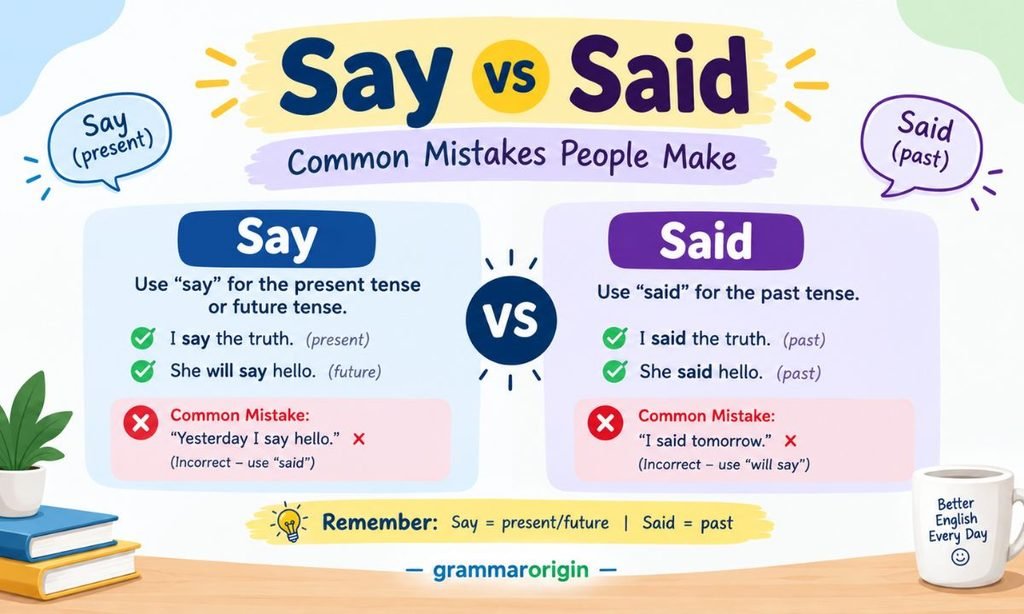
Say is the present tense form. Said covers both the past tense and the past participle.
- Say: happening now, or a general statement
- Said: already happened, or paired with has/have/had
- Sayed: not a real word in any context
Example: She says she’s tired today, but she said she was tired yesterday.
Simple Background
Say means to speak or express something in words, and it’s one of the most frequently used verbs in English.
Most verbs just add “-ed” for the past tense, but say breaks that pattern entirely.
Instead of “sayed,” English shifted to said, making say an irregular verb with no consistent spelling link between its forms.
You’ll also spot both words inside common phrases like “easier said than done” and “needless to say,” where the tense rule still holds exactly the same way.
Clear Explanation of the Difference
What is “Say”?
Say is the base form, used for present and future actions.
- I say thank you every time.
- What did she say just now?
- I will say it again if needed.
What is “Said”?
Said covers two jobs: simple past tense and past participle.
- He said he was running late. (simple past)
- They have said this before. (past participle, paired with “have”)
Both uses share the exact same spelling, which is part of why the past tense of say confuses so many learners.
Comparison Table
| Verb Form | Word | Example Sentence |
| Present (base) | Say | I say thank you every morning. |
| Present (third person) | Says | She says she’s running late. |
| Past Tense | Said | I said thank you yesterday. |
| Past Participle | Said | She has said that before. |
Which One to Use and When
Use say for anything happening now or in general statements about the future.
Use said the moment you’re describing something that already happened, or pairing it with has, have, or had. That’s the whole say vs said decision in most everyday sentences.
- Say: He says the deadline is Friday.
- Said: He said the deadline was Friday. (referring back to an earlier statement)
Simple Tip to Remember
Picture a timeline: today sits on the “say” side, yesterday sits on the “said” side.
- Today, I say what’s on my mind.
- Yesterday, I said what was on my mind.
That single mental split covers almost every say vs said situation you’ll run into.
Also Read This Eying or Eyeing?
Say vs Said Common Mistakes People Make
1. Saying “sayed”
This is the most frequent slip, since regular verbs add “-ed” and say looks like it should follow suit.
- Wrong: He sayed he would call back.
- Right: He said he would call back.
2. Using present tense for past actions
Mixing timelines mid-sentence confuses the reader about when something actually happened.
- Wrong: She say that yesterday during the meeting.
- Right: She said that yesterday during the meeting.
3. Forgetting irregular verb forms
Say doesn’t follow the standard pattern other verbs use, so its past tense has to be memorized rather than guessed.
- Wrong pattern guess: say, sayed, sayed
- Correct pattern: say, said, said
Say vs Said Everyday Real Life Examples

In School
- The teacher said the assignment was due Monday.
- Students often say they need more time before an exam.
In Daily Life
- I said goodbye before catching my train.
- She says the same joke every single dinner.
In Messages
- He said he’d text once he landed.
- They say the package should arrive by Thursday.
On Social Media
- I never said that, someone’s misquoting me.
- People say the weather this week has been unreal.
Short Learning Section for Students
Step 1: Learn the forms
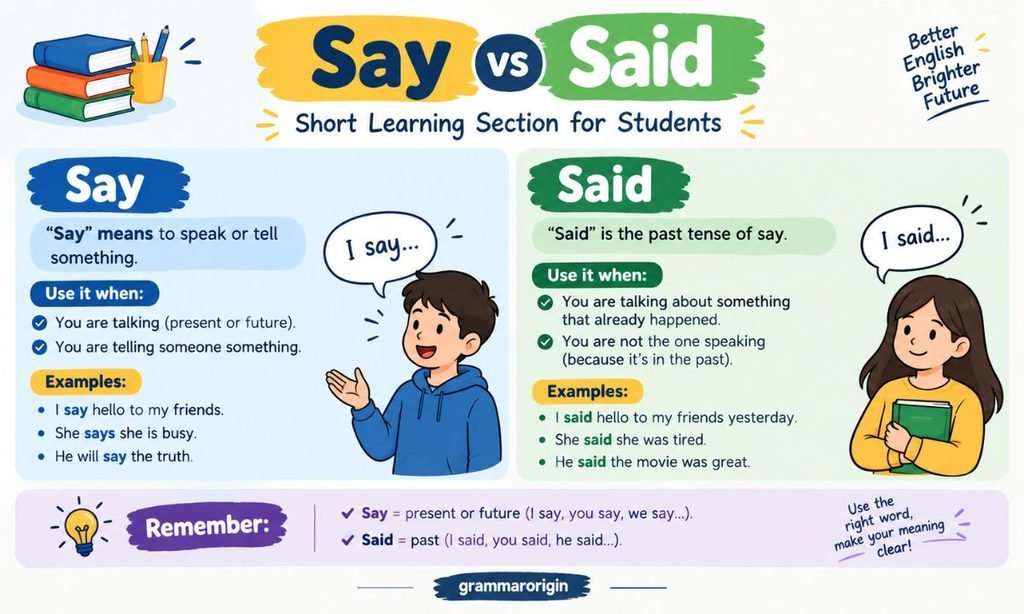
Say handles the present. Said handles both the past tense and the past participle, with no separate third form to memorize.
Also Read This Eying or Eyeing?
Step 2: Practice
- I say hello every day.
- I said hello yesterday.
- I have said hello a hundred times this week.
Step 3: Use memory trick
Repeat this line until it sticks: past speech always uses said.
Step 4: Practice speaking aloud
Say a sentence in the present, then immediately repeat it in the past. Hearing the shift out loud reinforces the pattern faster than reading it silently.
Frequently Asked Questions
What is the past tense of say?
The past tense of say is said. There’s no separate “sayed” form in standard English.
What is the past participle of say?
The past participle is also said, identical to the simple past tense. Both forms pair correctly with have, has, or had.
Should I use “says” or “said” when quoting someone?
Use said for quotes describing something already spoken, and says only when the statement is still true or ongoing right now. News writing typically favors said for past interviews and says for current, repeatable statements.
How does say or said work in reported speech?
Reported speech usually shifts the reporting verb to said, since you’re describing something that was spoken earlier. Example: She said she was coming, rather than she says she was coming.
What’s the difference between tell and told?
Tell needs a listener directly after it, as in “tell me,” while say doesn’t require that object. Told is simply the past tense of tell, working the same way said works for say.
Is “told” past tense or present tense?
Told is past tense only, used the same way said is used for say. There’s no present-tense version spelled “told.”
Can you give more examples of say and said in sentences?
Sure: I say what I mean (present), I said what I meant (past), and I have said enough for today (past participle) all show the same verb across its three uses. Working through say vs said examples like these is the fastest way to make the pattern stick.
Final Thoughts
Say vs said really comes down to timing: say for now, said for anything already spoken. Once that timeline clicks, quotes, reported speech, and everyday conversation stop feeling confusing.
Keep “sayed” out of your writing entirely, lean on said for both past tense and past participle, and the rest of this irregular verb falls into place naturally.

Muhammad Waqas is an English language teacher and grammar expert with over 8 years of experience helping students and professionals improve their writing skills. He specializes in English grammar, vocabulary, communication, and practical language learning. Through GrammarOrigin, Waqas shares clear, easy-to-understand content that helps readers write and speak English with confidence.