
Eying or Eyeing You’ve probably typed eye plus ing and paused halfway, unsure if it should read eying or eyeing. Both spellings show up online, which only adds to the confusion.
A simple rule explains why English keeps both versions alive, along with the meaning, the safer choice, and where dictionaries and style guides actually stand.
Quick Answer
Eyeing is the standard spelling in modern English. Eying is a recognized but far less common alternate form.
- Eyeing: preferred in American and British English
- Eying: technically correct, rarely used
- Meaning: identical in both
Example: She kept eyeing the last cookie on the plate, not “eying,” though a dictionary would still accept either spelling.
Where Do These Words Come From?
Both words trace back to the noun eye, the body part used for sight.
English later turned eye into a verb. To eye something means to look at it closely or with interest.
Adding the standard present-participle ending “-ing” to that verb is where the spelling confusion actually begins.
Why Are There Two Spellings?
English usually drops a silent “e” before adding “-ing,” which is exactly why this word causes hesitation.
That rule gives us make to making, write to writing, and by the same logic, eye to eying.
Writers found eying visually confusing since it barely resembles the word eye anymore. Keeping the extra “e” and writing eyeing solved that readability problem, and both forms stuck around as an irregular spelling pattern rather than a strict error.
Also Read This Wifes or Wives? The Correct Plural Form Explained
The Meaning Is Exactly the Same
Neither spelling changes the meaning of the word. Eying or eyeing both describe watching something with interest, attention, or intent.
Pronunciation stays identical too: both are said as /ˈaɪɪŋ/, roughly “eye-ing,” with no shift in sound between the two spellings.
- The buyer is eyeing that vacant lot.
- The buyer is eying that vacant lot.
Both sentences describe the exact same action; only the letters differ.
Comparison Table
| Feature | Eying | Eyeing |
| Meaning | Looking with interest | Looking with interest |
| Standard usage | Rare | Common |
| American English | Uncommon | Preferred |
| British English | Occasionally used | Preferred |
| Recommended for formal writing | No | Yes |
Which One Should You Use?
Choose eyeing in almost every situation. It reads more clearly and matches what most readers expect to see.
What should YOU write?
Default to eyeing unless you have a specific style reason to do otherwise.
If you are writing in American English:
Use eyeing every time. Example: The startup is eyeing a new round of funding.
If you are writing in British English:
Eyeing still leads here too, though eying occasionally appears in older or more formal British text. Example: The board is eyeing a leadership change.
If you are not sure:
Pick eyeing. It works everywhere and never looks out of place.
Eying or Eyeing Common Mistakes People Make
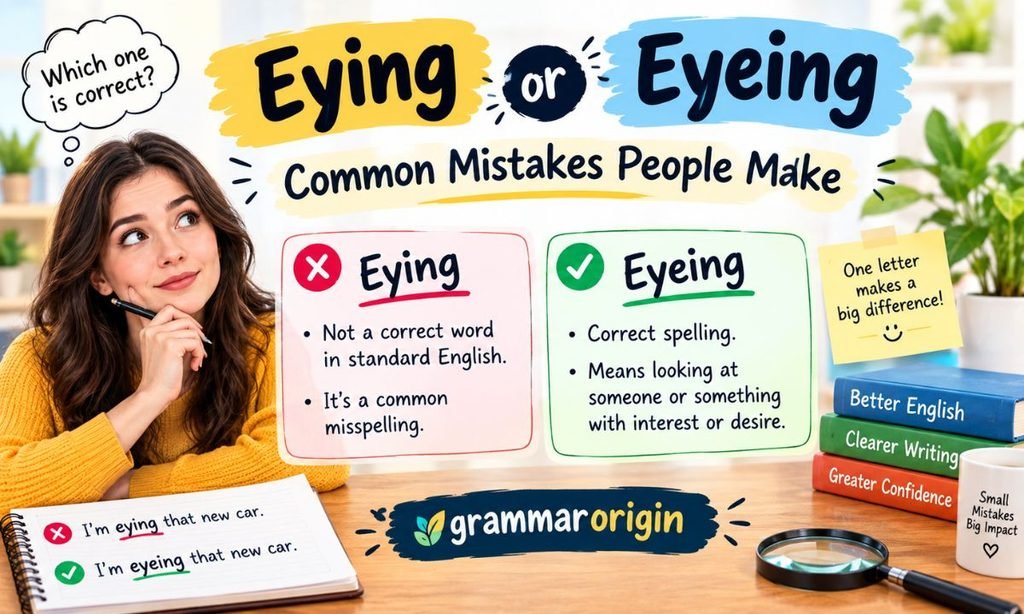
1. Thinking one spelling is wrong
Neither spelling is technically incorrect. Eyeing is simply far more common and easier to recognize at a glance.
2. Spelling it “eyeingg” or “eyeng”
Extra or missing letters slip in when people type quickly.
- Wrong: eyeingg, eyeng
- Right: eyeing, eying
3. Confusing “eyeing” with “seeing”
Seeing just means using your eyes. Eyeing adds intent or interest behind the look.
- I saw the painting. (plain observation)
- I was eyeing the painting. (I wanted it, or was studying it closely)
4. Forgetting the meaning
Eyeing rarely means a casual glance. It usually signals interest, evaluation, or a plan forming behind the look.
Example: He’s eyeing a transfer to the sales team, meaning he actively wants it.
Also Read This Wifes or Wives? The Correct Plural Form Explained
Everyday Real Life Examples
In Emails
- I’m eyeing the Thursday afternoon slot for our call.
- Our team is eyeing a Q3 launch for this feature.
In News Headlines
- Regulators are eyeing stricter rules for the industry.
- The city is eyeing a new transit line downtown.
On Social Media
- Been eyeing this jacket for a month, finally bought it.
- He’s eying that new console, might gift it for his birthday.
In Daily Conversations
- “The dog’s been eyeing your sandwich the whole time.”
- “She was eyeing the front row seats before the show started.”
- “They’re eyeing a bigger apartment closer to downtown.”
Simple Learning Section for Students

Step 1: Think of the base word eye
Start with the noun you already know: eye.
Step 2: Add -ing
Drop the “e” for eying, or keep it for eyeing. Both technically follow a valid English pattern.
Easy Memory Trick
If it needs to look connected to “eye,” keep the extra e and write eyeing. That’s the version to default to.
Practice Sentences
- The manager was eyeing a promotion for months.
- The cat sat still, eyeing the fish tank.
- Investors are eyeing the tech sector again.
- The kids kept eyeing the dessert table all evening.
Try writing two of your own sentences using eyeing, then check that the meaning matches “watching with interest.”
Frequently Asked Questions
What does eying or eyeing mean?
Both spellings mean the same thing: looking at something or someone with attention, interest, or intent. Neither spelling changes the definition.
Does the Oxford Dictionary recognize eying or eyeing?
Yes, Oxford lists eyeing as the primary spelling and eying as an accepted variant. Eyeing is the entry most readers and editors expect to see.
What does AP Style recommend, eying or eyeing?
AP Style guidance leans toward eyeing for news and media writing, since it matches the spelling most readers already recognize. Consistency within one article matters more than the choice itself.
What is a synonym for eyeing?
Common alternatives include watching, observing, monitoring, considering, and studying. Each swaps in cleanly depending on how formal the sentence needs to sound.
Is eying a valid word in Scrabble?
Yes, eying is accepted in most official Scrabble word lists, along with eyeing. Both scored, both valid, so either spelling works during a game.
Is it correct to say “eyeing on” something or someone?
Not quite. Standard usage drops the “on” entirely, as in “eyeing the position,” not “eyeing on the position.” The confusion likely comes from the phrase “keeping an eye on,” which does use “on.”
What does “side-eyeing” mean?
Side-eyeing describes glancing at someone sideways, usually to show doubt, suspicion, or mild disapproval without saying anything out loud.
Final Thoughts
Eying or eyeing both point to the same action: watching something closely, usually with interest or intent behind it. The spelling choice comes down to style, not correctness.
Default to eyeing for everyday writing, keep it consistent within a single piece, and the small hesitation between the two spellings won’t slow you down again.

Muhammad Waqas is an English language teacher and grammar expert with over 8 years of experience helping students and professionals improve their writing skills. He specializes in English grammar, vocabulary, communication, and practical language learning. Through GrammarOrigin, Waqas shares clear, easy-to-understand content that helps readers write and speak English with confidence.