
You’ve probably wondered about High School or Highschool at least once without thinking twice about it. It looks natural, especially when you’re texting fast or scrolling social media.
But only one version passes muster in real writing. This guide breaks down the correct spelling, why the mix-up happens, and how to use the phrase correctly every time.
Quick Answer
High school (two separate words) is the only correct spelling in standard English. Highschool, written as one word, is a spelling mistake and not an accepted alternative.
- Correct: She just started high school.
- Incorrect: She just started highschool.
- Use it for the education stage between middle school and college, roughly ages 14 to 18.
- The space stays in place whether you’re using it as a noun or describing something, like “high school teacher.”
Keep that single rule in mind and you’ll never second-guess it again.
Why Does This Confusion Happen?
The mix-up mostly comes down to habit, not ignorance. Autocorrect on phones sometimes merges words unpredictably, and fast typing skips spaces without anyone noticing.
English also has plenty of closed compound words, like notebook, keyboard, and sunflower, so it’s easy to assume every two-word phrase eventually fuses into one. Social media posts full of “highschool” screenshots don’t help either, since seeing a mistake repeatedly makes it feel normal.
None of that changes the rule, though. English treats high school as what’s called an open compound, and open compounds keep their space no matter how often people type them wrong.
Simple Origin and Background
School has been part of English for centuries, referring to any place where people go to learn. High was tacked on later to mark a specific stage, one above elementary or middle school.
Education systems generally move students through tiers: elementary, middle, then high school. In that structure, “high” simply describes which level of school you mean, the same way “big” describes a house or “small” describes a town.
Because high is doing descriptive work on school, the two stay apart. Compound phrases built this way almost never collapse into a single word.
Also Read this Niece or Neice
High School or Highschool Clear Explanation of the Difference
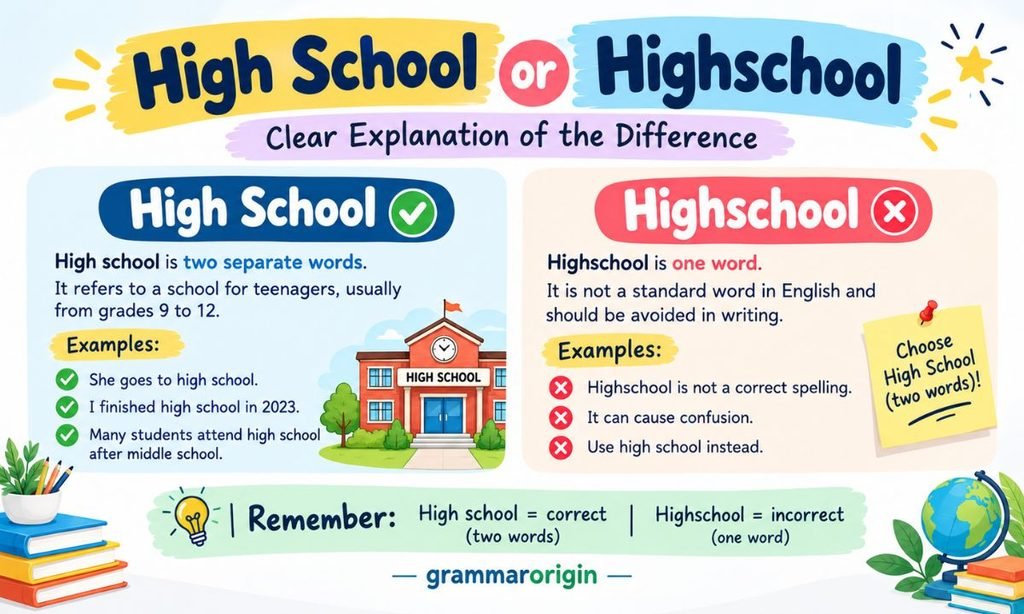
There’s a real, testable difference between these two spellings. One is standard English, and the other isn’t recognized by any major dictionary or style guide.
High School
This is the version you’ll find in dictionaries, textbooks, and every reputable style guide. It refers to secondary education, typically grades 9 through 12 in the U.S.
- My cousin just graduated high school last spring.
- He coaches basketball at the local high school.
- We reconnected years after high school ended.
Highschool
There’s no dictionary entry for this spelling. People land on it for a few predictable reasons: typing quickly, assuming it follows the closed-compound pattern, or simply copying what they’ve seen elsewhere online.
Whatever the reason, “highschool” doesn’t belong in essays, resumes, professional emails, or any writing meant to look polished.
High School or Highschool: Comparison Table
| Feature | High School | Highschool |
| Dictionary-recognized | Yes | No |
| Word count | Two words | One word |
| Acceptable in formal writing | Yes | No |
| Used in academic/education contexts | Yes | No |
| Recommended spelling | Yes | No |
The takeaway is simple: whenever you’re unsure, default to the two-word form.
Which One to Use and When
Short answer: always write high school with a space, regardless of the setting. The context might change your tone, but it never changes the spelling.
School Assignments
Teachers and professors expect standard spelling, and this one’s an easy point to lose if you get it wrong.
- My time in high school shaped how I approach deadlines today.
Emails
Even casual, quick emails benefit from correct spelling. It signals attention to detail.
- I finished high school two years before starting this job.
Articles and Reports
Published writing holds a higher bar, so the two-word form is non-negotiable here.
- Career counseling often starts during high school, not after.
Social Media
Grammar rules feel looser online, but the correct spelling still reads as more credible.
- First day of high school, nervous but excited.
High School or Highschool Common Mistakes People Make
Most errors with this phrase fall into a handful of repeatable patterns. Once you recognize them, they’re easy to avoid.
1. Writing It as One Word
Incorrect: I met my best friend in highschool. Correct: I met my best friend in high school.
2. Using It Incorrectly as an Adjective
High school stays two words even when it describes something else, as in “high school teacher” or “high school reunion.” A hyphen (high-school) occasionally appears in careful writing when the phrase directly modifies a noun, as in “a high-school diploma,” but the closed form “highschool” is never correct in either case.
3. Copying Incorrect Spelling Online
Seeing “highschool” in a comment thread or caption doesn’t make it standard. Plenty of casual writing online skips proper spelling altogether.
4. Forgetting the Space
This one’s usually just a typing slip, especially on mobile keyboards that predict text aggressively.
Incorrect: highschool Correct: high school
Also Read this Niece or Neice
High School or Highschool Everyday Real-Life Examples
Seeing the phrase in realistic contexts makes the correct spelling easier to remember than any rule on its own.
Emails
“Hi Professor Diaz, I’m a high school senior interested in your summer program. Could you share more details?”
Social Media Posts
- Can’t believe high school graduation is already here.
- Throwback to my awkward high school yearbook photo.
Conversations
- “Did you play any sports back in high school?”
- “She’s still close with three friends from high school.”
News Writing
The district approved funding for a new high school building set to open next fall.
Personal Stories
Some of my clearest memories are from high school, the good and the cringeworthy.
Learning Section for Students and Beginners
If spelling rules generally trip you up, this one has an easy shortcut. High school is a level of education, and levels of education almost always stay as two words: elementary school, middle school, high school.
Try reading a sentence out loud slowly. If your ears pick up two distinct words, your writing should show two words as well.
Practice a few on your own:
- I walk to high school every morning with my neighbor.
- My younger sister starts high school in September.
- Most of my closest friendships started in high school.
Repetition builds the habit faster than memorizing a rule ever will.
Frequently Asked Questions
Is high school capitalized?
Only when it’s part of a specific school’s proper name, like Lincoln High School. As a general term, such as “she’s in high school,” it stays lowercase.
Is it “high school diploma” or “highschool diploma”?
It’s always high school diploma, two words. “Highschool diploma” isn’t a recognized spelling in any formal or academic context.
Is “high school diploma” capitalized?
No, not as a general phrase. You’d only capitalize it if it’s part of an official document title or a specific institution’s name.
Is high school hard?
Difficulty varies by student, school, and course load, but high school generally introduces more independent responsibility and harder coursework than middle school. Most students adjust within the first year.
Is middle school one word?
No. Like high school, middle school is an open compound and stays as two separate words in all standard writing.
What does “high school” mean?
It refers to the stage of secondary education that typically comes before college or university, usually covering grades 9 through 12 in the U.S.
Why are titles like “High School Musical” or “Highschool of the Dead” spelled differently?
Media titles follow their own branding choices, not standard grammar rules. “High School Musical” is capitalized because it’s a proper title, while “Highschool of the Dead” is a stylized one-word spelling chosen specifically for the franchise’s name. It doesn’t reflect correct everyday English.
Final Thoughts
Between the two options, high school is the spelling that holds up in dictionaries, classrooms, and professional writing, while highschool remains a common but incorrect shortcut.
Once you connect it to other two-word education terms like middle school and elementary school, the correct form becomes second nature, and you won’t need to double-check it again.

Muhammad Waqas is an English language teacher and grammar expert with over 8 years of experience helping students and professionals improve their writing skills. He specializes in English grammar, vocabulary, communication, and practical language learning. Through GrammarOrigin, Waqas shares clear, easy-to-understand content that helps readers write and speak English with confidence.