
Typing fast, you paused mid-sentence and wondered: is it lieing or lying? You’re not the only one. This exact mix-up shows up in student essays, work emails, and late-night texts every single day. The good news is that English only accepts one of these spellings, and the reason behind it takes less than a minute to learn.
By the end of this guide, you’ll know the rule, see it applied in real sentences, and have a memory trick that sticks. Whether you’re an ESL learner, a student, or just double-checking a work email, we’ll cover where the confusion with “lying down” and “lying to someone” comes from, so you never second-guess yourself again.
Quick Answer
Lying is the only correct spelling. Lieing does not exist in standard English, no matter how the word sounds when spoken aloud.
Lying works as the present participle for two separate meanings of the verb “lie”: reclining in a flat position, and telling something untrue. Lieing simply breaks a basic spelling pattern that English applies to a small group of verbs.
Simple Background
Most English verbs just add -ing without any changes: walk becomes walking, jump becomes jumping. Verbs that end in -ie don’t follow that pattern.
For this small group, the -ie is swapped for a -y before -ing joins on. That single swap is the entire source of the lieing vs lying confusion:
- lie → lying
- die → dying
- tie → tying
- vie → vying
Skip that swap and you get “lieing,” “dieing,” and “tieing,” spellings that look off to a fluent reader because English almost never stacks three vowels together like that.
Where Does “Lying” Come From? A Quick Word History
The verb traces back to Old English licgan, which meant to recline or rest in a place. Over time, spelling and pronunciation shifted through Middle English lien before settling into the modern lie.
The dishonesty sense of “lie” developed as a separate but related Old English word, lyge. Centuries of English merging similar-sounding words is exactly why “lying” carries two meanings today, while “lieing” never carried any.
Clear Explanation of the Difference
What is “Lying”?
Lying is a verb form, and it covers two distinct ideas depending on context. Neither meaning changes the spelling.
- Not telling the truth: He is lying about where he was last night.
- Resting in a flat position: The dog is lying under the porch.
Dictionaries including Merriam-Webster list both senses under the verb “lie,” confirming lying as the standard present participle in every context.
What is “Lieing”?
Lieing isn’t a word. It’s a spelling error that happens when someone applies the regular “just add -ing” rule to an irregular verb. It carries no separate meaning of its own.
- Incorrect: She was lieing on the couch all afternoon.
- Correct: She was lying on the couch all afternoon.
Lie vs. Lay vs. Laying: Don’t Mix These Up
A second layer of confusion sneaks in once “lay” enters the picture, since lie and lay sound related and get swapped constantly in casual speech.
| Verb | Meaning | Present | Past | Past Participle | -ing Form |
| Lie | to recline (no object) | lie | lay | lain | lying |
| Lay | to place something (needs an object) | lay | laid | laid | laying |
The quickest test: if a sentence has an object being placed somewhere, use lay/laying. If nothing is being placed and someone is simply resting, use lie/lying.
- I lay my phone on the desk every morning. (object: phone)
- I lie down for a nap every afternoon. (no object)
Comparison Table
| Word | Type | Meaning | Correct Usage |
| Lying | Verb (present participle) | Reclining, or being untruthful | Correct |
| Lieing | Spelling mistake | No recognized meaning | Incorrect |
Which One to Use and When
Use lying any time you’re describing dishonesty or a resting position, in speech, writing, texts, or formal documents. There’s no situation, formal or casual, where “lieing” is acceptable.
Treat “lieing” the way you’d treat any typo, something to catch and fix, not a stylistic choice. Most spell checkers flag it automatically, but it still slips through in quick texts and social posts where autocorrect gets skipped.
Also Read This High School or Highschool
How to Pronounce “Lying” Correctly
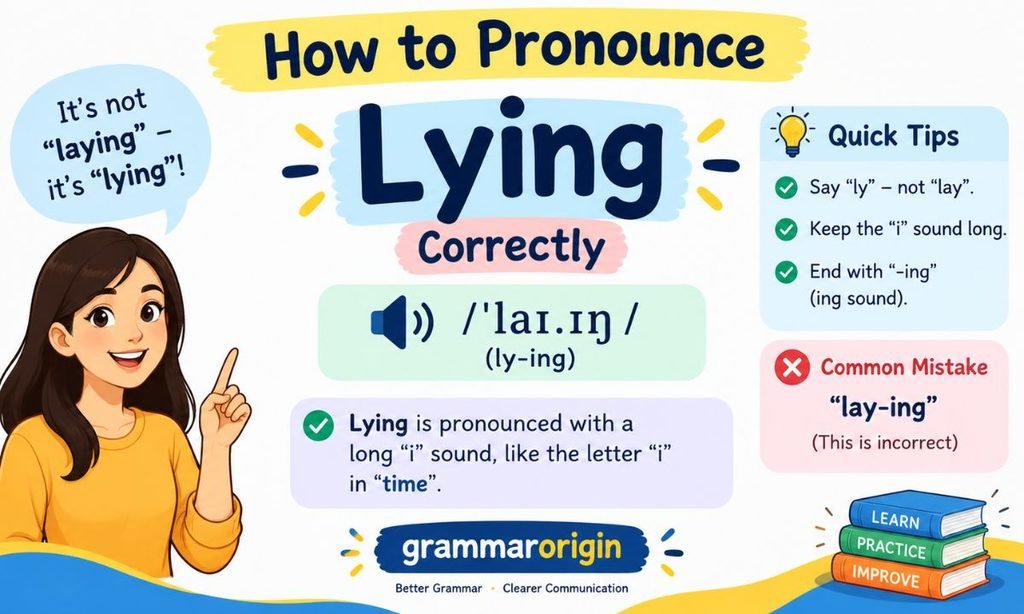
Lying is pronounced /ˈlaɪ-ɪŋ/: two syllables, rhyming with “trying” and “flying.” The first syllable sounds exactly like the word “lie.”
Because “lieing” and “lying” would sound identical if “lieing” were ever spoken, the mix-up is really a writing problem, not a pronunciation problem. Your ear won’t catch this mistake; only your eye will.
Simple Tip to Remember
Picture the pattern: ie flips to y before -ing. Run through the trio lie, die, tie in your head, and lying, dying, tying come out automatically.
If you ever type “lieing” and it looks strange on the screen, trust that instinct. It’s your brain flagging the broken pattern.
Lieing or Lying Common Mistakes People Make
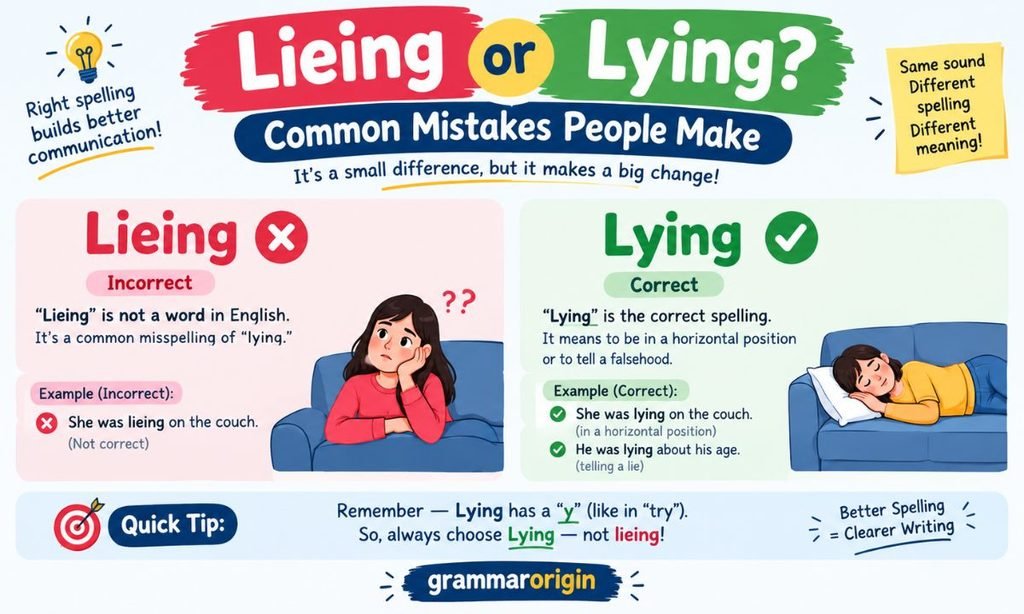
The lieing or lying mistake usually happens in one of three predictable ways, and each one is easy to fix once you know what to look for.
1. Keeping the “ie”
Writers often keep the original “ie” out of habit, producing “lieing” instead of applying the swap. This is the single most common version of the mistake.
- Incorrect: He kept lieing to his manager.
- Correct: He kept lying to his manager.
2. Forgetting spelling-change rules
Because most English verbs just add -ing with zero changes, learners assume “lie” should behave the same way. The exception rule for -ie verbs gets overlooked entirely.
3. Confusing pronunciation and spelling
Since “lieing” and “lying” would be pronounced the same, some writers assume both spellings must be valid. Spelling and sound don’t always match in English, and this is one of the clearest examples.
Lieing or Lying Everyday Real Life Examples
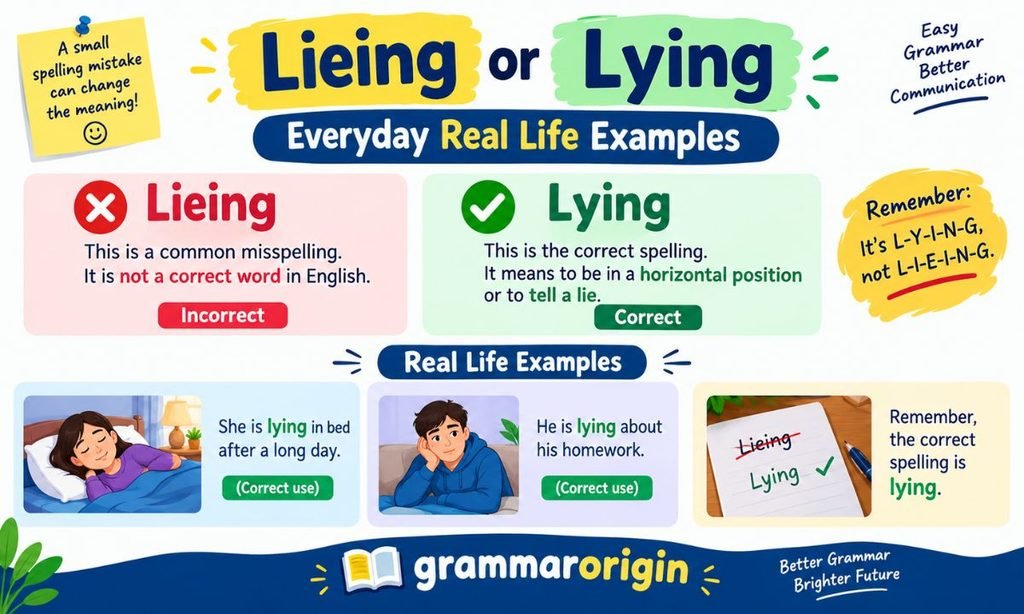
The word “lying” shows up in ordinary conversation far more often than “lieing” ever should, across daily life, messages, and school writing.
In Daily Life
- “The cat has been lying on the windowsill all morning.”
- “He was lying about finishing his homework.”
In Messages
- “Are you lying to me right now?”
- “Just lying around the house today, nothing exciting.”
On Social Media
- “Currently lying in bed avoiding responsibilities.”
- “Stop lying to your followers about that product.”
In School
- “The textbooks were lying open on every desk.”
- “The essay explained why lying under oath is a serious offense.”
Short Learning Section for Students
Students can master the lieing or lying rule in four short steps, without memorizing long grammar explanations.
Step 1: Learn the rule
Memorize the swap: -ie becomes -y before -ing. This single rule solves the entire lieing vs lying question.
Step 2: Practice
Write five sentences using “lying” for reclining and five using it for dishonesty. Repetition builds the habit faster than memorizing a definition.
Step 3: Use memory trick
Link lie to its two cousins, die and tie. If dying and tying feel automatic, lying will too.
Step 4: Check spelling carefully
Before submitting any essay, email, or post, scan for “ie” endings followed by “ing.” That quick check catches this error every time.
Also Read This High School or Highschool
Lieing or Lying Down
The correct phrase is always lying down, never “lieing down.” This applies whether you’re describing rest, illness, or simply relaxing.
- Incorrect: I need to go lieing down for a bit.
- Correct: I need to go lying down for a bit.
Lieing or Lying in Bed
The same rule applies here. Lying in bed is correct in every tense of the present participle, and “lieing in bed” is not a recognized spelling in any English dictionary.
- Incorrect: She spent the whole morning lieing in bed.
- Correct: She spent the whole morning lying in bed.
Lieing or Lying to Someone
When talking about dishonesty directed at another person, lying to someone is the standard phrase. The rule doesn’t change based on whether the topic is rest or deception.
- Incorrect: Stop lieing to me about your whereabouts.
- Correct: Stop lying to me about your whereabouts.
Quick Self-Check: Test Yourself
Try these before checking the answers below.
- The dog is _____ on the porch. (lying / lieing)
- He admitted _____ about his age. (lying / lieing)
- I was _____ awake all night. (lying / lieing)
- She kept _____ to her parents. (lying / lieing)
- The keys were _____ on the counter. (lying / lieing)
Answers: All five blanks take lying. If you picked lying every time, the spelling rule has already stuck.
Frequently Asked Questions
Is “lieing or lying” spelled differently in American and British English?
No. Neither American nor British English recognizes “lieing” as a standard spelling in any context, formal or informal. Lying is correct in both varieties.
Why does “lie” turn into “lying” instead of “lieing”?
Verbs ending in -ie swap that ending for -y before adding -ing, which is why lie becomes lying, just like die becomes dying and tie becomes tying.
Does “lying” always mean dishonesty?
No. Lying also describes resting in a horizontal position, and context determines which of the two meanings applies in a sentence.
How can I stop making this spelling mistake?
Practice the -ie to -y swap with lie, die, and tie together, and proofread any sentence containing “ing” attached to a base verb ending in -ie.
Is this mix-up common among fluent English speakers too?
Yes, even experienced writers occasionally type “lieing” out of habit, since the mistake comes from spelling logic rather than a lack of vocabulary.
What’s the difference between lying and laying?
Lying describes reclining with no object involved, while laying describes placing an object somewhere, such as laying a book on a table.
Can I use “lying” in professional or academic writing?
Yes. “Lying” is the standard, dictionary-approved spelling for every kind of writing, including academic papers, business emails, and formal reports.
Final Thoughts
Lying is the only spelling English grammar accepts, whether you mean resting flat or telling an untruth. Lieing breaks a well-established spelling rule and carries no meaning of its own.
Once the -ie to -y pattern clicks, through lie, die, and tie together, you’ll spell lying correctly without pausing to think about it again.

Muhammad Waqas is an English language teacher and grammar expert with over 8 years of experience helping students and professionals improve their writing skills. He specializes in English grammar, vocabulary, communication, and practical language learning. Through GrammarOrigin, Waqas shares clear, easy-to-understand content that helps readers write and speak English with confidence.