
Wondering what happens to “let” in the past tense? Here’s the short version: nothing happens at all. Let past tense stays exactly as “let,” with no “-ed” and no spelling change.
That single rule trips learners up because most English verbs do change, so expecting an exception feels natural. This guide walks through the forms, the common mistakes, and simple ways to remember the rule for good.
Quick Answer
“Let” keeps the same spelling in present, past, and past participle. There’s no separate past-tense form to memorize, which makes this one of the easier let past tense rules in English.
- Present: let
- Past: let
- Past Participle: let
Example: Yesterday, my manager let me leave early.
Definition of “Let”
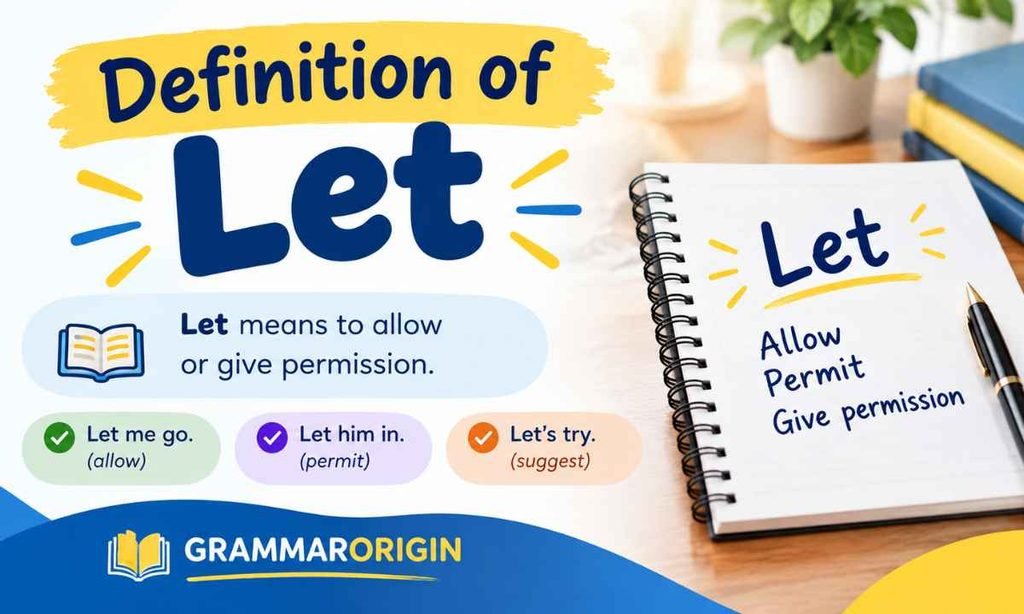
“Let” means to allow, permit, or not prevent something from happening.
It works in real situations, like letting someone into a room, and in softer ones, like letting an opportunity pass. Merriam-Webster and the Oxford English Dictionary both define it the same simple way: giving permission or not blocking an action.
Example: The coach let the team decide the lineup.
Simple Background
“Let” belongs to a small group of English verbs that don’t change form between present, past, and past participle.
It traces back to the Old English word “lætan,” and its behavior matches verbs like put, cut, hurt, and shut, all of which stay identical across tenses.
Example: Just like “cut,” the word let never takes an “-ed” ending.
Clear Explanation of the Difference
What is “Let”?
“Let” is the base and present-tense form of the verb, used when someone gives permission right now or in general.
Example: My parents let me stay up late on weekends.
What is the Past Tense of “Let”?
The past tense of “let” is also “let.” Nothing about the spelling changes when the sentence moves into the past, which is exactly why the let past tense meaning confuses so many learners at first.
Example: They let us enter the building yesterday.
Also Read This Finaly vs Finally: Correct Spelling & Meaning Guide
Full Verb Forms of “Let”
“Let” keeps its spelling across every tense and aspect, including continuous and perfect forms.
| Form Type | Present | Past | Future |
| Simple | let / lets | let | will let |
| Continuous | am/is/are letting | was/were letting | will be letting |
| Perfect | have/has let | had let | will have let |
| Perfect Continuous | have/has been letting | had been letting | will have been letting |
Example: She has let her hair grow out since spring.
Comparison Table
Here’s a quick-reference view of the three main forms side by side.
| Verb Form | Word | Example |
| Base / Present | Let | They let me go. |
| Past Tense | Let | They let me go yesterday. |
| Past Participle | Let | They have let him stay. |
Is “Let” a Regular or Irregular Verb?
“Let” is an irregular verb, since regular verbs add “-ed” in the past tense and “let” never does.
It belongs to a specific pattern of irregular verbs that keep one identical form throughout, rather than changing a vowel or adding an ending.
Example: Compare let with a regular verb like “walk,” which becomes “walked.”
Past Simple vs Past Participle: When to Use Which
Use plain “let” for simple past actions, and pair “let” with have or had whenever a helper verb is present.
Simple past stands alone in a sentence, while the past participle always needs an auxiliary verb like have, has, or had to form the perfect tenses.
Example: “He let her pass” (simple past) compared with “He has let her pass before” (past participle with “has”).
“Let’s” vs “Lets”: Don’t Confuse These
“Let’s” with an apostrophe is short for “let us,” while “lets” without one is the present-tense form used with he, she, or it.
Mixing these up changes your sentence’s meaning entirely, even though the two words sound identical when spoken.
Example: “Let’s go now” means “let us go,” but “she lets her kids play outside” describes what she allows.
Which One to Use and When
Use “let” for present, past, and past participle situations. The spelling never adjusts based on timing.
Simple Tip to Remember
Picture “let” as a word that refuses to change costumes no matter which tense it’s acting in.
Example: Today, tomorrow, or last year, the sentence still uses let.
Similar Irregular Verbs Like “Let”
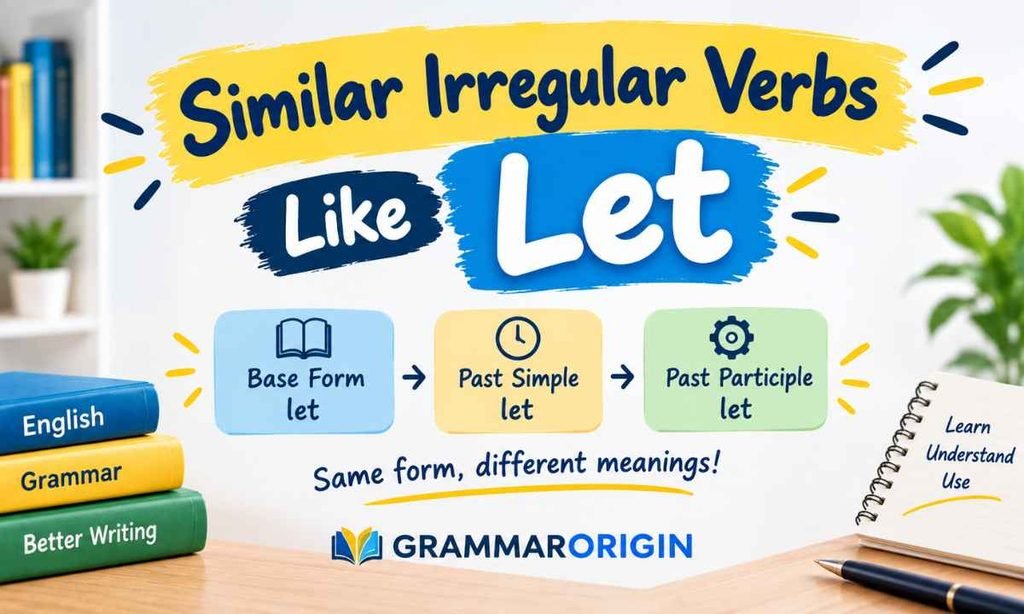
Several other short verbs follow the exact same no-change pattern as “let.”
Verbs like hurt, shut, bet, set, put, and cut all stay identical across present, past, and past participle.
Example: Just as you’d say “I hurt my knee yesterday,” you’d say “I let him in yesterday.”
Synonyms and Common Phrases with “Let”
Common synonyms include allow, permit, enable, and authorize, depending on how formal the sentence needs to sound.
“Let” also shows up in several everyday phrasal verbs, each carrying its own shade of meaning.
- Let go: to release or stop holding
- Let down: to disappoint
- Let in: to allow entry
- Let up: to become less intense
- Let off: to excuse from punishment
Example: She finally let go of her old notes before the move.
Common Mistakes People Make
1. Saying “letted”
“Letted” isn’t a word in English, even though it follows the regular “-ed” pattern learners expect.
Wrong: She letted me leave. Right: She let me leave.
2. Adding unnecessary endings
Some learners add an “-ing” or “-s” ending where it doesn’t belong, assuming the verb needs marking for tense.
“Let” already communicates the past tense on its own, so no extra ending is needed.
3. Forgetting it is irregular
Treating “let” like a regular verb leads straight to the “letted” mistake explained above.
Remembering that irregular verbs skip the “-ed” rule entirely helps you avoid this slip for good.
Also Read This Finaly vs Finally: Correct Spelling & Meaning Guide
Let Everyday Real-Life Examples

In School
Teachers use “let” constantly when describing classroom permissions.
Example: The teacher let us leave early on Friday.
In Daily Life
Casual daily situations often involve “let” for small permissions between people.
Example: My friend let me borrow his charger.
In Messages
Texting and quick messages use “let” the same way as speech, without any spelling change.
Example: She let me know about the schedule change.
In Family Conversations
Family settings frequently use “let” when talking about what parents allow.
Example: Dad let us watch a movie after dinner.
Short Learning Section for Students
Step 1: Learn the forms
Start by memorizing that let, let, and let cover present, past, and participle.
Step 2: Practice
Build two short sentences using the same verb in different time contexts.
Example: “They let me play” and “They let me play yesterday.”
Step 3: Use memory trick
Repeat the phrase “let never changes” until it becomes automatic.
Step 4: Avoid adding “-ed”
Whenever you’re tempted to write “letted,” pause and swap it for let.
Frequently Asked Questions
What is the past tense of “let”?
The let past tense is simply “let.” The spelling stays identical to the present tense in every situation.
What does “let” mean?
“Let” means to allow, permit, or not prevent something from happening.
How do you pronounce “let” in the past tense?
It’s pronounced the same way in every tense: /lɛt/, rhyming with “bet” or “set.”
Is “letted” ever correct?
No. “Letted” isn’t a recognized English word in any context, formal or casual.
Is “let” the same word as the past participle?
Yes. Present, past, and past participle all share the identical spelling: let.
Why doesn’t “let” change like other verbs?
It belongs to a small group of irregular verbs, including hurt, shut, bet, and set, that keep one form across every tense.
How can I remember the past tense of “let” easily?
Think of the phrase “let never changes.” That one line covers every tense you’ll need.
Final Thoughts
Let past tense is one of the simplest rules in English grammar: the word never changes, no matter the tense. Present, past, and past participle all use the same spelling, let.
Skip the “-ed” ending, remember the short list of similar irregular verbs, and you’ll use “let” correctly every time you write or speak.

Muhammad Waqas is an English language teacher and grammar expert with over 8 years of experience helping students and professionals improve their writing skills. He specializes in English grammar, vocabulary, communication, and practical language learning. Through GrammarOrigin, Waqas shares clear, easy-to-understand content that helps readers write and speak English with confidence.