
Finaly vs Finally Typed “finaly” and then paused, wondering if it’s even a real word? You’re not alone. This mix-up trips up writers everywhere, from students to professionals firing off late-night emails. The good news: sorting out finaly or finally takes less than two minutes.
Only one spelling belongs in a dictionary, and by the end of this guide you won’t second-guess it again. We’ll cover the correct form, why the mistake happens, and how to lock the rule into memory for good.
Quick Answer
The finaly or finally question has a short answer: “finally” is the only correct spelling. “Finaly” doesn’t exist in standard English. Drop the second “l” and you’ve made a spelling error, not an alternate version.
- Correct: finally
- Incorrect: finaly
Example: She finally answered the phone after five rings.
Finaly vs Finally AI Overview – Style Summary
“Finally” is the standard spelling of this adverb, built from “final” plus the suffix “-ly.” It means at last, in the end, or after a delay. “Finaly” is a misspelling that shows up from fast typing or guessing how the word sounds. It carries no meaning of its own and isn’t recognized in any English dictionary.
Simple Origin or Background Explanation
The word traces back to “final,” itself rooted in the Latin “finalis,” meaning “of an end.” Add the adverb suffix “-ly,” and English keeps the base word’s spelling the same rather than dropping a letter.
final + ly = finally
That extra “l” isn’t just decoration. It’s what happens whenever a word ending in “l” takes the “-ly” suffix, the same pattern that turns “real” into really, not “realy.”
Pronunciation Guide: How to Say “Finally”

“Finally” is pronounced FY-nuh-lee (/ˈfaɪnəli/), with stress on the first syllable.
Say it slowly and you’ll notice three clear beats: fi-nal-ly. That’s a handy trick when you’re unsure of the spelling too. Native speakers often blend that middle syllable in fast speech, which is partly why the misspelling finaly spreads in casual writing.
Finaly vs Finally Clear Explanation of the Difference
What does “finally” mean?
“Finally” is an adverb with two related meanings, and context tells you which one applies.
1. After a long time
It signals that something happened following a wait or a struggle.
Example: The delivery finally showed up after three delays.
2. At the end
It can also mark the last point in a sequence or list.
Example: Finally, check your spelling before hitting send.
What does “finaly” mean?
“Finaly” doesn’t mean anything. It’s not a word, just a dropped letter.
You won’t find it in Merriam-Webster, Oxford, or Cambridge dictionaries, because it has never been an accepted spelling in English at any point in time.
Key Point
“Finally” carries meaning. “Finaly” carries none. When in doubt, the safe choice is always the version with two L’s.
Also read this Long Term or Long-Term? Correct Usage & Grammar Rule
Comparison Table
Here’s how the two spellings stack up side by side.
| Feature | Finally (Correct) | Finaly (Incorrect) |
| Correctness | Standard English word | Spelling mistake |
| Word type | Adverb | Not a word |
| Dictionary status | Listed in all major dictionaries | Not listed anywhere |
| Meaning | At last / in the end | None |
| Example | She finally replied. | She finaly replied. |
Finaly vs Finally American vs British English Spelling
Both American and British English spell it the same way: finally, with two L’s.
Unlike words such as “colour/color” or “realise/realize,” this adverb doesn’t split by region. There’s no British variant of “finaly” hiding anywhere, so the rule holds no matter which English you’re writing in.
Synonyms of “Finally”
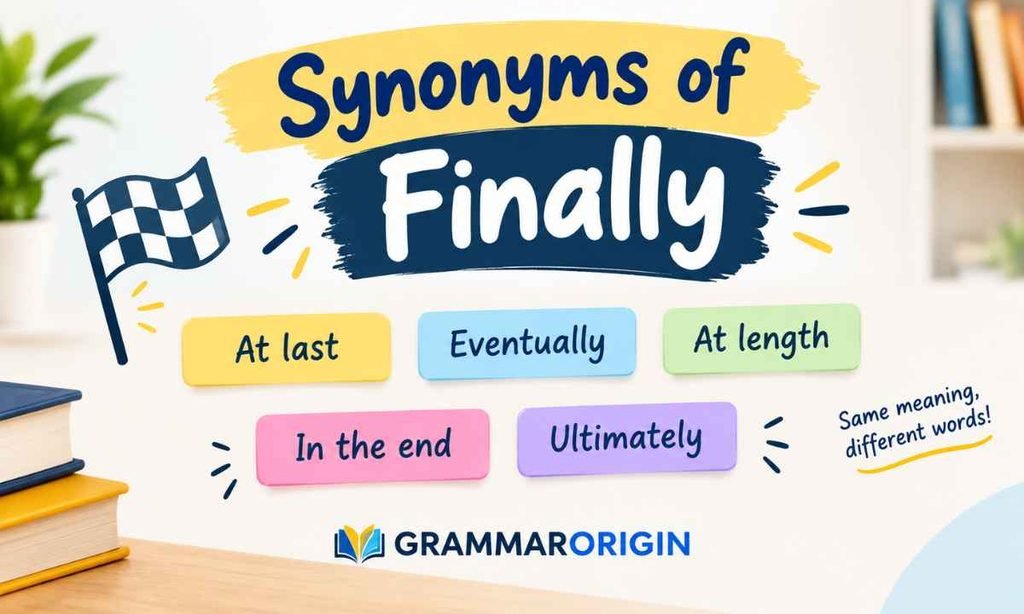
Several words can substitute for “finally,” depending on tone and formality.
- Eventually: after some time
- Ultimately: as a final result
- At last: after a delay, more conversational
- In the end: casual, summary tone
- Lastly: for ordering points in a list
Example: Eventually, the flight took off, three hours late.
Which One to Use and When
Use “finally” when:
Reach for “finally” whenever you’re describing relief after a wait or wrapping up a point.
- Something happens after waiting: We finally signed the lease.
- You’re ending a list or idea: Finally, save your document.
- You want to mark the last step: He finally hit submit.
Never use “finaly”
Formal, casual, academic, or professional: there’s no context where “finaly” is acceptable.
Swap it out the moment you spot it. Spellcheck tools usually flag it too, though not always during fast typing on mobile keyboards.
Simple Rule
Two L’s, every time, no exceptions. If you remember nothing else from this guide, remember that.
Why People Write “Finaly” Instead of “Finally”
The finaly or finally mix-up usually isn’t a knowledge problem. Most people who write “finaly” already know the word; they just lose the second “l” somewhere between thinking and typing.
Three patterns explain most of it: fast typing skips repeated letters, the spoken word blurs the double “l” into one sound, and autocorrect on some keyboards doesn’t always catch it. None of this means the writer doesn’t know English. It’s a mechanical slip, not a knowledge gap.
Finaly vs Finally Common Mistakes People Make
1. Missing one “l”
This is the single most common version of the error.
Wrong: I finaly left work early. Right: I finally left work early.
2. Typing too fast
Speed typing on phones often drops the repeated letter before your brain catches it.
Slowing down for just one extra second on this word saves you the edit later.
3. Not checking spelling
Skipping proofreading lets small errors like this slide into finished emails, essays, and posts.
A five-second reread before sending catches most of these slips.
4. Thinking both are correct
Some learners treat finaly or finally as two acceptable options and assume “finaly” is just an informal or shortened version. It isn’t.
There’s no casual exception here. Only finally is ever correct, in texts, essays, and professional reports alike.
Finaly vs Finally Everyday Real Life Examples
In Emails
I’ve finally wrapped up the quarterly report.
In News
The negotiations finally reached an agreement after months of talks.
On Social Media
Finally got tickets for the show!
In Daily Conversation
“Did she finally call you back?” “Yeah, this morning.”
Incorrect Examples (for learning)
Wrong: He finaly showed up late again. Right: He finally showed up late again.
Related Confusions: Finally vs Finale vs Finely
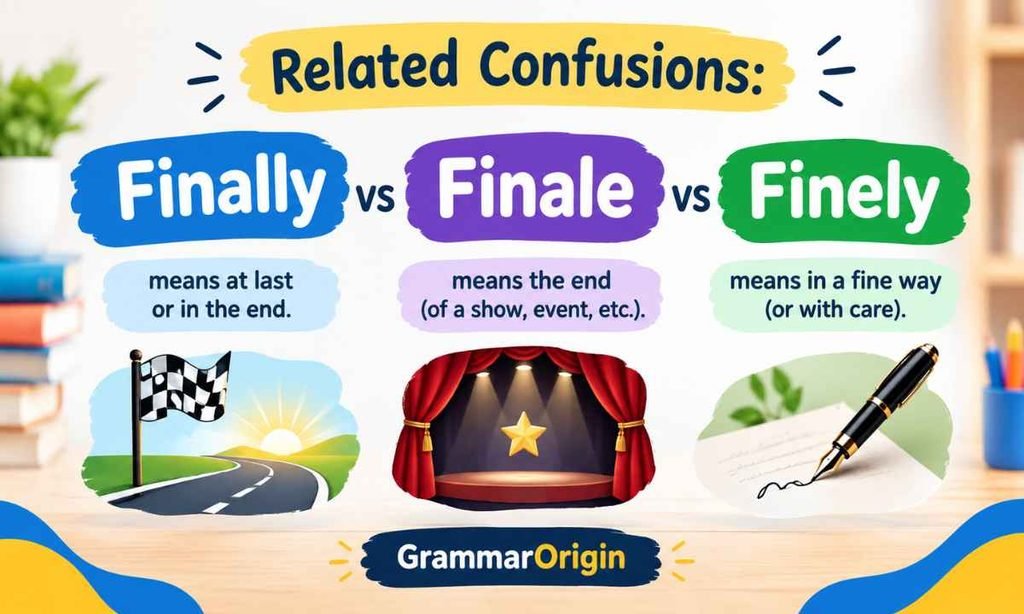
These three words look related but do completely different jobs.
- Finally (adverb): at last, in the end. We finally landed.
- Finale (noun): the last part of a show or event. The season finale airs tonight.
- Finely (adverb): in a delicate or precise way. Chop the onions finely.
Mixing these up won’t cause the same “not a word” problem as “finaly,” but it can still change what your sentence actually means.
Also read this Long Term or Long-Term? Correct Usage & Grammar Rule
Short Learning Section for Students and Beginners
Trick 1: Double “L” Rule
final + ly keeps both L’s together. Think of it as the word refusing to let one go.
Trick 2: Think of “full”
“Finally” feels full, complete, whole, and it needs both L’s to feel that way.
Trick 3: Say it slowly
Fi-nal-ly: say each syllable on its own and the double sound becomes obvious.
Practice Sentences
Fill in the blank, then check your answers below.
- I ______ finished my homework.
- She ______ arrived at the station.
- We ______ solved the problem.
Answers: finally, finally, finally
Frequently Asked Questions
Is “finaly” ever correct?
No. In the finaly or finally debate, “finaly” is always a spelling mistake, regardless of context or formality.
Why does “finally” have two L’s?
Because it’s built from “final” plus the suffix “-ly,” and English keeps the base spelling intact rather than dropping a letter.
What does “finally” mean in a sentence?
It means after a long time, or at the end of something. Both meanings point toward reaching a conclusion.
Is “finally” the same in British and American English?
Yes. Both spell it finally, with no regional variation between them.
What’s a simple way to remember the correct spelling?
Break it into final + ly, and remember the double “l” stays put, the same way real becomes really.
Is “finally” a formal word?
Yes, it works in academic, professional, and casual writing without any restriction.
What’s the difference between finally and finale?
“Finally” is an adverb meaning at last; “finale” is a noun meaning the last part of a show or event.
Summary
Between finaly or finally, only one belongs in your writing: finally, with two L’s, every single time. The mistake usually comes down to speed or sound, not a lack of knowledge, and it’s an easy one to fix once you spot the pattern.
Remember the rule, final plus ly, and the spelling stops being a guessing game. Keep that double “l” in place, and you’ll write it correctly without a second thought going forward.

Muhammad Waqas is an English language teacher and grammar expert with over 8 years of experience helping students and professionals improve their writing skills. He specializes in English grammar, vocabulary, communication, and practical language learning. Through GrammarOrigin, Waqas shares clear, easy-to-understand content that helps readers write and speak English with confidence.