
Dying is correct. Dieing isn’t a real English word, so you can safely drop it from your writing. The confusion between dieing or dying comes from one small spelling rule that English quietly breaks, and once you see it, you’ll never second-guess yourself again.
Most people type “dieing” because they’re following logic — verb plus “-ing” usually works fine. English had other plans for this particular verb. Below you’ll find the rule, the meanings, the hair-colour mix-up, UK usage, and a short quiz to lock it in.
Quick Answer
The correct spelling is dying. It’s the present participle of the verb die, and it covers everything from the end of life to a phone battery running flat.
“Dieing” doesn’t appear in Merriam-Webster, Cambridge, or Oxford. Even in manufacturing, where a die is a shaping tool, professionals write die cutting or die forming instead.
Example: Dying — “The fire is dying down.”
Simple Background
English normally lets you bolt “-ing” onto a verb without drama. Walk becomes walking, sing becomes singing, and nobody argues.
But verbs ending in “-ie” get special treatment. The “ie” flips to a “y” first, which is why die turns into dying rather than the spelling your fingers expect.
Why bother? Because “dieing” would stack three vowels in a row and slow the reader down. English tends to smooth those edges out.
Example: Die → dying — “Her houseplants keep dying.”
Dieing or Dying Clear Explanation of the Difference
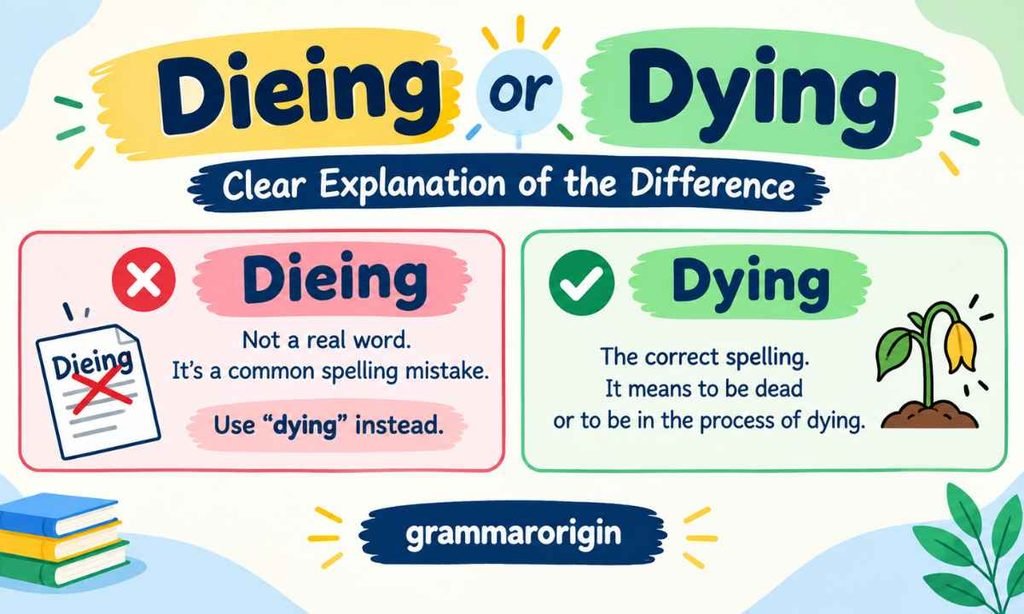
One of these words is standard English. The other is a typo that looks convincing enough to slip past a quick proofread.
What is “Dying”?
Dying is the present participle of die, meaning something is losing life, fading, weakening, or coming to an end. It also works as an adjective and shows up constantly in figurative speech.
Native speakers use it three ways. Literally, for life ending. Figuratively, for things winding down — trends, batteries, engines, conversations. And as an exaggeration, when someone says they’re dying to hear the news.
It can sit in front of a noun too, as in a dying wish or a dying breed.
Example: Dying — “My laptop’s battery is dying, so I’ll call you back.”
What is “Dieing”?
Dieing is a misspelling. It isn’t listed as a headword in the major dictionaries, which is the clearest test we have for whether something counts as standard English.
You’ll occasionally spot it in engineering forums, where a die is a tool that cuts or stamps metal. Even there, it’s informal shorthand rather than accepted usage, and trade publications stick to die cutting, die casting, or die forming.
So if you’re writing an email, an essay, or an exam answer, there’s no situation that calls for it.
Example: Dieing — “The leaves are dieing.” (Incorrect — write dying.)
Dieing or Dying Comparison Table
Three similar-looking words trip people up, not two. Here’s how they actually differ.
| Word | Type | What it means | Correct? | Example |
| Dying | Present participle of die | Losing life, fading, ending | Yes | The battery is dying. |
| Dieing | Misspelling | No dictionary meaning | No | The plant is dieing. |
| Dyeing | Present participle of dye | Changing colour with a pigment | Yes | She’s dyeing the curtains navy. |
Example: Dyeing — “He’s dyeing his beard before the wedding.”
Which One to Use and When
Use dying whenever something is ending, weakening, or losing life — and that includes objects, moods, and trends, not just living things.
Use dyeing only when colour is involved. Use dieing never.
A quick test: if you can swap in “losing life” or “fading out,” you want dying. If you can swap in “adding colour,” you want dyeing.
Example: Dying — “Interest in the show is dying fast.”
Also Read this Didn’t or Doesn’t: The Difference Explained
Simple Tip to Remember
Drop the “ie,” add a “y.” That single move turns die into dying every time.
Pair it with a word you already spell correctly. If you write lying and tying without hesitating, dying follows the exact same path.
Example: Tie → tying, die → dying.
The Spelling Rule: Why “Die” Changes to “Dying”
English changes a final “-ie” to “y” before adding “-ing.” It’s a small, consistent rule that applies to a short list of verbs.
The reason is readability. Keeping the “ie” would create an awkward vowel cluster, so the spelling shifts to keep the word quick to read and pronounce.
The verb itself is old — it traces back to Old Norse deyja, meaning to lose life. The meaning stayed put across centuries; only the “-ing” spelling adapted.
Example: Vie → vying — “Two teams are vying for the title.”
Other Verbs That Follow the Same ie → y Rule
Once you know the pattern, these stop being individual spellings to memorise and become one rule with five outputs.
- die → dying
- lie → lying
- tie → tying
- vie → vying
- hie → hying (rare, but it obeys the rule)
Notice that none of them keep the “ie.” That consistency is your proof the rule is real.
Example: Lie → lying — “He’s lying on the sofa.”
All Verb Forms of “Die”
Seeing the full conjugation makes the odd one out obvious. Only the present participle changes shape.
| Form | Spelling | Example |
| Base form | die | Plants die without water. |
| Third-person singular | dies | The signal dies near the tunnel. |
| Past tense | died | My phone died at noon. |
| Past participle | died | The engine has died twice. |
| Present participle | dying | The engine is dying. |
Example: Died — “The music died the moment she walked in.”
Dieing or Dying Common Mistakes People Make
These four errors account for almost every wrong spelling you’ll see online.
1. Writing “dieing” instead of “dying”
This is the big one, and it usually happens on autopilot. You know the verb is die, you add “-ing,” and the rule slips your mind.
Speed makes it worse. Fast typing, phone keyboards, and autocorrect guesses all push people toward the wrong form.
Example: Incorrect — “The flowers are dieing.” → Correct — “The flowers are dying.”
2. Not knowing the spelling rule
Plenty of writers fix the word once, then make the same mistake with lying or tying a week later. That’s a sign the rule never landed, only the single correction did.
Learning the ie → y pattern solves all five verbs at once, which is far less work than memorising each one.
Example: Incorrect — “She’s tieing her laces.” → Correct — “She’s tying her laces.”
3. Never seeing the rare meaning
Some guides claim dieing is valid in manufacturing. That overstates things, and it’s worth correcting, because dictionaries don’t back it up.
Industry writing uses compound terms instead. If you mean shaping metal with a die, write die cutting or die forming and you’re on solid ground.
Example: Clearer — “The panels go through a die-cutting press.”
4. Mixing up “dying” with “dyeing”
Both are real words, which makes this error harder to catch than a simple typo. A spellchecker won’t flag it because nothing is misspelled — it’s just the wrong word.
Ask yourself whether colour is involved. If yes, it’s dyeing.
Example: Incorrect — “I’m dying my hair red tonight.” → Correct — “I’m dyeing my hair red tonight.”
Dieing or Dying Everyday Real Life Examples
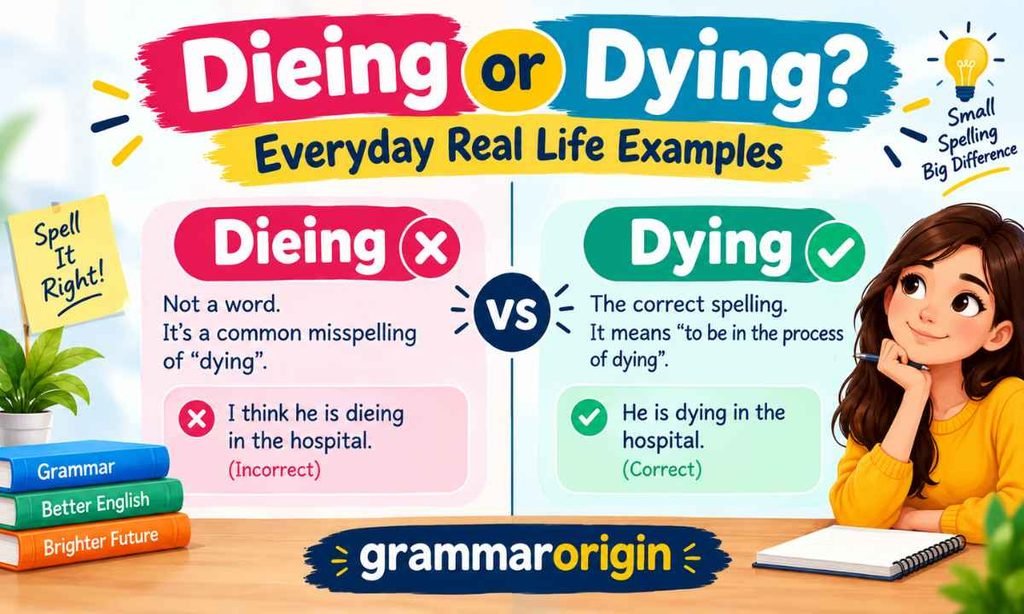
You already use dying several times a week without thinking about it. Here’s where it shows up.
In Emails
Work emails lean on the figurative sense — deadlines, devices, and momentum rather than anything literal.
Example: Dying — “Apologies for the short reply, my laptop’s dying.”
In Messages
Texts use the exaggerated version constantly. It signals strong feeling, not anything serious.
Example: Dying — “That clip had me dying 😂”
On Social Media
Posts and captions use it for trends, formats, and fading interest.
Example: Dying — “This app is dying and nobody wants to admit it.”
In Daily Life
Spoken English uses it for anything winding down — sound, light, weather, or energy.
Example: Dying — “The wind’s dying down, so we can head out.”
Short Learning Section for Students
Four steps, roughly ten minutes, and the spelling sticks.
Step 1: Learn the rule
Memorise one line: “-ie” becomes “y” before “-ing.” That single sentence covers die, lie, tie, and vie.
Example: Rule — die → dying.
Step 2: Practice
Write five sentences using dying in different senses — a plant, a battery, a trend, a sound, and an exaggeration. Variety builds recall better than repetition.
Example: Practice — “The signal is dying near the bridge.”
Step 3: Use memory trick
Anchor it to a word you already trust. If lying feels automatic, borrow that confidence for dying.
Example: Trick — “Lying, tying, dying — same family.”
Step 4: Double check spelling
Before you submit anything, search the document for “dieing.” It takes seconds and catches the error every time.
Example: Check — Ctrl+F “dieing” → replace with dying.
Dieing or Dying Hair
Neither. For hair colour, the correct word is dyeing, from the verb dye.
You’ll see “dying my hair” everywhere online, and in casual chat it passes without comment. In anything you’re graded on or paid for, though, spell it dyeing — the “e” is what separates colour from life.
Dieing is wrong in both senses, so it never belongs here.
Example: Correct — “She’s dyeing her hair silver.” Incorrect — “She’s dieing her hair silver.”
Died or Dyed — The Past Tense Version
The same split carries into the past tense, and the spellings are cleaner here: died for life ending, dyed for colour.
There’s no “e” confusion to untangle, which makes this pair easier than the “-ing” forms. One letter still changes the entire meaning.
Example: Died — “The battery died.” Dyed — “She dyed the fabric indigo.”
Dieing or Dying Meaning
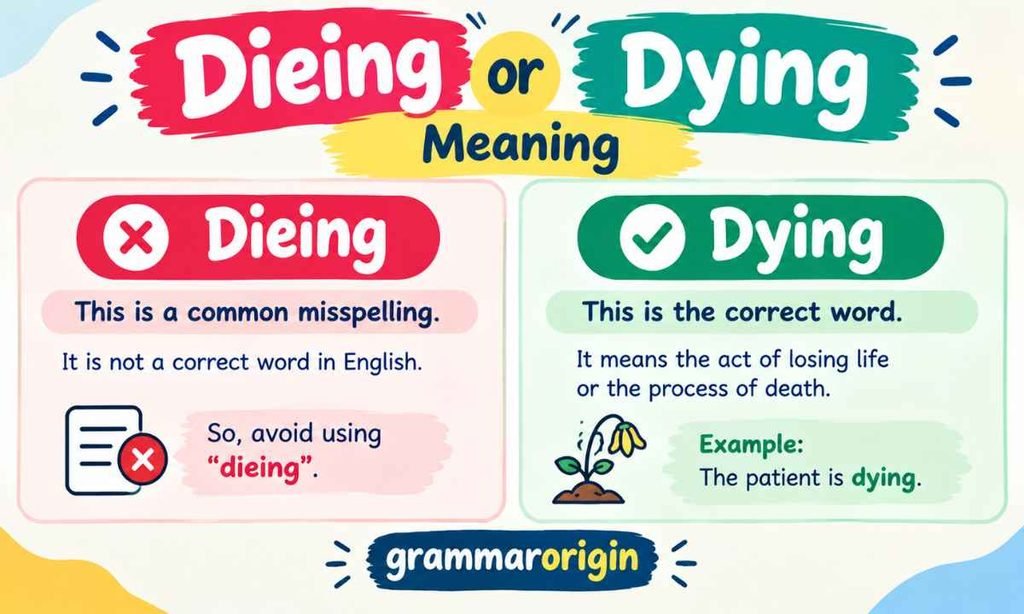
Dying means losing life, fading, or coming to an end. Dieing has no dictionary meaning at all, so there’s nothing to define.
The broader sense matters more than people expect. Dying applies to fires, phone batteries, engines, conversations, and trends just as naturally as it applies to living things.
As an adjective, it points to the final stage of something — a dying breed, a dying industry, a dying echo.
Example: Dying — “Print magazines are a dying format.”
“Die” as a Noun: Dice and Manufacturing Tools
Die isn’t only a verb. As a noun it names a single cube used in board games, and its plural is dice.
It also names a hardened tool that cuts or stamps material into shape — the sense behind die casting and die cutting. Neither noun produces the spelling “dieing.”
The old phrase “the die is cast” uses this noun too, meaning a decision can no longer be reversed.
Example: Die — “Roll the die to start.” Dice — “Both dice landed on six.”
Dieing or Dying UK
British English uses dying, exactly like American English. There’s no transatlantic split on this one.
Unlike colour and color or realise and realize, this spelling doesn’t vary by region. Dictionaries published in the UK and the US list the same present participle.
So whether you’re writing for Manchester or Miami, the spelling stays put.
Example: UK and US — “The tradition is dying out.”
Also Read this Didn’t or Doesn’t: The Difference Explained
Dieing or Dying Death
When you’re writing about death, the correct word is dying — always. Dieing is never appropriate in this context.
Tone matters here as much as spelling. Dying describes an ongoing process, which is why it appears in careful, respectful writing about illness and end-of-life care.
Example: Dying — “The hospice supports dying patients and their families.”
Dying vs Dead vs Deceased vs Passed Away
These four aren’t interchangeable, and choosing well shows real command of the language.
| Word | Stage | Tone | Example |
| Dying | Ongoing process | Neutral, direct | He’s dying of natural causes. |
| Dead | Completed state | Blunt, factual | The plant is dead. |
| Deceased | Completed state | Formal, legal | The deceased left no will. |
| Passed away | Completed state | Gentle, softened | Her grandfather passed away in May. |
Example: Deceased — “Contact the deceased’s solicitor.”
Quick Practice Quiz (With Answers)
Pick the right spelling for each sentence, then check yourself below.
- The candle is ______ out. (dying / dieing)
- I’m ______ my jeans black this weekend. (dying / dyeing)
- My headphones ______ during the call. (died / dyed)
- He’s ______ to tell you the news. (dying / dieing)
- She ______ the curtains a deeper green. (died / dyed)
Answers: 1. dying · 2. dyeing · 3. died · 4. dying · 5. dyed
Example: Q4 answer — “He’s dying to tell you the news.”
Frequently Asked Questions
Is “dieing” ever correct?
No. It isn’t listed in Merriam-Webster, Cambridge, or Oxford, so it fails the standard test for correct English. Even in manufacturing contexts, writers use die cutting or die forming rather than “dieing.”
Why isn’t it spelled “dieing”?
Because English changes a final “-ie” to “y” before adding “-ing.” The same rule turns lie into lying and tie into tying, so die becomes dying.
Is it “dying my hair” or “dyeing my hair”?
For colour, it’s dyeing my hair. The verb dye keeps its “e” in the “-ing” form, which is what separates it from dying. Casual writing often blurs this, but formal writing shouldn’t.
What’s the difference between dieing or dying in UK English?
There’s no difference. British English uses dying just as American English does, and “dieing” is incorrect in both. This spelling doesn’t vary by region.
Can “dying” be used for objects?
Yes, and it’s extremely common. Batteries, engines, signals, fires, and trends can all be described as dying when they’re fading or winding down.
How do I stop making this mistake?
Run a quick search for “dieing” before you submit anything, and learn the ie → y rule once rather than fixing each word separately. Tying the spelling to lying and tying makes it stick faster.
Final Verdict
The choice between dieing or dying really comes down to one rule: swap the “ie” for a “y” before adding “-ing.” That gives you dying, which is correct in every context, in both British and American English.
Keep dyeing reserved for colour, skip “dieing” entirely, and you’ve cleared one of the most common spelling traps in English. One letter, one rule, and the problem’s solved for good.

Muhammad Waqas is an English language teacher and grammar expert with over 8 years of experience helping students and professionals improve their writing skills. He specializes in English grammar, vocabulary, communication, and practical language learning. Through GrammarOrigin, Waqas shares clear, easy-to-understand content that helps readers write and speak English with confidence.