
Split is the word you want in the present, the past, and everywhere in between. Splitted shows up in casual writing sometimes, but it isn’t standard English.
This guide explains the split or splitted question in plain terms: why the confusion happens, what the correct grammar rule is, and how to apply it in real sentences. You’ll also see the rare cases where splitted still appears today.
Quick Answer
Use split for every tense: present, past, and past participle. Splitted is not part of standard English grammar.
- Split = correct in all tenses
- Splitted = incorrect (archaic and nonstandard)
- Pattern: Split, Split, Split
Example: “She split the invoice into three parts” is correct no matter the tense, whether you’re talking about yesterday, today, or using “has.”
What Does “Split” Mean?
Split means to divide something into two or more parts, or to separate something that was once whole. It works as both a verb and a noun.
As a verb, it describes an action, like dividing a bill, a team, or a piece of wood. As a noun, it describes the result, like “a three-way split.”
Example: “The bakery owners agreed on a 50-50 split of the profits.”
Examples
Here’s how split looks across different tenses, using the same unchanged word every time.
- Present: I split the rent with my roommate every month.
- Past: We split the rent last month too.
- Perfect: We have split the rent since we moved in.
- Passive: The rent is split evenly between us.
These four sentences use four different tenses, yet the verb form never changes. That’s exactly what trips learners up, since most English verbs don’t behave this way.
Simple Origin or Background Explanation
Split belongs to a small group of English verbs that keep the same form in the base, past, and past participle. Grammarians call this a zero-change irregular verb, and it sits alongside words like cut, hit, and put.
Regular verbs follow a predictable pattern by adding “-ed.” Irregular verbs like split skip that rule completely, which is exactly why so many learners try to fix it with an ending that was never there.
Example: Just as “cut” never becomes “cutted,” split never becomes “splitted” in standard usage.
Also Read this Dieing or Dying? The Correct Spelling Explained (2026)
The Difference Between Split and Splitted
Split
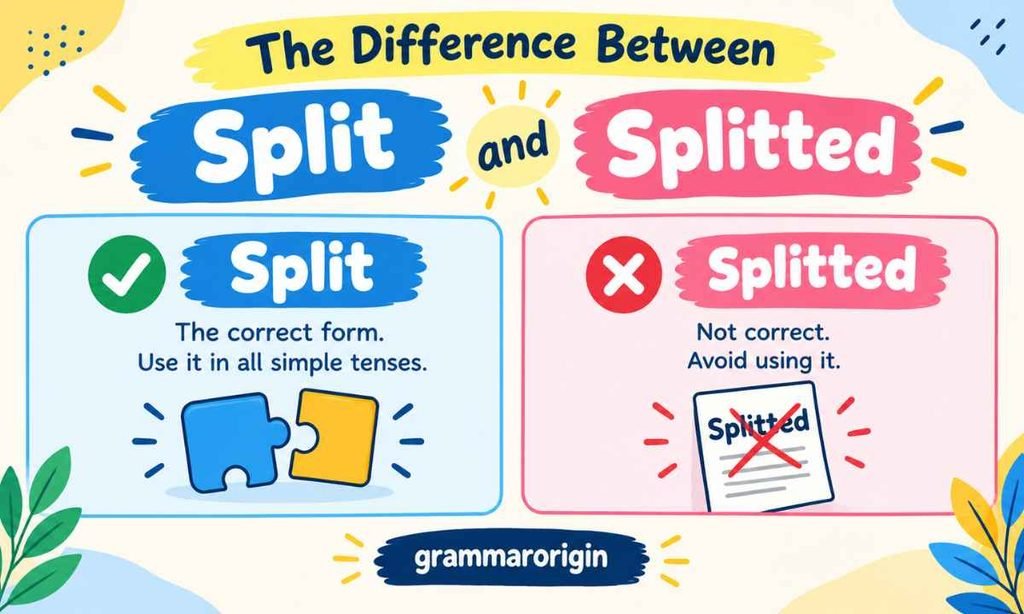
Split is the only form recognized by major dictionaries. Merriam-Webster, Collins, and Cambridge all list it as the base, past, and past participle form.
It fits naturally into every sentence type: statements, questions, passive voice, and perfect tenses.
Example: “The committee split the budget three ways” works whether you’re describing yesterday or last year.
Splitted
Splitted is labeled archaic by Merriam-Webster and nonstandard by Collins. Archaic simply means old-fashioned and rarely used in modern writing.
It occasionally shows up in old texts, in the speech of non-native learners, or in older technical writing. This informal use never became part of accepted grammar.
Example: A 2023 review of Apache Camel’s software documentation flagged every instance of “splitted” as an error that needed to be corrected to “split.”
Comparison Table
| Feature | Split | Splitted |
| Dictionary status | Standard | Archaic, nonstandard |
| Base form | Yes | No |
| Past tense | Yes | No |
| Past participle | Yes | No |
| Used in daily English | Yes | Rarely |
| Recommended by grammar guides | Yes | No |
| Example sentence | We split the bill. | We splitted the bill. (Incorrect) |
Which One to Use and When
Use “Split” When
Use split in every situation: casual conversation, formal writing, emails, and academic papers. This is the safest answer to the split or splitted question in almost any context.
- Talking about the present or past
- Writing in passive voice
- Using perfect tenses (has, have, had split)
Example: “The class has split into two teams for the project” works cleanly without any tense confusion.
Avoid “Splitted”
Skip splitted entirely in standard writing, even when the “-ed” ending feels natural.
Incorrect: “The teacher splitted the class.” Correct: “The teacher split the class.”
Example: Before sending an email, essay, or report, swap every instance of “splitted” for “split.”
Easy Memory Trick
Remember the pattern: Split, Split, Split. All three forms are identical, so there’s nothing extra to memorize.
If you’re ever unsure, default to split. It’s the correct verb form in nearly every context you’ll encounter.
Example: Think of it like “hit.” You’d never say “hitted,” so don’t say “splitted” either.
Split or Splitted Common Mistakes People Make
Mistake 1: Adding “-ed”
The most common error is treating split like a regular verb and adding “-ed” to the end.
Incorrect: Splitted Correct: Split
Example: “They splitted the check” should read “They split the check.”
Mistake 2: Using Splitted in the Past Tense
Learners often reach for splitted specifically when describing past events.
Incorrect: “We splitted the profits last quarter.”
Example: The correct version is: “We split the profits last quarter.”
Mistake 3: Using Splitted After “Have”
Perfect tenses are another common trap, since “have” often signals that a past participle is coming next.
Incorrect: “They have splitted the company.”
Example: Correct: “They have split the company into two divisions.”
Mistake 4: Using Splitted in Passive Voice
Passive sentences using “was” or “were” often tempt writers toward the wrong form.
Incorrect: “The group was splitted into teams.”
Example: Correct: “The group was split into teams of four.”
Mistake 5: Forgetting It’s an Irregular Verb
Many writers simply don’t know that split belongs to the irregular verb category, so the “-ed” habit takes over automatically.
Example: Keeping a short list of zero-change verbs (split, cut, hit, put) helps break this habit for good.
Split or Splitted Everyday Real Life Examples
In Emails
Correct: “I’ve split the invoice into two payments for easier tracking.”
Example: Team leads often write, “Tasks have been split among the group,” when assigning work.
In News Reports
Correct: “The party split over the new policy proposal.”
Example: Headlines often use phrases like “Opinion split on latest ruling” to describe divided public reaction.
On Social Media
Correct: “We split the Uber fare four ways tonight.”
Example: A common caption reads, “My friends and I have split every road trip cost since college.”
At School
Correct: “The teacher split the class into reading groups.”
Example: Report cards sometimes note, “The semester was split into two grading periods.”
At Home
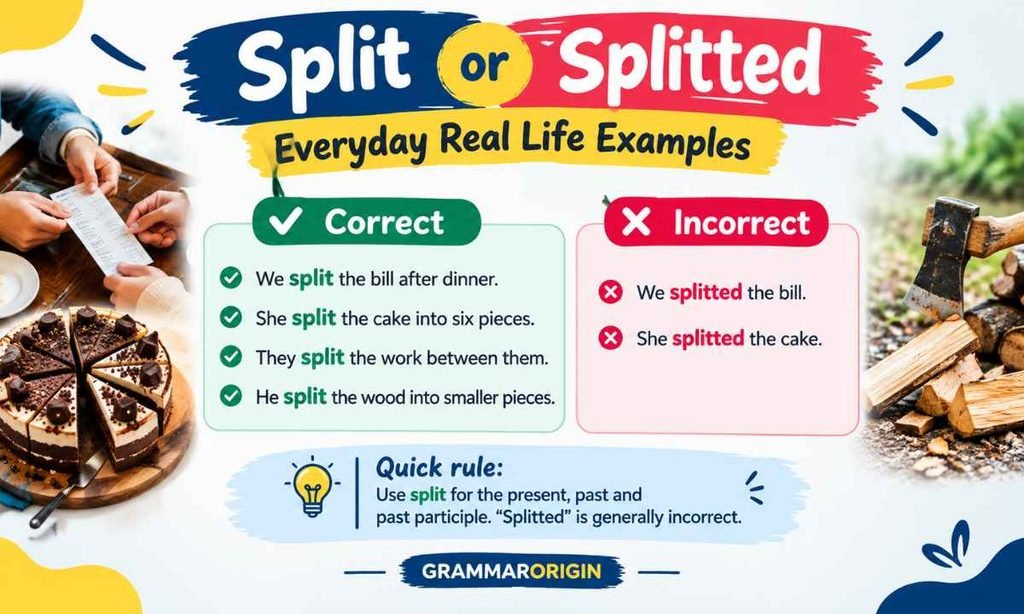
Correct: “We split the pizza into six slices.”
Example: Roommates often say, “Utilities are split evenly between the three of us.”
At Work
Correct: “The manager split the workload before the deadline.”
Example: A project update might read, “Responsibilities have been split across three departments.”
Also Read this Dieing or Dying? The Correct Spelling Explained (2026)
Related Irregular Verbs
Split isn’t alone. Several everyday verbs follow the same zero-change pattern, which makes them easier to learn as a group.
- Cut, Cut, Cut
- Hit, Hit, Hit
- Put, Put, Put
- Hurt, Hurt, Hurt
- Cost, Cost, Cost
Example: Just as you’d never write “hurted” or “costed” in the price sense, you should never write “splitted.”
Short Learning Section for Students and Beginners
The fastest way to remember this rule is to say all three forms out loud, back to back: split, split, split.
Then build a few short sentences using the same word in different tenses without changing it at all.
Example: “I split the orange. I split the orange yesterday. I have split the orange before.” Notice the word never moves.
Frequently Asked Questions
Is “splitted” a real word?
It appears in some older or informal texts, but standard dictionaries label it archaic or nonstandard. Stick with split in everyday and professional writing.
What is the past tense of split?
The past tense is split, identical to the base form. There’s no “-ed” version of this word in standard English.
What does “splitted” mean?
Splitted meaning, when the word is used at all, matches split exactly: divided or separated. It carries no different meaning of its own; it’s simply the wrong form of the same word.
Will it be split or splitted?
For future tense, use “will be split.” Future constructions always pair “will be” with the base form, so “will be splitted” is incorrect.
Has it been split or splitted?
The correct phrase is “has been split.” Perfect passive sentences never take “splitted” in standard grammar.
Why do people say “splitted” by mistake?
Most English verbs form the past tense with “-ed,” so learners apply that same rule to split without realizing it’s an exception.
Are there any real uses for “splitted”?
A handful of older technical documents in computing or engineering have used it informally, but it has never been accepted as correct grammar and is usually flagged as an error today.
Conclusion
Split is the correct choice for the base form, past tense, and past participle, with no exceptions in standard English. Splitted still shows up occasionally, but dictionaries and grammar authorities treat it as archaic or simply wrong.
When you’re unsure which one to write, default to split. The pattern never changes: split, split, split.

Muhammad Waqas is an English language teacher and grammar expert with over 8 years of experience helping students and professionals improve their writing skills. He specializes in English grammar, vocabulary, communication, and practical language learning. Through GrammarOrigin, Waqas shares clear, easy-to-understand content that helps readers write and speak English with confidence.