
Getting in-person vs in person right comes down to one simple test. Does the phrase sit next to a noun, or does it follow a verb? That small hyphen changes the grammatical function of the word, and mixing it up is one of the most common small errors in business writing.
This guide breaks the rule down with real examples, a dictionary-backed comparison, common mistakes people make, and a quick quiz so you can test yourself before you hit send on that next email.
Quick Answer
Use in-person (with a hyphen) when the phrase sits before a noun, and in person (no hyphen) when it follows a verb.
| Term | Job in the Sentence | Example |
| In-person | Adjective (describes a noun) | She scheduled an in-person interview. |
| In person | Adverbial phrase (describes an action) | She interviewed the candidate in person. |
Why the Difference Matters
English often hyphenates a compound modifier when two words team up to describe a noun. That’s the logic behind in-person. The hyphen joins “in” and “person” into one descriptive unit that sits in front of a noun.
Drop the noun, and the hyphen has no job left to do. That’s why in person stands alone as two plain words once it’s describing how something happened rather than what something is.
Featured Snippet Answer
In-person describes a noun, as in an in-person meeting. In person describes an action, as in we met in person. If the phrase sits right before the thing it’s describing, hyphenate it. If it comes after the verb and explains how something happened, leave the hyphen out.
Understanding “In-Person” as an Adjective
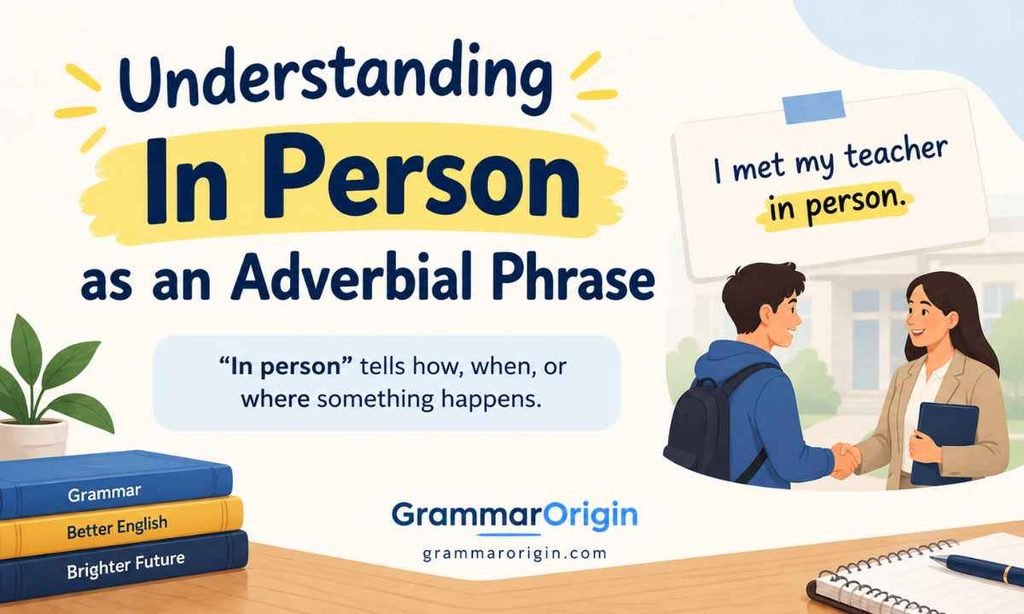
In-person works as a compound adjective, a pair of words fused by a hyphen to jointly modify a noun. Whatever noun follows it, such as interview, class, or event, the hyphenated form is telling you something about that noun.
When to Use In-Person
Reach for in-person any time it sits directly in front of a noun.
- an in-person interview
- an in-person consultation
- an in-person workshop
- an in-person appointment
- an in-person session
Example Sentences
Example: The clinic added extra in-person appointments this week to handle the backlog.
Example: Her manager insisted on an in-person review instead of a video call.
Example: The university brought back in-person lectures for first-year students.
Common Pattern
The shape is always the same, in-person plus a noun. Swap in almost any noun tied to attendance or participation, such as training, briefing, tour, or hearing. The hyphenated adjective still fits, because it’s still describing that noun.
Also Read This Split or Splitted? Which One Is Correct? (2026 Guide)
Understanding “In Person” as an Adverbial Phrase
Strip the hyphen, and in person switches jobs entirely. Now it works as an adverbial phrase. It sits after a verb to explain the manner in which something happened, physically and face-to-face, rather than by phone or screen.
When to Use In Person
Place in person right after the verb it’s modifying.
- meet in person
- apply in person
- vote in person
- testify in person
- pick up in person
Example Sentences
Example: After weeks of texting, they finally sat down in person for coffee.
Example: Residents can renew their passports in person at the downtown office.
Example: He preferred to deliver bad news in person rather than by email.
Common Pattern
Here the pattern flips, verb plus in person. The phrase is answering “how,” not “what kind.” That’s why it never needs the hyphen, no matter which verb it’s paired with.
In-Person vs In Person: Side-by-Side Comparison
| Feature | In-Person | In Person |
| Hyphenated | Yes | No |
| Grammar role | Compound adjective | Adverbial phrase |
| What it modifies | A noun | A verb |
| Typical position | Right before the noun | Right after the verb |
| Sample phrase | in-person training | train in person |
| Sample phrase | in-person voting | vote in person |
What Do Dictionaries and Style Guides Say?
Merriam-Webster treats in person as an adverb meaning “in one’s bodily presence,” and in-person as the adjective form describing something done by someone who is physically present. That matches the noun-or-verb test explained above.
Major style guides agree on the underlying logic, even if they phrase it a little differently.
| Style Guide | Position on the Hyphen |
| Merriam-Webster | In person is an adverb; in-person is an adjective |
| AP Style | Hyphenates compound modifiers before a noun, so in-person is standard |
| Chicago Manual of Style | Follows the same noun-modifier rule for compound adjectives |
Example: A newsroom following AP Style would write “an in-person press briefing,” but “the mayor spoke to reporters in person.”
Memory Trick
Ask yourself one question. Is it standing next to a thing, or explaining an action? A thing, meaning a noun, pulls in the hyphen. An action, meaning a verb, leaves it out.
Example: “in-person class” describes the class itself, so it’s hyphenated. “attend in person” describes how you attend, so it isn’t.
Real-Life Example: How Businesses Use These Terms
Hybrid work has made this distinction show up constantly in company communication. A recruiting email might read, “You’ve been selected for an in-person interview next Tuesday.” Here the phrase is labeling the interview format.
The very next line might say, “We look forward to meeting you in person.” Now the same two words, without a hyphen, describe the act of meeting rather than the interview itself.
Example: A university notice can combine both in one sentence: “The orientation is an in-person event, so please plan to attend in person rather than joining remotely.”
Usage Trends and Language Data (2025-2026)
Hybrid and remote work arrangements have kept both phrases in heavy rotation across emails, event pages, and internal memos. Workplace surveys from groups like Gallup and Microsoft’s Work Trend Index continue to show hybrid schedules as the norm rather than the exception through 2025 and 2026.
That steady mix of office and remote days means writers constantly need to flag which meetings, interviews, or classes happen physically versus online. This keeps the hyphenation question relevant in everyday standard American English writing.
Why This Matters
When a reader can’t immediately tell whether “in person” refers to a noun or an action, the sentence slows them down. Getting the hyphen right keeps professional writing quick to read, especially in scheduling emails and event listings where clarity really matters.
In Person Common Mistakes Writers Make

Even confident writers slip on this pair, usually in one of five predictable ways.
Mistake 1: Using In Person Before a Noun
Incorrect: We booked an in person meeting. Correct: We booked an in-person meeting.
Mistake 2: Using In-Person After a Verb
Incorrect: They talked in-person yesterday. Correct: They talked in person yesterday.
Mistake 3: Hyphenating Everything
Not every compound needs a hyphen once it moves after the verb, even if it “feels” like it should.
Incorrect: She testified in-person. Correct: She testified in person.
Mistake 4: Mixing Formal and Informal Usage
Example: A formal report that hyphenates correctly in one paragraph and drops it in the next looks careless, even if each single sentence is technically fine. Staying consistent across a document matters as much as getting one sentence right.
Also Read This Split or Splitted? Which One Is Correct? (2026 Guide)
Mistake 5: Writing “Inperson” as One Word
Some writers merge the phrase into a single word, but “inperson” isn’t standard English in any style guide.
Incorrect: The inperson event starts at noon. Correct: The in-person event starts at noon.
How to Remember the Rule Every Time
A short checklist settles almost every case in seconds.
Use “In-Person” If:
- It sits right before a noun
- It’s describing a meeting, class, event, or interview
- You could ask “what kind?” and this phrase answers it
Example: in-person orientation, in-person hearing, in-person exam
Use “In Person” If:
- It follows a verb
- It’s describing how an action took place
- You could ask “how?” and this phrase answers it
Example: apply in person, testify in person, register in person
One-Sentence Formula
Noun gets the hyphen. Action doesn’t.
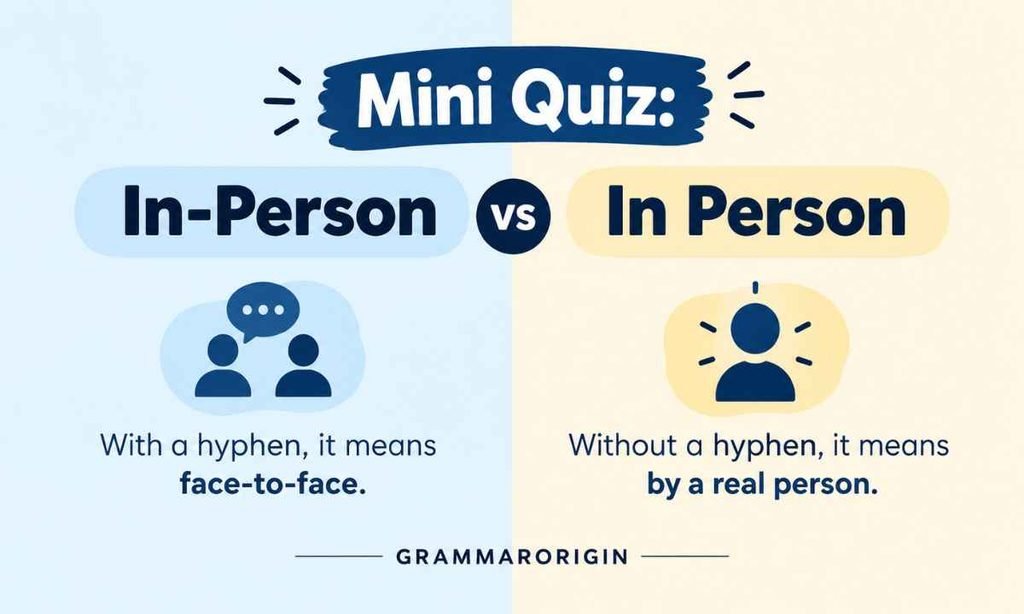
Mini Quiz: In-Person vs In Person
Quiz 1: Which One Describes a Noun?
Which form goes directly before a noun? A) in person B) in-person Answer: B) in-person
Quiz 2: Fill in the Blank
We joined an ______ workshop last month. Answer: in-person
Quiz 3: Quick Choice
A) We spoke in-person last week. B) We spoke in person last week. Answer: B) We spoke in person last week.
Quiz 4: Fill in the Blank
The office scheduled an ______ hearing for Friday. Answer: in-person
Quiz 5: True or False
“In person” usually follows a verb. Answer: True
Quiz 6: Fill in the Blank
I’d rather explain this ______ than over email. Answer: in person
Quiz 7: Spot the Correct Sentence
A) She led an in-person session. B) She led an in person session. Answer: A) She led an in-person session.
Quiz 8: Fill in the Blank
We finally caught up ______ after months apart. Answer: in person
Quiz 9: Grammar Check
Is “in-person consultation” correct? Answer: Yes
Quiz 10: Fill in the Blank
The clinic still offers ______ visits alongside video calls. Answer: in-person
Quiz 11: What Does It Describe?
In “in-person exam,” what is being described? A) an action B) a noun Answer: B) a noun
Quiz 12: Fill in the Blank
Voters can register ______ at the county office. Answer: in person
Quiz 13: Choose the Right Form
A) The witness testified in person. B) The witness testified in-person. Answer: A) The witness testified in person.
Quiz 14: Quick Rule Test
If the phrase comes right before a noun, should it be hyphenated? Answer: Yes, use in-person.
Quiz 15: Final Challenge
Complete it: “We held an ______ briefing, then followed up ______ with each team.” Answer: in-person, in person
References
- Merriam-Webster: In Person vs. In-Person
- Google Search Central
Frequently Asked Questions
Is it “join us in person” or “join us in-person”?
It’s “join us in person,” with no hyphen, because the phrase describes how you’ll join. That’s an action, not a noun.
Is it “attend in person” or “attend in-person”?
“Attend in person” is correct. “Attend” is a verb, and the phrase right after it explains the manner of attending, so no hyphen is needed.
What’s the difference between “in person” and “personally”?
They’re close in meaning, but “in person” specifically means physically present, face-to-face. “Personally” can also mean “from my own point of view,” as in “personally, I disagree.” So the two aren’t always interchangeable.
What does “in-person meeting” mean?
An in-person meeting is one that happens with everyone physically present in the same location, as opposed to a video call or phone meeting.
Is “inperson” one word?
No. Standard English always writes it as either “in person,” two open words, or “in-person,” hyphenated. It’s never merged into a single word.
Is “in-person” AP Style correct?
Yes. AP Style hyphenates compound modifiers before a noun, so “in-person interview” follows the standard rule.
Can “in-person” ever follow a verb?
Not in standard usage. Once the phrase follows a verb and describes an action, drop the hyphen and use “in person” instead.
Summary
The rule behind in-person vs in person comes down to one quick check. If it’s sitting next to a noun, hyphenate it. If it’s describing an action after a verb, leave the hyphen out.
Run your sentence through that noun-or-verb test, and you’ll pick the right form every time, whether you’re drafting an email, an event listing, or a formal report.

Muhammad Waqas is an English language teacher and grammar expert with over 8 years of experience helping students and professionals improve their writing skills. He specializes in English grammar, vocabulary, communication, and practical language learning. Through GrammarOrigin, Waqas shares clear, easy-to-understand content that helps readers write and speak English with confidence.