
Wondering whether goodmorning or good morning is the right way to write this everyday greeting? The short answer is “good morning,” two separate words. “Goodmorning” is a spacing mistake that sneaks into texts, emails, and captions all the time.
This guide covers the grammar rule behind it, real examples, the mistakes people keep making, and a short quiz at the end so you can test yourself.
What Is the Correct Form: Goodmorning or Good Morning?
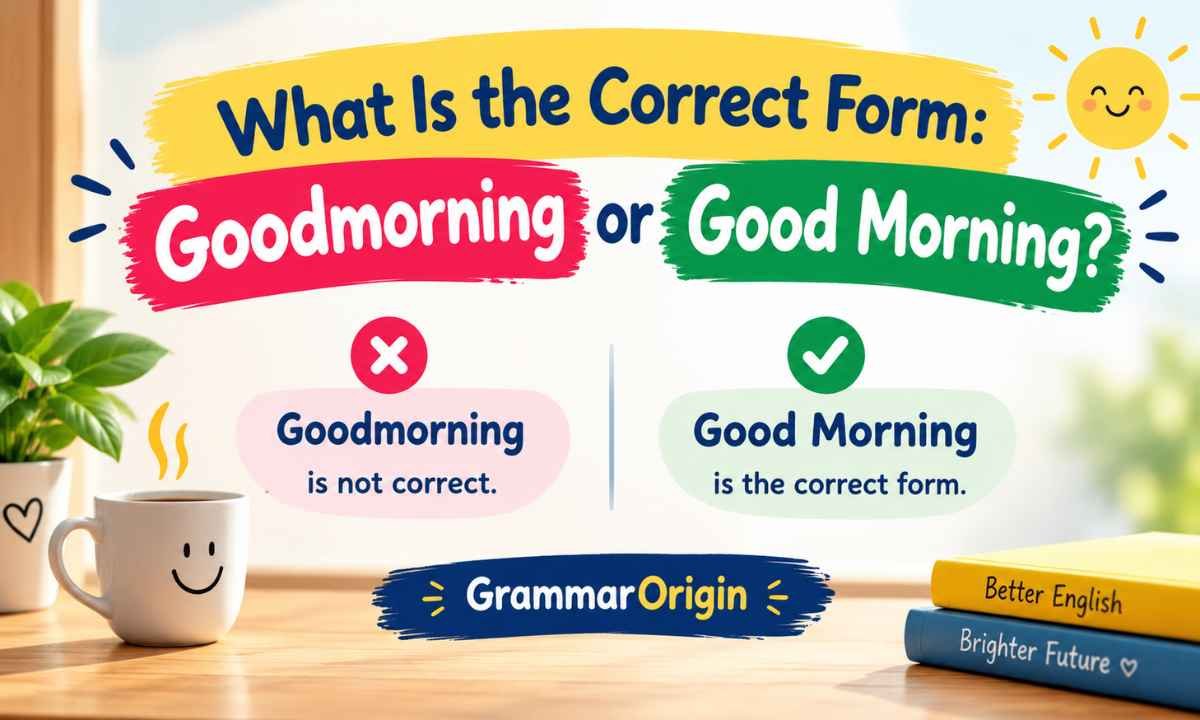
“Good morning” is correct. It pairs an adjective, “good,” with a noun, “morning,” and English keeps that kind of salutation as two open words rather than one.
“Goodmorning” isn’t a recognized word. You won’t find it listed in any major dictionary, no matter how often it shows up online.
Also read This In-Person vs In Person: The Correct Usage Guide
Examples of Correct Usage
- Good morning, Sarah.
- Good morning, everyone.
- I hope you have a good morning.
- Good morning, team. Let’s get started.
Examples of Incorrect Usage
- Goodmorning, Sarah.
- I said goodmorning to my teacher.
- Goodmorning everyone.
Example: Change “Goodmorning, hope you slept well” to “Good morning, hope you slept well,” and the sentence instantly looks more polished.
Why “Goodmorning” Is Incorrect
English keeps most adjective-noun greetings open, so the words stay apart instead of fusing into one. That’s really all there is to it.
People merge them out of habit, usually while typing fast on a phone, but habit doesn’t rewrite the grammar rule.
Example: Nobody writes “goodafternoon” as a single word, so there’s no real reason “good morning” should work any differently.
What Do Dictionaries Say About “Good Morning”?
Merriam-Webster and Cambridge Dictionary both list “good morning” as a standard greeting, spelled with a space between the two words.
Neither one recognizes “goodmorning” as an accepted spelling. That alone tells you it’s an error, not just an informal style choice.
Example: Search “goodmorning” in most dictionary apps, and you’ll get redirected straight to the two-word entry for “good morning.”
How Do You Pronounce “Good Morning”?
It’s pronounced /ɡʊd ˈmɔːrnɪŋ/ in American English, with the stress landing on the first syllable of “morning.”
Spoken quickly, it does sound like one word, which is probably why so many people assume it should be written that way too.
Example: Say it slowly out loud and you’ll catch a tiny pause between “good” and “morning,” even though everyday speech glosses right over it.
Why Do People Write “Goodmorning” Instead of “Good Morning”?
Mostly because speech has no spaces. Fast typing habits carry that spoken rhythm straight into writing, and three specific factors make it worse.
Fast Digital Communication
Texting and social media reward speed over accuracy, so a lot of writers skip the space just to save a second.
Example: A quick WhatsApp message like “Goodmorning bro” is everywhere, even though it isn’t grammatically correct.
Influence of Compound Words
English does turn some phrases into single compound words, like “notebook” or “football,” so people assume greetings follow that same pattern.
Example: If someone already knows “goodnight” can work as one word, it’s an easy leap to wrongly assume “goodmorning” should too.
Autocorrect and Informal Habits
Autocorrect doesn’t always catch a missing space between two real words, so the mistake slides right through in casual writing.
Example: Your keyboard might fix a typo mid-sentence but leave “goodmorning” untouched, simply because it isn’t flagged as an error.
Understanding the Grammar Behind “Good Morning”
Break the phrase into its two parts, and the logic becomes pretty simple.
“Good” Functions as an Adjective
“Good” describes the noun “morning,” the same way it describes “day,” “afternoon,” or “evening” in related greetings.
Example: You’d never merge “good day” into a single word, and “good morning” follows that exact same structure.
Greeting Phrases Usually Stay Separate
Most time-based English greetings keep their words apart instead of fusing into one term.
Example: “Good afternoon” and “good evening” are both open compounds, written as two words, and “good morning” matches that pattern.
Why “Goodnight” Is Different
“Goodnight” has become accepted as one word in many informal settings, largely because it’s used as a farewell rather than a greeting.
“Good morning” never went through that shift. It stays as two words in both formal and casual writing, no exceptions.
Example: You might text “Goodnight!” as a sign-off, but the correct greeting the next morning is still “Good morning,” never “Goodmorning.”
When Should You Use “Good Morning”?
Pretty much any time you’re greeting someone early in the day, whether that’s a formal email or a quick text to a friend.
Professional Situations
Use it to open business emails, meetings, interviews, and customer conversations, anywhere a polite, clear tone matters.
Example: “Good morning, Mr. Patel. Thank you for joining today’s call.”
Casual Conversations
It works just as naturally with friends, family, and social media followers who prefer a friendlier tone.
Example: “Good morning! Hope your day starts off easy.”
Time Range for “Good Morning”
Most people stick to “good morning” from sunrise until around noon, though some workplaces stretch that a little later.
Example: A coworker starting a shift at 4 a.m. might still say “good morning,” simply because that’s when their day begins.
Capitalization Rules
Mid-sentence, only “Good” gets capitalized, as in “I said good morning to my neighbor.” At the top of an email or in a title, both words are sometimes capitalized for style, as in “Good Morning, Team.”
Example: “Good morning, everyone” fits a normal sentence, while “Good Morning” suits a headline or a greeting line at the top of an email.
Common Mistakes Related to “Good Morning”
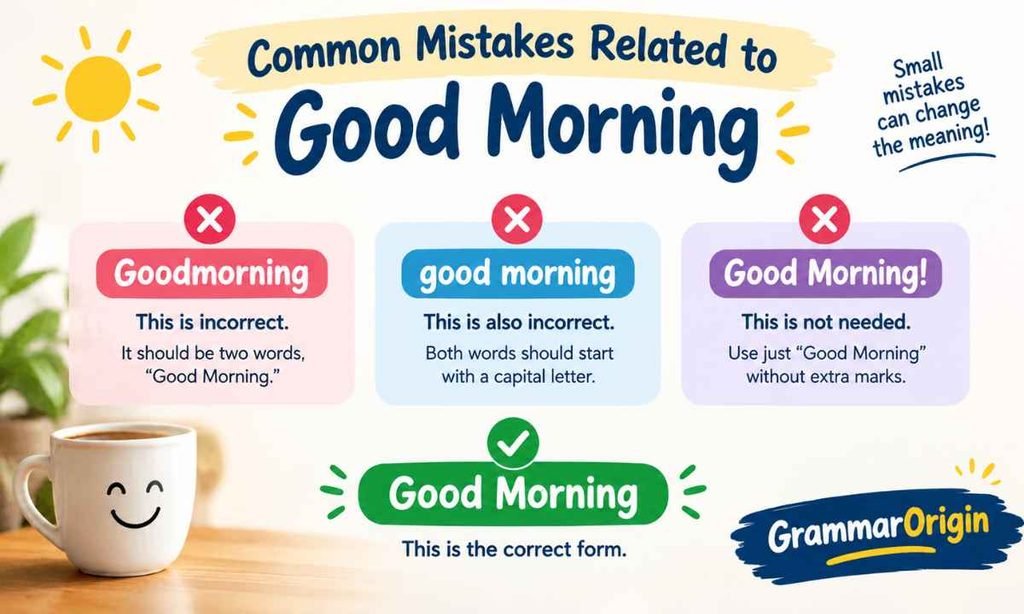
A handful of small errors show up again and again with this one.
Writing It as One Word
Incorrect: Goodmorning Correct: Good morning
This is, by far, the most common slip tied to this phrase.
Using Incorrect Punctuation
Incorrect: Good morning everyone Correct: Good morning, everyone.
A comma before a name or a direct address just makes the sentence easier to read.
Overcapitalization
Incorrect: GOOD MORNING Incorrect: Good Morning Everyone
Capitalizing every letter, or every word, tends to read as shouting rather than friendly.
Also read This In-Person vs In Person: The Correct Usage Guide
Confusing It With Email Subject Styles
Marketing emails often capitalize every major word in a subject line, something like “Good Morning Everyone.” That’s a headline convention, not standard sentence grammar.
Example: An email subject line can read “Good Morning Offer Inside,” while the body text should still stick to normal sentence style, “Good morning, here’s today’s deal.”
Good Morning in Texting and Social Media
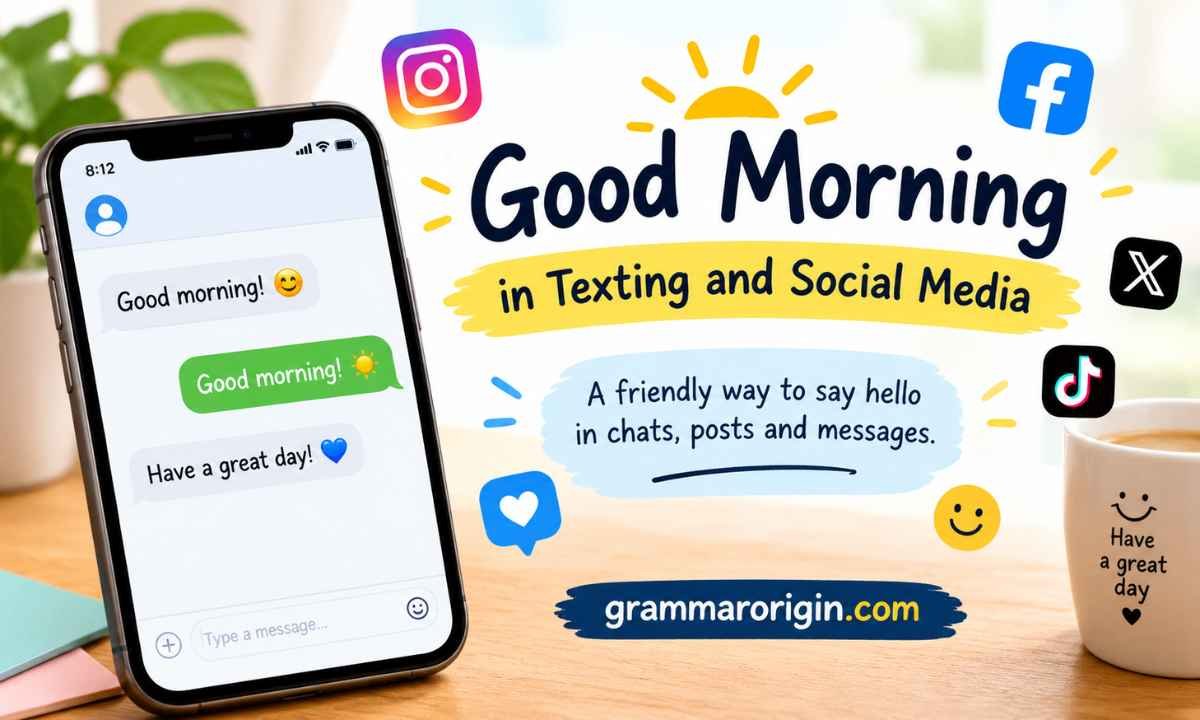
Texting gives you more room to be casual, but “good morning” still reads cleaner with the space included.
Dropping the space won’t confuse a friend, but it can make a message feel rushed, even if that’s not the intent.
Example: A caption like “Goodmorning fam” shows up constantly on social media, though “Good morning, fam” reads just as casual and skips the spelling slip entirely.
Good Morning in Professional Writing and Emails
Small details like this shape how professional a message feels the moment someone reads it.
Why Correct Greetings Matter
A correctly spelled greeting signals attention to detail, and that can quietly shape how a colleague, client, or recruiter sees your writing overall.
Example: Two emails with identical content can land very differently depending on whether one opens with “Good morning” and the other with “Goodmorning.”
Professional Email Examples
Formal: “Good morning, Ms. Reyes. Thank you for your quick response.” Semi-formal: “Good morning, team. Please review the attached notes before noon.” Customer support: “Good morning! How can we help you today?”
Should You Use “Hi” or “Good Morning”?
Both work, but they carry a different tone. “Hi” feels quick and casual, while “good morning” feels a bit warmer and more polished.
Example: A quick internal Slack message might just say “Hi team,” while a client-facing email usually reads better as “Good morning, team.”
Real-Life Example: How a Small Grammar Mistake Affected Professional Communication
A content writer once made it through several interview rounds for a remote role at an international company. Her writing samples were strong, but the hiring manager kept noticing one thing: her emails always opened with “Goodmorning” instead of “Good morning.”
That single habit didn’t cost her the job outright, but the recruiter brought it up during feedback, pointing out that small spelling details carry extra weight in writing-focused roles.
Example: After tightening up her email habits and proofreading more carefully, she landed a similar role a few months later, one where her attention to detail was actually praised.
Good Morning vs Similar Greeting Expressions
Lining “good morning” up next to related greetings makes the pattern much easier to remember.
Comparison Table
| Expression | Correct Form | Notes |
| Good morning | Two words | Standard morning greeting |
| Good afternoon | Two words | Formal daytime greeting |
| Good evening | Two words | Standard evening greeting |
| Goodnight | Often one word | Common as a farewell |
| Goodbye | One word | Standard modern spelling |
Why English Greetings Can Be Confusing
English greetings evolved at different points across the language’s history, which is exactly why some stayed separate while others merged into one word.
Example: “Good morning” and “goodbye” look structurally similar, yet only one of them ever turned into a single compound word over time.
Data and Trends: How Common Is the “Goodmorning” Mistake?
Search data keeps showing “goodmorning or good morning” as a recurring grammar question, which suggests this mistake cuts across age groups and writing styles alike.
Educational language platforms and workplace communication reports point to a steady rise in casual typing shortcuts, even as remote work pushes people toward more polished written English.
2025-2026 Writing Trend Insights
Recent workplace patterns suggest casual shortcuts like “goodmorning” show up often in quick chat messages, but far less in reviewed, formal documents.
Example: Someone might type “goodmorning” in an internal Slack thread without a second thought, then automatically switch to “good morning” for a client email.
How to Remember the Correct Spelling Easily
A few simple tricks make this rule stick for good.
Simple Rule
If the phrase pairs an adjective with a noun, like “good” and “morning,” it usually stays separate in a greeting.
Memory Trick
Line up “good morning,” “good afternoon,” and “good evening” side by side. Since the other two are always two words, “good morning” follows suit.
Read It Naturally
Say the phrase slowly, pausing slightly between the two words. That small pause is your reminder that you’re dealing with two words, not one.
Use Grammar Checking Tools
Grammar tools or a quick dictionary lookup can confirm the spelling in seconds whenever you’re unsure.
Example: Type “goodmorning” into most grammar checkers, and you’ll get a suggestion to add the space and fix it to “good morning.”
Step-by-Step Guide to Using “Good Morning” Correctly
Run through these four steps whenever you’re unsure how to write this greeting.
Step 1: Keep the Words Separate
Always write “good morning” with a space. Never merge it into “goodmorning,” no matter the setting.
Step 2: Add Proper Punctuation
Add a comma when you’re addressing someone directly, such as “Good morning, David,” instead of leaving it unpunctuated.
Step 3: Match the Tone
Go formal for professional emails and relaxed for casual chats, while keeping the spelling exactly the same either way.
Step 4: Proofread Before Sending
Take a few extra seconds to check spelling, punctuation, and capitalization before you hit send, especially for anything professional.
Example: A quick reread before sending an email catches a slipped “goodmorning” before it ever reaches a client’s inbox.
Mini Quiz: Goodmorning or Good Morning
Quiz 1: Spot the Correct Greeting
Which sentence is correct? A) Goodmorning, Alex. B) Good morning, Alex. Answer: B) Good morning, Alex.
Quiz 2: One Word or Two?
Is “good morning” written as one word or two words? A) One word B) Two words Answer: B) Two words
Quiz 3: Find the Mistake
Which option contains a grammar mistake? A) Good morning, everyone. B) Goodmorning everyone. Answer: B) Goodmorning everyone.
Quiz 4: Professional Email Test
Which greeting looks more professional in an email? A) Good morning, Team. B) goodmorning team Answer: A) Good morning, Team.
Quiz 5: Correct the Sentence
Choose the corrected version. A) I said goodmorning to my teacher. B) I said good morning to my teacher. Answer: B) I said good morning to my teacher.
Quiz 6: Morning Greeting Challenge
What’s the correct spelling? A) Good Morning B) Goodmorning C) Good morning Answer: C) Good morning, though “Good Morning” can appear in titles or headings.
Quiz 7: Quick Grammar Check
Why is “good morning” written as two words? A) Because “good” describes “morning” B) Because it sounds better Answer: A) Because “good” describes “morning”
Quiz 8: Casual vs Correct
Which greeting is grammatically correct for texting or social media? A) Goodmorning friends! B) Good morning, friends! Answer: B) Good morning, friends!
Frequently Asked Questions
Is “goodmorning” ever an acceptable spelling?
No. It isn’t listed in any standard dictionary, and the correct spelling in every context is “good morning,” written as two words.
Why is “good morning” written as two words instead of one?
Because it pairs an adjective, “good,” with a noun, “morning.” English keeps most greeting phrases like this open rather than merged.
Where can I find goodmorning or good morning quotes?
Search using the two-word spelling, “good morning quotes.” Collections built around the correct spelling are easier to find and far more likely to show up in search results.
What’s a good “goodmorning or good morning” message to send to my love?
Keep it simple and warm, something like “Good morning, love. I hope your day is as wonderful as you are.” Just make sure the greeting itself stays spelled as two words.
Is “good morning” formal or casual?
Both. A short version suits texts and social posts, while a slightly longer, punctuated version fits professional emails just as well.
Do native English speakers ever write “goodmorning”?
Some do, mostly in quick texts or casual chats, but it’s still a spelling mistake rather than an accepted alternative.
Should I use a comma after “good morning”?
Yes, whenever you’re addressing someone directly. “Good morning, Sarah” simply reads more naturally with the comma in place.
Final Thoughts
Between goodmorning or good morning, the correct choice is always “good morning,” two separate words, whether you’re texting a friend or opening a formal email.
Keep the adjective-noun structure in mind, add a comma when greeting someone by name, and this is one mistake you won’t make again.

Muhammad Waqas is an English language teacher and grammar expert with over 8 years of experience helping students and professionals improve their writing skills. He specializes in English grammar, vocabulary, communication, and practical language learning. Through GrammarOrigin, Waqas shares clear, easy-to-understand content that helps readers write and speak English with confidence.