
Trying to figure out cocoon or cacoon? The correct spelling is “cocoon,” the silky casing insects spin during metamorphosis. “Cacoon” isn’t a typo you can just wave off, though. It’s a real word too, just one that means something completely different.
This guide breaks down the correct spelling, the actual meaning behind both words, why the mix-up happens so often, and a quick quiz to lock it all in.
What Is the Correct Spelling: Cacoon or Cocoon?
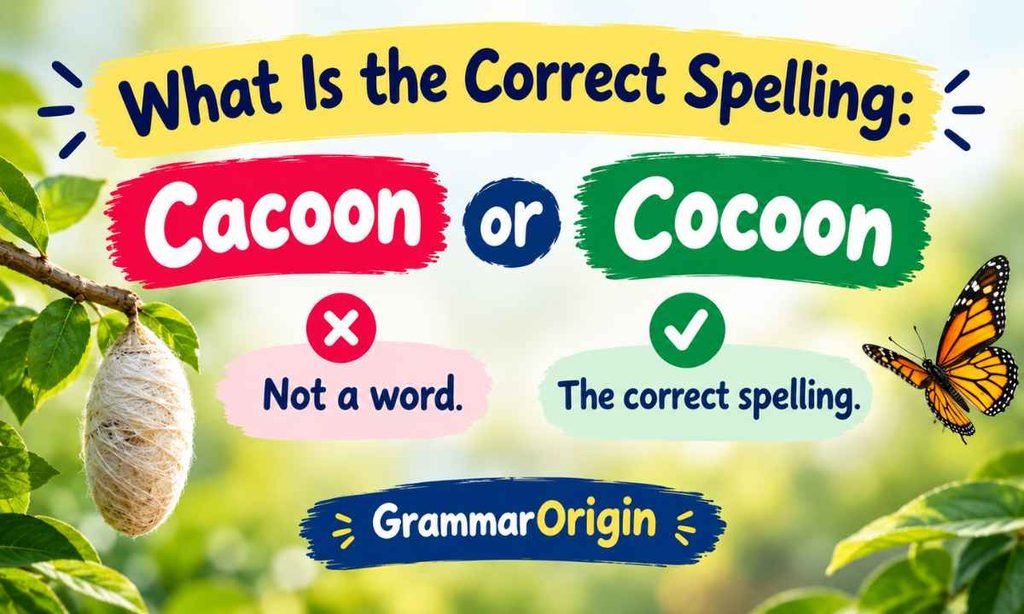
“Cocoon” is the spelling you want whenever you’re talking about insects, comfort, or protection. “Cacoon” exists too, but it points to something entirely unrelated.
Quick Answer
| Word | Correct for Insects? | Meaning |
| Cocoon | Yes | Protective casing spun by insects during metamorphosis |
| Cacoon | No (different meaning) | A tropical bean from the snuffbox bean plant |
What Does Cocoon Mean?
A cocoon is the silky shell certain insect larvae spin around themselves before emerging as adults.
Example: The silkworm wrapped itself in a cocoon days before it finally became a moth.
Beyond biology, people use “cocoon” to describe any cozy, sheltered space, physical or emotional.
Example: Wrapped in three blankets, she felt like she’d built herself a cocoon against the cold.
Why Do People Write “Cacoon”?
Most people type “cacoon” simply because the two words sound nearly identical when spoken quickly.
Example: Someone rushing through a text might type “the caterpillar’s cacoon” without noticing the swapped vowel.
Understanding the Meaning of Cocoon
“Cocoon” carries both a literal, scientific meaning and a looser, everyday one.
Literal Meaning
In biology, a cocoon is the silk casing spun mainly by moth larvae, protecting them through their pupal stage.
Example: Researchers found a cocoon tucked beneath the bark, still weeks away from hatching.
Figurative Meaning
Outside of biology, “cocoon” often describes isolation, comfort, or being shielded from the outside world.
Example: The remote cabin became their cocoon for the entire snowy weekend.
Business and Lifestyle Usage
Marketers and designers borrow the word constantly, often pairing it with luxury, comfort, or calm.
- Cocoon of luxury
- Cocoon-like workspace
- Cocooning lifestyle
- Cocoon chair
Example: The furniture brand marketed its new hanging seat as a “cocoon chair” built for quiet afternoons.
Why the Spelling Confusion Happens
This cocoon or cacoon mix-up isn’t random. A few overlapping habits explain why “cacoon” keeps slipping into people’s writing.
Similar Sound Patterns
The unstressed first syllable in “cocoon” is easy to mishear, so some writers assume it starts with an “a” instead of an “o.”
Example: Words like “balloon” and “occasion” trip people up the same way, since spelling doesn’t always match how a word sounds out loud.
Influence of Regional Accents
Vowel sounds shift slightly across different accents, and that shift can nudge listeners toward guessing the wrong spelling.
Example: A speaker with a flatter vowel sound might say the word in a way that makes “cacoon” seem like a reasonable guess.
Auto-Correct Doesn’t Always Help
Most spell-checkers flag “cacoon,” but fast typing on a phone can still let the mistake through unnoticed.
Example: A quick social caption might publish with “cacoon” still in it, simply because nobody paused to double-check before hitting post.
Also Read This Goodmorning or Good Morning: Correct Usage Guide
Cacoon vs Cocoon: Side-by-Side Comparison
Here’s the whole comparison in one place.
| Feature | Cocoon | Cacoon |
| Refers to insects | Yes | No |
| Refers to a tropical bean | No | Yes |
| Common in everyday writing | Yes | Rare |
| Found in major dictionaries | Yes | Yes, as a separate entry |
| Recommended for insect topics | Always | Never |
Dictionary Recognition
Merriam-Webster lists “cocoon” as the standard word for an insect’s protective casing. It also carries a separate entry for “cacoon,” describing it as the bean of a tropical vine.
That second entry is exactly why “cacoon” isn’t a made-up word. It’s simply the wrong word for insect-related writing.
Example: Look up “cacoon” in a dictionary and you’ll find it tied to the Fevillea cordifolia plant. It’s a climbing vine native to parts of Africa and the West Indies, and it has nothing to do with caterpillars.
Writing Recommendation
Use “cocoon” for anything related to insects, comfort, or protection. Reserve “cacoon” only for the botanical bean, and skip it entirely if that’s not what you mean.
Example: A biology essay should always read “the moth emerged from its cocoon,” never “cacoon.”
Real-Life Example: How a Small Spelling Error Can Affect Professional Writing
The cocoon or cacoon slip shows up in professional writing more often than people expect. A university student once submitted a biology report describing how “the moth develops inside a cacoon before emerging.” The grader understood the intended meaning right away, but the misspelling still stood out as a red flag for carelessness.
A similar issue can hit businesses harder. An online shop selling science kits kept using “cacoon” across product descriptions, and customers started questioning how carefully the content had been reviewed.
Example: Once the shop corrected every instance to “cocoon,” customer trust and engagement both improved within a couple of months.
Language and Search Trends: Why Correct Spelling Matters in 2025-2026

Search behavior keeps showing steady interest in “cocoon or cacoon” as a spelling question, which suggests the confusion hasn’t faded with time.
Key Trends
- Search engines increasingly correct misspellings automatically.
- Readers still associate accurate spelling with credibility.
- Educational and science-focused content gets held to a higher spelling standard.
What This Means for Writers
Bloggers, teachers, students, and business owners all benefit from using “cocoon” consistently, since it signals attention to detail in a way that spelling errors quietly undercut.
Example: A science teacher grading student essays is far more likely to trust a paper that spells “cocoon” correctly throughout.
How to Remember the Correct Spelling of Cocoon
A few small memory tricks make the correct spelling stick.
Trick 1: Think of Two O’s for Protection
“Cocoon” contains two pairs of the letter “o”: co-coon. Picture those rounded letters wrapping around the insect like a shell.
Example: Every time you write the word, count the o’s, cocoon has four of them in total.
Trick 2: Associate It with Common Words
Notice how “cocoon” shares its double “oo” sound with words like “cool,” “moon,” and “balloon.”
Example: If you can spell “balloon” correctly, you already know the pattern “cocoon” follows.
Trick 3: Visual Memory
Picture a caterpillar curled up inside a round, protective shell. The rounded shape mirrors the rounded letter “o” twice over.
Example: Sketch a tiny circle around the word “cocoon” in your notes, and the image tends to stick.
Common Examples of Cocoon in Sentences
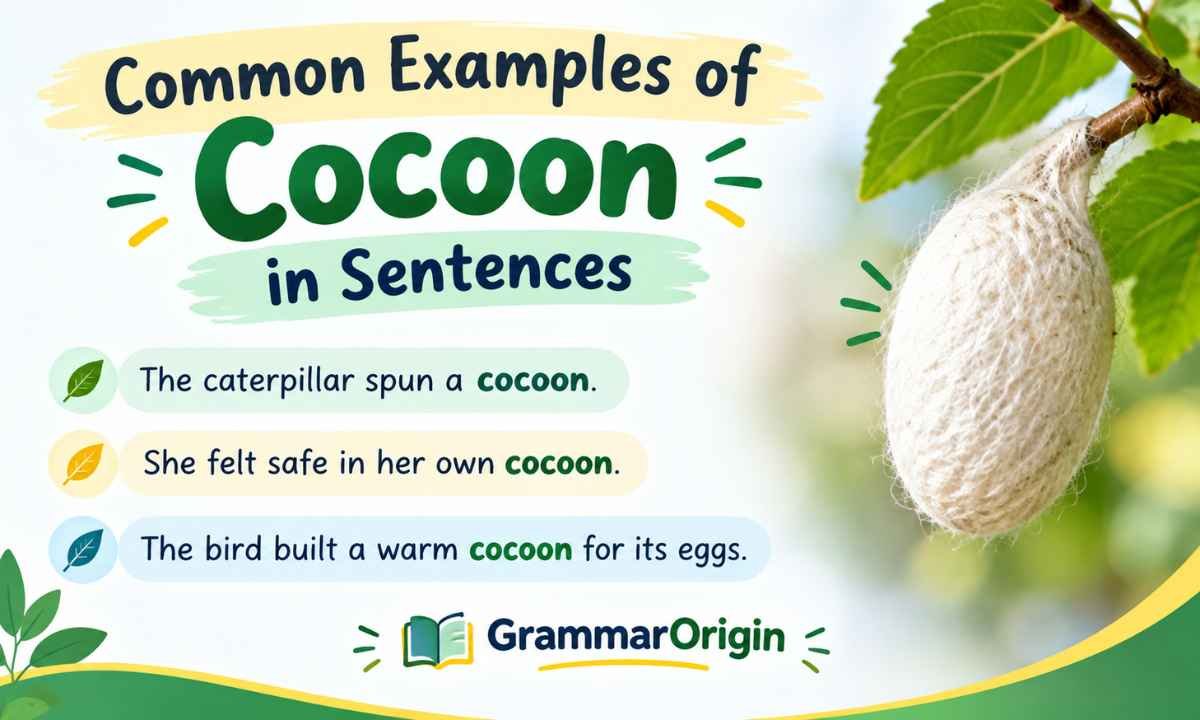
Seeing the word in context makes the correct spelling easier to remember.
Biological Usage
- The caterpillar stayed inside its cocoon for nearly three weeks.
- Scientists examined the cocoon under a microscope before it hatched.
Everyday Usage
- The thick blanket formed a warm cocoon around her shoulders.
- The quiet cabin felt like a cocoon, cut off from the noise outside.
Professional Writing
- The spa promises guests a cocoon-like experience of total relaxation.
- The apartment’s design creates a cocoon of privacy in a busy city.
Example: A travel brochure describing a retreat as “your personal cocoon of calm” reads far more polished than one that slips and writes “cacoon.”
Common Mistakes to Avoid
A handful of errors keep showing up around this word.
Mistake 1: Writing Cacoon
Incorrect: The butterfly emerged from its cacoon. Correct: The butterfly emerged from its cocoon.
Mistake 2: Using Spellings Based on Pronunciation
English spelling often doesn’t match pronunciation, so sounding a word out isn’t a reliable spelling strategy.
Example: Just as “occasion” isn’t spelled “ocassion,” “cocoon” isn’t spelled the way it sounds when said quickly.
Also Read This Goodmorning or Good Morning: Correct Usage Guide
Mistake 3: Ignoring Spell Check Suggestions
Most writing tools flag “cacoon” instantly, yet plenty of writers click past the suggestion without reading it.
Example: A quick glance at a red squiggly underline can save you from publishing the wrong word entirely.
Mini Quiz: Cocoon or Cacoon
Quiz 1: Which spelling is correct?
Cocoon or Cacoon, which one is correct for insects? Answer: Cocoon
Quiz 2: Fill in the blank
The correct spelling for an insect’s protective casing is ______. Answer: cocoon
Quiz 3: What is wrong spelling?
Which word is a misspelling when referring to insects? Answer: Cacoon
Quiz 4: Fill in the blank
A cocoon is spun by a ______ before it becomes an adult insect. Answer: caterpillar
Quiz 5: Meaning check
What does cocoon mainly refer to? Answer: A protective casing spun by insect larvae
Quiz 6: Fill in the blank
The moth eventually comes out of its ______. Answer: cocoon
Quiz 7: True or False
“Cacoon” is never a real English word. Answer: False, it’s a real word, just one referring to a tropical bean, not insects.
Quiz 8: Fill in the blank
Figuratively, cocoon can describe a feeling of ______ and safety. Answer: comfort
Quiz 9: Choose the correct option
Which spelling should you use when writing about a caterpillar? A) Cacoon B) Cocoon Answer: B) Cocoon
Quiz 10: Fill in the blank
A cocoon forms during an insect’s ______ process. Answer: metamorphosis
Quiz 11: Spelling test
Which spelling appears in biology textbooks? Answer: Cocoon
Quiz 12: Fill in the blank
Many writers mistakenly type ______ instead of cocoon. Answer: cacoon
Quiz 13: Quick understanding
Cocoon is most closely associated with which field of study? Answer: Biology, specifically entomology
Frequently Asked Questions
Is cacoon a real word?
Yes, though not the one most people mean. “Cacoon” refers to a tropical bean from the snuffbox bean plant, not to insects.
Which spelling is correct: cacoon or cocoon?
For anything related to insects, comfort, or protection, “cocoon” is correct. “Cacoon” only applies to the specific botanical bean.
What does cocoon mean?
A cocoon is the protective silk casing certain insect larvae spin before becoming adults, and it’s also used figuratively for a safe, sheltered space.
Is a cocoon the same as a butterfly cocoon?
Not exactly. Most butterflies actually form a chrysalis, a hardened casing made from their own body, while moths are the ones that typically spin a true silk cocoon.
What’s the difference between a cocoon and a chrysalis?
A cocoon is a silk casing spun around a larva, mostly by moths. A chrysalis is different. It’s a hardened shell a butterfly larva forms directly from its own skin, with no silk spinning at all.
Why do people spell cocoon as cacoon?
Mostly because the two words sound almost identical when spoken quickly, and the unstressed first syllable is easy to mishear.
Can using “cacoon” hurt my writing’s credibility?
It can, especially in academic or professional writing, since even a small misspelling can make a reader question the accuracy of everything around it.
Final Thoughts
Between cocoon or cacoon, the choice is simple for anything involving insects, comfort, or protection: “cocoon” is correct, while “cacoon” belongs strictly to a tropical bean plant.
Keep the two words separate in your mind, and you’ll never second-guess this spelling again, whether you’re writing a biology report or a cozy description of your favorite reading nook.

Muhammad Waqas is an English language teacher and grammar expert with over 8 years of experience helping students and professionals improve their writing skills. He specializes in English grammar, vocabulary, communication, and practical language learning. Through GrammarOrigin, Waqas shares clear, easy-to-understand content that helps readers write and speak English with confidence.