
You Too or You To If someone wishes you well and you type “you to” as a reply, that’s the wrong spelling. The correct reply almost always uses the extra “o” — the version that means “also you” or “the same to you.”
The two spellings are homophones — they sound identical out loud, which is exactly why typing them correctly trips people up. Below, you’ll get the exact rule, real examples from texts and emails, plus a quick way to check yourself every time.
What Is the Difference Between “You Too” and “You To”?
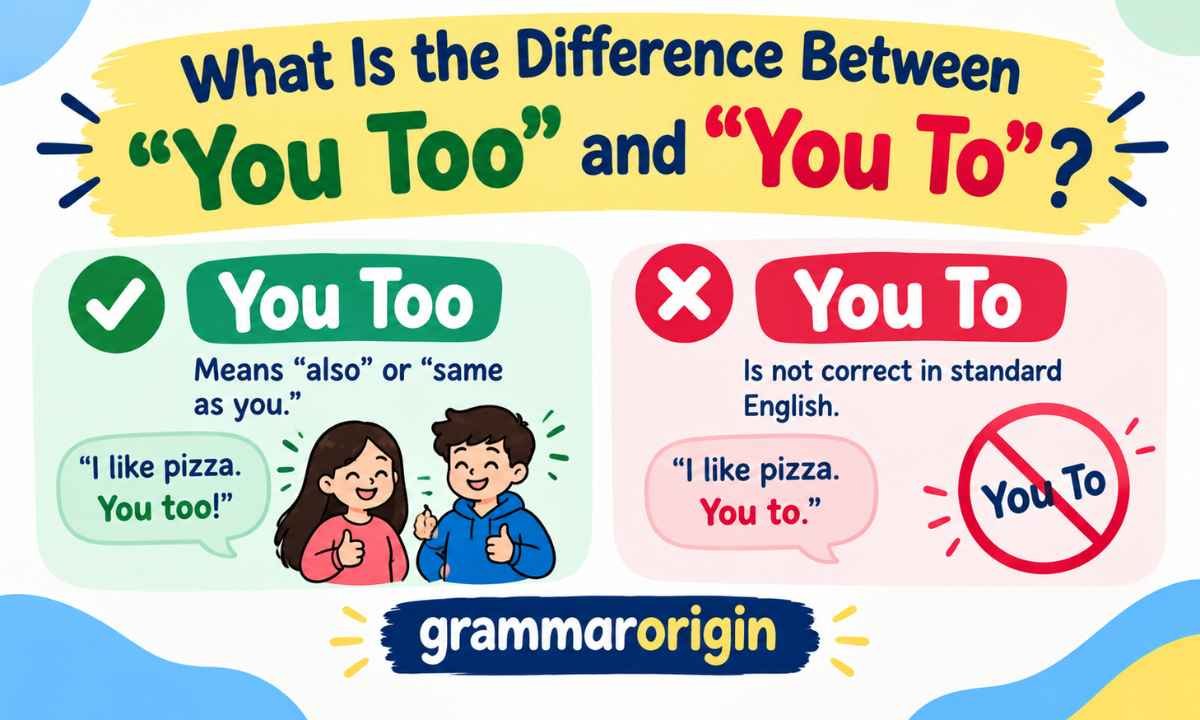
You too means “also you” or “the same to you.” You to is usually incomplete on its own and normally leads into a verb.
Think of it this way: one version stands alone as a full reply, while the other needs something after it to make sense.
Quick Answer
| Phrase | Meaning | Correct Usage |
| You too | Also you; same to you | Works alone as a reply |
| You to | Introduces an action | Needs a verb right after |
Examples:
- Have a great weekend! You too!
- I need you to call me back.
Why “You Too” Is Usually Correct
This spelling is correct because “too” is an adverb meaning “also” or “as well.” When someone wishes you well, replying this way means you’re wishing the same thing back.
Example: Someone says “Safe travels!” — the matching reply means “I hope you have a safe trip also.”
Examples of “You Too”
- Enjoy the concert! Same short reply works here too.
- Good luck with the exam! Same reply applies.
Why It Works
This reply is a shortened version of a longer sentence, with the repeated words dropped because the meaning is already obvious.
Example: “Have a nice day” answered this way really means “I hope you have a nice day too” — English speakers just trim the repeated part.
Common Situations
- Casual chats: “See you later.” / “You too!”
- Work emails: “Have a productive week.” / Same short reply, added with thanks.
- Social posts: “Happy holidays!” / Matching wish back.
When Is “You To” Correct?
This version is correct when “to” works as an infinitive marker or preposition, right before a verb. It’s grammatically fine as long as it isn’t standing alone.
Example: Wanting someone to succeed fits this pattern because a verb sits right after the linking word.
Examples
- We need you to finish the report.
- The teacher asked for the assignment to be submitted this way.
- I’d like someone to join our team.
Structure
The pattern follows: subject + verb + you + to + verb.
Example: “I expect prompt arrival” follows the same logic — a verb comes right after the linking word.
Important Rule
If you’re replying to a greeting or good wish, use the version with the extra “o.” If you’re telling someone to do something, the shorter spelling usually fits.
You Too vs You To: Side-by-Side Comparison
The clearest way to separate these is by function — one is a standalone reply, the other introduces action.
Example Comparison
| Situation | Correct | Incorrect |
| Giving instructions | I need you to call me. | I need you too call me. |
This mistake happens often because both words sound exactly the same when spoken.
Common Mistakes People Make
Most errors come down to swapping the spellings by sound instead of by grammar function.
Mistake 1: Using “To” Instead of “Too”
Incorrect: Have a nice day. You to! Correct: Have a nice day. You too!
This happens because the reply needs the “also” meaning, which only the longer spelling carries.
Mistake 2: Using “Too” Instead of “To”
Incorrect: I need you too finish the project. Correct: I need you to finish the project.
Here, the sentence needs the infinitive marker before the verb, not the adverb.
Mistake 3: Auto-Correct Errors
Keyboards sometimes swap one spelling for the other during fast typing, especially on mobile.
Example: A rushed closing line that drops the extra letter reads oddly to the recipient — always glance back before sending.
Real-Life Example: How One Small Grammar Mistake Changed a Professional Email
A sales rep once closed a client email with the wrong spelling right after the client wrote “Have a great weekend.” The client noticed but said nothing at the time.
Weeks later, during a casual call, the client jokingly brought up the typo. The deal wasn’t affected, but the rep admitted it made them double-check every closing line since.
Example takeaway: the fix takes two seconds — add the missing letter — but a rushed reply can leave a longer impression than intended.
Also Read This Transferred vs Transfered: Which Spelling Is Actually Correct?
Grammar Rule: Understanding “Too”
Definition of Too
This word carries two main meanings, and knowing both helps you spot it correctly in context.
Meaning 1: Also
Example: “I like tea, and she does too” — meaning she also likes tea.
Meaning 2: Excessively
Example: “The coffee is too hot” — meaning more hot than it should be.
When replying to good wishes, you’re always using the first meaning: also.
A related question people search is whether to add a comma before this word. In most cases, at the end of a sentence, no comma is needed — “I’m coming too” reads fine without one. A comma before it is optional and mainly used for emphasis, as in “I, too, have concerns,” or when it sits between a verb and its object, where commas on both sides are usually expected.
Easy Memory Trick
This spelling has an extra letter compared to the other word, and that extra letter is a handy reminder.
Example: Extra “o” equals extra meaning (“also”), so more letters point to the “also” sense every time.
Grammar Rule: Understanding “To”
This word serves several jobs in a sentence, and all of them involve pointing toward something.
Function 1: Showing Direction
Example: “Drive to the airport” — pointing toward a destination.
Function 2: Forming Infinitives
Example: “I want to learn” — pairing with a verb to form an infinitive.
Function 3: Connecting Actions
Example: “We expect someone to arrive early” — introducing an action someone else should take.
2025–2026 Writing Trends and Grammar Statistics
Digital messaging keeps growing, and mix-ups between similar-sounding words remain one of the most common writing slips across emails, texts, and social posts.
Grammar-checking tools and style guides — including the Chicago Manual of Style and Grammarly’s own editing data — continue to flag to/too/two confusion as one of the most frequently corrected error types in everyday writing. Workplace communication surveys from the past year also found that employers still link clear writing to a professional, detail-focused image.
Given how often people reply to greetings and give instructions in writing, getting this pair right stays relevant for students, professionals, and content creators alike.
How to Remember the Difference Every Time
A short mental check settles this in seconds, without needing to memorize any rule.
Ask Yourself a Question
Are you saying “also you”? Use the version with the extra “o.” Is a verb coming right after? Use the shorter spelling.
Example: “Have fun!” answered with the longer spelling passes the first test; an instruction followed directly by a verb passes the second.
Quick Checklist
- Replying to good wishes: use the longer spelling
- Meaning “also”: use the longer spelling
- Followed by a verb: use the shorter spelling
- Giving an instruction: use the shorter spelling
Examples in Everyday Situations
Real contexts make the rule easier to apply without thinking twice.
Text Messages
Friend: “Good luck tomorrow!” Reply: “Thanks! You too!”
Workplace Emails
Manager: “Have a productive afternoon.” Reply: “Thank you, same to you.”
School Setting
Teacher gives an instruction that needs the shorter spelling right before the verb — “complete the worksheet by Friday.”
Also Read This Transferred vs Transfered: Which Spelling Is Actually Correct?
Family Conversation
Parent: “Drive safely.” Response: matching the wish back, same as always.
Mini Quiz: You Too or You To
Mini Quiz 1: Which One Means “Also You”?
A) You to B) You too Answer: B — this spelling carries the “also” meaning.
Mini Quiz 2: Spot the Correct Reply
Someone says “Have a great day!” Correct reply: You ___! A) to B) too Answer: B.
Mini Quiz 3: Fill in the Blank
I need you ___ finish the report. A) too B) to Answer: B — a verb follows right after.
Mini Quiz 4: True or False?
The “also you” spelling is common in emails and texts. Answer: True.
Mini Quiz 5: Grammar Challenge
Thanks, you ___. A) to B) too Answer: B.
Mini Quiz 6: Quick Pick
Which spelling means “also”? A) To B) Too Answer: B.
Mini Quiz 7: Everyday English Test
Your friend says “Good luck!” Correct reply: You ___! A) too B) to Answer: A.
Mini Quiz 8: Find the Mistake
A) We need you to help us. B) We need you too help us. Answer: B contains the mistake.
Mini Quiz 9: One-Word Check
Which phrase can stand alone as a full reply? A) You too B) You to Answer: A.
Mini Quiz 10: Final Grammar Test
Complete: “I’d like you ___ join our team.” A) too B) to Answer: B.
Credible References
For further reading on this topic, these sources are worth checking:
- Merriam-Webster Dictionary — for standard definitions of “to” and “too”
- Grammarly Blog — for usage guides on homophones and comma placement
- The Chicago Manual of Style — for formal guidance on punctuation around “too”
Final Thoughts
Once you know the role each word plays, this pair stops being confusing. Use the longer spelling when replying to greetings, and the shorter spelling when a verb follows right after.
The next time someone wishes you well, you’ll know exactly which spelling to type back — and your writing will read a little more polished for it.

Muhammad Waqas is an English language teacher and grammar expert with over 8 years of experience helping students and professionals improve their writing skills. He specializes in English grammar, vocabulary, communication, and practical language learning. Through GrammarOrigin, Waqas shares clear, easy-to-understand content that helps readers write and speak English with confidence.