
Typed “transfered” in an email and watched the red squiggly line pop up under it? You’re not alone. The confusion between transferred vs transfered is one of the most common spelling slips in everyday English, even among fluent writers.
Here’s the short answer: transferred, with a double “r,” is correct. Transfered, with a single “r,” is a misspelling with no accepted use in English. Below, you’ll find the grammar reasoning, real examples, common mix-ups, and a few tricks to remember the correct spelling for good.
What Is the Difference Between Transferred vs Transfered?
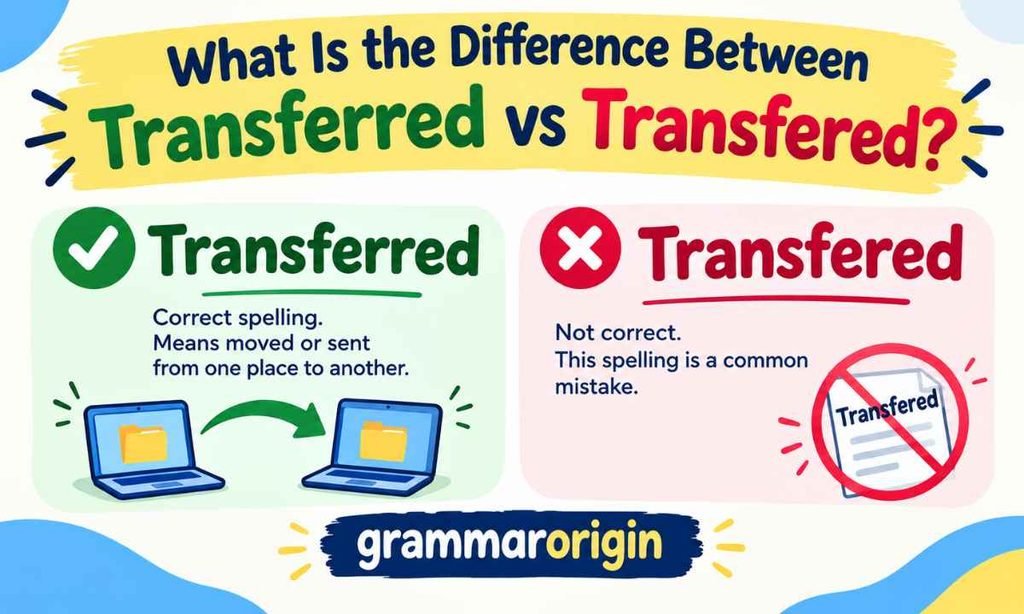
There’s only one correct answer here. Transferred, spelled with two r’s, is the accepted form. Transfered, with a single r, isn’t recognized in any English dictionary, British or American.
This isn’t a matter of regional preference or casual usage. It’s a plain spelling error that happens when the underlying grammar rule, called consonant doubling, gets skipped. Knowing the correct spelling of transferred also helps with related words that follow the same pattern.
Why Is “Transferred” Correct?
The word follows a doubling pattern used by a specific group of English verbs. When a verb ends in a single vowel followed by a single consonant, and the stress lands on that final syllable, the last consonant doubles before “-ed” or “-ing” is added.
Say “transfer” out loud. The emphasis falls on “fer,” not “trans.” That stressed final syllable is why the “r” doubles when the word shifts into its past tense form.
Correct Examples
Example: “The manager transferred the funds before the deadline.” Example: “Our files were transferred to the new server overnight.” Example: “She transferred colleges after her first semester.”
Incorrect Examples
Example (wrong): “The manager transfered the funds before the deadline.” Example (wrong): “Our files were transfered to the new server overnight.”
Neither sentence would pass a basic spell-check, and both would be flagged in professional writing.
Understanding the Grammar Rule Behind “Transferred”
English spelling rules get a bad reputation for being random, but this particular rule stays fairly consistent once you see the pattern.
The Consonant Doubling Rule
A final consonant doubles before a suffix when three things line up: the word ends in consonant-vowel-consonant, the stress falls on that last syllable, and the suffix being added starts with a vowel, like “-ed” or “-ing.”
Example: Transfer becomes transferred. Stress falls on the second syllable, so the “r” doubles. Example: Occur becomes occurred. Same pattern, same result.
Compare that to a word like “visit,” where the stress sits on the first syllable (“VIS-it”). That’s why it becomes “visited,” not “visitted.”
Why Stress Matters
Stress decides the whole rule. If someone said “TRANS-fer” instead of “trans-FER,” the spelling would likely go the other way. But that’s not how the word is actually pronounced in English.
Native speakers often get this right instinctively, just from how the word sounds. Non-native speakers or fast typists tend to slip because the rule isn’t something most people are taught explicitly after school.
Also Read This Long Term or Longterm: Which One Is Correct?
British vs American English
This is one of the rare cases where British and American spelling agree completely. Both dialects treat the doubled consonant the same way.
Example: A British newspaper and an American company report would both write “transferred,” never “transfered.” There’s no regional exception to fall back on, so how to spell transferred stays the same no matter where you’re writing from.
Transferred Meaning and Usage in English

Transferred is simply the past tense and past participle of the verb “transfer.” It describes something that has already moved, changed hands, or been reassigned.
Definition of Transferred
The transferred meaning covers something that was moved, relocated, reassigned, or passed from one place, person, or system to another. It applies to physical movement as well as digital or financial movement.
Common Contexts Where “Transferred” Is Used
Banking: “The payment was transferred within minutes.” Education: “He transferred to a different university in his second year.” Employment: “She was transferred to the regional office last spring.” Technology: “The backup files were transferred to cloud storage.”
Each context follows the same spelling rule. Only the setting changes.
Synonyms of Transferred
A useful transferred synonym list includes moved, relocated, reassigned, shifted, transmitted, transplanted, and rerouted. Using these naturally alongside “transferred” keeps writing from feeling repetitive without losing precision.
Example: Instead of repeating “transferred” three times in one paragraph, a writer might say the funds were “moved,” then later that the account was “reassigned” to a new branch.
Common Spelling Mistakes Similar to Transfered
Transfered isn’t an isolated mistake. It belongs to a whole family of words people misspell for the same reason.
Frequently Confused Words
| Incorrect | Correct |
| Transfered | Transferred |
| Refered | Referred |
| Prefered | Preferred |
| Ocurred | Occurred |
| Comited | Committed |
Most of these confused pairs share the same root cause behind transferred vs transfered: a skipped or forgotten doubling rule, not a lack of general grammar knowledge.
Why People Misspell “Transferred”
A few habits usually explain the slip: typing quickly without proofreading, leaning too heavily on autocorrect, never learning the stress-based doubling rule, or simply mishearing how the word sounds when spoken.
Non-native English speakers sometimes carry over spelling patterns from their first language, where consonant doubling doesn’t follow the same logic.
Memory Trick to Remember “Transferred”
Here’s a simple way to lock it in. Picture the word splitting into “transFER” plus “red.” If you can hear the stress on “fer,” you’ll remember to double the r before adding “ed.”
Example: Think “trans-FER-red.” The stronger the stress you hear on “fer,” the more natural the double r feels when you write it.
Real-Life Example: How a Spelling Error Affected Professional Communication
A small business owner once nearly lost a client over something that seemed minor at first. She’d been emailing a vendor about a wire payment and kept writing “the amount has been transfered” across three separate messages.
The vendor’s finance team flagged the emails internally. Not because the meaning was unclear, but because repeated spelling errors in payment confirmations raised doubts about how carefully the paperwork was being handled. One follow-up email even asked her to confirm the transfer details again, which felt more like a trust check than a routine request.
After a colleague pointed out the mistake, she started running a quick spell-check before sending anything finance-related. The next transaction went through without a single follow-up question, a small fix that made a real difference in how professional the communication felt.
2025–2026 Language and Writing Statistics
Written communication faces more scrutiny than ever, especially now that so much business happens over email, chat, and AI-assisted writing tools.
Recent Writing Statistics
Workplace communication research consistently shows that spelling accuracy affects how trustworthy a message feels to the reader, particularly in finance, legal, and client-facing emails. Search interest around grammar and spelling correction tools has also climbed as more people write across multiple digital platforms every day. At the same time, AI writing assistants and browser-based spell-checkers make it easier to catch doubling errors like transfered before hitting send, though the mistake still shows up often in fast, informal typing.
People frequently search variations like transferred or transfered, transfer past tense, and correct spelling of transferred, a clear sign this specific error is still common in day-to-day writing.
How to Avoid Spelling Mistakes Like “Transfered” (Step-by-Step Guide)
A little consistency goes a long way here. These steps help the correct spelling stick without memorizing a long list of exceptions.
1. Learn Basic Consonant Doubling Rules
Focus on verbs that behave like transfer: refer, prefer, occur, commit. Once the pattern clicks for one, it clicks for the whole group.
2. Use Grammar Checking Tools
Built-in spell-checkers in Word, Google Docs, and most browsers catch this error right away. It’s worth turning on real-time checking instead of relying only on a final read-through.
3. Read Your Writing Aloud
Reading a sentence out loud slows you down enough to notice spellings your eyes might skip over while typing fast.
4. Practice Frequently Confused Words
Keep a short list of words you personally tend to misspell and review it now and then. Repetition, not memorization, is what makes it automatic.
5. Understand Patterns Instead of Memorizing Randomly
Once the stress-based doubling rule makes sense for transferred, it applies to dozens of other verbs without extra effort. That’s what makes learning the pattern more useful than memorizing single words.
Transferred vs Transfered in SEO and Professional Writing

Spelling accuracy isn’t just a grammar detail. It has a real effect on how content performs and how professional a writer looks.
Search Engine Trust and Readability
Clean, error-free writing tends to read more smoothly, which keeps visitors on a page longer. Search engines pay attention to signals like readability and user engagement when judging content quality, so getting transferred vs transfered right matters more than it might seem.
User Trust and Credibility
A reader who spots a spelling mistake like transfered in the first paragraph is more likely to question the accuracy of everything else on the page, even if the rest of the content is solid.
Importance for Students and Professionals
Correct spelling matters most in situations with real stakes: job applications, academic submissions, client-facing emails, and published articles. A single doubling error can undercut an otherwise well-written piece.
Also Read This Long Term or Longterm: Which One Is Correct?
Mini Quiz: Transferred vs Transfered
Quick Quiz 1: Spot the Correct Spelling
Which is correct, “He transfered the call” or “He transferred the call”? Answer: He transferred the call.
Quick Quiz 2: Fill in the Blank
“The property was ______ to the new owner.” (transfered / transferred) Answer: transferred
Quick Quiz 3: True or False
“Transfered” is an accepted spelling in American English. Answer: False
Quick Quiz 4: Grammar Challenge
Why does “transferred” double the final consonant? Answer: Because the stress falls on the final syllable of “transfer.”
Quick Quiz 5: Find the Mistake
Spot the misspelled word: Preferred, Referred, Transfered, Committed. Answer: Transfered
Quick Quiz 6: Choose the Correct Sentence
“The data was transfered securely” or “The data was transferred securely”? Answer: The data was transferred securely.
Quick Quiz 7: One Word Answer
What’s the past tense of transfer? Answer: Transferred
Quick Quiz 8: Fast Typing Test
Which looks more professional in an email, “funds transfered” or “funds transferred”? Answer: funds transferred
Quick Quiz 9: Fill the Missing Letter
Transfe__ed. a) r b) rr c) rrr Answer: b) rr
Quick Quiz 10: Real-Life English Check
Which sounds more polished in a resume, “Transfered to senior role” or “Transferred to senior role”? Answer: Transferred to senior role
Quick Quiz 11: Rule Master
Words like transfer, refer, and occur usually: Answer: Double the final consonant before adding a suffix.
Quick Quiz 12: Mini Brain Test
Which spelling would survive most spell-checkers, transfered or transferred? Answer: transferred
Transferred Synonym
If “transferred” feels repetitive in a piece of writing, strong alternatives include moved, relocated, shifted, reassigned, and transmitted. Each fits slightly different situations, from physical relocation to digital data movement, and each works as a natural transferred synonym in context.
Frequently Asked Questions
Is “transfered” ever correct in any form of English?
No. Transfered isn’t recognized in British or American English. It’s always a spelling mistake, regardless of context.
Why does transferred have two r’s instead of one?
Because transfer carries stress on its final syllable, English spelling rules require the last consonant to double before adding “-ed.”
What is the correct past tense of transfer?
The correct past tense and past participle of transfer is transferred, spelled with a double r.
Is transferred spelled differently in British and American English?
No. This is one case where both spelling systems agree completely. Transferred is correct on both sides.
What’s an easy way to remember the correct spelling?
Say the word out loud and listen for the stress on “fer.” That stressed sound is the cue to double the r before adding “ed.”
What part of speech is “transferred”?
It’s a verb form, specifically the past tense and past participle of “transfer.”
Why do so many people misspell transferred as transfered?
Mostly fast typing, weak familiarity with the consonant doubling rule, and relying on autocorrect instead of manual proofreading.
Final Thoughts
Between transferred vs transfered, only one spelling holds up in any dictionary, style guide, or spell-checker: transferred, with its double r. The rule behind it isn’t random. It comes down to where the stress falls in the original word “transfer.”
Once that pattern makes sense, it applies to a whole family of similar verbs, not just this one. A quick read-aloud check or a reliable grammar tool is usually enough to avoid this mistake in emails, resumes, and published writing going forward.

Muhammad Waqas is an English language teacher and grammar expert with over 8 years of experience helping students and professionals improve their writing skills. He specializes in English grammar, vocabulary, communication, and practical language learning. Through GrammarOrigin, Waqas shares clear, easy-to-understand content that helps readers write and speak English with confidence.