
“At least” is correct. It’s always written as two separate words. “Atleast” is a common misspelling that shows up because the phrase gets slurred together when we speak it out loud (pronounced roughly “at leest,” /æt liːst/).
You’ll see the wrong version everywhere: texts, comments, even work emails. That doesn’t make it right. This guide breaks down why the two-word form wins, how to use it correctly, and the small mistakes that trip up even confident writers.
What Does “At Least” Mean?
It means a minimum amount, number, or degree, the lowest point something can be, with room to go higher. It’s a small phrase that does a lot of quiet work in a sentence, and it has close cousins in meaning like “at minimum,” “no less than,” and “at the very least.”
Depending on where you drop it, the tone shifts entirely, from a strict number to a comforting afterthought.
“At Least” for Minimum Amounts
Here it sets a floor. Example: “You need at least two forms of ID to open the account.” Two is the minimum; three or four would still work.
This use shows up constantly in instructions, recipes, and rules where a threshold matters more than an exact figure.
“At Least” as Reassurance
Here it softens bad news. Example: “The flight got delayed, but at least we’re still landing before midnight.” It picks out the one good thing in an otherwise rough situation.
Native speakers lean on this version in everyday conversation far more than the minimum-amount meaning.
“At Least” as Qualification
Here it limits a claim without abandoning it. Example: “At least in my experience, the new manager listens.” The speaker isn’t sure the statement holds universally, just for their own case.
This version often opens a sentence, signaling a slight hedge before the speaker commits to a point.
Is “Atleast” a Word?
No, “atleast” is not a recognized English word. No major dictionary lists it, and no style guide accepts it in formal writing.
It’s a spelling error, plain and simple, born from how quickly the two parts blend together in speech.
Why People Write “Atleast”
People merge the words because English already has a habit of doing this. “Already,” “anyway,” and “everyday” all started as two words before some of them became one over decades of use.
The brain hears one sound and assumes one word. Example of the mistake: “I need atleast three days off.” The fix is simple: add the space back, “at least three days off.”
At Least vs Atleast: Side-by-Side Comparison
| Feature | At Least | Atleast |
| Grammatically correct | Yes | No |
| Found in dictionaries | Yes | No |
| Acceptable in formal writing | Yes | Never |
| Acceptable in texting or casual chat | Yes | Common but still wrong |
| Word count | Two words | Incorrectly merged into one |
Why “At Least” Stays Two Words
The phrase is built from a preposition (“at”) plus a noun functioning as an idiom (“least”). English doesn’t fuse these two parts because they still behave as separate grammatical units, not one new word with its own meaning.
Compare it to “a lot,” another phrase people constantly try to squeeze into “alot,” which also isn’t a word.
Compare Open vs Closed Compounds
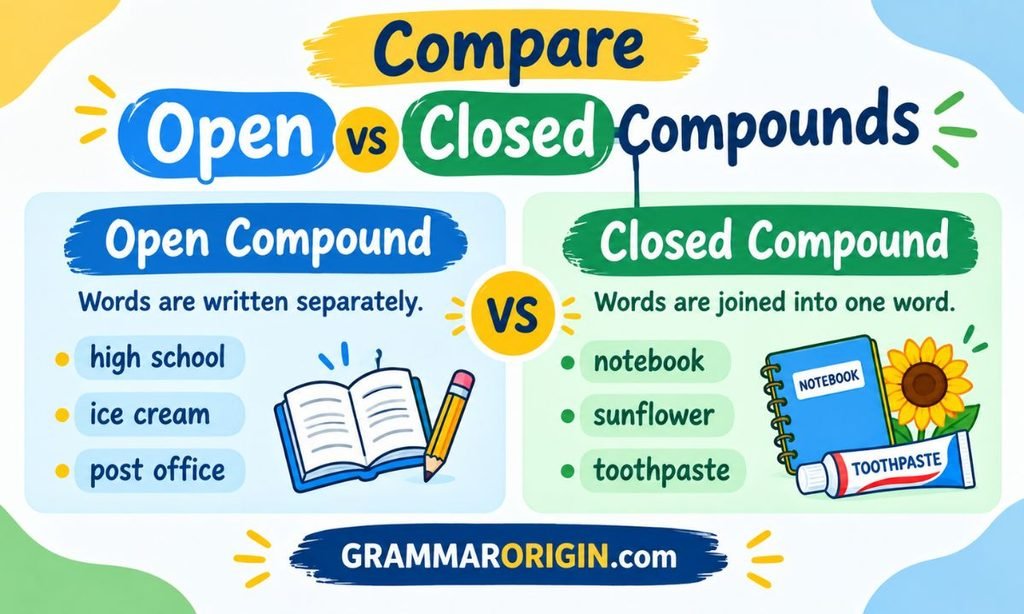
Some two-word phrases eventually close up into one word (“everyday,” “cannot”). Others stay open forever, and this one falls firmly in the second group.
Linguists call this an “open compound”: two words that function together but keep their own spelling identity, unlike closed compounds that eventually fuse into a single word.
Also Read This Well Deserved vs Well-Deserved: Which One Is Correct?
How to Use “At Least” Correctly
Place it directly before the number, amount, or idea it’s limiting, and keep it as two words every time. Once the placement is right, the rest is just context.
The three situations below cover almost every real-world use of this phrase.
For Numbers and Amounts
Example: “The recipe calls for at least four eggs.” Four is the floor; more is fine, fewer isn’t.
Keep the phrase right before the number so there’s no ambiguity about what’s being counted.
Use “At Least” for Reassurance
Example: “We lost the game, but at least nobody got hurt.” This softens disappointment by pointing at a silver lining.
This use often sits mid-sentence, right after a setback has already been mentioned.
Use “At Least” in Estimates
Example: “It’ll take at least an hour to fix, maybe more.” The speaker is giving a rough lower bound, not a guarantee.
This works well in planning, quoting timelines, or setting expectations without overpromising.
Common Mistakes With “At Least”
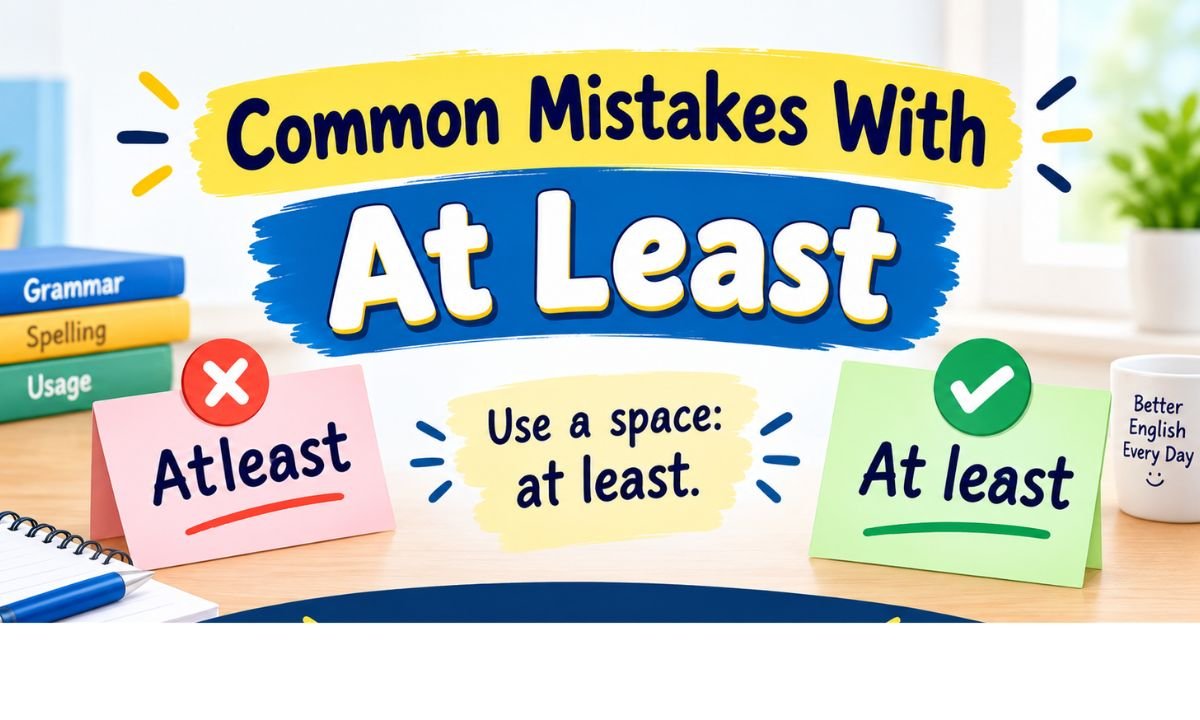
Most errors with this phrase fall into three predictable traps, none of them hard to fix once you know what to look for.
Writing “Atleast”
The single biggest mistake is simply merging the words into “atleast.” Autocorrect sometimes lets it slide, but spell-check tools built on proper dictionaries will flag it.
Read the sentence out loud slowly. If you can hear a tiny pause between the two parts, write it as two words.
Misplacing the Phrase
Example of a misplaced version: “At least I need two days” (unclear) vs. “I need at least two days” (clear). Position changes what the phrase is actually limiting.
Keep it directly next to the thing it modifies: a number, a claim, or a condition.
Confusing “At Least” and “At Last”
These two sound nothing alike once you slow down, but tired fingers still swap them. Example of the mix-up: “At last, we need three volunteers,” which makes no sense, because “at last” means finally, not minimum.
At Least vs At Last
One sets a minimum. The other signals something finally happened after a wait. They share three letters and nothing else in meaning.
Mixing them up usually happens through autocorrect or plain typing speed, not confusion about grammar rules.
Example Comparison
“At least five guests are coming” (minimum number) versus “At last, the guests arrived” (relief after waiting). Swap them and the sentence stops making sense.
Memory Trick
Think “least” equals low number, “last” equals final moment. If the sentence is about quantity, you want “at least.” If it’s about timing or relief, you want “at last.”
At the Least vs At Least
They mean almost the same thing, but the longer version sounds more formal and slightly old-fashioned. Both are correct.
Natural Usage
Example: “At the least, he could have called.” This version leans literary or emphatic, while “at least he could have called” reads more natural in everyday speech. Most modern writing favors the shorter form.
“At Least” as an Adverbial Phrase
Grammatically, it functions as an adverbial phrase, modifying a number, a verb, or an entire clause rather than a single noun. That’s why it can slide around a sentence and still work.
This flexibility is exactly why it shows up in so many different fixed expressions, which we’ll cover next.
Common Phrases Using “At Least”
English has built several fixed expressions around this phrase, each with a slightly different flavor.
At Least Once
Meaning: a minimum of one occurrence. Example: “Visit the dentist at least once a year.”
At Least One
Meaning: a minimum count of exactly one item or person. Example: “At least one witness confirmed the story.”
At Least for Now
Meaning: acceptable temporarily, though it might change. Example: “The plan works, at least for now.”
At Least in Part
Meaning: partially true or responsible. Example: “The delay was, at least in part, caused by weather.”
Last but Not Least
This one uses “last,” not “least,” a common confusion point. It means the final item mentioned still matters as much as the earlier ones. Example: “And last but not least, thank you to our sponsors.”
Formal vs Informal Writing
It fits comfortably in both formal and casual writing. The correct spelling never changes, only the surrounding tone does.
Academic Writing
Academic papers favor it for precise minimums: “The sample required at least thirty participants for statistical validity.”
Business Writing
Business emails often use it for reassurance or estimates: “We’ll need at least two weeks to complete the audit.”
Everyday Speech
In conversation, it’s mostly the reassurance meaning: “At least you tried.”
Social Media
This is where the misspelling appears most: fast typing, no proofreading, autocorrect gaps. Even here, the correct spelling stays two words.
Case Study: How This Error Hurts Credibility
A single instance of “atleast” in a resume, proposal, or client email can quietly undercut how careful and detail-oriented you look. Hiring managers and editors notice small spelling slips faster than most writers expect.
Picture a freelance writer who submits a polished draft but leaves the error in three separate places. A client scanning quickly may not name the exact issue, but the overall impression shifts: the piece feels less proofread, even if everything else is solid.
Why Search Engines Show “Atleast”
Search engines display results for the misspelling because so many people type it that way, not because the spelling is valid. Google indexes based on search volume and intent, not correctness.
This is exactly why grammar sites rank content explaining the difference: the demand exists because the confusion is real and constant.
Style Guide Perspective
Every major style guide, including AP, Chicago, and MLA, treats this as two words with no exceptions. None of them list the merged spelling as an accepted variant, formal or informal.
If you’re writing for publication, a professor, or a client, this isn’t a stylistic choice. It’s a fixed rule.
Similar Two-Word Expressions Often Misspelled
This phrase isn’t alone. English is full of open compounds that people keep trying to close up:
- A lot (never “alot”)
- All right (not “alright,” in formal writing)
- Already vs. all ready (different meanings entirely)
- Awhile vs. a while (one’s an adverb, one’s a noun phrase)
- Anyway (never “any way” unless you mean a specific route or method)
Getting this one right makes it easier to catch these related patterns too.
Easy Ways to Remember “At Least”
Three quick checks settle almost any doubt about this phrase in seconds.
The Space Test
Say the sentence slowly and listen for a tiny breath between the two parts. If you can hear it, the space belongs there.
The Minimum Test
Ask yourself: could you swap it for “at the minimum” and keep the same meaning? If yes, you’re using it correctly as two words.
Visual Trick
Picture the words as two separate bricks, stacked but never glued. That mental image alone stops most people from merging them.
Also Read This 31st or 31th: Which One Is Correct?
Real-World Published Usage Examples
Professional writing across industries treats this phrase the same way, without variation.
Journalism
News reports commonly write: “At least twelve people were affected by the outage.” Precision matters here, since numbers carry legal and factual weight.
Business
Corporate reports use it for projections: “The company expects at least a 5% increase in revenue next quarter.”
Books
Novelists use the reassurance meaning constantly: “At least she hadn’t cried in front of him.”
Frequently Confused Sentence Placement
Where the phrase sits inside a sentence can quietly change what’s being limited.
Beginning of Sentence
Example: “At least he showed up.” Here it modifies the entire situation, softening a broader complaint.
Middle of Sentence
Example: “He showed up at least on time.” Here it narrows the focus to just one detail, timing, not the whole event.
Quote Worth Remembering
A simple rule worth keeping in mind: if you can pause between the words when you say them out loud, you can space them apart when you write them.
Quick Usage Checklist
Run through this before hitting send on anything important.
Correct Usage Checklist
- Two words, never one: at least
- Placed right next to what it’s limiting
- Not confused with “at last”
- Not swapped for “at the least” unless a formal tone is wanted
- Read aloud once before submitting
Mini Diagram: How “At Least” Works
Think of it as a simple floor-and-ceiling model:
[ minimum value: AT LEAST X ] —–> [ actual value could be X or higher ]
Whatever number or claim follows this phrase marks the lowest possible point; everything above it is still valid.
Common Questions People Ask
Quick answers to the doubts that come up most often around this phrase.
Can “At Least” Start a Sentence?
Yes. Starting a sentence with it is completely acceptable in both formal and casual writing. Example: “At least the roof didn’t leak this time.”
Should There Be a Comma After “At Least”?
Usually not, unless it’s followed by a pause for emphasis. “At least try” needs no comma, but “At least, in theory, it should work” can take commas around an inserted phrase.
Is “Atleast” Ever Acceptable?
No, not in any recognized dictionary or style guide, formal or informal. It only appears because of typing habits, never because it’s a sanctioned spelling.
Why This Tiny Rule Matters
One small spacing mistake won’t ruin your writing, but patterns of small mistakes add up to a bigger impression of carelessness. Readers form judgments fast, often from details this minor.
The Bigger Lesson About English Compounds
English keeps some phrases open and closes others for reasons that aren’t always logical; they’re historical. Learning a handful of the common ones trains your eye to catch the rest naturally over time.
Practical Examples You Can Copy
Use these as templates for your own writing.
Correct
- “You should drink at least eight glasses of water a day.”
- “At least the meeting ended early.”
- “We need at least three signatures to approve this.”
Incorrect
- “You should drink atleast eight glasses of water a day.”
- “Atleast the meeting ended early.”
- “We need atleast three signatures to approve this.”
Common Editing Trick Professionals Use
Editors run a simple find-and-replace search for the misspelling before final submission, catching every instance in seconds. It’s a two-second habit that saves an embarrassing correction later.
Add this to your own proofreading pass: search the document, fix every hit, move on.
Frequently Asked Questions
Is “atleast” ever correct in English?
No. It’s never correct in any context: casual, formal, academic, or professional. The correct spelling is always two words, “at least.”
What is the difference between “at least” and “at the least”?
Both mean roughly the same thing, but “at the least” sounds more formal and emphatic, while “at least” is the more common, natural choice in everyday writing.
Why does “at least” sound like one word when spoken?
Because the sounds blend together in fast speech, making the phrase sound like a single word even though it’s grammatically two.
Can I start a formal email with “At least”?
Yes, as long as the sentence structure makes sense. It’s commonly used to soften a point or set expectations early in professional writing.
Does autocorrect fix “atleast” automatically?
Not always. Many autocorrect tools only flag it as a possible error rather than fixing it outright, so manual proofreading still matters.
Is “at least” formal or informal?
It works in both registers. The phrase itself is neutral; only the surrounding sentence determines whether the tone feels formal or casual.
What’s a quick way to remember the correct spelling?
Say the phrase slowly and listen for the pause between the words, or mentally swap it with “at the minimum.” If that works, the space belongs there.
Final Thoughts
“At least” is the only correct spelling: two words, no exceptions, across every style guide and dictionary. “Atleast” is simply a common typing habit that never earned a place in formal English.
Once the space test and the minimum test feel automatic, this becomes one of those small grammar rules you’ll never second-guess again.

Muhammad Waqas is an English language teacher and grammar expert with over 8 years of experience helping students and professionals improve their writing skills. He specializes in English grammar, vocabulary, communication, and practical language learning. Through GrammarOrigin, Waqas shares clear, easy-to-understand content that helps readers write and speak English with confidence.