
If you’ve typed “cancelation” and then stopped to wonder if you dropped a letter, you’re in good company. This mix-up shows up constantly in emails, policies, and everyday writing.
Here’s the short version of cancellation vs cancelation: “cancellation” with two Ls is the standard, correct spelling in both American and British English. “Cancelation” with one L does exist, but it’s rare and best avoided in most writing.
Quick Answer
The correct spelling is cancellation, spelled with two Ls, and it’s accepted everywhere from casual emails to legal contracts. “Cancelation” isn’t technically wrong in American English, but almost nobody uses it.
Example: “Please confirm the cancellation of my subscription by Friday.”
Cancellation vs Cancelation – Key Differences at a Glance
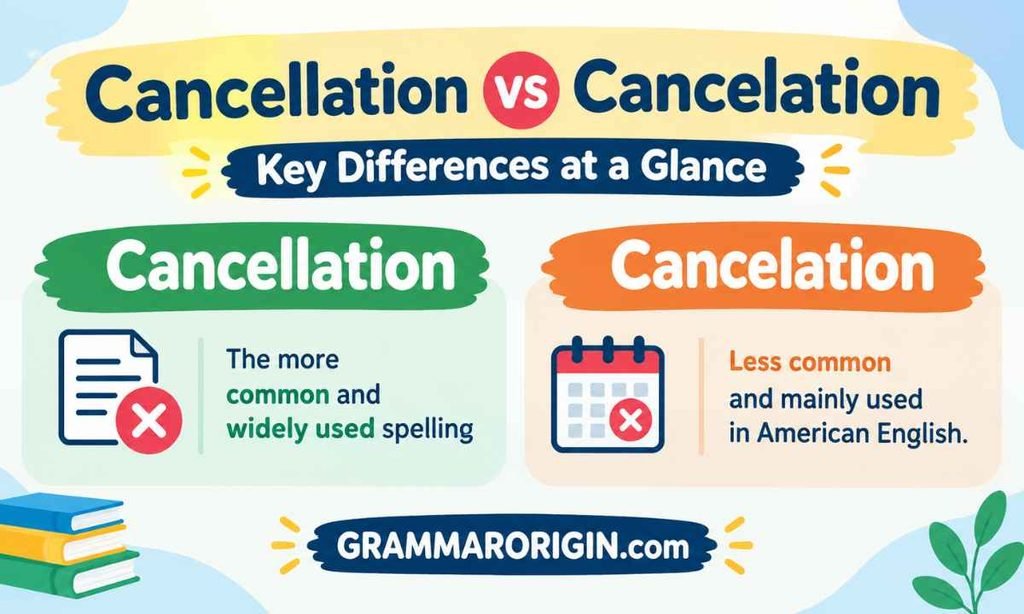
Both words come from the verb “cancel,” but only one of them shows up in everyday writing. Cancellation is the version you’ll see in news articles, business emails, and travel notices.
Cancelation shows up so rarely that many readers will assume it’s a typo, even though a handful of American dictionaries list it as a secondary form.
Example: A hotel’s official policy page will almost always read “cancellation policy,” not “cancelation policy.”
American vs British English: The Real Difference
There isn’t really a US vs UK split here, and that surprises a lot of writers. Both regions treat cancellation as the standard spelling.
Webster’s Spelling Reforms
Noah Webster trimmed extra letters from many British spellings in the early 1800s, turning “colour” into “color” and “centre” into “center.” Those reforms shaped a lot of modern American spelling habits.
Example: “Travelled” became “traveled” in the US under this same push toward simpler spelling.
US Spelling Trends
American English generally favors shorter word endings, which is why “canceled” and “canceling” use just one L in the US. Oddly enough, “cancellation” didn’t follow that trend.
Example: You’ll see “he canceled the trip” in American writing, yet the noun stays “cancellation,” not “cancelation.”
Global Publishing Standards
News outlets, academic journals, and international brands consistently use cancellation no matter where they’re based. It’s treated as the universal standard in professional publishing.
Example: A global airline’s terms and conditions page will use “flight cancellation” regardless of which country it’s written for.
What Major Dictionaries Say
Merriam-Webster lists “cancelation” as a minor variant while naming “cancellation” as the main entry. Oxford and Cambridge dictionaries list only cancellation.
Example: Searching “cancelation” in most dictionary apps redirects you straight to the “cancellation” entry.
Why Is “Cancellation” Spelled with Two Ls?
“Cancellation” keeps two Ls because of the double consonant rule, which kicks in when “-ation” is added to a short word like “cancel.” The final consonant doubles to preserve the word’s sound.
This doubling pattern shows up across plenty of English words, which is why the second L in cancellation isn’t random at all.
Example: The same doubling logic explains why “controllable” keeps two Ls after “control.”
Is “Cancelation” Ever Correct?
Technically, yes, in a narrow sense. A small number of American dictionaries list “cancelation” as an accepted variant, though it’s far from common.
Most style guides still recommend sticking with cancellation for anything formal, professional, or public-facing.
Example: A style guide for a US company would flag “cancelation” during proofreading even though it isn’t a dictionary error.
Real Examples of “Cancellation” in Sentences
Seeing the word in real sentences makes the correct spelling easier to remember than any rule alone.
- “The flight cancellation left dozens of passengers stranded overnight.”
- “I never received confirmation of my order cancellation.”
- “Their gym membership cancellation policy requires 30 days’ notice.”
Example: Swap “cancellation” for “cancelation” in any of those sentences and it immediately reads as a typo.
Is “Cancelation” Ever Acceptable?
In casual, personal writing, nobody’s going to correct you for using “cancelation.” In anything formal, it’s best to avoid it.
Rare Acceptance Cases
You might spot “cancelation” in older American texts or in quick, informal notes where nobody’s proofreading closely.
Example: An internal Slack message like “cancelation confirmed” wouldn’t raise eyebrows, but a printed contract would.
Also Read This At Least or Atleast: Which One Is Correct? (Full Grammar Guide)
Why It Looks Wrong to Most Readers
People are simply used to seeing cancellation everywhere, from school forms to travel sites, so the single-L version reads as a mistake by comparison.
Example: A reader scanning “cancelation fee” on an invoice will likely assume it’s a spelling slip, even if it’s technically valid.
Common Grammar Pattern: Traveling vs Travelling & Other Double-L Words
This same confusion pops up with several other “-l” verbs, and knowing the pattern helps with all of them at once.
| American English | British English |
| traveling | travelling |
| labeled | labelled |
| modeling | modelling |
| canceled | cancelled |
Example: “She traveled to Chicago” is standard American spelling, following the same single-L habit as “canceled.” The same cancelling vs canceling split, and even enrollment vs enrolment, follow this exact pattern.
Why This Pattern Matters
Here’s the twist: even though American English drops the extra L in verbs like “canceled,” the noun cancellation keeps both Ls anyway. It doesn’t fully follow the simplified pattern.
Example: “Enrollment” behaves the same way, keeping a double L in American English even though related short forms often get trimmed.
Common Mistakes & How to Avoid Them
The most common slip is writing “cancelation policy” on a website or form, assuming American English always drops extra letters.
How to Avoid Mistakes
Stick with cancellation for the noun in every context, stay consistent with either US or UK spelling for verb forms like canceled/cancelled, and let a grammar checker catch anything that slips through. If you want to sidestep the spelling question entirely, a cancellation synonym like “termination” or “revocation” can work in some formal contexts.
Example: Choosing “cancellation fee” instead of “cancelation fee” keeps a policy page looking professional and consistent.
Quick Comparison Table
| Feature | Cancellation | Cancelation |
| British English | Standard | Not used |
| American English | Preferred | Rare variant |
| Academic writing | Yes | Not recommended |
| Business writing | Yes | Avoid |
| Global use | Standard | Very rare |
Cancellation vs Cancelation – Which Should You Use?
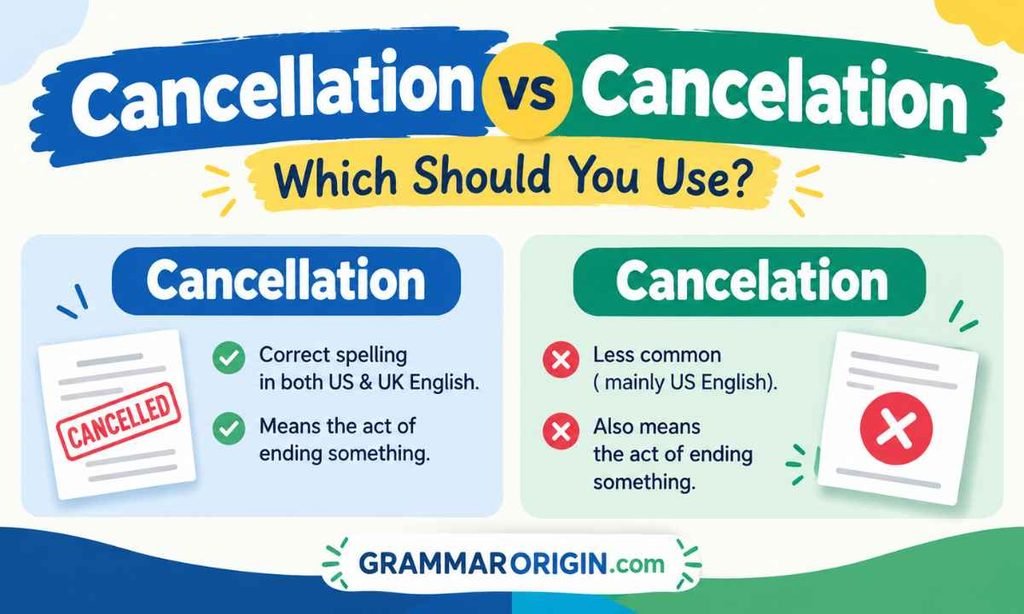
Use cancellation every time you’re writing for an audience, whether that’s a business email, a website, or a school assignment.
“Cancelation” isn’t a hard error, but it’s rare enough that it can distract readers from your actual message.
Example: Choosing “cancellation” over “cancelation” is the safer call in nearly every writing situation you’ll run into.
Also Read This Todays or Today’s :Which One Is Correct
Cancellation and Cancelation Pronunciation
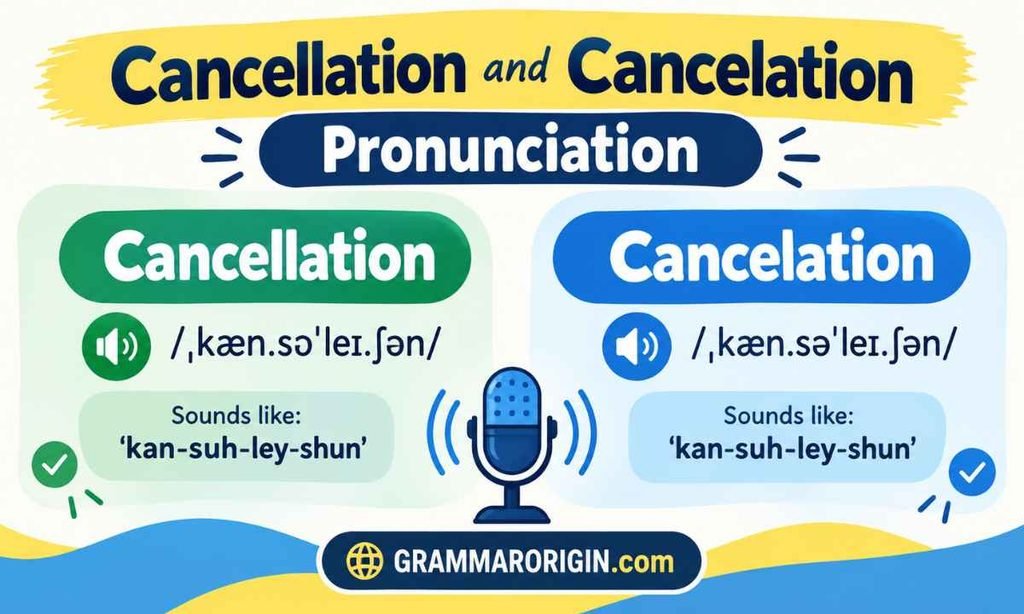
Both spellings are pronounced exactly the same way: kan-suh-LAY-shun. The spelling difference doesn’t change how the word sounds out loud.
Example: Saying “flight cancellation” and “flight cancelation” aloud produces an identical sound either way.
Frequently Asked Questions
Is cancelation a real word?
Yes, technically. A few American dictionaries list it as a rare variant, but “cancellation” is the spelling almost everyone actually uses.
Why does cancellation have two Ls?
It follows a standard English spelling rule where the final consonant doubles before adding “-ation” to a word like “cancel.”
Is cancellation correct in British English?
Yes, “cancellation” is the only accepted spelling in British English. “Cancelation” isn’t used there at all.
Do Americans spell it cancelation or cancellation?
Most Americans use “cancellation,” even though other related words like “canceled” drop the extra letter.
What’s the difference between canceled and cancelled?
“Canceled” is the standard American spelling, while “cancelled” is standard in British English. Both are correct depending on your audience.
Which spelling should I use on a business website?
Always use “cancellation.” It reads as professional and correct no matter where your readers are located.
Is there a pronunciation difference between the two spellings?
No. Both “cancellation” and “cancelation” are pronounced the same way, so the spelling choice is purely visual.
Summary
The rule here is straightforward: cancellation is the correct, standard spelling everywhere, while “cancelation” is a rare variant best left out of formal writing. The double L follows a normal English spelling pattern, not an exception you need to memorize separately.
Whenever you’re writing a policy, an email, or a website page, choosing cancellation keeps your writing accurate and consistent for any audience.

Muhammad Waqas is an English language teacher and grammar expert with over 8 years of experience helping students and professionals improve their writing skills. He specializes in English grammar, vocabulary, communication, and practical language learning. Through GrammarOrigin, Waqas shares clear, easy-to-understand content that helps readers write and speak English with confidence.