
Todays or today’s: which one actually belongs in your sentence? It’s one of those small punctuation questions that quietly wrecks otherwise clean writing, whether you’re finishing a school assignment or sending a client email.
The good news is that the rule isn’t complicated once you see it clearly. This guide walks through the grammar, the history, and the exact moments where writers slip up, so you stop guessing for good.
Todays or Today’s – Quick Answer
Today’s (with the apostrophe) is the form you want almost every time. Todays technically exists as a plural, but it’s so rare that most native speakers go their whole lives without ever needing it.
The apostrophe does one job. It tells the reader that whatever comes next belongs to, or is tied to, the present day. Drop it before a noun, and the sentence reads as a typo rather than a stylistic choice. That’s the whole answer to the today’s vs todays question in one line.
Example: “Check today’s schedule before you leave the office” is correct. “Check todays schedule” is not; it’s missing the piece that connects “schedule” to “today.”
What Is “Today”?
“Today” isn’t a fixed part of speech. It shifts jobs depending on where it lands in a sentence, and that shift is exactly why the apostrophe question exists in the first place.
It can behave as a noun on its own, as an adverb describing when something happens, or as a possessive noun sitting in front of another word. That third role is the only one that ever needs an apostrophe.
Example: “Today was exhausting” (noun), “Call me today” (adverb), “Today’s call ran long” (possessive noun modifier).
The Origin of Today’s / Todays
The word traces back to Old English “tō dæġe,” which literally meant “on this day.” Over several centuries, the phrase fused into a single word, and the sound at the end wore away as the language changed.
Once “today” settled into modern English, it started following the same possessive pattern every other singular noun follows: apostrophe, then s. There’s nothing special or exceptional about it. It’s ordinary grammar doing ordinary work, and it’s why the apostrophe rules here never really needed an update.
Example: “Today’s” forms its possessive the same way “the driver’s seat” or “my sister’s car” does. Same rule, same pattern, just a different word.
British English vs. American English Spelling
Here’s one spot where you don’t need to worry about which side of the Atlantic you’re writing for. British and American English handle this identically.
Both dialects require the apostrophe in “today’s” whenever it sits in front of a noun, and both treat a bare “todays” in that same position as an error. Unlike words such as “colour” and “color,” there’s no split to memorize here.
Example: A headline in London and a headline in Chicago would both read “today’s top stories,” never “todays top stories.”
Key Rule: When to Use Today’s vs. Todays
Use today’s any time the word sits directly in front of a noun and shows that the noun is connected to the present day. That single condition covers almost every real-world sentence you’ll ever write.
Reserve todays for the rare, mostly poetic plural: situations where a writer is deliberately talking about more than one “today” as a concept, not describing an actual calendar date.
The One Rule You Need to Know
Ask yourself one question before you type the word: does whatever follows belong to today? If the answer is yes, the apostrophe goes in. If “today” is just describing when something happens, it stays out.
Example: “Today’s forecast” passes the test, since the forecast belongs to today. “I’m leaving today” doesn’t need one, because nothing follows the word for it to own.
Today’s as Possessive vs. Today’s as Contraction
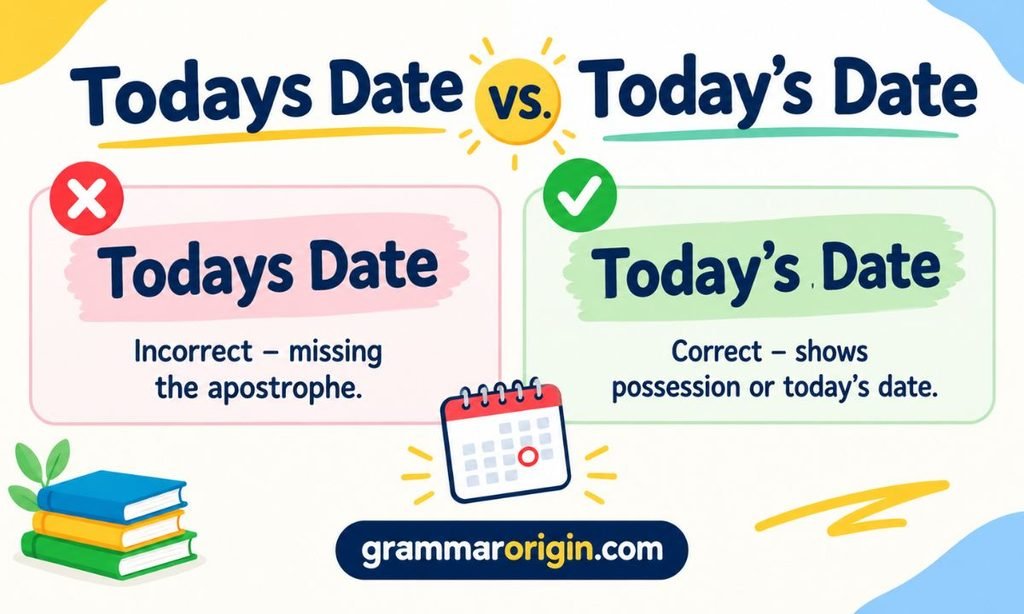
“Today’s” quietly does two different jobs, and only the sentence around it tells you which one is active. One version shows possession; the other is shorthand for “today is.”
Mixing these up rarely changes the spelling, but it’s worth knowing the difference so you can read your own sentences back with confidence. This is also where today’s meaning can shift slightly depending on context, even though the spelling stays the same.
Example: “Today’s report is late” is possessive (the report belonging to today). “Today’s the day we launch” is a contraction, read as “today is the day we launch.”
Comparison Table: Today’s or Todays Meeting
One of the most searched versions of this question involves the word “meeting.” Here’s the side-by-side breakdown.
| Phrase | Correct? | Why |
| Today’s meeting | Yes | Possessive. The meeting belongs to today |
| Todays meeting | No | Missing apostrophe before the noun |
| Todays’ meeting | No | Apostrophe misplaced. “Today” has no standard plural to possess |
| The meeting today | Yes | “Today” works as an adverb here, so no apostrophe is needed |
Example: “I moved today’s meeting to 3 PM” is the version you want in an email. The other three will read as mistakes to most readers.
Todays Date vs. Today’s Date
This is probably the single most common way people run into this rule, since “date” gets typed constantly in forms, emails, and documents.
Today’s date is the only correct option here. The date in question belongs to the current day, which makes it a textbook case for the possessive apostrophe. Writing “todays date” is simply the wrong spelling of a phrase that already has one correct form.
Example: “Please write today’s date at the top of the form” is correct; “Please write todays date at the top of the form” is a punctuation error, not a stylistic variation.
Also Read This Labeller or Labeler: Which Spelling Is Correct? (US vs UK)
Which Spelling Should You Use?
Think of it as a three-way decision, and the vast majority of sentences will land in the first bucket.
- Today’s: whenever a noun follows and that noun connects to the present day (today’s news, today’s plan, today’s weather).
- Todays: only for the rare, deliberate plural, usually in creative or reflective writing (“our todays shape tomorrow”).
- Today: when the word stands alone as a noun or adverb, with nothing following it to possess.
Example: “Today’s homework is longer than usual” needs the apostrophe; “I finished my homework today” doesn’t, because “today” isn’t modifying anything there.
Common Mistakes with Todays / Today’s
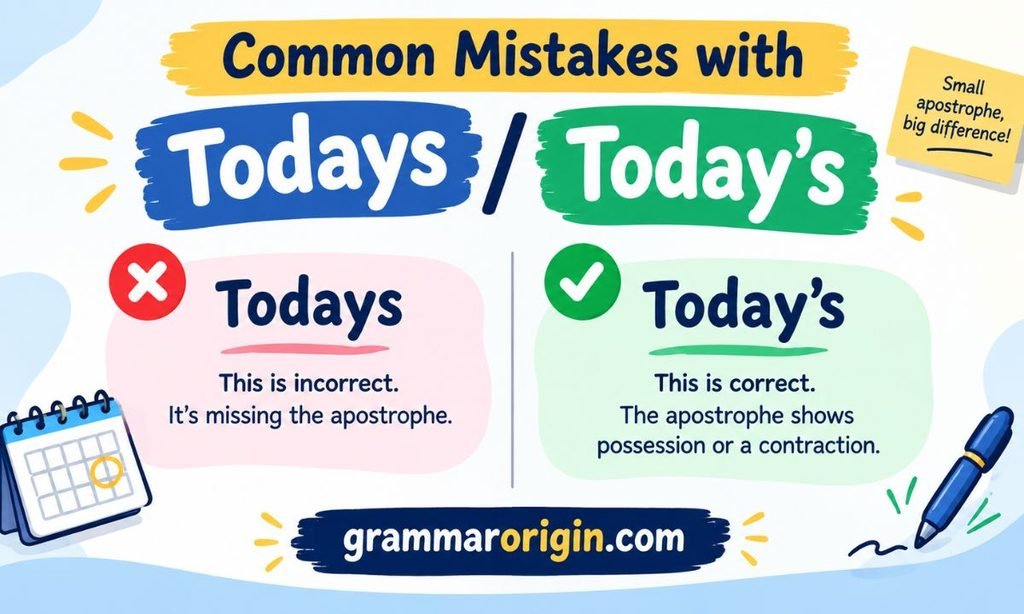
Most errors here come down to a handful of repeat offenders. Once you can spot these, the whole rule stops feeling shaky.
Mistake 1: Dropping the apostrophe before a noun
This is the single most common slip. Writers treat “today” like a plain adjective and skip the punctuation entirely.
Example: Incorrect: “Don’t forget about todays deadline.” Correct: “Don’t forget about today’s deadline.”
Mistake 2: Placing the apostrophe after the “s” (todays’)
Some writers assume “today” can be pluralized like a regular noun and then made possessive the way “the students’ books” works. It can’t. “Today” doesn’t have a normal plural to work from.
Example: Incorrect: “Todays’ meeting has been postponed.” Correct: “Today’s meeting has been postponed.”
Mistake 3: Treating “today” like an adjective without an apostrophe
Writers sometimes stack “today” directly in front of a noun the way they would with a regular adjective like “warm” or “quick,” forgetting that “today” needs the possessive marker to do that job correctly.
Example: Incorrect: “The today weather is nice.” Correct: “Today’s weather is nice.”
Mistake 4: Confusing the adverb form with the possessive form
The confusion usually comes from not pausing to ask what “today” is actually doing in the sentence: describing when, or showing ownership.
Example: Correct: “I have a call today.” (adverb, tells you when) Correct: “Today’s call starts at noon.” (possessive, tells you which call)
Today’s / Today’s in Everyday Examples
Seeing the rule play out across different settings makes it stick faster than any explanation alone.
Work: Today’s agenda covers three items. Please send today’s numbers by end of day.
School: Today’s lesson focuses on fractions. Did you finish today’s assignment?
News: Today’s headlines are dominated by the election. Have you seen today’s front page?
Casual conversation: Today’s the last day for the sale. What’s on today’s menu?
Today or Today’s Activity
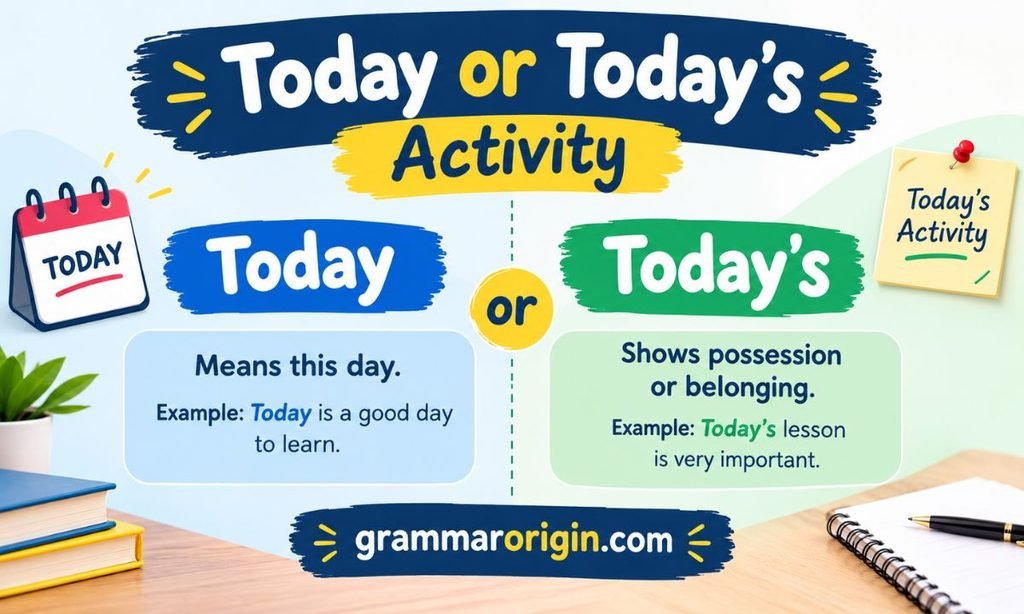
The difference here comes down to whether “today” is describing timing or ownership, and it’s an easy one to test in your head.
If nothing follows “today” to connect it to, leave it plain. If a noun follows and belongs to the day, add the apostrophe.
Example: “We’ll do the activity today” (no apostrophe needed). “Today’s activity is a group project” (the activity belongs to today).
Today or Today’s Class
Same logic applies to “class.” When “today” simply marks the timing of the class, it stays bare. When the class itself is being described as connected to the day, it needs the apostrophe.
Example: “The class is today” versus “Today’s class covers punctuation rules,” both correct, doing different jobs.
Todays or Today’s Date
When people type this exact phrase into a search bar, they’re almost always trying to settle one thing: does “date” need the apostrophe attached to “today.” It does.
The date in question is inseparably tied to the current day, which is precisely the relationship a possessive apostrophe exists to show. This is also one of the clearest real-world tests of the todays or today’s rule as a whole.
Example: “What’s today’s date?” is the version you’ll find in every style guide and every well-edited publication.
What Do Grammar Authorities Say?
Major dictionaries and style references treat this as settled grammar rather than a debated point. Merriam-Webster and the Cambridge Dictionary both list “today’s” as the standard possessive form of “today,” and neither treats “todays” as an accepted alternative before a noun.
Style guides used across publishing and journalism, including the Chicago Manual of Style and the AP Stylebook, follow the same standard possessive apostrophe rule that applies to any singular noun. “Today’s” isn’t handled as a special case.
Example: A copy editor following AP style would flag “todays deadline” in a press release the same way they’d flag “the companys profits”: both are missing a required apostrophe.
Also Read This Labeller or Labeler: Which Spelling Is Correct? (US vs UK)
Todays or Today’s – Google Trends & Usage Data
Search behavior tells a consistent story: people type “today’s” far more often in finished, edited writing, while “todays” shows up mostly in quick searches where the apostrophe simply got skipped while typing.
Grammar-checking tools like Grammarly and Microsoft Editor treat a bare “todays” before a noun as an error by default, which lines up with how style guides and dictionaries already treat it.
Example: Type “todays meeting” into almost any grammar checker, and it will suggest “today’s meeting” as the fix.
Keyword Comparison Table
| Search Phrase | Correct Form | Category |
| Todays date | Today’s date | Possessive |
| Todays meeting | Today’s meeting | Possessive |
| Todays weather | Today’s weather | Possessive |
| Todays news | Today’s news | Possessive |
| Todays schedule | Today’s schedule | Possessive |
| I’ll do it today | Today | Adverb, no apostrophe |
Quick Self-Check
Try these before you move on. Cover the answers first if you want a real test.
- “___ meeting starts at 3 PM.” Answer: Today’s
- “I’ll call you ___.” Answer: today
- “___ homework is due tomorrow.” Answer: Today’s
- “Our ___ shape our tomorrows.” (poetic plural) Answer: todays
- “What is ___ date?” Answer: today’s
If you got four or five right, you’ve already got the rule down better than most writers do.
Frequently Asked Questions
Is todays or today’s the correct spelling?
Today’s is the correct spelling in nearly every situation. Todays only exists as a rare plural form and almost never appears in normal writing.
Is “todays” a real word?
Yes, technically. It’s the plural of “today.” It’s just extremely uncommon and mostly limited to poetic or reflective writing, not everyday sentences.
Why does “today’s” need an apostrophe?
Because it’s a possessive noun form, and English marks possession on singular nouns with an apostrophe plus s. “Today’s” simply follows that same standard pattern.
Is it “today’s date” or “todays date”?
It’s always “today’s date.” The date belongs to the current day, which is exactly the relationship the possessive apostrophe is built to show.
Can I use “todays” without an apostrophe in a sentence?
Only in rare, deliberate literary usage, such as “our todays become memories.” Outside that narrow case, the apostrophe is required.
Is “today’s” used the same way in British and American English?
Yes. Both varieties require the apostrophe in exactly the same situations. There’s no regional difference to account for here.
What’s the difference between “today” and “today’s”?
“Today” works as a noun or adverb on its own. “Today’s” is the possessive form, used right before another noun to show that noun belongs to the present day.
Conclusion
The rule underneath the whole todays or today’s question is smaller than it looks. “Today’s” carries the apostrophe almost every time it sits in front of another word, because that apostrophe is doing exactly one job: showing that something belongs to the present day.
Once that clicks, “todays” stops being a coin flip. It becomes the rare exception you’ll almost never reach for, while “today’s” handles nearly everything else you write.

Muhammad Waqas is an English language teacher and grammar expert with over 8 years of experience helping students and professionals improve their writing skills. He specializes in English grammar, vocabulary, communication, and practical language learning. Through GrammarOrigin, Waqas shares clear, easy-to-understand content that helps readers write and speak English with confidence.