
If you’ve ever paused mid-sentence wondering whether it’s “thiefs” or “thieves,” you’re not alone. This is one of the most common plural-spelling mix-ups in English. The short answer: thieves is correct, and “thiefs” isn’t a real word in any dictionary.
The confusion makes sense. Most English nouns just take an “-s” in the plural, but “thief” belongs to a smaller group of words that swap the ending entirely. Once you see the pattern, you’ll never second-guess it again.
Thiefs
“Thiefs” looks like a natural plural. Just add an “s,” right? That’s exactly the trap. This spelling has never been accepted by any major dictionary, and it doesn’t follow the actual rule English uses for words like “thief.”
Example: “Two thiefs ran from the store” is incorrect in every style of English.
Thieves
“Thieves” is the one and only correct plural of “thief.” It follows a well-known pattern where words ending in “-f” swap that ending for “-ves” instead of simply adding an “s.”
Example: “The thieves ran from the store before police arrived.”
Thiefs or Thieves – Quick Answer
The plural of “thief” is always thieves, never “thiefs.” This isn’t a style choice or regional variation; it’s a fixed grammar rule that applies across formal and casual writing alike.
Rule
Words ending in “-f” or “-fe” often drop that ending and add “-ves” to form the plural. “Thief” is a textbook example of this pattern.
- thief → thieves
- calf → calves
- knife → knives
Quick Examples
Seeing the correct and incorrect forms side by side makes the rule stick faster than any explanation.
- Incorrect: The thiefs stole the car.
- Correct: The thieves stole the car.
- Incorrect: Three thiefs were arrested downtown.
- Correct: Three thieves were arrested downtown.
What Does “Thieves” Mean?
“Thieves” simply means more than one thief: people who take something that isn’t theirs without permission. It’s the standard plural used in everyday speech, news, and legal writing alike.
You’ll also see it in fixed expressions, like calling close friends “thick as thieves,” where the word takes on a more figurative sense.
Example: “Identity thieves target people who reuse the same password everywhere.”
The Origin of Thief and Thieves
“Thief” traces back to Old English þēof, a word already in use by the 9th century. As English evolved, the pronunciation softened, and by the time spelling standardized, “thief” had settled into its modern form.
The plural followed a sound pattern common to Old and Middle English, where certain final consonants turned voiced when a plural ending was added. That shift is the real reason “thief” becomes thieves instead of simply “thiefs.”
British English vs American English Spelling
Both British and American English agree completely here. There’s no regional split for this word. Thieves is correct on either side of the Atlantic.
Comparison Table
| Feature | British English | American English |
| Singular | thief | thief |
| Correct plural | thieves | thieves |
| Incorrect form | thiefs | thiefs |
| Regional difference? | None | None |
Example Sentences
- British: “The thieves slipped away before the alarm sounded.”
- American: “Detectives believe the thieves worked in pairs.”
Notice both sentences use the exact same spelling. No adjustment is needed depending on your audience.
Which Spelling Should You Use?
Use thieves every time you’re writing about more than one thief, no matter the context or tone.
Use “Thieves” When:
- Talking about two or more people who steal
- Writing news, legal, or academic content
- Using idioms like “thick as thieves”
Example: “The thieves left almost no evidence behind.”
Never Use “Thiefs”
“Thiefs” doesn’t appear in Merriam-Webster, Oxford, Cambridge, or Collins. Every major spell-checker will flag it instantly, so there’s no context where it’s safe to use.
Also Read This Cancellation vs Cancelation: The Correct Spelling Explained
Why Does Thief Become Thieves?
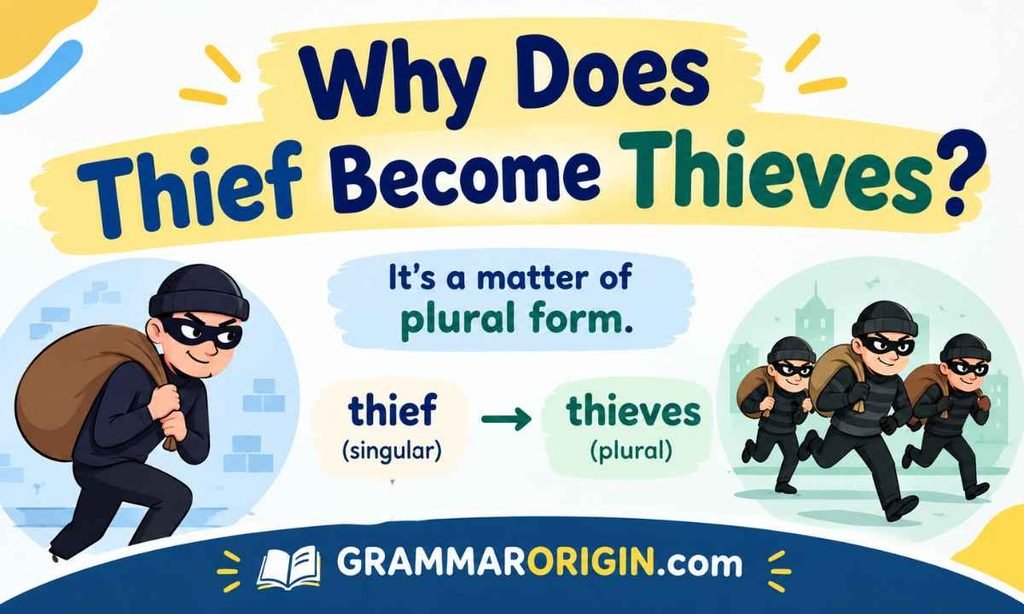
“Thief” changes because it belongs to a group of “-f” ending words that shift to “-ves” in the plural, driven by an old sound pattern rather than a random exception.
The F to VES Plural Rule
When a word ends in “-f” or “-fe,” English often drops that letter (or letters) and adds “-ves.” The soft “f” sound becomes a “v” sound once the plural ending is attached, and that’s the reason behind the change.
Example: thief becomes thieves, following the same shift as “loaf” becoming “loaves.”
Similar Words That Follow the Same Rule
| Singular | Plural |
| thief | thieves |
| wolf | wolves |
| shelf | shelves |
| wife | wives |
| calf | calves |
Not every “-f” word follows this pattern. “Roof” simply becomes “roofs,” so it’s worth checking a dictionary when you’re unsure.
Common Mistakes with Thiefs or Thieves
Most errors here come from applying the regular “-s” rule out of habit, or mixing “thief” up with words that behave differently.
Mistake 1: Adding “S” Instead of “VES”
This is by far the most frequent slip. It means treating “thief” like a regular noun and just tacking on an “s.”
Wrong: The thiefs broke the window. Right: The thieves broke the window.
Mistake 2: Confusing with Similar Words
Words like “beliefs” and “chefs” keep the plain “-s” ending, which throws people off when they assume every “-f” word behaves the same way.
Wrong: Two thiefs got away. Right: Two thieves got away.
Mistake 3: Ignoring Irregular Plural Rules
Many learners memorize the standard “add -s” rule first and never circle back to irregular forms, so “thief” keeps tripping them up years later.
Example: Treating “thieves” as an exception to learn once, rather than part of a whole family of “-ves” words, is what makes the mistake stick around.
Thiefs or Thieves in Everyday Examples
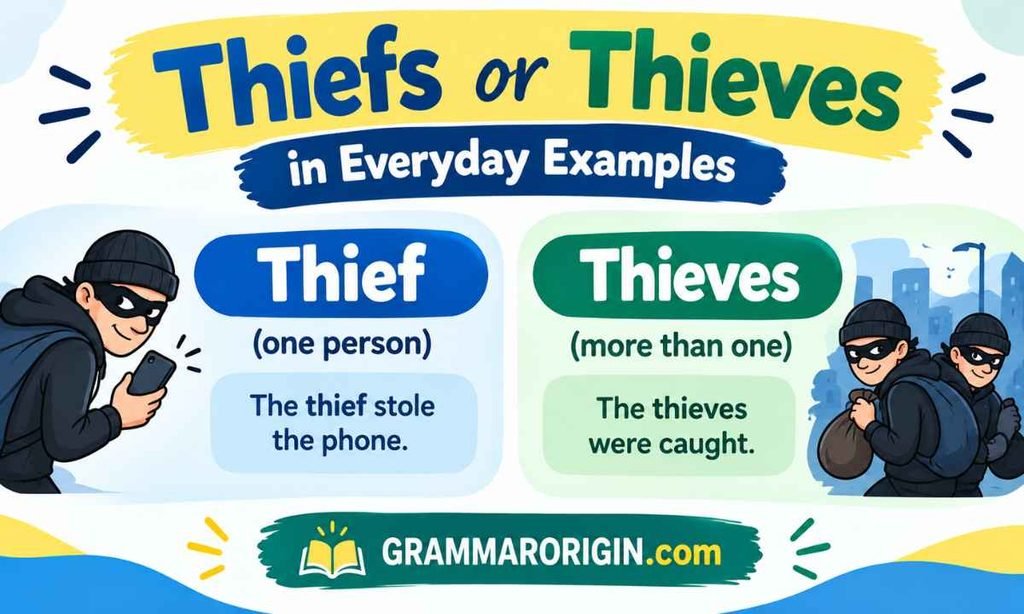
Seeing thieves used across different writing styles helps confirm there’s no context where “thiefs” would ever be acceptable.
In Emails
“Our team noticed unusual activity. It looks like thieves accessed the storage unit overnight.”
In News
“Thieves made off with jewelry worth an estimated $150,000 from a downtown store.”
On Social Media
“Left my bike outside for two minutes and thieves still managed to grab it. Unreal.”
In Formal Writing
“The accused, described in court filings as repeat thieves, face multiple charges.”
Thiefs or Thieves – Google Trends & Usage Data
Search behavior consistently shows people typing “thiefs” mainly to check if it’s correct, not because they actually use it in writing.
Usage Patterns
Most queries for “thiefs” are spelling-check searches rather than genuine usage, while “thieves” shows up constantly in published writing, news archives, and everyday conversation.
Country Trends
Across the US, UK, Canada, Australia, and India, thieves is the spelling everyone settles on. No English-speaking region treats “thiefs” as standard.
Comparison Table: Thiefs vs Thieves
| Feature | Thiefs | Thieves |
| Grammatically correct | No | Yes |
| In dictionaries | No | Yes |
| Used by native speakers | Rarely | Always |
| Flagged by spell-check | Yes | No |
Other English Words That Change F to VES
Once you group “thief” with its word family, the rule becomes much easier to remember instead of feeling random.
- Leaf → Leaves: “The leaves turned orange almost overnight.”
- Knife → Knives: “She keeps her knives razor sharp.”
- Half → Halves: “Split the sandwich into two halves.”
- Life → Lives: “Paramedics saved three lives that night.”
- Scarf → Scarves: “He packed two wool scarves for the trip.”
How to Remember the Correct Spelling of Thieves
A few small tricks make this spelling automatic instead of something you have to look up every time.
Group it with its family. Say “leaves, knives, wolves, thieves” together. The shared “-ves” sound helps the pattern stick in your memory.
Listen for the V sound. When you say “thieves” out loud, you hear a clear “v,” which is your cue to spell it with “-ves,” not just “-s.”
Run a quick search test. “Thieves” pulls up dictionary results, while “thiefs” pulls up spelling-correction pages. That contrast alone is a simple way to double-check.
Also read This Taught or Tought: The Correct Spelling Explained
Thiefs or thieves synonym
Common alternatives to “thieves” include robbers, burglars, crooks, and bandits, depending on how formal or specific you need the wording to be.
Example: “Police described the burglars as well-organized and fast-moving,” works as a natural substitute for “thieves” in a news context.
Thieves pronunciation
“Thieves” is pronounced /θiːvz/, like “theeves,” with a soft “th” sound at the start and a clear “v” before the final “z” sound.
Example: Saying it slowly as “thee-vz” helps reinforce why the spelling ends in “-ves” rather than “-fs.”
Frequently Asked Questions
Is “thiefs” ever correct?
No. “Thiefs” isn’t recognized by any major dictionary and is considered a spelling error in every context, formal or casual.
What is the plural of thief?
The plural of “thief” is “thieves.” The “-f” ending changes to “-ves” following a standard irregular plural pattern.
Why does thief become thieves instead of thiefs?
“Thief” belongs to a group of “-f” ending words that shift to “-ves” in the plural because of how the sound naturally changes when pluralized.
Does British English spell it differently than American English?
No. Both varieties of English use “thieves” as the correct plural, with zero regional variation.
Can “thief” be used as a plural on its own?
No. “Thief” is strictly singular. Referring to more than one requires “thieves.”
What other words follow the same f-to-ves pattern?
Examples include leaf/leaves, knife/knives, wolf/wolves, shelf/shelves, and life/lives.
Is “identity thieves” the correct phrase?
Yes. “Identity thieves” is the standard, correct way to refer to multiple people committing identity theft.
Final Thoughts
The rule is simple and doesn’t change with context: thieves is always correct, and “thiefs” is always wrong. “Thief” follows the same “-f to -ves” pattern as leaves, knives, and wolves, so grouping it with that word family is the easiest way to remember it for good.
Whether you’re writing a text message, a news report, or a formal document, sticking with thieves keeps your writing accurate and mistake-free every time.

Muhammad Waqas is an English language teacher and grammar expert with over 8 years of experience helping students and professionals improve their writing skills. He specializes in English grammar, vocabulary, communication, and practical language learning. Through GrammarOrigin, Waqas shares clear, easy-to-understand content that helps readers write and speak English with confidence.