
If you’ve ever typed a sentence like “My mom ___ me how to cook” and paused right before that blank, you already know the struggle. Taught or tought is one of those spelling questions that trips up native speakers and English learners alike.
The short version: taught is correct, and tought isn’t a real word in standard English. This guide breaks down exactly why, how to remember it for good, and how to use it confidently in real sentences.
Taught or Tought: The Quick Answer
Between taught or tought, only one is a real word: taught. It’s the past tense and past participle of the verb teach, and it shows up constantly in everyday writing, school essays, and professional documents.
Example: “She taught me how to drive last summer.”
Tought isn’t a recognized spelling in English at all. It doesn’t appear in Cambridge, Merriam-Webster, or Oxford as a standalone word. It’s simply a common typo that happens when writers blend the sound of “taught” with the spelling pattern of words like “thought” or “bought.”
Taught vs Tought: Quick Comparison
| Point | Taught | Tought |
| Real English word | Yes | No |
| Comes from “teach” | Yes | Not applicable |
| Function | Past tense / past participle | Misspelling |
| Correct sentence | “He taught the class.” | “He tought the class.” (Incorrect) |
| Found in dictionaries | Yes | No |
| Safe for formal writing | Yes | Never |
Featured Snippet Answer
Taught is the only correct spelling. It means someone gave instruction, training, or knowledge to another person, and it works as both the simple past tense and past participle of teach. Tought has no meaning in English and should be treated as a spelling error every time it appears.
Example: “My grandfather taught me chess when I was seven.”
Once that core rule clicks, the rest of this guide is really just reinforcement: memory tricks, sentence patterns, and enough practice to make the correct spelling automatic.
What Does “Taught” Mean?
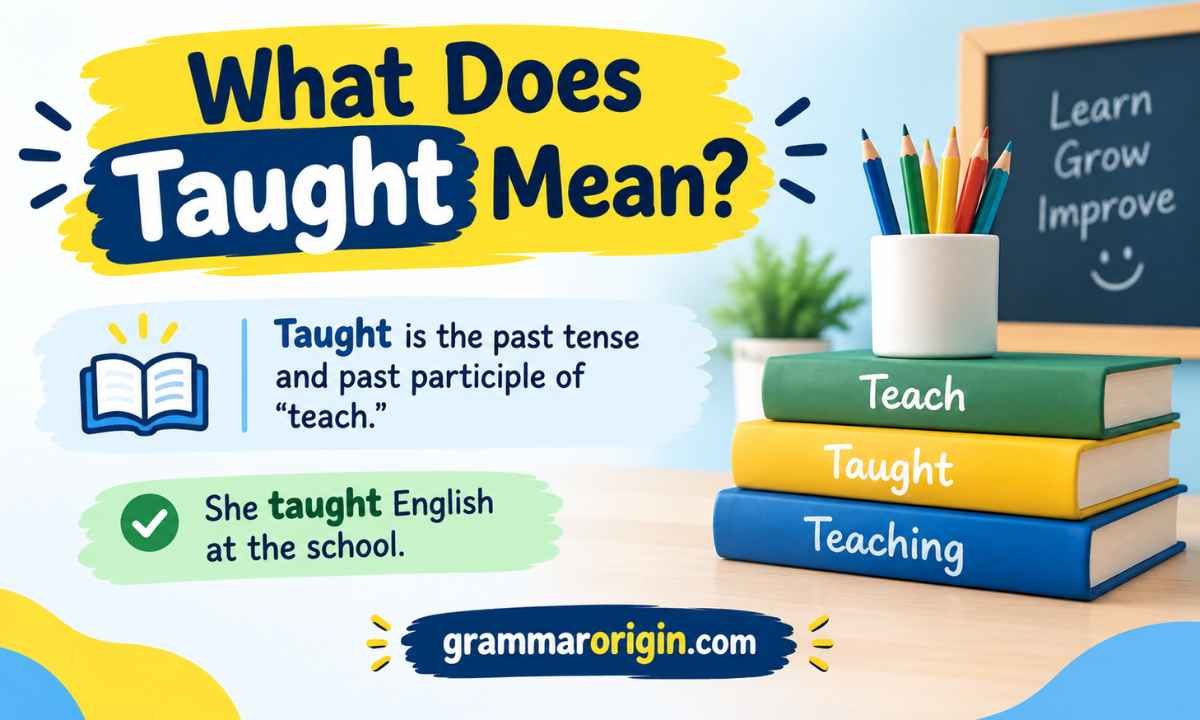
Taught means someone gave knowledge, a skill, or guidance to another person. It’s what happens when teaching is complete. The word traces directly back to the base verb teach.
Example: “The coach taught the players a new defensive move before the match.”
Teaching isn’t limited to classrooms. You can teach a language, a sport, a habit, or even an unspoken lesson through your actions. The verb covers all of it, and taught is simply that verb pushed into the past.
Because teach is an irregular verb, it doesn’t follow the normal “add -ed” rule that regular verbs use. Instead, it changes shape entirely, following this simple conjugation pattern:
Teach → Taught → Taught
This pattern puts teach in the same family as other irregular verbs like catch → caught, buy → bought, and bring → brought, all words where the vowel sound shifts and the spelling changes along with it.
Also Read This Appreciate It or Appreciated It: Which One Should You Use?
Taught as the Past Tense of Teach
Reach for taught any time the teaching already happened and is finished. It marks a completed action, plain and simple.
Example: “Our professor taught that course for over a decade before retiring.”
A few more everyday uses:
- My older sister taught me to swim at the community pool.
- The mentor taught the interns three new techniques last Tuesday.
- That job taught her more about patience than any classroom ever did.
Notice how each sentence points to a specific moment or stretch of time in the past. That’s the signal to use taught rather than the present-tense form, teach.
Taught as a Past Participle
Taught also pairs with helping verbs like have, has, and had to build perfect tenses. The spelling never shifts, no matter which helping verb comes before it.
Example: “She has taught piano lessons for fifteen years.”
Here’s how the tense changes while the spelling stays fixed:
- Simple past: He taught yoga at the studio downtown.
- Present perfect: He has taught yoga at the studio for six years.
- Past perfect: He had taught yoga before switching careers.
That consistency is actually good news for writers. Once you know the word, it works everywhere without any extra rules to memorize.
Taught Can Also Refer to Lessons Learned Through Experience
You don’t need a classroom or a formal instructor for something to have “taught” you a lesson. Life, mistakes, and hard moments can teach just as effectively as a person can.
Example: “Losing that contract taught our whole team to double-check every deadline.”
A few more examples of this meaning:
- Growing up abroad taught him to adapt quickly to new situations.
- That injury taught her to warm up properly before every workout.
- The failed launch taught the founders a lesson they never forgot.
This wider meaning is one reason “taught” shows up so often in reflective writing, memoirs, and personal essays. It captures growth, not just formal instruction.
Why Is “Tought” Incorrect?
Tought is incorrect because it isn’t an actual English word. It’s a blend error that happens when the brain mixes the sound of “taught” with the spelling of similar-looking words like thought, bought, and fought.
Example (wrong): “He tought me how to fish.” The correct version reads: “He taught me how to fish.”
English has a cluster of past-tense verbs ending in that same “-ought” sound: thought, bought, brought, caught, fought. Writers sometimes assume “teach” should follow the identical pattern, landing on “tought” instead of the actual irregular form.
The rule to remember:
Teach becomes taught, never “tought.”
The “Thought” and “Taught” Confusion
The most common source of this mistake is confusing taught with thought, two words that sound almost identical but come from completely different verbs.
Example: “I thought about calling her, but my manager taught me to always confirm plans in writing first.”
Thought comes from think:
- I thought you’d already left.
- She thought the meeting went well.
- We have thought about relocating.
Taught comes from teach:
- I taught the workshop last week.
- She taught her dog a new trick.
- We were taught to double-check our work.
One simple way to tell them apart for good: think leads to thought, teach leads to taught. Match the base verb, and the correct spelling follows automatically.
Why English Learners Often Make This Mistake
This particular error is common because English pronunciation rarely matches its spelling in a clean, predictable way. The base verb teach sounds nothing like its past-tense form, which throws off a lot of learners who expect a smoother transition.
Example: A student who correctly writes “I teach math” every day may still slip and write “Yesterday I tought math,” simply because the jump in sound feels unrelated to the jump in spelling.
- Present: teach, pronounced with a long “ee” sound
- Past: taught, pronounced with a completely different “aw” sound
That’s a bigger leap than most regular verbs make, which is exactly why memorizing the full pattern, rather than guessing from pronunciation, works so much better.
Does “Tought” Ever Mean Something Else?
No. Tought doesn’t carry any alternate or special meaning in standard English. It isn’t slang, it isn’t a regional variant, and it isn’t an accepted informal spelling anywhere in modern usage.
Example: Searching “tought” in any major dictionary returns either no results or a suggestion asking, “did you mean taught?”
If your sentence is about giving instruction, showing someone a skill, or describing a lesson learned, the word you’re reaching for is always taught, never tought, in any context.
Taught or Tought: How to Remember the Correct Spelling
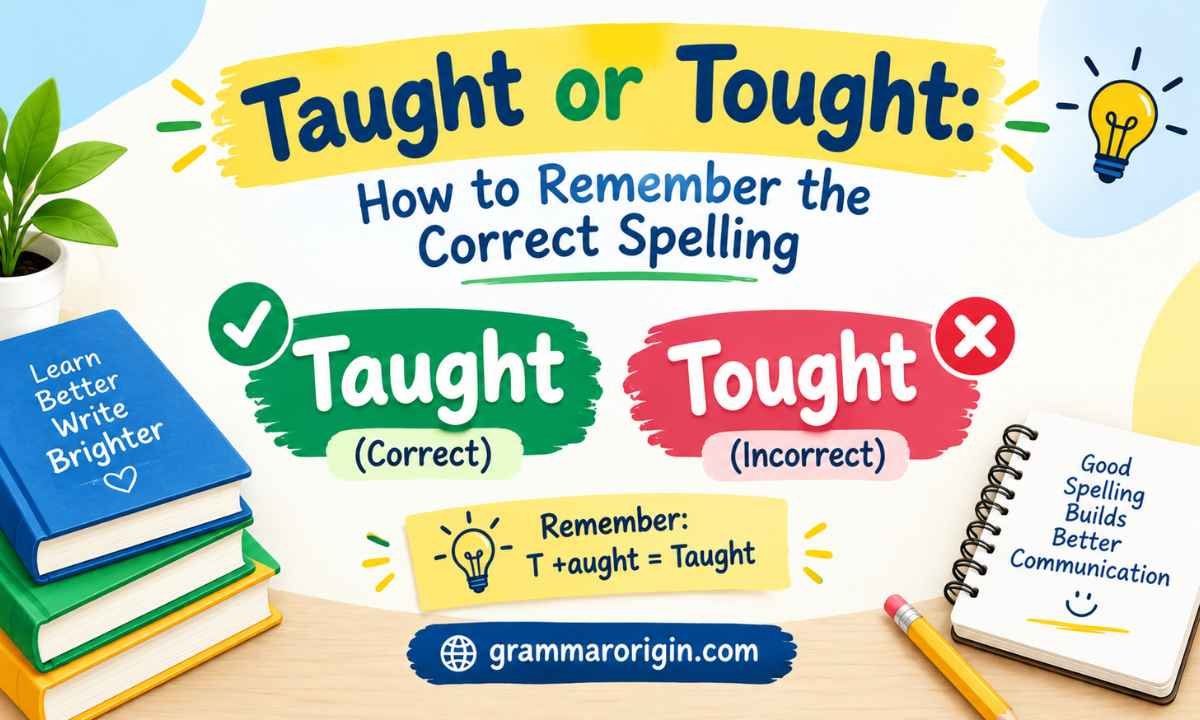
The fastest way to lock in taught for good is to stop treating it as a standalone word and start treating it as part of a three-word verb pattern you memorize together.
Example memory sentence: “Today I teach, yesterday I taught, and I have taught for years.”
Saying that sentence out loud a few times does more for your spelling than any rule ever could, because it forces your brain to link all three forms in one sequence.
The Best Memory Trick: Teach Has “EA,” but Taught Has “AU”
Here’s a simple visual anchor: the present tense teach contains the letters EA, while the past tense taught switches to AU. Spot that letter swap, and you’ll stop reaching for “tought” for good.
Example: Write “tEAch” and “tAUght” side by side and circle the vowel pair in each. The contrast sticks surprisingly fast.
Connect Taught With Other Common Irregular Verbs
Taught belongs to a small group of irregular verbs that share a similar past-tense sound, even though their spellings aren’t identical letter for letter.
Example: “She caught the ball, bought a snack, and taught her nephew the rules, all before lunch.”
- Catch → Caught
- Buy → Bought
- Bring → Brought
- Teach → Taught
Grouping these together in your head builds a mental shortcut. When a verb’s past form ends in that “-ought” or “-aught” sound, there’s a good chance it’s irregular and worth double-checking.
Ask Yourself: “What Is the Base Verb?”
Whenever you’re stuck between taught or tought, trace the sentence back to its root verb first. If the base verb is teach, the past form has to be taught. There’s no other option.
Example: In “My tutor ___ me algebra,” ask yourself what the base verb is. It’s teach, so the blank has to be filled with taught.
This trick works especially well during editing, when you’re scanning your own writing with fresh eyes instead of typing on autopilot.
How to Use “Taught” Correctly in Sentences
Knowing that taught is correct is only half the job. Using it naturally across different sentence structures is what makes your writing sound fluent rather than memorized.
Example: “The instructor taught the beginners a warm-up routine before the main lesson began.”
Using Taught With a Person
A common pattern places taught directly between the teacher and the topic: someone + taught + someone + something.
Example: “My aunt taught me embroidery over the summer.”
You’ll also see a slightly rearranged version: someone + taught + something + to + someone, as in “She taught yoga to a group of beginners.” Both patterns are equally correct; pick whichever reads more naturally in your sentence.
Using Taught With “How to”
When someone shows another person the steps to complete a task, the structure taught + person + how to + verb fits perfectly.
Example: “His older brother taught him how to change a tire.”
A few more natural variations:
- The chef taught the class how to knead dough properly.
- My father taught me how to negotiate a fair price.
- She taught her roommate how to budget each paycheck.
Using Taught in Passive Voice
Taught shows up constantly in passive constructions, where the focus shifts to the person receiving the lesson rather than the one delivering it.
Example: “I was taught to always double-check my sources before publishing.”
More passive examples:
- The recruits were taught basic first aid on their first day.
- We were taught to respect other people’s time.
- She was taught by one of the best coaches in the league.
Common Examples of Correct Usage
Seeing taught used across a range of everyday sentences helps the correct spelling feel automatic rather than memorized.
Example: “Every skill she has ever taught me, from cooking to budgeting, started with patience.”
- My high school teacher taught us how to write a proper essay.
- The bootcamp taught hundreds of students in its first year alone.
- He had taught himself to code before turning eighteen.
- Life taught her to trust her instincts.
Taught or Tought in 2025–2026: What Current Reference Data Shows
Every major dictionary reference active in 2025 and 2026 agrees on the same verb pattern, without exception: teach becomes taught in both the simple past and the past participle.
Example: A 2026 dictionary lookup for “teach” returns the same conjugation chart it has shown for years: teach, taught, taught, with no listed alternate spelling.
| Check | Result |
| Base verb | Teach |
| Simple past | Taught |
| Past participle | Taught |
| “Tought” as an accepted variant | No, in any current reference |
This consistency matters more than it might seem. Informal writing online moves fast, and misspellings can spread through comment sections and social posts simply because they’re repeated often, not because they’re correct. For anything you plan to publish, submit, or send professionally, sticking with dictionary-backed spelling is always the safer call.
Also Read This Appreciate It or Appreciated It: Which One Should You Use?
Why Reliable References Matter
Autocorrect and grammar checkers catch plenty of typos, but no tool is perfect, and understanding the actual rule protects you when one misses something.
Example: Some autocorrect settings won’t flag “tought” if a custom dictionary or predictive keyboard has learned it from repeated typos in your own messages.
A reliable process looks like this:
- Figure out what you’re actually trying to say.
- Identify the base verb behind the word.
- Check whether that verb is regular or irregular.
- Confirm with a dictionary if you’re still unsure.
- Reread the full sentence once more before hitting send.
Real-Life Case Study: A Small Spelling Error in Professional Writing
Consider Maria, a freelance UX consultant updating her portfolio site. One line under her bio read: “Maria has tought workshops for design teams across three countries.”
Example: The rest of her portfolio was polished, with a clean layout and strong case studies, but that single misspelling sat right in the sentence meant to showcase her teaching experience.
A colleague reviewing the site before launch caught the error and suggested the fix: “Maria has taught workshops for design teams across three countries.” The correction took seconds, but the timing mattered, since that sentence was meant to build trust in her skills.
Maria’s situation is common. A spelling slip rarely blocks understanding entirely, but it can hurt a reader’s trust exactly where they’re deciding whether to believe your expertise.
What This Case Study Teaches
A single misspelled word can matter far more depending on where it lands. Contexts like the following raise the stakes considerably:
- A resume or portfolio bio
- A client proposal or pitch deck
- An academic paper or thesis
- A professional email to a new contact
- Published blog or website content
Whenever a sentence involves the past tense of teach, taught is the only safe choice. Treating it as a fixed pattern removes the guesswork entirely.
Common Mistakes to Avoid With Taught
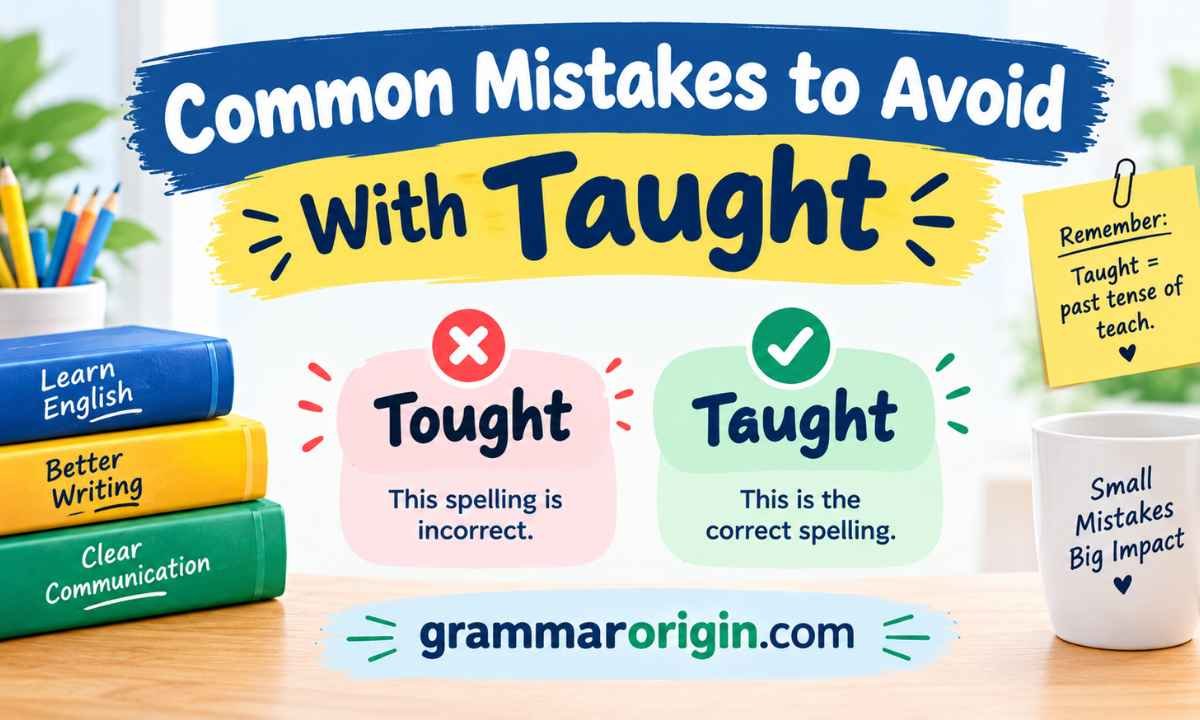
Beyond the core taught versus tought mix-up, a handful of related errors tend to show up around this same verb.
Example: “Yesterday my coach teach us a new drill” mixes up the tense entirely. The corrected version reads: “Yesterday my coach taught us a new drill.”
Mistake 1: Writing “Tought” Instead of “Taught”
Wrong: “She tought me how to bake bread.” Right: “She taught me how to bake bread.”
This is the foundational error this entire guide addresses, and the easiest one to fix once the pattern clicks.
Mistake 2: Using “Teach” When You Need the Past Tense
Wrong: “Last year, he teach a course on public speaking.” Right: “Last year, he taught a course on public speaking.”
Since the action already happened, the present-tense form teach simply doesn’t fit. Taught is required.
Mistake 3: Using “Taught” When the Present Tense Is Needed
Wrong: “Every Friday, she taught guitar lessons.” Right: “Every Friday, she teaches guitar lessons.”
For habitual or ongoing actions happening in the present, swap taught for the correct present-tense form, teaches.
Mistake 4: Confusing Taught With Thought
Wrong: “My mentor thought me to negotiate better.” Right: “My mentor taught me to negotiate better.”
Keep the distinction simple: thought relates to thinking, taught relates to teaching.
Mistake 5: Forgetting the Past Participle Form
Wrong: “She has teach English abroad for years.” Right: “She has taught English abroad for years.”
Any time has, have, or had comes before the verb, the past participle taught is what belongs there.
A Simple Checklist Before Using “Taught”
Before you hit publish or send, run through this quick mental checklist to confirm you’ve got the right word.
Example: For the sentence “My uncle ___ me how to fix a bike,” each checklist point below confirms taught is correct.
- Does the sentence trace back to the base verb teach?
- Is the action set in the past?
- Does it involve giving instruction or helping someone learn?
- Is there a has, have, had, or passive structure involved?
- Have you spelled it t-a-u-g-h-t, not t-o-u-g-h-t?
If every answer lines up, taught is the word you want.
A Five-Second Grammar Test
Try completing this sentence: “Last week, my coach ___ me a new technique.”
The base verb is teach, and the timing is clearly in the past.
Example: “Last week, my coach taught me a new technique.” That’s correct; “tought” isn’t a word at all.
Taught vs Thought vs Bought vs Caught
Several English past-tense verbs share a similar sound but come from entirely different base words, which is exactly why mix-ups happen so often.
Example: “She thought about it, bought the supplies, caught the last bus, and still taught her class on time.”
| Word | Base Verb | Meaning |
| Taught | Teach | Gave instruction |
| Thought | Think | Had an idea |
| Bought | Buy | Purchased something |
| Caught | Catch | Grabbed or received |
The Meaning Test
The fastest way to pick the right word from this group is to ask what the sentence is actually about.
Example: If the sentence is about instruction, taught fits. If it’s about an opinion or idea, thought fits instead.
Run through it quickly: talking about teaching means taught, talking about thinking means thought, talking about buying means bought. Meaning, not sound, should always drive the choice.
When Should You Use “Taught”?
Use taught any time you need the past tense or past participle of teach, whether that’s simple past, perfect tenses, passive voice, or a lesson learned from experience.
Example: “That single mistake taught me more than any lecture ever could.”
Use Taught for Completed Past Actions
- My professor taught that seminar for three semesters.
- The trainer taught a full class yesterday afternoon.
- My parents taught me to always ask questions.
Use Taught With Perfect Tenses
- She has taught abroad for close to a decade.
- They have taught thousands of students over the years.
- He had taught the material before switching schools.
Use Taught in Passive Sentences
- I was taught to read carefully before signing anything.
- We were taught the fundamentals during our first week.
- The recruits were taught by an experienced supervisor.
Use Taught for Lessons From Experience
- That setback taught him to plan further ahead.
- Traveling alone taught her real independence.
- Years in customer service taught them patience.
Mini Quiz: Taught or Tought
Test what you’ve learned with these quick questions.
Quiz 1: Pick the Correct Spelling
Which is correct? A. My teacher tought me English. B. My teacher taught me English.
Answer: B. Taught is the correct past tense of teach.
Quiz 2: Fill in the Blank
Yesterday, my father ______ me how to change a tire. A. teach B. taught C. tought D. teaching
Answer: B. The action already happened, so taught fits.
Quiz 3: Quick Choice
Which is the correct past tense of teach? A. Teached B. Tought C. Taught D. Teachen
Answer: C. The pattern is teach, taught, taught.
Quiz 4: Fill in the Blank
She has ______ dance for over a decade. A. teach B. tought C. taught D. teaching
Answer: C. After has, use the past participle taught.
Quiz 5: Spot the Mistake
“Our mentor tought us a valuable lesson.”
Answer: “Tought” is wrong. It should read, “Our mentor taught us a valuable lesson.”
Quiz 6: Choose the Right Sentence
A. I was tought how to swim. B. I was taught how to swim.
Answer: B. This passive structure requires taught.
Quiz 7: Fill in the Blank
My grandmother ______ me to bake from scratch. A. taught B. tought C. teach D. teaches
Answer: A. Taught fits this completed past action.
Quiz 8: Taught or Thought?
I ______ about your offer before deciding. A. taught B. thought C. tought D. teach
Answer: B. Thought comes from think, not teach.
Quiz 9: Easy Grammar Check
Complete the pattern: Teach → ______ → Taught A. Tought B. Teached C. Taught D. Teaching
Answer: C. The full pattern is teach, taught, taught.
Quiz 10: Fill in the Blank
That hard year ______ me more than any class could. A. teach B. taught C. tought D. teaches
Answer: B. Experiences can “teach,” and their past form is taught.
Quiz 11: Find the Correct Word
Which word means “gave someone instruction”? A. Thought B. Bought C. Taught D. Tought
Answer: C. Taught comes directly from teach.
Quiz 12: Fill in the Blank
The recruits were ______ basic safety procedures. A. teach B. tought C. taught D. teaches
Answer: C. After were, taught is the correct passive form.
Quiz 13: Which One Sounds Right?
A. She had tought the class before. B. She had taught the class before.
Answer: B. Taught is the correct form after had.
Quiz 14: Final Challenge — Fill in the Blank
“That failure has ______ me to plan ahead.” A. tought B. thought C. taught D. teach
Answer: C. The correct sentence reads: “That failure has taught me to plan ahead.”
References
- Merriam-Webster Dictionary
- Cambridge Dictionary
Frequently Asked Questions
Is “tought” a real word in any context?
No. Tought has no recognized meaning or usage in standard English, formal or informal.
Example: “He tought me algebra” should always read “He taught me algebra.”
What’s the correct spelling: taught or tought?
The correct spelling is always taught, whether you’re using it as a simple past tense or a past participle.
Example: “The workshop taught us three new tools.”
Is taught the past tense of teach?
Yes. Taught serves as both the simple past tense and past participle of teach, following the pattern teach, taught, taught.
What’s the difference between taught and thought?
Taught comes from teach and refers to instruction. Thought comes from think and refers to an idea or opinion.
Example: “I thought about it, then remembered what she taught me.”
Can “taught” follow have, has, or had?
Yes. Taught works as the past participle after any of these helping verbs.
Example: “They have taught this course since 2019.”
Why do people confuse taught with tought?
It usually happens because writers pattern-match teach’s past tense against similar-sounding words like thought, bought, and caught, which all end in a similar sound but follow different spellings.
Is there a quick trick to remember the correct spelling?
Yes. Memorize teach and taught together as one unit rather than trying to build the past tense from scratch: “Today I teach, yesterday I taught.”
Final Verdict: Taught or Tought?
The verdict is straightforward: taught is the only correct spelling whenever you’re using the past tense or past participle of teach, and tought simply isn’t a word in standard English.
Keep the full pattern in mind: teach, taught, taught. Lean on the memory tricks above whenever you catch yourself hesitating. With a little practice, spelling it correctly will stop requiring any thought at all.

Muhammad Waqas is an English language teacher and grammar expert with over 8 years of experience helping students and professionals improve their writing skills. He specializes in English grammar, vocabulary, communication, and practical language learning. Through GrammarOrigin, Waqas shares clear, easy-to-understand content that helps readers write and speak English with confidence.