
Sentence or sentance: if you’ve typed both and hesitated before hitting send, you’re not alone. The correct spelling is sentence, and sentance is simply a common typo that never made it into any dictionary.
This guide settles the question in the first few lines, then walks through why the mix-up happens, where the word comes from, and a trick that makes the correct spelling stick for good. You’ll also see how “sentence” changes meaning entirely once you step from the classroom into a courtroom.
Sentence or Sentance: Quick Answer
The correct word is sentence. Sentance isn’t recognized in Merriam-Webster, Oxford, or Cambridge. It’s a spelling error, not an alternate form or regional variant.
Is It Sentence or Sentance?
Sentence is correct in every context: grammar, law, education, and everyday writing. Sentance has never been accepted anywhere in standard English.
Example: She wrote a clear, grammatical sentence. (Not: She wrote a clear, grammatical sentance.)
Quick Examples
Here’s the difference in action:
- Correct: The teacher asked us to write a complete sentence.
- Incorrect: The teacher asked us to write a complete sentance.
- Correct: The judge handed down a five-year sentence.
- Incorrect: The judge handed down a five-year sentance.
Sentence vs Sentance Comparison Table
| Word | Correct? | Meaning |
| Sentence | Yes | A complete grammatical statement, or a legal punishment |
| Sentance | No | Common misspelling of sentence |
The Easy Rule to Remember
If you’re writing about grammar, law, school, or everyday communication, the answer is always sentence, never sentance.
Example: Think of “sentence” as sitting next to “essence” and “presence.” All three end in -ence, and all three are correct only that way.
Why Do People Misspell Sentence as Sentance?
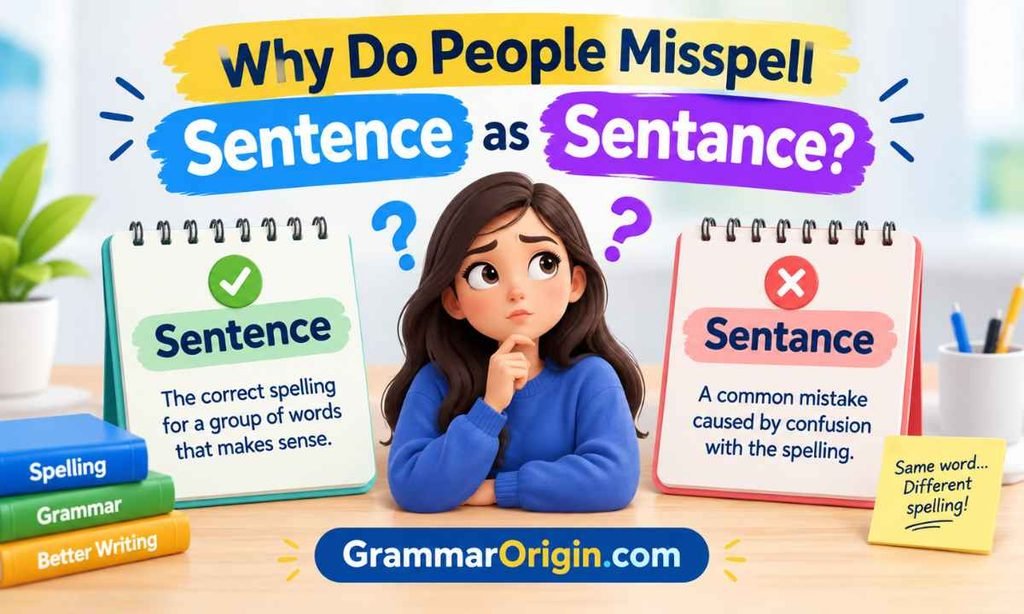
The mistake feels random, but it actually follows a predictable pattern rooted in sound, memory, and habit.
Pronunciation Creates Confusion
Sentence is pronounced /ˈsen.təns/, and that final unstressed syllable barely sounds like “-ence” or “-ance” at all. Spoken quickly, both endings blur into the same soft “uhns” sound.
This is a classic case of English orthography (the writing system) not matching pronunciation closely enough to guide spelling on its own.
Example: Say “attendance” and “sentence” out loud, back to back. The endings sound nearly identical, even though the spellings aren’t.
Also Read This Tomatoes or Tomatos: The Correct Spelling Explained
Similar Words Influence Our Memory
English is full of words ending in -ance and -ence, and writers often borrow the wrong pattern from memory.
| Words Ending in -ance | Words Ending in -ence |
| Importance | Difference |
| Distance | Experience |
| Acceptance | Reference |
| Performance | Sentence |
Example: Someone who just typed “performance” and “importance” is primed to type “sentance” next. The brain simply repeats the pattern it used seconds earlier.
Typing Habits Matter
Fast typists rely on muscle memory more than conscious spelling rules, and muscle memory doesn’t always know the difference between -ance and -ence.
Example: A student typing an essay under time pressure is far more likely to type “sentance” than someone slowly writing a formal letter.
Search Trends Show Ongoing Confusion
People regularly search phrases like “sentence or sentance,” “how to spell sentence,” and “is sentance a word.” That pattern shows this isn’t a rare slip. It’s a recurring point of doubt for writers at every level.
Example: Type “sentanc” into any search bar, and it will usually auto-complete toward “sentence,” simply because so many people search the misspelling first.
Editor’s Tip: If you catch yourself typing “sentance,” pause and swap it mentally with “essence.” Both end the same way, and “essence” rarely gets misspelled, so borrow its confidence.
What Does Sentence Mean?
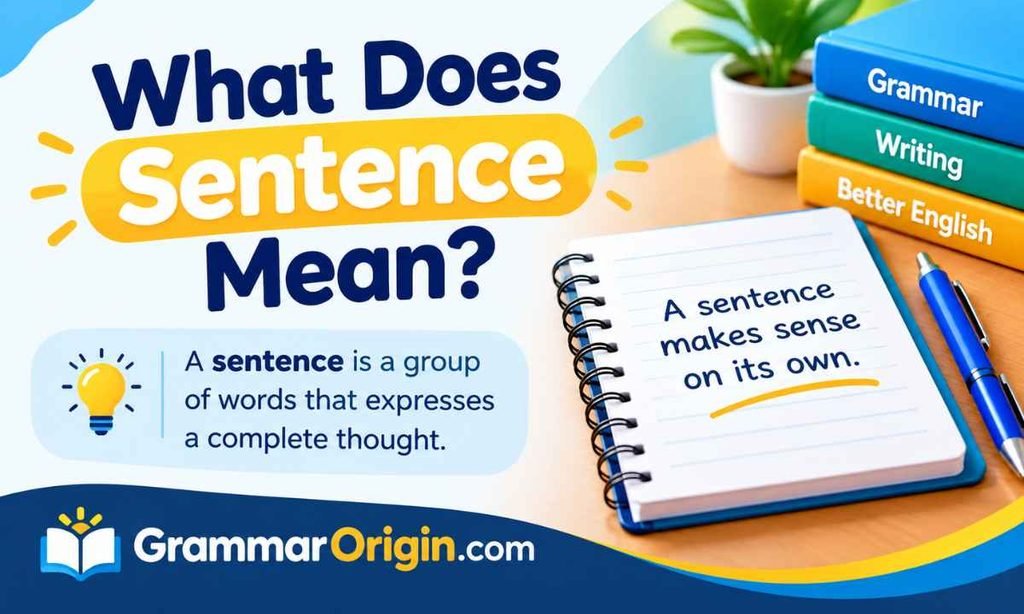
Sentence carries two distinct meanings, and understanding both makes the correct spelling easier to remember.
Dictionary Definition of Sentence
A sentence is a group of words that expresses a complete thought, usually built from a subject and a verb.
Example: The dog barked loudly. This is a complete thought, so it qualifies as a sentence.
Sentence as a Grammar Term
In grammar, a sentence is the smallest independent clause that can stand entirely on its own without extra context.
Example: “Running through the park” is a fragment, but “She was running through the park” is a full sentence.
Sentence as a Legal Term
In law, a sentence is the punishment a court hands down after a conviction.
Example: The defendant received a ten-year prison sentence for the offense.
Two Meanings of Sentence
| Meaning | Example |
| Grammar | Write one complete sentence. |
| Law | The judge read out the sentence. |
Is Sentance a Real Word?
No. Sentance has never been an accepted English word in any major dictionary.
The Short Answer
Sentance is not listed in Merriam-Webster, Oxford, or Cambridge dictionaries. It’s treated purely as a spelling error, not a valid word.
Example: Type “sentance” into any dictionary search bar, and it will redirect you straight to “sentence.”
Why Does Sentance Appear Online?
It shows up in blog comments, forum posts, and rushed emails simply because so many people repeat the same typing mistake, and search engines index that text regardless of accuracy.
Example: A quick web search for “sentance” still returns plenty of pages. Almost all of them are accidental misspellings, not intentional usage.
Can Sentance Ever Be Correct?
No. Unlike color and colour, where regional spelling genuinely differs, sentance has no regional or historical claim to legitimacy anywhere.
Example: Whether you’re writing for a UK publisher or a US classroom, the accepted spelling never changes. It’s sentence in both.
The Origin and History of the Word Sentence
The spelling of sentence isn’t random. It’s the product of centuries of borrowing between Latin, French, and English.
The Latin Beginning
The root traces back to the Latin sententia, itself formed from sentire, meaning “to feel” or “to perceive.” The connection to “sense” and “sentiment” isn’t a coincidence. They share the same root.
Example: Just as “sentiment” describes a felt opinion, the original Latin sense of sentence described a judgment or opinion someone had formed.
Through Old French
Latin sententia passed into Old French as sentence, keeping both the spelling and the core meaning of “judgment” or “opinion” largely intact.
Example: Old French writers used sentence to describe a wise saying or a formal judgment, a meaning that survives today in legal sentencing.
Arrival in English
Middle English absorbed the word through Norman French influence, and its meaning gradually expanded to cover grammatical statements alongside judicial decisions.
Example: By the 1400s, English writers were already using sentence both for a court’s ruling and for a properly formed statement in writing.
Also Read This Tomatoes or Tomatos: The Correct Spelling Explained
Why the Ending Uses “-ence”
The -ence ending survived because it came directly from the Latin -entia suffix through French, not because of how the word sounds when spoken today. This is a small example of morphology (word structure) outlasting pronunciation over time.
Example: Words like “essence,” “presence,” and “sentence” all trace to similar Latin -entia roots, which is exactly why they share the same ending.
Sentence vs Sentance: Key Differences Explained
Once you line the two words up side by side, the contrast is straightforward.
Spelling Comparison
| Version | Status |
| Sentence | Correct |
| Sentance | Incorrect |
Dictionary Recognition
| Dictionary Check | Sentence | Sentance |
| Standard Dictionaries | Listed | Not listed |
| Academic Use | Accepted | Rejected |
| Professional Writing | Accepted | Rejected |
Pronunciation Comparison
Both versions sound almost the same out loud, which is exactly why the spelling mistake persists. Linguists sometimes call this kind of near-identical sound a homophone-like pattern, even though sentance isn’t a real word on its own.
Example: Read “complete sentence” and “complete sentance” aloud. Most listeners won’t hear any difference at all.
Usage Comparison
Sentence appears in books, court documents, textbooks, and professional writing. Sentance appears almost exclusively as a typo.
Example: Search any published novel or news article for “sentance,” and you’ll come up empty. It simply doesn’t exist in edited text.
How to Remember the Correct Spelling of Sentence
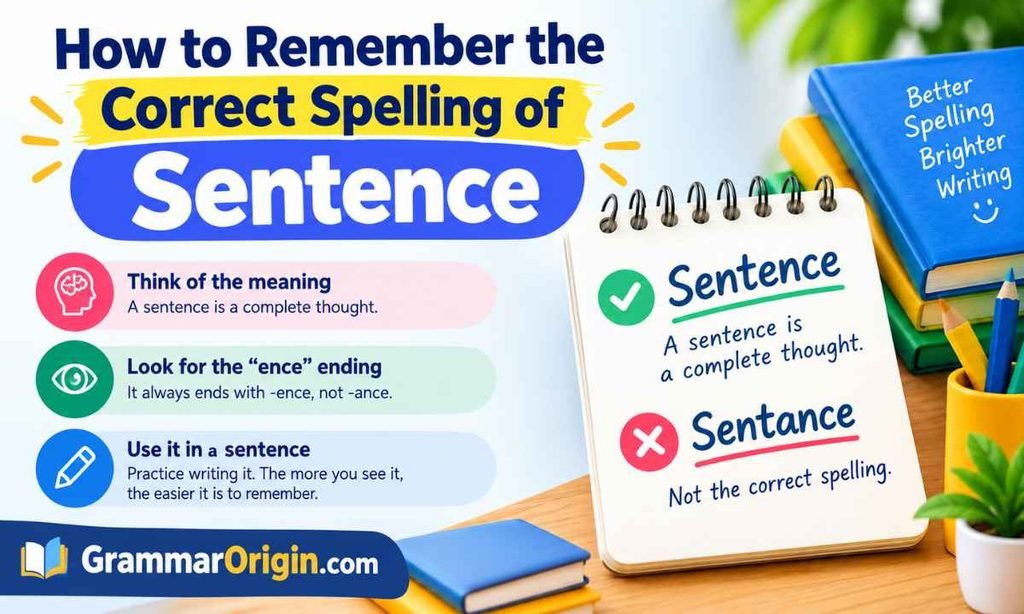
A short memory trick removes the guesswork permanently.
The ENCE Memory Trick
Picture the ending as a small family: essence, presence, sentence. All three share -ence, and all three describe something abstract, whether it’s a feeling, a state, or a complete thought.
Example: If you can spell “essence” correctly, you already know how to end “sentence.”
Visual Pattern Recognition
Look at the shape of the word rather than sounding it out. The letters “enc” sitting together, followed by “e,” form the pattern to lock in.
Example: Difference, reference, and sentence all show the same “-ence” silhouette when you glance at them.
Word Association Method
Tie the word to its meaning: a sentence contains a complete idea, and that link between meaning and spelling gives your memory a small anchor to hold onto.
Example: Repeat “a complete sentence needs complete essence” a few times, and the ending starts to feel automatic.
Why Memory Tricks Work
The brain holds onto patterns and associations far longer than isolated spelling rules, which is why a short mnemonic often beats memorizing a dictionary entry.
Example: Most people can’t recite a spelling rule from memory, but they can recall a silly phrase they made up themselves years later.
Common Mistakes with Sentence
Even confident writers slip up here occasionally.
Writing Sentance Instead of Sentence
This is the single most common error tied to this word.
Example: Incorrect: Please write three sentances. Correct: Please write three sentences.
Confusing Similar Words
Sentence gets mixed up with sentience, sentimental, and sentencing, words that share a root but mean very different things.
Example: “Sentience” refers to the ability to feel or perceive, while “sentence” refers to a statement or a punishment. Don’t let the shared letters fool you.
Ignoring Spell Check Warnings
Modern writing tools flag “sentance” instantly, yet plenty of writers dismiss the red underline out of habit.
Example: Autocorrect on most phones will fix “sentance” automatically, but only if you don’t override the suggestion.
Incorrect vs Correct Examples
| Incorrect | Correct |
| Sentance | Sentence |
| Sentances | Sentences |
| Sentance structure | Sentence structure |
| Complete sentance | Complete sentence |
Sentence in Grammar: What Counts as a Sentence?
Not every string of words qualifies as a sentence, even if it looks like one at first glance.
Definition of a Complete Sentence
A complete sentence needs a subject, a verb, and a thought that stands on its own without extra context.
Example: “The students finished their homework” is complete on its own. “Finished their homework” is not.
Subject and Predicate Basics
Every full sentence splits into two parts: the subject, which names who or what, and the predicate, which says what that subject does.
Example: In “The students completed their assignments,” “the students” is the subject and “completed their assignments” is the predicate.
Sentence Fragment Example
A fragment looks like a sentence but leaves the thought unfinished.
Example: Fragment: Because the weather changed. Complete: Because the weather changed, the game was postponed.
Run-On Sentence Example
A run-on jams two complete thoughts together without proper punctuation.
Example: Run-on: The team arrived late they missed the meeting. Correct: The team arrived late, so they missed the meeting.
Types of Sentences in English
English grammar sorts sentences into four core types based on purpose.
Declarative Sentences
These simply state something.
Example: The meeting starts at noon.
Interrogative Sentences
These ask a question.
Example: What time does the meeting start?
Imperative Sentences
These give a command or instruction.
Example: Submit the report today.
Exclamatory Sentences
These express strong emotion.
Example: What an incredible achievement!
Comparison Table
| Type | Purpose | Example |
| Declarative | Statement | The project succeeded. |
| Interrogative | Question | Did the project succeed? |
| Imperative | Command | Complete the project. |
| Exclamatory | Emotion | What a successful project! |
Sentence or Sentance in Everyday Writing
The correct spelling matters more in some settings than others, but it always matters.
Academic Writing
Teachers and professors judge sentence structure alongside content, so a stray “sentance” can quietly cost marks.
Example: A well-organized sentence in an essay introduction often sets the tone for the grade that follows.
Business Emails
Clear sentences prevent misunderstandings in professional correspondence.
Example: Please review the attached proposal before Friday. Short, direct, and easy to act on.
Workplace Communication
Managers who write concise sentences reduce back-and-forth clarification with their teams.
Example: “Submit the file by 5 PM” leaves no room for confusion, unlike a rambling, unclear instruction.
Social Media
Even a short post benefits from a properly built sentence, since broken grammar can distract from the message itself.
Example: A single clear sentence in a caption often gets more engagement than a jumbled one.
Legal Writing
Lawyers depend on precise sentences because a misplaced clause can shift the entire legal meaning of a document.
Example: A single comma error in a contract sentence has led to real, expensive courtroom disputes.
Textbooks and Educational Materials
Every textbook relies on clearly built sentences to explain new concepts without losing the reader halfway through.
Example: A textbook chapter written in short, clear sentences is easier to study from than one full of dense, tangled ones.
Sentence in Legal and Criminal Justice Contexts
The legal meaning of sentence deserves its own spotlight, since it’s completely separate from the grammar definition.
What Is a Criminal Sentence?
A criminal sentence is the punishment a court formally imposes after a conviction.
Example: After the guilty verdict, the judge announced the sentence the following week.
Types of Legal Sentences
| Type | Description |
| Probation | Supervised release instead of jail |
| Fine | A monetary penalty |
| Jail Sentence | Short-term confinement |
| Prison Sentence | Long-term confinement |
Example
The court issued a ten-year prison sentence for the conviction.
Grammar vs Legal Meaning
The same word serves two completely different purposes. One builds communication, the other decides consequences.
Example: “Write a complete sentence” and “the judge passed sentence” use the identical word for entirely unrelated outcomes.
Words Commonly Misspelled Like Sentence
Sentence isn’t alone. Plenty of English words trip people up in the exact same way.
Occurrence vs Occurence
Correct: Occurrence. Incorrect: Occurence.
Example: The unusual occurrence made headlines across the city.
Separate vs Seperate
Correct: Separate. Incorrect: Seperate.
Example: Please keep the two files separate from each other.
Definitely vs Definately
Correct: Definitely. Incorrect: Definately.
Example: She will definitely attend the meeting tomorrow.
Maintenance vs Maintainance
Correct: Maintenance. Incorrect: Maintainance.
Example: The building requires regular maintenance every quarter.
Common Pattern
In every case, pronunciation smooths over details that spelling insists on keeping. That gap between sound and spelling is exactly why these mistakes repeat across generations of writers.
Editor’s Tip: Keep a personal list of the words you misspell most often. Reviewing that short list every week fixes mistakes faster than any general grammar guide.
Sentence Usage Statistics and Search Trends
The word sentence stays near the top of everyday English usage, which naturally pulls its misspelling along with it.
Why People Search for Sentance
Most searches come from homework help, essay writing, exam prep, and everyday uncertainty about spelling.
Example: A student unsure how to end an essay sentence will often search the spelling before submitting the assignment.
Popular Search Queries
Common variations include “sentence meaning,” “sentence examples,” “sentence structure,” and “sentence or sentance.”
Example: Search suggestions frequently pair “sentence” with “definition” and “examples,” showing that people want both meaning and usage together.
Educational Importance
Mastering sentence construction supports every other writing skill, from essays to professional emails.
Example: A student who masters basic sentence structure early tends to write clearer paragraphs later on.
Sentence or Sentance Quiz
Test yourself quickly before moving on.
- Which spelling is correct: sentence or sentance?
- True or false: Sentance is accepted in British English.
- Fill in the blank: The judge read out the ______ (correct spelling).
- Which word shares the same “-ence” ending as sentence: essence or acceptance?
- Spot the error: “Please write three sentances for homework.”
Answers: 1) Sentence. 2) False. 3) Sentence. 4) Essence. 5) “Sentances” should be “sentences.”
Sentance vs Sentence Fragment
These two terms sound related but describe completely different problems, and mixing them up is its own common mistake.
“Sentance” is purely a spelling error. It’s simply the wrong way to write the word sentence. A “sentence fragment,” on the other hand, is a grammatically correct term for an incomplete thought that’s missing a subject, a verb, or both.
Example: “Sentance” is simply a misspelling of a real word, while “Running through the park” is a properly spelled sentence fragment, incomplete in meaning, not in spelling.
Knowing the difference matters for anyone learning grammar terminology. One is a typo to avoid, the other is a structural issue to fix in your writing.
Final Thoughts
The correct spelling is sentence, and sentance is nothing more than a spelling slip that pronunciation and habit keep alive. Once you connect the ending to words like essence and presence, the mistake becomes easy to catch on your own.
Beyond spelling, sentence carries real weight in both grammar and law, and understanding both meanings makes you a sharper, more confident writer in any setting, whether academic, professional, or everyday.
Frequently Asked Questions
Is sentance ever correct in British English?
No. British and American English both use sentence exclusively. There’s no regional variant like color and colour here.
Why do people keep writing sentance instead of sentence?
Mainly because the ending sounds almost identical to -ance endings in fast speech, so the brain grabs the wrong pattern from memory.
What’s an easy way to remember the correct spelling of sentence?
Link it to “essence.” Both end in -ence, and most people rarely misspell “essence.”
Does spell check always catch sentance?
Yes, virtually every modern spell checker flags sentance and suggests sentence automatically.
What are the two main meanings of sentence?
One is grammatical, a complete statement, and the other is legal, the punishment a court imposes after a conviction.
Is a sentence fragment the same thing as writing sentance?
No. Sentance is a spelling mistake, while a sentence fragment is a real grammar term for an incomplete thought.
Where does the word sentence come from?
It comes from the Latin sententia, through Old French sentence, arriving in English with both its grammatical and judicial meanings intact.

Muhammad Waqas is an English language teacher and grammar expert with over 8 years of experience helping students and professionals improve their writing skills. He specializes in English grammar, vocabulary, communication, and practical language learning. Through GrammarOrigin, Waqas shares clear, easy-to-understand content that helps readers write and speak English with confidence.