
Tomatoes or Tomatos Quick answer: the correct plural of tomato is tomatoes, never tomatos. Drop the extra “e” and you’ve written a common misspelling, not a valid alternative. This trips up plenty of confident writers, especially when typing fast on a phone.
It entered English through Spanish and Nahuatl, and its odd plural is a leftover from that journey. Words like potato, hero, and echo quietly follow the same pattern. Once you see it below, the spelling stops feeling like a guessing game.
Real-World Usage
People write “tomatos” far more often than they realize, mostly in texts, captions, and rushed grocery lists. Speech hides the mistake completely, so the error only shows up once it’s typed out.
A neighbor once wrote “Fresh tomatos $3/lb” on a yard-sale sign, and nobody blinked because the ear never catches the missing letter. Recipes, farmers-market chalkboards, and casual emails are where this slip shows up most.
What Does “Tomato” Mean?
Definition
A tomato is a soft, juicy fruit that’s usually red, though yellow and green varieties exist too. Cooks treat it as a vegetable, but botanists classify it as a fruit, specifically a berry. Heirloom and cherry varieties are two of the most common ones people picture right away.
Example: a home cook slicing a ripe tomato for a sandwich isn’t thinking about botany, just flavor.
Linguistic Origin
The word traveled a long road before landing in English. It started as tomatl in Nahuatl, the Aztec language, then became tomate in Spanish before English speakers reshaped it into tomato in the 1500s.
That borrowed history is exactly why the plural doesn’t just tack on a simple “s.” English absorbed the word’s sound pattern along with its spelling.
Also Read This Comparable vs Comprable: Which Spelling Is Correct?
Tomatoes vs Tomatos: The Correct Answer
Correct Plural Form
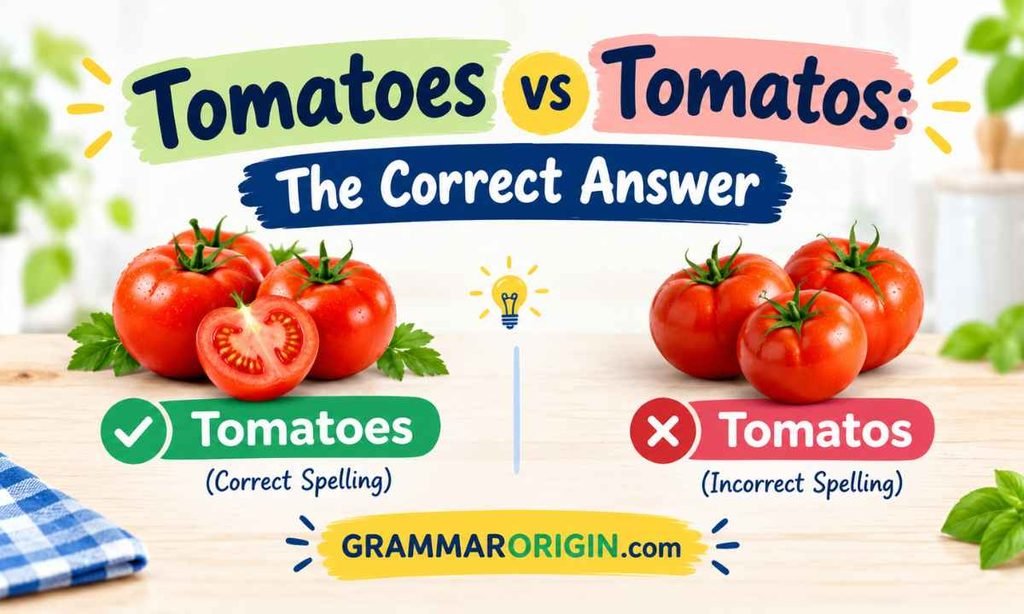
Tomatoes is correct. Tomatos is not a recognized spelling in any major dictionary, style guide, or grammar reference.
Example: “She grew three tomatoes on her balcony this summer” is the only version that passes a spell-check.
Why English Adds “-es”
Nouns ending in a consonant plus “o” (think tomato, potato, hero) usually take “-es” in the plural. The extra letter isn’t decorative; it keeps the word easy to say and read.
Drop the “e” and you get an abrupt, clipped sound that doesn’t match how English speakers naturally pronounce the plural.
Why “Tomatos” Is Wrong
The Grammar Rule
The rule is short: consonant + “o” at the end of a word usually means add “-es,” not just “-s.” This word fits that pattern exactly, alongside potato, hero, and echo.
Example: nobody writes “heros” for more than one hero, and the same logic protects tomatoes.
Pronunciation Reason
Say “tomato-s” out loud and it feels clipped, almost swallowed. Say “tomato-es” and the extra syllable flows naturally into the word.
English spelling often tracks how a word actually sounds, and that smoother rhythm is part of why tomatoes stuck.
Historical Standardization
Dictionaries settled on tomatoes well over a century ago, and nothing about that has shifted since. Major style guides, including the Chicago Manual of Style and the AP Stylebook, list it as the only accepted plural.
Comparison Table: Tomatoes vs Tomatos
| Feature | Tomatoes | Tomatos |
| Dictionary status | Listed, standard | Not recognized |
| Grammar rule | Follows consonant + o → -es | Breaks the rule |
| Academic writing | Accepted | Marked as an error |
| Professional emails | Safe to use | Looks careless |
| Search engines | Treated as correct | Treated as a misspelling |
| Pronunciation | Natural flow | Feels clipped |
The English Rule Behind Tomato Plurals
Category 1: Add “-es”
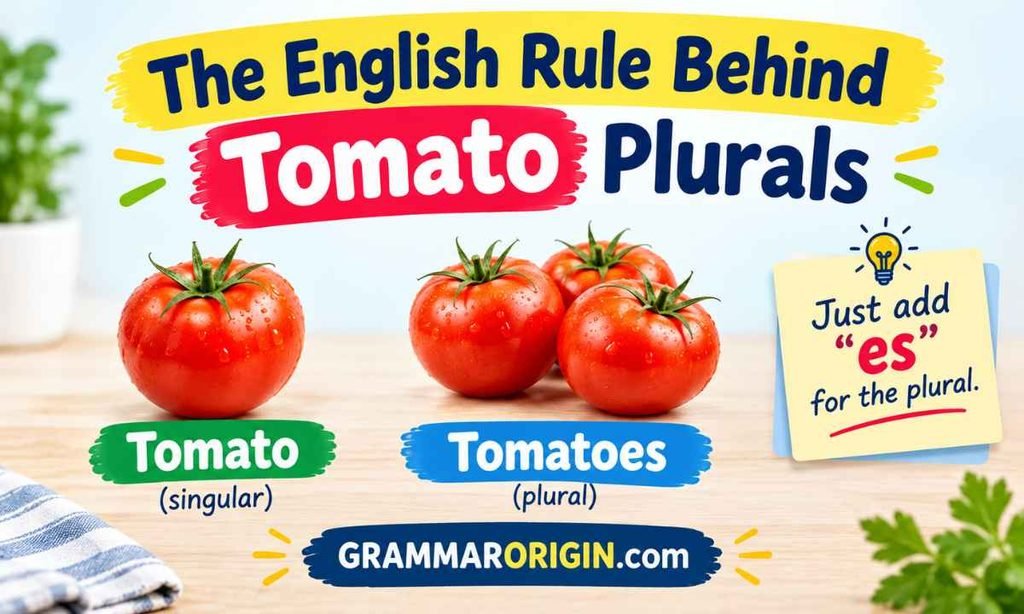
Words ending in consonant + “o” typically add “-es.” This group includes tomato → tomatoes, potato → potatoes, hero → heroes, and echo → echoes.
Category 2: Add Only “-s”
Other “-o” words just take a plain “s.” Photos, pianos, and radios all fall here, along with most loanwords borrowed for technology or music.
Example: nobody says “pianoes.” A piano stays a piano with a simple “s” tacked on.
Why the Difference?
There’s no single clean rule that predicts every case. English pluralization grew out of centuries of borrowed vocabulary, not a designed system. Food words that arrived early, like this pair, tended to keep the fuller “-es” ending, while newer or shortened words simplified faster.
Common Mistakes People Make
Assuming All Plurals Add “S”
Most English learners are taught one blanket rule: add “s” to make something plural. That works most of the time, just not here.
Autocorrect Overconfidence
Phones don’t always flag “tomatos” as wrong, especially in casual keyboards tuned for speed over accuracy. People trust the green underline, or the lack of one, more than they should.
Influence of Spoken Language
Spoken English hides the spelling difference completely, since “tomatoes” and “tomatos” would sound almost identical if anyone tried to say the second one. Writers fall back on how the word sounds rather than how it’s actually spelled.
Social Media Habits
Fast, casual posting rewards speed over precision. A caption typed in five seconds rarely gets a second glance before it’s published.
Real-Life Examples of Usage
In Emails
Incorrect: “Please order three tomatos for the lunch platter.” Correct: “Please order three tomatoes for the lunch platter.”
On Social Media
Incorrect caption: “Fresh organic tomatos, picked this morning!” Correct caption: “Fresh organic tomatoes, picked this morning!”
Academic Writing
“Tomatoes contain lycopene, a compound linked to heart health” is the kind of sentence that belongs in a paper. Swap in “tomatos” and a grader will likely mark it down instantly.
Everyday Speech vs Writing
Spoken English never reveals which spelling someone means, since the words sound the same either way. Writing is where the error becomes visible, and where it actually matters.
British vs American English
Unlike color/colour or theatre/theater, this one has no regional split. British, American, Australian, and Canadian English all agree: the plural is tomatoes, full stop.
The Famous “Tomato, Tomahto” Expression
The old line “you say tomato, I say tomahto” is about pronunciation, not spelling. Both speakers in that phrase still write the plural the exact same way: tomatoes.
Accent changes how a word sounds, never how it’s spelled on the page.
Related Words Following the Same Rule
Words Ending in -O That Add ES
Potato, hero, echo, and torpedo all take “-es” in the plural: potatoes, heroes, echoes, torpedoes.
Words That Add Only S
Photo, piano, logo, and memo simply add “s”: photos, pianos, logos, memos. There’s no shortcut for memorizing which group a word falls into beyond repeated exposure.
Memory Tricks to Remember “Tomatoes”
The Food Rule Trick
Many common food words ending in “-o” pick up the extra “e” before the final “s.” Potatoes and tomatoes both fit that pattern, so thinking “food words grow an extra letter” can jog your memory.
The Rhythm Trick
Say both versions out loud: “to-ma-toes” flows, while “to-ma-tos” stops short. Your ear is often a better guide here than any rule you memorized in school.
The Grocery Store Method
Picture a shopping list: apples, bananas, tomatoes. Seeing the word next to other familiar plurals helps the correct spelling stick.
Linguistic Insight: Why English Keeps Irregularities
English isn’t built on one tidy logical system; it’s a patchwork shaped by Germanic roots, French vocabulary after 1066, Latin scholarship, and waves of borrowed vocabulary from Spanish and elsewhere. Its plural is a small souvenir of that messy, borrowed history rather than a random exception someone invented.
Case Study: Spelling Errors in Digital Content

Observed Patterns
Content with visible spelling slips tends to read as less polished, and readers notice even when they can’t name exactly why. Small errors quietly chip away at trust before a reader even reaches the main point.
Example Scenario
Picture two grocery ads running side by side: one reads “Fresh tomatos delivered daily,” the other “Fresh tomatoes delivered daily.” Most shoppers would instinctively read the second store as the more careful, more trustworthy one, even without consciously spotting the spelling difference.
SEO and Keyword Insights
Keyword Reality
Searchers type “tomatoes” far more often than “tomatos,” and search engines generally treat the second as a misspelling variant rather than a genuine alternative term.
Also Read This Comparable vs Comprable: Which Spelling Is Correct?
Why Correct Spelling Matters
Clean spelling supports clearer ranking signals, stronger reader trust, and better readability scores overall. None of that is about pleasing an algorithm for its own sake. It’s about matching what a real reader expects to see.
Educational Perspective: How Schools Teach This Rule
Early grammar lessons usually introduce the basic “add -s” rule first, then layer in exceptions for words ending in s, sh, ch, x, z, and consonant + o. This word often becomes the go-to teaching example precisely because it shows students that rules have exceptions worth remembering.
Grammar Expert Insight
Editors and language teachers tend to emphasize recognizing patterns over rote memorization, since English rarely rewards pure memorization alone. Understanding why it behaves this way, through its borrowed history, sticks better than simply drilling the spelling on its own.
The Psychology Behind Spelling Errors
Cognitive Reasons
Brains process sound before spelling, which is part of why a word that sounds fine can still look wrong on the page. Fast typing also cuts down on the moment of pause where a writer might catch the slip.
Digital Age Effect
Messaging culture rewards speed, and speed rarely leaves room for a second look. The more casual the platform, the more often small errors like this one slip through untouched.
Tomatoes in Professional Communication
Business proposals, marketing copy, journalism, and product labeling all lean on correct spelling to signal competence. A single “tomatos” in a client-facing email might seem minor, but it’s exactly the kind of detail that shapes a reader’s first impression.
Fun Facts About Tomatoes
| Fact | Detail |
| Botanical classification | Fruit (specifically a berry) |
| Culinary classification | Treated as a vegetable |
| Global production | Well over 180 million tons a year |
| Top producers | China, India, Turkey, and the United States |
| Nutrition highlight | Rich in lycopene |
How Dictionaries Treat the Word
Merriam-Webster, the Oxford English Dictionary, and the Cambridge Dictionary all list tomatoes as the plural form, with no competing entry for tomatos anywhere. That consistency across sources is itself a strong signal of how settled this spelling really is.
Quick Rule Summary
- Tomato becomes tomatoes, never tomatos
- Consonant + “o” endings usually add “-es”
- Both British and American English agree here
- Correct spelling supports credibility in writing
Practical Writing Checklist
- Double-check plural nouns that end in “-o”
- Read the sentence out loud before sending it
- Don’t fully trust autocorrect; verify manually
- Watch food vocabulary closely; it’s a common trap
- Proofread headlines and captions last, not first
Plural of Potato and Tomato in English
Potato and tomato follow the exact same rule side by side: potato → potatoes, tomato → tomatoes. Both words entered English from Spanish, and both picked up the “-es” ending along the way, which is why they’re such a reliable pair to remember together.
Plural of Tomato in German
German handles this differently from English. The singular is die Tomate, and the plural is simply die Tomaten, with no separate “-es” logic involved, since German plurals follow their own grammar system entirely. It’s a useful reminder that “add -es” is an English-specific quirk, not a universal rule about the word itself.
Conclusion
The difference between tomatoes and tomatos looks small, but it’s one of those details that quietly shapes how polished your writing feels. The rule itself is simple: words ending in a consonant plus “o” usually add “-es” rather than a plain “s,” and this word is no exception. Once that pattern clicks, the spelling stops being a guessing game.
Whether you’re writing a grocery list, a client email, or an essay, sticking with tomatoes keeps your writing accurate and easy to trust. It’s a small rule, but it’s one worth locking in for good.
FAQs
Q1. Is it tomatoes or tomatos?
It’s tomatoes. Tomatos isn’t a recognized spelling in any major English dictionary or style guide.
Q2. Why do so many people write “tomatos”?
Most writers default to the general “add -s” plural rule, which works for the majority of English nouns but not for this one. The mistake is common precisely because the rule it breaks is so widely taught.
Q3. Is “tomato’s” the same as “tomatoes”?
No. Tomato’s with an apostrophe shows possession, as in “the fruit’s skin split in the heat.” Tomatoes without an apostrophe is simply the plural form.
Q4. Do British and American English spell it differently?
No, both agree completely. Tomatoes is the correct plural in British, American, Canadian, and Australian English alike.
Q5. What other words follow the same “-es” rule as tomato?
Potato, hero, and echo all follow the same pattern, becoming potatoes, heroes, and echoes. Photo and piano, on the other hand, break the pattern and just take a plain “s.”
Q6. What’s an easy way to remember the correct spelling?
Try pairing it with potato, since both rhyme and both take the “-es” ending. Saying “tomatoes and potatoes” out loud together helps the pattern stick.
Q7. What is the plural of tomato in German?
In German, the plural is die Tomaten, following German grammar rules rather than the English “-es” pattern.

Muhammad Waqas is an English language teacher and grammar expert with over 8 years of experience helping students and professionals improve their writing skills. He specializes in English grammar, vocabulary, communication, and practical language learning. Through GrammarOrigin, Waqas shares clear, easy-to-understand content that helps readers write and speak English with confidence.