
Students is the plural form with no apostrophe, student’s shows something belonging to one student, and students’ shows something belonging to more than one student. All three look nearly identical but mean very different things.
This mix-up trips up even confident writers because apostrophes shift meaning without changing pronunciation. This guide breaks down each form with real examples, so you’ll never second-guess your sentence again.
Students
This is simply the plural noun. It refers to more than one person who studies at a school, college, or university, and it never takes an apostrophe.
Example: The students arrived early for the assembly.
Student
The singular form refers to just one learner. It’s the base word that the other three forms build from.
Example: Every student in the room raised a hand.
Students vs Student’s vs Students’: Quick Answer
No apostrophe means plural. An apostrophe before the “s” means one owner. An apostrophe after the “s” means many owners.
Examples
- The students are in the library. (plural, no ownership)
- The student’s essay won first place. (one student)
- The students’ essays were all published. (many students)
Students vs Student’s vs Students’: Definitions with Examples & Top Queries
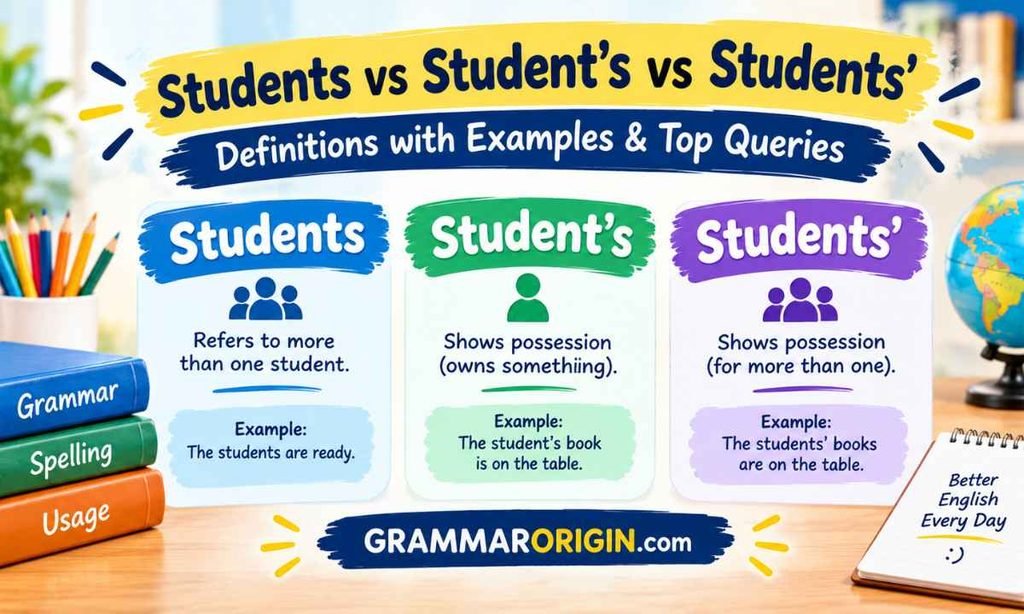
Each form answers a different question: how many people, and does anyone own something? The three definitions below cover every case you’ll run into.
Students (Definition)
This word is the plural of “student” and refers to more than one person studying somewhere.
Examples
- Students filled the auditorium.
- All students received their results today.
Student’s (Definition)
This form shows that something belongs to a single student.
Examples
- The student’s laptop needs repair.
- The student’s grade improved this term.
Students’ (Definition)
This form shows that something belongs to more than one student.
Examples
- The students’ feedback shaped the new schedule.
- The students’ project won a school award.
User Queries
People commonly search phrases like “students vs student’s difference,” “when to use students or student’s,” and “is students possessive or plural.” These searches almost always come down to one question: is there ownership involved, and how many owners are there?
Student or Students: Understanding Singular and Plural Forms

Before apostrophes even come into play, you need to know whether you’re talking about one person or several. Student is singular; students is plural, formed simply by adding an “s.”
Example: “One student finished early” versus “several students finished early” shows the singular-to-plural shift clearly.
The Origin of Students vs Student’s vs Students’
English marks plurals by adding “-s” and marks possession by adding an apostrophe, a rule that goes back centuries to how Old English handled ownership in writing.
Over time, writers settled on placing the apostrophe before the “s” for one owner and after the “s” for multiple owners, giving us the three-way split you see today.
Example: That historical rule is exactly why student’s and students’ land on opposite sides of the same letter.
Students vs Student’s vs Students’: British vs American English
There’s no regional split here. Both British and American English follow the same apostrophe rules for these three forms.
Example: A British essay and an American one will both write “the students’ results,” never a different version.
Also Read This Enquiries vs Inquiries: What’s the Real Difference?
Students vs Student’s vs Students’: Which One Should You Use?
Use “Students” When
You’re simply referring to more than one learner, with no ownership involved.
Example: “The students are taking their exam.”
Use “Student’s” When
One student owns or is connected to something.
Example: “The student’s bag was left on the bus.”
Use “Students'” When
More than one student owns or is connected to something.
Example: “The students’ bags were collected after the trip.”
Memory Trick
Picture the apostrophe as a small hook. If the hook sits before the final “s,” it’s grabbing onto one owner. If it sits after, it’s grabbing onto a whole group.
Student’s or Students’: How Apostrophes Change Meaning
The position of a single apostrophe changes whether you’re talking about one student’s belongings or a whole group’s belongings, even though the words sound identical out loud.
Example: “The student’s notebook” and “the students’ notebooks” sound the same when spoken but mean completely different things in writing.
A related mistake worth flagging is writing students’s, adding an extra “s” after the apostrophe. This form doesn’t exist in standard English; the correct plural possessive stays as students’.
Example: “The students’s results” is incorrect; it should read “the students’ results.”
Common Mistakes with Students vs Student’s vs Students’
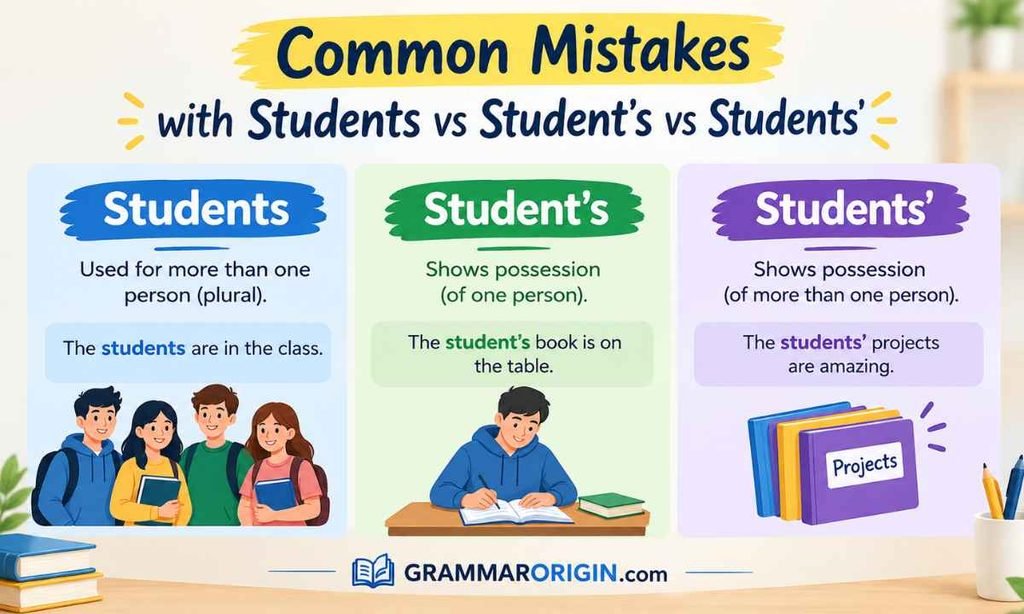
1. Using apostrophe for plural
Writers sometimes add an apostrophe just to make a word plural, which is never correct.
Example: “Student’s are here” is wrong; it should read “students are here.”
2. Forgetting apostrophe for possession
Leaving out the apostrophe when ownership is involved changes or breaks the sentence’s meaning.
Example: “The students books” is incomplete; it needs to read “the students’ books.”
3. Confusing singular and plural possession
Writers often place the apostrophe correctly but pick the wrong side, mixing up one owner with many.
Example: Writing “the student’s results” when you mean the whole class changes the meaning to just one person.
4. Guessing usage
Some writers guess instead of checking whether the sentence involves one student, many students, or no ownership at all.
Example: Pausing to ask “how many owners, if any?” clears up most students versus student’s confusion instantly.
Students vs Student’s vs Students’ in Everyday Examples
Seeing these forms in real settings makes the difference easier to remember than any rule on its own.
Daily Life
A parent might say, “The students are heading home,” with no ownership involved at all.
Social Media
A teacher’s post might read, “So proud of my students this semester!” celebrating a whole group.
School Writing
A report card comment could note, “The student’s essay was outstanding,” praising one learner specifically.
Professional Writing
An HR email might state, “The students’ internship applications are under review,” referring to several applicants at once.
Students vs Student’s vs Students’: Usage Trends & Popularity
Key Insight
The plain plural, students, appears far more often in everyday writing than either possessive form, simply because most sentences don’t involve ownership.
Trend
Apostrophe mistakes with this word pair rank among the most common grammar errors in student essays and workplace emails alike.
Example: A quick scan of student essays usually turns up at least one misplaced apostrophe in a students’ or student’s sentence.
Also Read This Enquiries vs Inquiries: What’s the Real Difference?
Students or Student’s: Common Grammar Questions Explained
Choosing between these forms comes down to two questions: are you talking about more than one person, and is anything being owned?
Example: “The students are studying” needs no apostrophe, while “the student’s notes are missing” needs one because ownership is involved.
Comparison Table
| Form | Meaning | Usage Type | Example |
| Students | More than one student | Plural | Students are here |
| Student’s | One student’s possession | Singular possessive | Student’s book |
| Students’ | Many students’ possession | Plural possessive | Students’ books |
Students or students plural possessive
The plain plural, students, never carries an apostrophe. The plural possessive form, students’, adds only an apostrophe after the existing “s.”
Example: “The students submitted their essays” stays apostrophe-free, while “the students’ essays were graded” needs one.
Students vs student’s vs students meaning
At their core, all three forms point back to the same base word, but the meaning shifts based on number and ownership. Students means more than one learner, student’s means something tied to one learner, and students’ means something tied to a group of learners.
Example: “The students left early” describes people; “the student’s essay” and “the students’ essays” both describe things those people own.
Frequently Asked Questions
What’s the difference between students and student’s?
Students is plural with no ownership. Student’s shows something belongs to one student.
What does students’ mean?
It shows that something belongs to more than one student.
3. Is students with an apostrophe ever correct?
Only when showing possession, never to form the plural.
Can I use student’s for a group of students?
No. Use students’ instead when more than one student owns something.
What’s an easy way to remember the difference?
Ask whether you’re describing people (no apostrophe) or something they own (apostrophe needed), and how many owners there are.
Is “students’s” ever correct?
No. This form doesn’t exist in standard English; the correct plural possessive is students’.
Do these rules change between British and American English?
No. Both follow the exact same apostrophe rules for these three forms.
Summary
Students is simply the plural form and needs no apostrophe at all. Student’s points to one owner, while students’ points to many, and the apostrophe’s position is the only thing separating them.
Once you pause to ask how many people you mean and whether ownership is involved, choosing the right form becomes automatic. Keep this guide handy, and apostrophe mix-ups with this word pair will stop for good.

Muhammad Waqas is an English language teacher and grammar expert with over 8 years of experience helping students and professionals improve their writing skills. He specializes in English grammar, vocabulary, communication, and practical language learning. Through GrammarOrigin, Waqas shares clear, easy-to-understand content that helps readers write and speak English with confidence.