
Enquiries and inquiries both mean asking for information, but the spelling you pick depends on your region. British and Commonwealth writers favor the first form, while American writers stick with the second.
The confusion doesn’t stop at spelling, though. In British English, a small meaning gap has quietly developed between the two, and most guides gloss over it. This article breaks down the origin, the regional rules, and the real nuance so you can choose the right form with confidence.
Enquiries or Inquiries: Quick Answer
Both spellings are correct, and the split comes down to region, not correctness.
- British, Australian, and New Zealand writers use enquiries
- American writers use inquiries
Example: “For general enquiries, call our UK office” versus “Send your inquiries to our US team.”
Enquiries vs Inquiries: Meaning, Usage, and Common Confusion
For most everyday writing, both words mean the same thing: a request for information. The spelling choice depends on where your reader lives, not on any strict rule of grammar.
That said, British English is quietly developing a real distinction worth knowing, which the next section covers in detail.
Example: A UK customer service page might read “email your enquiry,” while a US one reads “submit your inquiry.”
Common Real Life Phrases
You’ll run into set phrases like general enquiries, customer inquiries, and media enquiries constantly in business writing.
Example: A press release might say “media inquiries should be directed to our PR team.”
The Origin of Enquiries or Inquiries
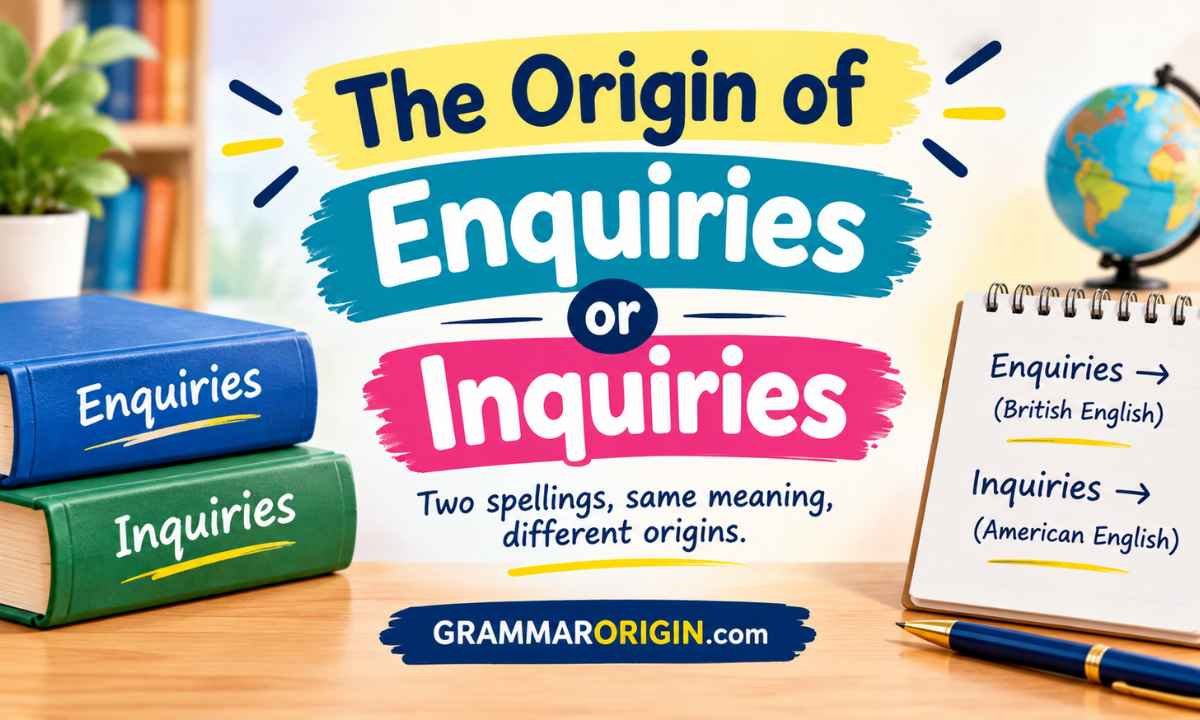
Both words trace back to the Latin verb inquirere, meaning to search or ask about. The word passed through Old French before settling into Middle English with two competing spellings.
Neither spelling is a modern invention. Writers used both forms centuries before regional habits split them apart.
Example: Early English texts show “enquire” and “inquire” used side by side in the same document.
British English vs American English Spelling
This split follows the same pattern as other British-American pairs, where the UK keeps an older form and the US simplifies it.
Example: Just like colour becomes color, enquiry becomes inquiry once you cross into American writing.
Comparison Table
| Feature | British English | American English |
| Everyday spelling | Enquiries | Inquiries |
| Formal investigation | Inquiry (usually) | Inquiry |
| Common regions | UK, Ireland, Australia, NZ | United States |
| Style guides | Oxford, Cambridge | AP, Chicago |
Which Spelling Should You Use?
Match your spelling to your audience’s region rather than guessing.
If your audience is American
Use inquiries. It’s the standard form across US business, media, and education, and the other spelling can look like a typo to American readers.
Example: “Please direct all inquiries to our support line.”
If your audience is British or Commonwealth
Use enquiries. This form feels natural to readers in the UK, Australia, and New Zealand.
Example: “For booking enquiries, contact our front desk.”
If your audience is global
Pick one form and stay consistent across your entire site or document. Many global brands lean American simply because it’s more widely recognized online, but a UK-based company often keeps its native spelling on purpose.
Example: A global SaaS company might use inquiries site-wide even though its headquarters are in London.
Also Read This Liason vs Liaison: What Is the Difference?
Common Mistakes with Enquiries or Inquiries
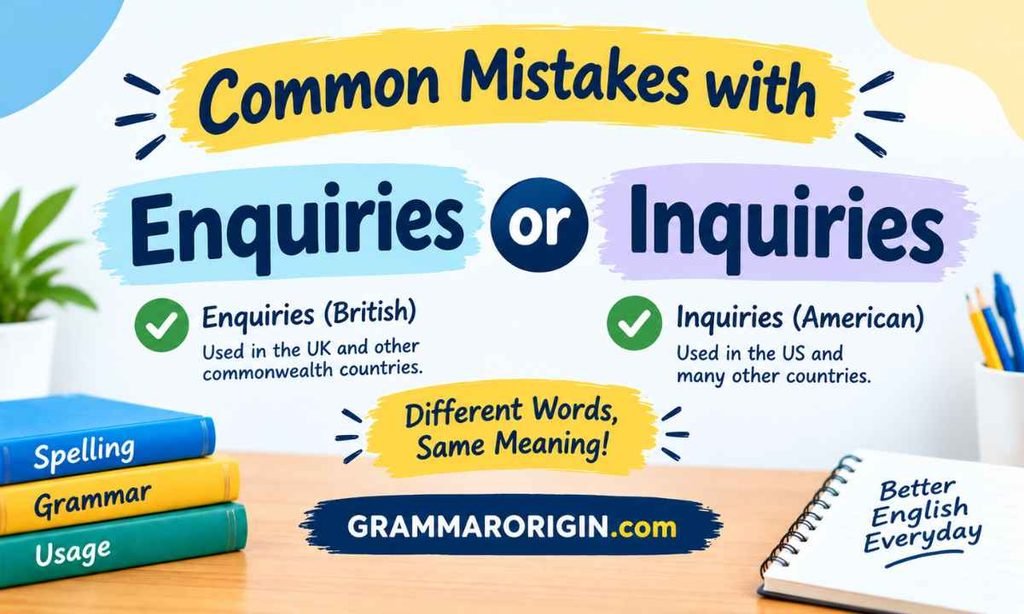
A few patterns cause most of the errors writers make with these words.
1. Mixing spellings in one document
Switching between the two forms mid-document looks inconsistent and unpolished.
Example: Writing “customer enquiries” in one paragraph and “all inquiries welcome” in the next is a mistake worth fixing.
2. Thinking they have different meanings
This isn’t entirely a myth. In American English, there’s no real meaning gap at all. But in British English, a genuine distinction is forming: enquiry now leans toward a casual question, while inquiry leans toward a formal investigation, though the line still isn’t strict.
Example: A UK newspaper might write “police launched an inquiry” for an investigation, but “customers sent enquiries” for simple questions.
3. Spelling errors
Writers sometimes tack on the wrong plural ending or drop a letter by accident.
Example: “Enquirys” is wrong; the correct plural is “enquiries.”
4. Using regional spelling for the wrong audience
Writing “enquiries” for an all-American audience can look out of place, even though it isn’t technically wrong.
Example: A US landing page that says “enquiries” instead of “inquiries” may confuse local visitors.
5. Overthinking the choice
The meaning stays close enough in most contexts that picking either form rarely causes real misunderstanding.
Example: Whether you write “enquiries” or “inquiries” on a contact page, readers will still understand you’re inviting questions.
How to Spell Enquiries or Inquiries + When to Use Each
Spelling Guide
- Enquiries is the British spelling
- Inquiries is the American spelling
Example: A quick way to remember it: “e” for England, “i” for the “I” in the United States.
When to Use Each Form
Use the British form for UK, Australian, or New Zealand audiences, and the American form for US readers or global business content following US style guides.
Example: A UK government website uses “enquiries,” while a US federal agency uses “inquiries.”
Common Usage Examples
- “If you have any enquiries, get in touch.”
- “For further inquiries, email our team.”
- “We handle customer inquiries every day.”
Small but Important Grammar Notes
The singular forms, enquiry and inquiry, follow the same regional split as their plurals. Don’t confuse “inquires” (a verb form) with “inquiries” (the noun).
Example: “He inquires daily” is a verb; “he sent several inquiries” is the noun form.
Enquiries or Inquiries in Everyday Examples
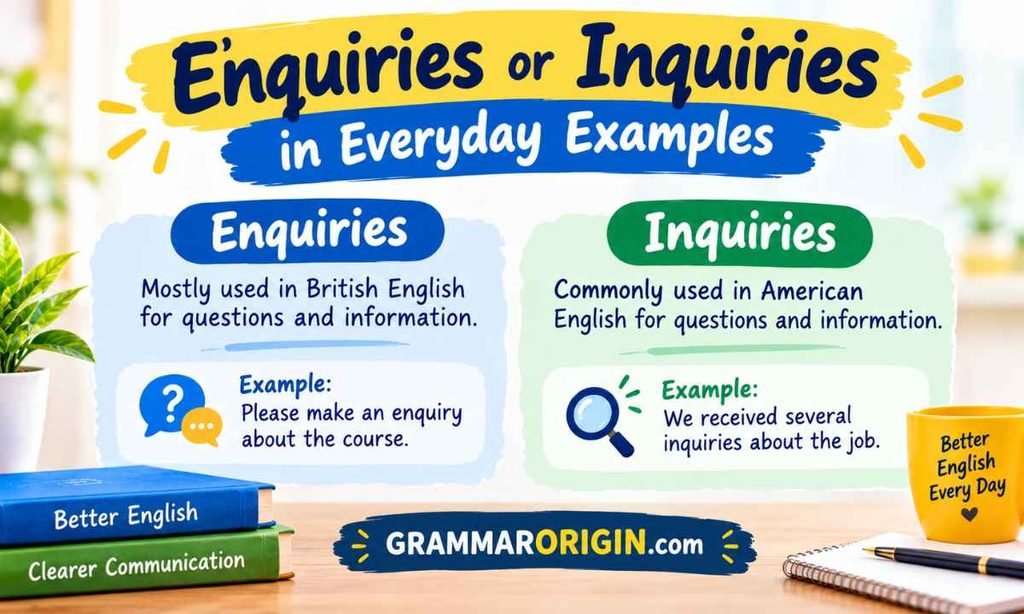
Emails
“Thank you for your enquiry, we’ll respond within 24 hours” (UK) versus “We appreciate your inquiry and will reply shortly” (US).
Business Writing
“Sales enquiries rose this quarter” reads naturally in a UK report, while a US report would say “sales inquiries rose.”
News Writing
“Officials opened an inquiry into the incident” works in both regions, since formal investigations lean toward this spelling everywhere.
Social Media
“DM us with any enquiries!” suits a UK brand voice, while “Send us your inquiries” suits a US one.
Academic Writing
“Further inquiries are needed before drawing conclusions” is standard phrasing in American academic papers.
Customer Service Pages
Many websites label their contact sections “General Enquiries” or “General Inquiries” depending on where the company is based.
Enquiries or Inquiries: Google Trends & Usage Data
United States
The American spelling dominates completely here, appearing across news sites, business pages, and education content.
United Kingdom
The British form shows up on most customer service pages and official documents, though the American spelling appears in legal or investigative contexts.
Australia and New Zealand
Both countries follow British spelling habits closely, and government and company sites reflect that consistently.
Canada
Canadian usage is genuinely mixed. Some organizations follow American style guides, while others keep the British form out of tradition.
Global Online Content
Because so much online content originates in the US, the American spelling has spread widely, even though regional readers still recognize and expect their own local form.
Example: A UK visitor to an American site will still understand “inquiries” without any confusion.
Also Read This Liason vs Liaison: What Is the Difference?
Comparison Table: Keyword Variations Side by Side
| Variation | Region | Usage Context | Example |
| Enquiry | British | Singular noun | Booking enquiry |
| Enquiries | British plural | General questions | Customer enquiries |
| Inquiry | American | Singular noun | Formal inquiry |
| Inquiries | American plural | Questions or requests | Media inquiries |
Enquiries vs inquiries grammar
Grammatically, both words behave the same way as regular plural nouns, and both pair with the verbs “enquire” or “inquire” depending on the spelling you’ve chosen.
Example: “She made several enquiries” follows the exact same sentence structure as “she made several inquiries.”
Enquiries vs inquiries worksheet
Teachers and ESL learners often practice this pair using fill-in-the-blank exercises that test regional spelling awareness rather than meaning.
Example: A worksheet prompt might read “For all ____ (UK), please contact reception,” expecting the answer “enquiries.”
Frequently Asked Questions
Are enquiries and inquiries interchangeable?
In American English, yes. In British English, they’re close but not identical, since a formal-versus-general distinction is developing.
Which spelling should I use for a global audience?
Pick one form and stay consistent. Many international brands choose the American spelling for wider recognition.
Is enquiries wrong in American English?
It’s not incorrect, but it looks unusual to American readers, who expect inquiries.
Can Americans use enquiry at all?
Rarely. Some style guides accept it, but most American editors treat it as a misspelling.
Why does English have two spellings for this word?
The split reflects how British and American English evolved separately after diverging from shared Middle English roots.
Does pronunciation change between the two spellings?
No. Both forms are pronounced the same way regardless of spelling.
Is there ever a real meaning difference?
Mostly no, but British English is slowly developing one: enquiry for general questions, inquiry for formal investigations.
Conclusion
Both enquiries and inquiries mean the same thing at their core: a request for information. The real decision comes down to your audience’s region and, in British English, a developing sense of formality.
Match your spelling to where your readers are, stay consistent throughout your writing, and you’ll never second-guess this pair again.

Muhammad Waqas is an English language teacher and grammar expert with over 8 years of experience helping students and professionals improve their writing skills. He specializes in English grammar, vocabulary, communication, and practical language learning. Through GrammarOrigin, Waqas shares clear, easy-to-understand content that helps readers write and speak English with confidence.