
Customize or customise? Both are correct. Customize is the American and Canadian spelling, and customise is the British, Australian and New Zealand spelling. The meaning is exactly the same, so pick the one your readers expect.
This guide shows where each spelling comes from, which one fits your audience, and how to keep it consistent across a website. You’ll also get real sentences, every word form, and the difference between customize and personalize.
Customize
Customize is the spelling used in American and Canadian English. It ends in -ize, just like organize and recognize. That’s the standard customize spelling in US style guides.
Many software menus and apps use this form by default, so American readers see it all day. When you’re choosing between customize or customise for a US audience, this is the one they expect.
Example: Tap the gear icon to customize your home screen.
Customise
Customise is the British spelling, and it’s also standard in Australian English, New Zealand English and South African English. It swaps the z for an s, the same way organise and recognise do.
UK publishers and shops print this form, so in the customize or customise choice, it looks natural to local readers. A British reader who meets customize will still understand it, but it can feel imported.
Example: Shoppers can customise the gift box before checkout.
Customize or Customise – Quick Answer
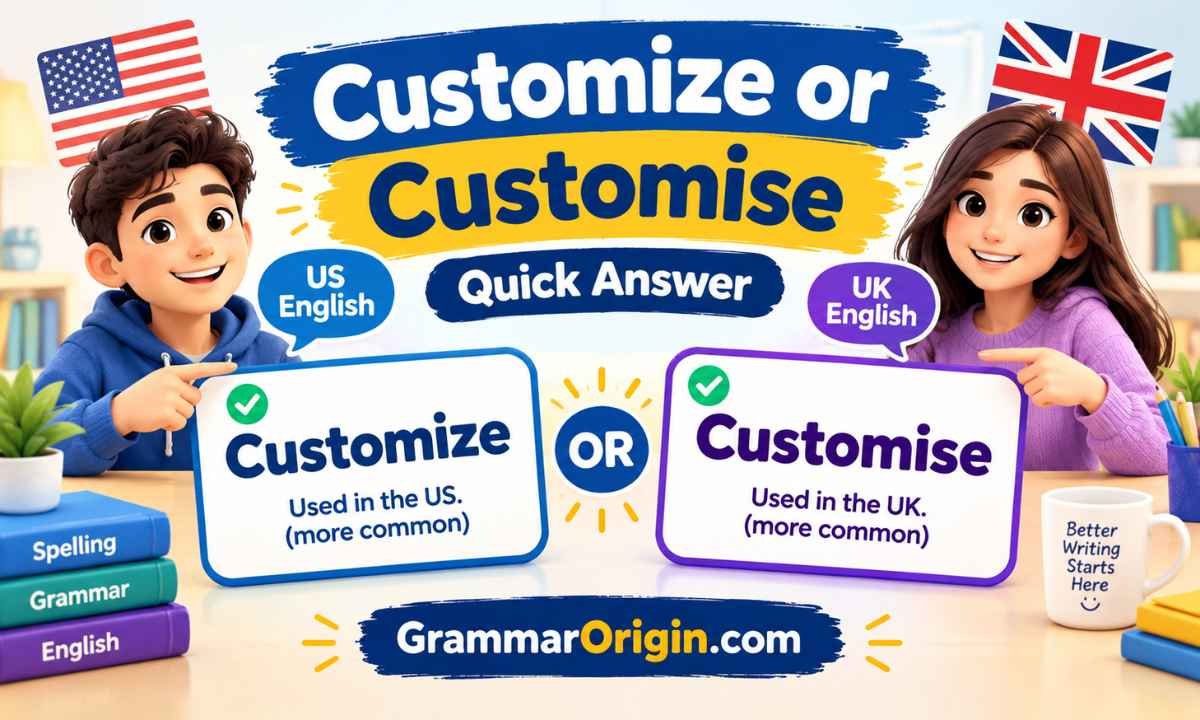
Customize or customise: both spellings are correct, and the only difference is region. Use customize in the US and Canada, and customise in the UK, Australia, New Zealand and South Africa.
- Customize: American and Canadian English
- Customise: British, Australian, New Zealand and South African English
They’re spelling variants of one word, so meaning, grammar and pronunciation stay the same. If you’re wondering how to spell customize, the US answer is with a z, and the UK customise spelling uses an s. If you’re not sure, choose by where most of your readers live, then stick with it.
Example: Our app lets you customize every menu.
Meaning of “Customize/Customise”
To customize or customise something means to change it so it fits one person’s needs, taste or purpose. It’s a verb, and it needs an object: you customize a thing.
The change can be tiny, like moving a button, or big, like building a product to order. The word stays neutral either way, and the customize meaning is the same in every region.
Example: She wants to customise the template for each client.
Examples
The quickest way to see the customize or customise difference is to read both spellings in real sentences. Only the spelling changes, never the meaning.
American English:
- Please customize the report before you send it.
- He customized his bike with new handlebars.
British English:
- You can customise the menu in your account.
- They customised the uniform for the whole team.
Word Forms of Customize and Customise
Every form of customize or customise follows one pattern: American forms use z, and British forms use s. Match them all, so you never write customise next to customization. The noun pair, customization vs customisation, follows the same rule.
| Form | American English | British English |
| Base verb | customize | customise |
| Past tense | customized | customised |
| -ing form | customizing | customising |
| Third person | customizes | customises |
| Noun | customization | customisation |
| Adjective | customizable | customisable |
The base word custom (as in custom order or custom-made) is spelled the same everywhere.
Example: The customizable dashboard saves each user’s layout.
The Origin of Customize / Customise
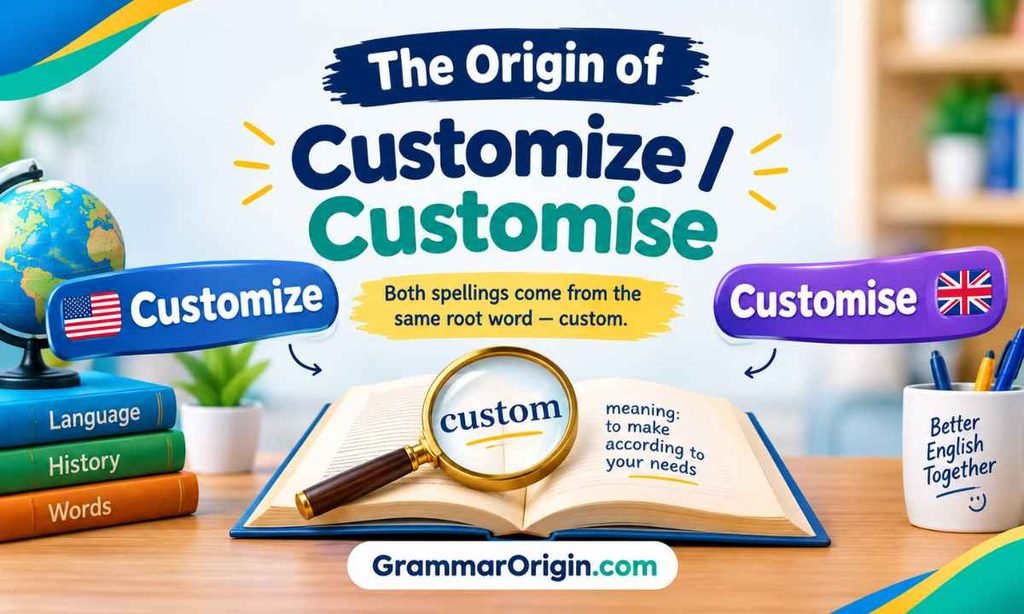
The word behind customize or customise grows out of custom. Custom came into English from Old French and goes back to the Latin consuetudo, meaning habit or usual practice. The verb was made by adding the -ize ending to custom.
It’s a fairly young word. The Online Etymology Dictionary dates the noun customization to 1975, and Grammarist describes the verb as a mid-20th-century American coinage. The -ize ending itself comes from the Greek -izein, which means to make or to act in a certain way.
Example: Tailors have always made suits to order, and today buyers customize almost anything online.
Read Also This Unfazed vs Unphased: Which Is Correct? Meaning & Examples
British English vs American English Spelling
The -ize vs -ise split is a classic British vs American spelling difference, and customize or customise is one more case of it. Americans write -ize, and most British publishers write -ise.
The same swap touches a long list of verbs, such as organize/organise, realize/realise and recognize/recognise. Once you know the pattern, you can predict the spelling of many other verbs.
Example: Americans organize events, and Britons organise them.
Comparison Table
Here’s the customize or customise difference at a glance.
| Feature | American English | British English |
| Spelling | customize | customise |
| Ending | -ize | -ise |
| Noun | customization | customisation |
| Where it’s used | US, Canada | UK, Australia, New Zealand, South Africa |
| Common references | AP Stylebook, Chicago Manual of Style, Merriam-Webster | Guardian style guide, Collins, most UK publishers |
| Sample line | Customize your order | Customise your order |
There’s one exception. Oxford University Press uses -ize in its own house style, so -ize isn’t a mistake in British writing. It’s just less common. Cambridge Dictionary lists both spellings.
Example: Customize your order today (US), or customise your order today (UK).
Why Do Both Spellings Exist?
Customize or customise both exist because the ending is Greek, but French nudged British writers toward -ise. English first borrowed the suffix with a z. Later, French verbs ending in -iser influenced many British writers to use an s.
American writers kept the z, and Noah Webster’s 1828 dictionary helped make -ize the settled American choice. Oxford spelling also keeps the z because it matches the Greek root and the way the word sounds. The Oxford English Dictionary lists -ise as a frequent spelling of -ize.
Example: A British academic press may print customize, while a UK newspaper prints customise.
Which Spelling Should You Use?
For customize or customise, use the spelling your readers expect, and keep it the same everywhere. For most people, that means customize for North America and customise for the rest of the English-speaking world.
Example: A Toronto bakery writes “Customize your cake,” while a Sydney bakery writes “Customise your cake.”
For American English
In the customize or customise choice for US writing, use customize. The AP Stylebook and the Chicago Manual of Style both use -ize spellings, and Merriam-Webster lists customize as the standard form.
A US article with customise can look like a typo to many readers, even though it isn’t one.
Example: Users can customize their notifications in one tap.
For British English
In the customize or customise choice for UK writing, use customise. Most UK newspapers and retailers print the -ise form, so it’s what local readers see every day.
A few verbs, like advertise, revise and surprise, take -ise in American English too. The z/s swap only applies to verbs that can take -ize.
Example: You can customise the sofa fabric and legs.
For International Audiences
For customize or customise on a global site, pick one variety on purpose, and match it to where most of your readers live. If your traffic is truly mixed, customize is often the safer pick for global tech and e-commerce. Many software interfaces default to US English.
If you run local versions of a site, use separate en-US and en-GB pages with hreflang tags, and spell each one the local way.
Example: A global app shows “Customize your profile” in en-US and “Customise your profile” in en-GB.
For Business and Marketing Content
For customize or customise in marketing copy, follow your brand’s main market, and write the choice into your style guide. People usually search with their local spelling, so using it in titles and headings helps you match them.
Once you choose, apply it to ads, emails, packaging and support pages.
Example: The UK landing page says “Customise your plan,” and the US page says “Customize your plan.”
Common Mistakes with Customize / Customise
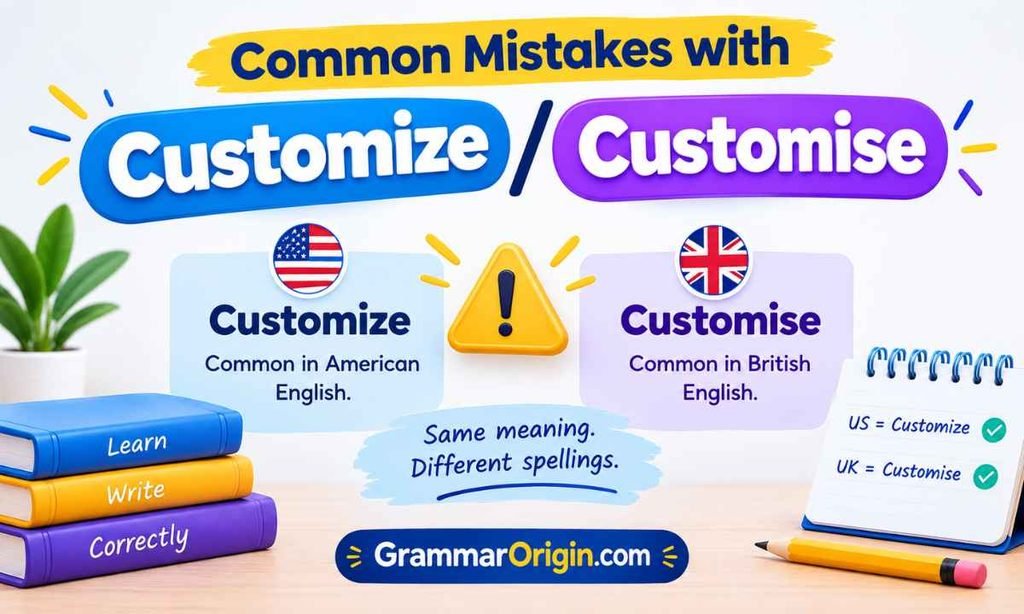
Four mistakes come up again and again with customize or customise. Writers mix spellings, use different ones across one site, confuse customize with personalize, or ignore where their readers live. All of them are easy to fix.
Example (mixed, so avoid it): Customize your plan, then review your customisation options.
Mistake 1: Mixing UK and US Spellings
Mixing spellings in one piece looks careless, even though each spelling is correct alone. It usually happens with word forms, like customise in one sentence and customization in the next.
The fix is simple. Choose one variety, run a find and replace, and set your spell checker to match.
Example: Wrong: You can customise the layout and view your customization history. Right: You can customise the layout and view your customisation history.
Read Also This Unfazed vs Unphased: Which Is Correct? Meaning & Examples
Mistake 2: Using Different Spellings on the Same Website
A site that switches spellings between pages feels unpolished. It happens fast when several writers work without a shared style guide.
Write the rule into your guide, check the site every few months, and set your CMS language to one variety.
Example: The home page says “Customize your order,” but the help page asks “How do I customise my order?”
Mistake 3: Confusing “Customize” with “Personalize”
Customize means the user makes the change, while personalize means the system or seller adapts something to that user. Mixing them up can promise more control than a feature really gives.
In shops, a personalized mug usually just means a name was added. In software, personalized usually means the app chose things for you.
Example: Your feed is personalized for you, but the app theme is something you customize.
Mistake 4: Ignoring Audience Location
Writing for London shoppers in American spelling won’t break anything, but it can feel slightly off. Small mismatches add up on product pages, where trust matters.
Check your analytics for your top countries before you pick a spelling.
Example: A Manchester shop that shows “Customize your mug” reads as American to local buyers.
Customize / Customise in Everyday Examples
You’ll meet customize or customise in menus, emails, posts, documents and product pages. The spelling should match the audience in each place.
Example: Choose a theme to customize your screen.
Websites and Apps
Websites and apps use customize or customise on buttons, menus and settings pages, so short wording works best.
- Drag and drop widgets to customize your dashboard. (US)
- Customise your alerts in Settings. (UK)
Emails
In emails, the word shows up in subject lines and calls to action. Keep the same spelling as your website.
- Here’s how to customize your weekly summary. (US)
- We’ve made it easier to customise your newsletter. (UK)
Social Media
On social media, match the spelling to where most of your followers live.
- New tool alert: customize every template in a few clicks. (US)
- You can now customise your profile banner. (UK)
Business Documents
In proposals and contracts, keep the spelling consistent with the rest of the document and the client’s country.
- The vendor will provide a customized proposal for each department. (US)
- Terms can be customised to suit each client. (UK)
Product Descriptions
In product descriptions, pair customize or customise with the real choices a buyer can make.
- Choose your color and customize the engraving. (US)
- Choose your colour and customise the engraving. (UK)
Customize vs Personalize: What’s the Difference?
Customize means the user changes something on purpose. Personalize means the system, or the seller, adapts something to a person, often using their name or data.
| Word | Who acts | Typical example |
| Customize | The user | Picking your own color scheme in an app |
| Personalize | The system or seller | A store suggesting items based on your past orders |
Businesses often use both together. A shop can personalize its homepage for you and still let you customize the product.
Example: You customize your keyboard shortcuts, and the app personalizes your news feed.
Customize or Customise – Google Trends & Usage Data
Searches for customize or customise follow geography. As a rule, customize leads in the US and Canada, and customise leads in the UK, Australia and New Zealand.
Google Trends shows relative interest on a 0 to 100 scale, not raw search counts, and the picture shifts over time. Open Google Trends, compare both terms, set the country and choose the last 12 months to see the current split.
Example: A UK shop should target “customise phone case,” and a US shop should target “customize phone case.”
Search Popularity by Country
The customize or customise split is clear in most English-speaking markets, and mixed in a few.
| Country | Usually preferred |
| United States | customize |
| Canada | customize |
| United Kingdom | customise |
| Australia | customise |
| New Zealand | customise |
| India | Both, depending on the site |
India shows both spellings because Indian English usually follows British spelling, while US software sets many on-screen defaults.
Example: An Australian retailer selling gifts should use “customise” in titles and headings.
Usage in Published Content
In published writing worldwide, customize appears more often, mostly because so much software, tech and e-commerce copy comes from the US. Customise stays the norm in UK newspapers, retailers and Commonwealth publishing.
Grammarist shared an older, rough usage check. In British news, customise appeared about 20 times for every customize. In US and Canadian writing, customize appeared about 500 times for every customise. Treat those numbers as a guide, not a fixed rule.
Example: A UK news story says “shoppers can customise their order,” while a US tech blog says “you can customize your order.”
Comparison Table: Customize vs Customise
This table puts every customize or customise detail side by side.
| Category | Customize | Customise |
| Variety of English | American, Canadian | British, Australian, New Zealand, South African |
| Ending | -ize | -ise |
| Past tense | customized | customised |
| Noun | customization | customisation |
| Adjective | customizable | customisable |
| Pronunciation | Same | Same |
| Best for | US and Canadian readers, global tech copy | UK, Australian and NZ readers |
Example: A US team ships a customizable app, and a UK team ships a customisable one.
How to Choose the Right Spelling for Your Audience
To settle customize or customise, use three checks: where your readers live, what your brand already uses, and what your searchers type. When those agree, the choice is easy.
- Reader location. Look at your top countries in analytics and follow the majority.
- Brand voice. If your site already uses one variety, don’t switch for a single article.
- Search habits. Use the spelling searchers in your market actually type in titles and headings.
Then set your spell checker to English (US) or English (UK) in Microsoft Word or Google Docs, so it flags a mismatch before you publish.
Example: If most of your customers are in Australia, write “Customise your order” on every page.
Customisation in business
In business, customisation means adapting a product, service or offer to one client’s needs instead of selling the same version to everyone. It can raise cost and lead time, but it often improves fit and loyalty.
You’ll see it in made-to-order furniture, tailored packaging, custom software and client proposals. Sellers also call this bespoke or made to order work. In SaaS and UX work, teams often separate configuration from customisation: configuration means choosing from built-in options, while customisation means going beyond them, sometimes with code. The related term mass customization, written with a z in US English, describes offering personal options at scale.
Example: The supplier will customise the packaging for orders above 500 units.
Customize in a sentence
Use customize as a verb with an object: you customize something. These sentences show customize or customise in different forms and situations.
- You can customize the colors in the theme settings.
- She customized her resume for every job she applied to.
- We’re customizing the course for each team.
- The kit comes with a customizable carrying case.
- Customization takes an extra three days.
- Can you customize the invoice with our logo?
- He customizes each speech to fit the crowd.
For the British version, swap the z for an s: customise, customised, customising, customisable and customisation.
Example: The studio will customize your portrait to match your room.
How Do You Pronounce Customize and Customise?
Customize or customise, the pronunciation is the same: KUS-tuh-mize, with the stress on the first syllable and a long i at the end. The noun customization is said kus-tuh-my-ZAY-shun.
The z/s spelling doesn’t change the sound, so you can’t tell the spelling from speech.
Example: Say “customize” and “customise” out loud, and you’ll hear the same word.
Customize or Customise FAQs
Is it customize or customise?
Both are correct. Customize is the American and Canadian spelling, and customise is the British, Australian and New Zealand spelling.
Which is better for SEO, customize or customise?
Neither is better everywhere, so match your audience. Searchers usually type their local spelling, so use customize for US readers and customise for UK and Australian readers.
Is customise wrong in American English?
No, but it’s uncommon. American readers will see it as a British spelling, so it can look out of place in a US article.
Can I use customize in the UK?
Yes, people will understand it, and Oxford house style uses -ize. Still, most UK publishers use customise, so it feels more natural to local readers.
Is it customized or customised?
Customized is the American past tense, and customised is the British one. Use the same variety for every form, like customizing and customization.
What’s the difference between customize and personalize?
Customize means the user changes something, while personalize means the system or seller adapts it to the user. A theme you pick is customized, and a feed the app tunes for you is personalized.
Conclusion
So, customize or customise? Both are right, and the region of your readers decides. Use customize in the US and Canada, and customise in the UK, Australia and New Zealand.
Write your choice into a style guide, set your spell checker to match, and keep every word form in the same variety.

Muhammad Waqas is an English language teacher and grammar expert with over 8 years of experience helping students and professionals improve their writing skills. He specializes in English grammar, vocabulary, communication, and practical language learning. Through GrammarOrigin, Waqas shares clear, easy-to-understand content that helps readers write and speak English with confidence.