
Principal means a school head or something main, while principle means a rule or belief. That’s the whole principal or principle puzzle in one line, and once it sinks in, you won’t second-guess it again.
The two words sound identical, so your ear won’t help you here. This guide gives you clear definitions, a comparison table, memory tricks, and two uses most guides skip: film sets and money.
Quick Answer (Principle VS Principal)
Use principal for a person in charge, something most important, or a sum of borrowed money. Use principle for a rule, a belief, or a basic truth.
Here’s a shortcut for any principal or principle choice. If “main” fits the sentence, write principal. If “rule” fits, write principle. That swap test handles nearly every sentence you’ll run into.
Example: Her principal worry was the deadline, but she still refused to cut corners on principle.
Meaning and Definition of Principal or Principle
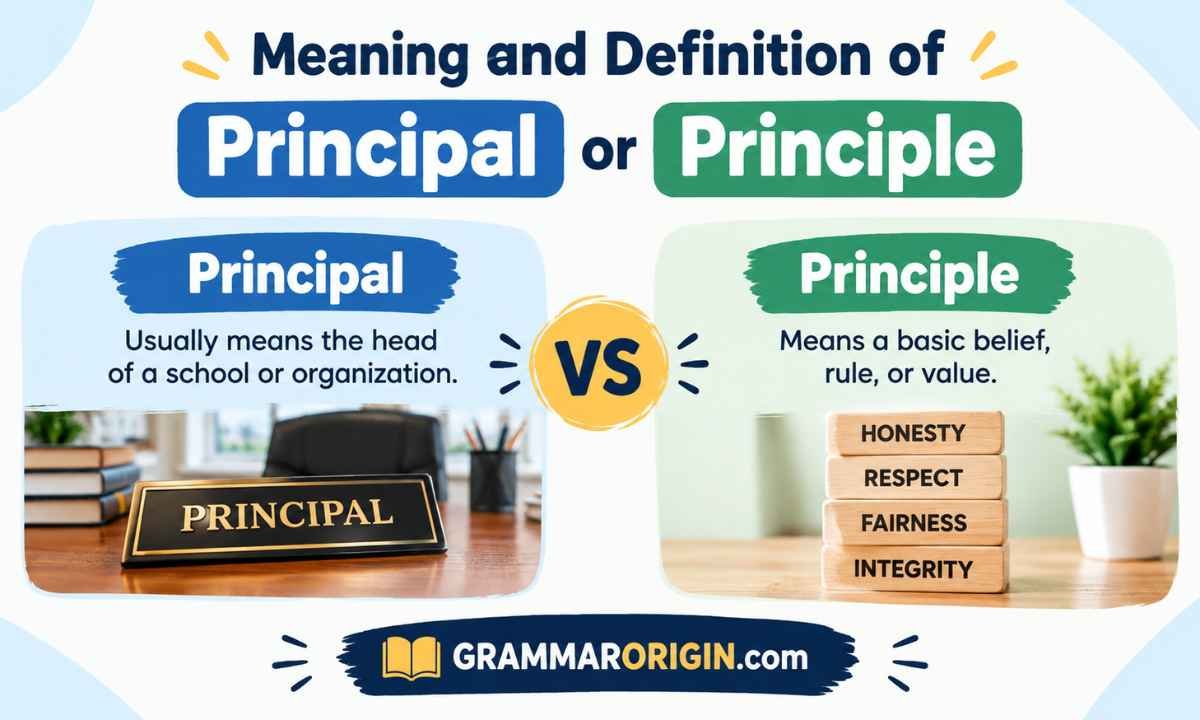
Principal covers people, importance, and money. Principle covers rules and beliefs, and nothing else.
Principal and principle are homophones, so the sound gives you no clue. The principal or principle mix-up isn’t random either. Principal comes from the Latin prīncipālis, meaning “first” or “chief,” while principle comes from prīncipium, meaning “beginning” or “origin.” Both grew out of the same root, so they look like twins even though they work differently.
Example: The college principal reminded students that fairness is a principle, not a suggestion.
1. Principal
Principal names a leader, describes something main, or points to the original amount of a loan. It works as both a noun and an adjective.
It shows up in five common ways:
- The head of a school or college (in some universities, such as Queen’s University in Canada, the head of the whole institution holds the title too)
- A lead performer, as in a principal dancer or principal violinist
- The party who hires an agent in a legal or business deal (the principal-agent relationship)
- The adjective meaning “main,” as in the principal reason
- The money you borrowed or invested before any interest gets added
Example: Lentils are the principal ingredient in this soup.
2. Principle
Principle is a noun for a rule, a moral standard, or a basic truth that something rests on. It never works as an adjective.
You’ll meet it in ethics (honesty, fairness), in science (Archimedes’ principle explains why a steel ship floats), and in personal choices (“I don’t lend money to friends, it’s just a principle of mine”). Its adjective cousin is principled.
Example: Archimedes’ principle explains why a heavy ship stays afloat.
Key Differences Between the Principal or Principle
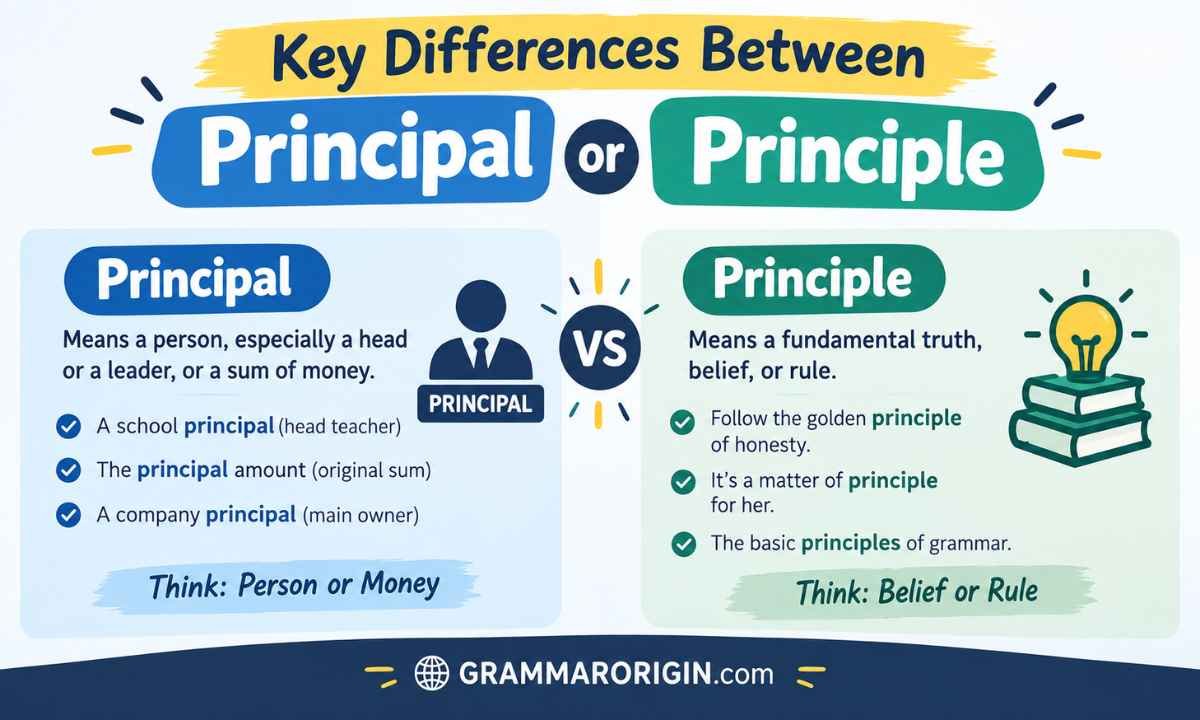
The biggest difference in principle vs principal is what each word points to. Principal points to a person, a rank, or an amount of money, while principle points to an idea you follow or a law that explains something.
A few more contrasts worth knowing:
- Word class: principal is a noun and an adjective. Principle is a noun only.
- Question it answers: principal answers “who?” or “how much?” Principle answers “what do you believe?” or “why does this work?”
- Plural: principals are people or parties. Principles are rules or values.
- Related forms: principal gives you principally. Principle gives you principled.
Example: The principals of the firm agreed on three principles for the merger.
Comparison Table: Principal vs Principle
Here’s principal vs principle side by side, so you can scan the difference in a few seconds.
| Feature | Principal | Principle |
| Part of speech | Noun and adjective | Noun only |
| Core meaning | Head, main, or original sum | Rule, belief, or basic truth |
| Refers to | People, ranks, money | Ideas, ethics, laws of nature |
| Common phrases | school principal, principal reason, principal amount | in principle, on principle, guiding principle |
| Plural | principals | principles |
| Related form | principally | principled |
| Quick test | Swap in “main” | Swap in “rule” |
| Memory hook | Contains “pal” (a person) | Ends like “rule” (-le) |
Example: The bank charges interest on the principal, yet it claims to follow the principle of clear pricing.
Examples in Sentences: Principle or Principal
Principal or principle gets easier once you see the words working, so here are sentences grouped by meaning.
Example: The principal shared one principle with the class: be honest.
Using “Principal”
Principal turns up in schools, banking, film, and business writing.
Example:
- The principal called a meeting about the new bus timings.
- Rising fuel costs are the principal cause of the delay.
- Each month, you’ll pay interest on whatever principal is still left.
- She was promoted to principal violinist last spring.
- The agent must follow the instructions of the principal.
Using “Principle”
Here the word always stands for an idea, a standard, or a law.
Example:
- Fairness is a principle he never bends.
- She turned down the offer on principle.
- Our team follows one design principle: keep it clear.
- In principle, the plan works. The budget is the problem.
- Pascal’s principle explains how hydraulic brakes multiply force.
Common Mistakes: Principal and Principle
The most frequent slip is writing principle for a school head or a loan amount. The next most common is the reverse: writing principal for a rule.
This pair often lands on lists of commonly confused words. Principal or principle errors survive spellcheck because both words are real. Your software sees a valid spelling and moves on, so the catch has to come from you. Watch for “in principal,” “principle photography,” “principle reason,” and “principal of gravity.”
Example: “The principle reason for the delay” reads smoothly at a glance, but it should say principal.
Also Read This Customize or Customise: Which Spelling Is Correct?
Incorrect vs Correct
Almost every fix here is a one-letter swap. Compare each pair below.
Example:
- Incorrect: The school principle called my parents.
- Correct: The school principal called my parents.
- Incorrect: We agreed in principal.
- Correct: We agreed in principle.
- Incorrect: He repaid the principle amount first.
- Correct: He repaid the principal amount first.
- Incorrect: Honesty is my guiding principal.
- Correct: Honesty is my guiding principle.
- Incorrect: Principle photography starts in May.
- Correct: Principal photography starts in May.
Tips to Remember: Principle and Principal
Pick the principal vs principle trick that fits how your brain works. Each of the four below can stand on its own.
Example: Say “my pal, the principal” out loud once, and the spelling tends to stick.
1. “Principal is your pal”
Look for the word “pal” tucked inside principal. A pal is a person, and principal is the word for a person in charge.
It also covers principal dancers and principals in a deal, since those are people too. It won’t help with the “main” or money meanings, which is where tip three comes in.
Example: My pal, the principal, signed the permission slip.
2. “Principle = rule”
Principle and rule share the same ending, -le. Same ending, same job.
When you’re unsure, try swapping in the word “rule.” If the sentence still makes sense, principle is your spelling.
Example: “Never quit” is a principle I live by. Swap in “rule,” and it still works.
3. Use association
Tie each word to a scene you can picture. For principal, think of a school office, a loan statement, or a movie set. For principle, think of a rulebook, a physics textbook, or a friend saying, “It’s a matter of principle.”
A mental picture beats a memorized definition most days.
Example: Picture the first big number on a loan statement. That number is the principal.
4. Visual Memory
Write the two words on a sticky note and mark the endings. Circle the “al” in principal and draw a stick figure named Al beside it. Underline the “le” in principle and sketch a ruler.
It takes ten seconds, and the note works even when your memory doesn’t.
Example: principAL gets a stick figure at a school gate, and principLE gets a ruler.
When to Use Principal or Principle
Reach for principal when you mean a person, a main thing, or money. Reach for principle when you mean a rule, a belief, or a scientific law.
Example: The principal of the firm set one principle: no hidden fees.
Use “Principal” When:
- You’re naming the head of a school or college
- You want a word for “main” or “most important” before a noun
- You’re talking about the original sum of a loan or investment
- You mean a lead performer or a party in an agency relationship
- You’re writing the film term principal photography
Example: The principal objective of the new policy is to cut waiting times.
Use “Principle” When:
- You’re stating a moral standard or personal code
- You’re describing a scientific or legal law
- You’re using set phrases like “in principle,” “on principle,” or “guiding principle”
- You’re talking about first principles, meaning the basic ideas a subject rests on
Example: As a matter of principle, the editor never publishes unchecked claims.
Grammar Rules (Principal or Principle)
Two rules settle most principal or principle questions. Principal can be a noun or an adjective, while principle can only be a noun.
Beyond that:
- If a word sits before a noun and describes it, as in “principal reason,” it must be principal.
- Only principal has an adverb, principally. Principle’s adjective is principled, and its opposite is unprincipled.
- Both words take a plain -s for the plural: principals and principles.
- “The principle of ___” is the usual pattern for a rule or law.
Example: Traffic is the principal reason I moved closer to work.
Example:
Here are those rules in short sentences you can borrow.
Example:
- Adjective slot: The principal cause of the flood was a broken dam.
- Adverb: The book is principally about ethics.
- Adjective from principle: He’s a principled negotiator who never bluffs.
In Principle vs In Principal
“In principle” is the only correct spelling. It means “in theory” or “in general agreement.” “In principal” isn’t a valid phrase.
Don’t confuse it with “on principle,” which means “because of a firm belief.” One describes agreement in general terms, and the other describes a stand you take.
Example: In principle, the plan is sound. He never gambles, on principle.
Also Read This Customize or Customise: Which Spelling Is Correct?
Synonyms or Related Words: Principal or Principle
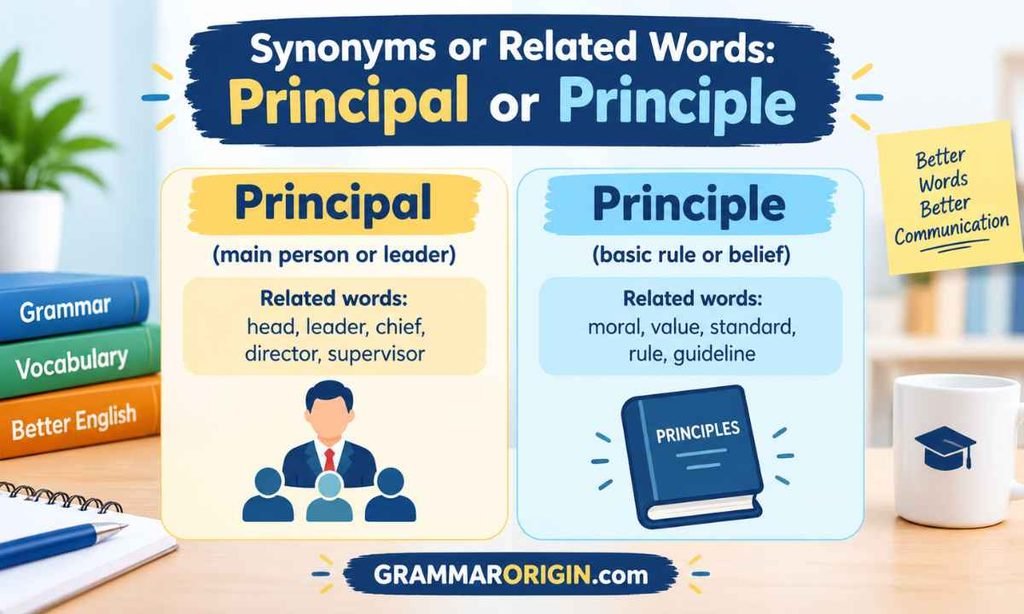
Synonyms are a handy double-check for principal or principle, though they aren’t perfect swaps. If “chief” or “main” fits, you want principal. If “rule” or “belief” fits, you want principle.
Related forms round out the family: principally (adverb), principled (adjective), and unprincipled (adjective).
Example: The chief reason for the delay is the principal reason for the delay.
Principal (Synonyms):
As an adjective: main, chief, primary, leading, foremost, key. As a noun: head, headteacher, director, leader. In finance: capital sum, original amount, base amount.
Example: The primary ingredient is the principal ingredient.
Principle (Synonyms):
Rule, tenet, doctrine, standard, ethic, code, conviction, belief. For science, “law” often does the same job.
Example: Honesty is her personal code, or in other words, her principle.
Principal or principle photography
It’s principal photography. Here, principal means “main,” because this is the main filming stage of a movie.
Principal photography is when the lead cast and crew shoot most of a film’s scenes. Pre-production comes before it, and post-production comes after. Smaller crews may film extra shots later. “Principle photography” is a common misspelling and has nothing to do with rules.
Example: Principal photography wrapped after 58 days on location.
Principal vs principle money
For money, always use principal. It’s the original amount you borrow or invest, before interest gets added.
Say you take a $10,000 loan at 8% simple annual interest. The principal is $10,000, and the interest for one year is $800. On monthly instalments, part of each payment cuts the principal and the rest covers interest. Paying extra toward the principal early can shrink the total interest you owe, so it’s worth asking your lender how extra payments are applied.
You’ll often see the phrase principal amount on loan papers. Principle only shows up in money writing when you mean a rule, such as the principle of compound interest.
Example: You borrowed $10,000, and the principle of compounding means unpaid interest can start earning interest of its own.
Frequently Asked Questions
What is the difference between principal or principle?
Principal is a person, a main thing, or original money. Principle is a rule or belief. The first can be a noun or an adjective, while the second is only ever a noun.
Example: The principal praised her principles.
Is principle ever used as an adjective?
No. Principle is only a noun. If you need an adjective, use “principled,” which means “based on strong moral rules.”
Example: She’s a principled leader, not a “principle” leader.
Is it “in principle” or “in principal”?
It’s “in principle.” The phrase means “in theory” or “in general,” and “in principal” is never correct.
Example: In principle, we agree, but we still need to see the contract.
Is it principal or principle when talking about loans?
It’s principal. The principal is the amount you borrowed before interest.
Example: After my extra payment, the principal dropped to $8,200.
Is it principal photography or principle photography?
It’s principal photography. The word means “main,” since this is the main phase of filming.
Example: Principal photography begins on Monday.
How do I remember principal vs principle?
Link principal with “pal,” because a pal is a person, and link principle with “rule,” because both end in -le. You can also test the sentence by swapping in “main” or “rule.”
Example: If “main” fits, write principal. If “rule” fits, write principle.
Are principal and principle homophones?
Yes. They’re homophones, which means they sound the same but differ in spelling and meaning. Only the spelling and the sentence tell them apart.
Example: The principal explained the principle behind the rule.
Summary
Choosing between principal or principle comes down to one question. Are you talking about a person, a main thing, or money, or about a rule? The first group takes principal, and the second takes principle.
Keep the “pal” trick, the “rule” trick, and the swap test close, and this pair stops being a problem. Then the choice takes a second.

Muhammad Waqas is an English language teacher and grammar expert with over 8 years of experience helping students and professionals improve their writing skills. He specializes in English grammar, vocabulary, communication, and practical language learning. Through GrammarOrigin, Waqas shares clear, easy-to-understand content that helps readers write and speak English with confidence.