
Treck or trek? The correct spelling is trek, and treck is a common misspelling. A trek is a long, hard journey, usually on foot, and the word works as both a noun and a verb.
This guide shows why that extra c sneaks in, where the word really comes from, and how to use trek, trekked and trekking correctly. You’ll also see the few places where treck appears as a name.
Quick Answer: Treck or Trek – Which Spelling is Correct?
Trek is the correct spelling. Treck is not a standard English word, so editors and teachers treat it as a mistake.
- Correct: trek
- Incorrect: treck
Four letters, no c: t-r-e-k. That settles the treck or trek question for good.
Example: We finished the trek to the lake before sunset.
Why this confusion happens
The confusion happens because English often writes the k sound as “ck” after a short vowel. Think of deck, neck, check and wreck.
Trek doesn’t follow that pattern because it was borrowed from another language and kept a simpler spelling. Autocorrect doesn’t always catch the slip either, which keeps the treck or trek question alive.
Example: Wreck and check end in “ck”, but trek ends in a plain k.
What Does Trek Mean in English?
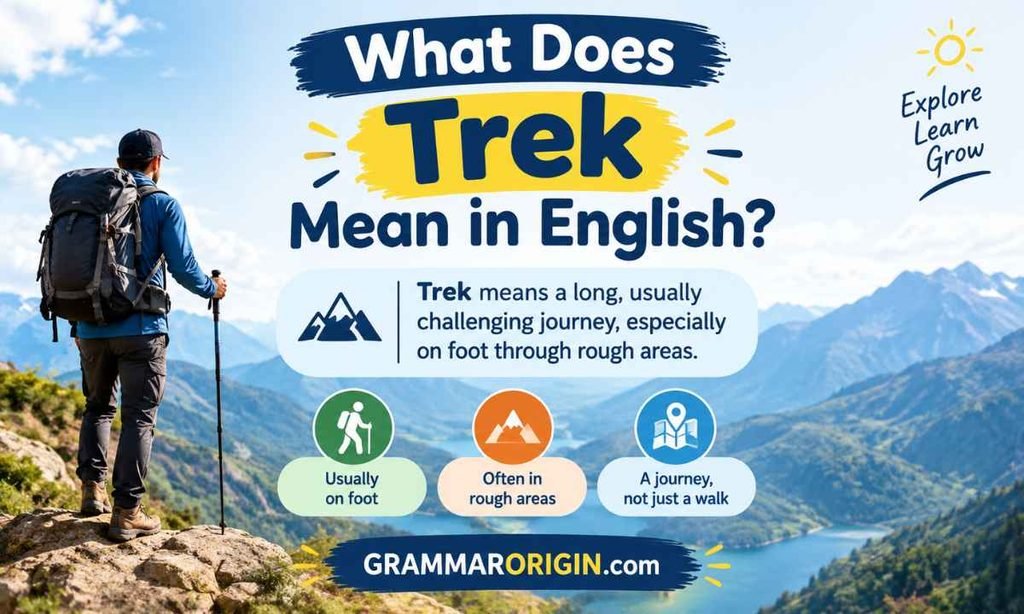
A trek is a long, difficult journey, usually made on foot. Merriam-Webster describes the noun as an arduous trip and the verb as making your way with great effort.
The word always points to distance and effort together. A short, easy stroll doesn’t qualify.
Example: The family made a slow trek across the desert.
Core meaning
Trek means a long journey that takes real effort. That effort can come from rough ground, bad weather, heavy bags or simply the length of the road.
As a verb, it means to travel that way. As a noun, it names the journey itself.
Example: After the storm, the trek back to camp took all night.
Today, “trek” can also mean:
Today, trek covers more than mountain walks. Writers stretch it to fit several situations:
- A tiring walk that feels longer than it should
- An organized multi-day hiking trip, such as a trekking holiday
- A long commute or errand that wears you out
- A concert or sports tour, a sense you’ll often see in entertainment news
Example: Her daily trek to work involves two buses and a long walk.
Example sentences
Here are five sentences that show how trek reads in normal English.
- We began the trek at dawn.
- They trekked through thick snow for two days.
- The hotel is a short trek from the station.
- He treks to the library every morning.
- Her guide has led hundreds of Himalayan treks.
Emotional meaning behind the word
Trek carries a feeling of effort, distance and a little hardship. That feeling is why writers pick it over plain words like walk or trip.
Use it when the journey matters, not when the distance is small.
Example: A trek to the mailbox in a snowstorm sounds heroic, while a walk to it sounds ordinary.
Is Treck a Real Word or Just a Mistake?
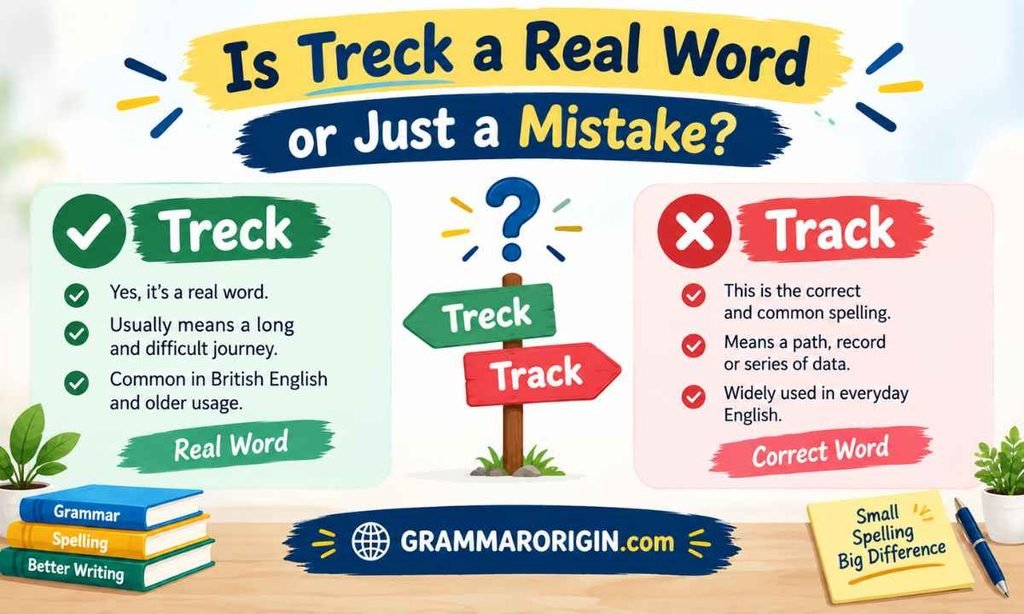
In standard English, treck is a mistake, not a word. Dictionaries list trek and nothing else.
There are a few real-world exceptions, but they are names, not spellings of the everyday word.
Example: “We planned a treck through the hills” would get a red underline in any edited document.
“Treck” is NOT recognized in standard English
Treck has no entry as a noun, verb, slang term or alternate spelling. It isn’t a British spelling or an American one either.
So there’s no region or style guide where treck becomes acceptable for the everyday word. In the treck or trek debate, only trek survives.
Example: The correct sentence is “We planned a trek through the hills.”
Why it keeps appearing online
It keeps appearing because people type by sound and by habit. Phone keyboards, fast posting and copying other people’s captions all help the error spread.
Some writers also assume the odd-looking spelling must be a regional variant, which it isn’t.
Example: A caption reading “Weekend treck with friends” gets copied by others who assume it’s fine.
Dictionary consensus
Dictionaries agree: the entry you want is trek. Merriam-Webster lists trek as both a noun and a verb, with the forms trekked and trekking. Etymonline traces the same word back to Afrikaans and Dutch.
Neither treats treck as a variant of the everyday word, so the treck or trek choice is already made for you.
Example: Look up trek, and you’ll find its meaning, its forms and its history in one place.
Where you may still see “treck”
Treck does appear in a few real places, but none of them make it a spelling option. One is Treck, Inc., a company that makes embedded networking software.
Another is the older Dutch form treck, which Merriam-Webster’s noun etymology points back to. You may also meet it in usernames or stylized brand names.
Example: When a page about networking software mentions Treck, that’s a company name, not a typo.
The Origin and History of the Word “Trek”
Trek comes from Afrikaans, which borrowed it from Dutch. Its original sense was pulling or hauling, which fits an ox dragging a wagon.
English picked the word up in the 1800s, and it has grown a lot since then.
Example: Every English trek carries a little of that old idea of pulling something heavy a long way.
Etymology
The word traces to the Dutch verb trecken, meaning to pull, haul or migrate, by way of Afrikaans. Etymonline adds that the Dutch verb is probably related to the source of the English word track.
In modern Dutch, “trek” also means appetite, which is a fun surprise for English speakers.
Example: The Dutch verb trekken meant to pull, and Afrikaans turned it into a word for a wagon journey.
Historical context
The word became well known through the Great Trek, the migration that began around 1835 when more than 10,000 Boers left the Cape Colony. Early English uses were almost always about South Africa and ox-wagon travel.
Merriam-Webster dates the first known use of the verb to 1835 and the noun to 1849.
Example: In old accounts, a trek was often one stage of a wagon journey.
Modern evolution
Trek moved from a South African term to a general English word for any long, tiring journey. Etymonline says this broader noun sense was in general use by 1941.
Wiktionary also notes that in Nigerian English, to trek can simply mean to travel on foot.
Example: Today a hiker, a commuter and a touring band can all be on a trek.
Also Read This Gauging Interest vs Gaging Interest: Which Is Correct?
Why Do People Write “Treck” Instead of “Trek”?
Most people write treck because it looks right to them, not because they believe it’s a real variant. Four habits explain almost every case.
Knowing the cause makes the treck or trek mistake easier to catch in your own writing.
Example: A writer says trek aloud, then adds a c out of habit when typing it.
1. Phonetic spelling confusion
English spelling doesn’t match sound very closely, so people guess. The word sounds like it ends the way check and neck do, so a “ck” feels natural.
Example: Because it rhymes with neck, some people give it the same ending.
2. Pattern overgeneralization
Learners notice that many short-vowel words end in “ck” and apply that rule everywhere. The rule is common, but it has exceptions, especially in borrowed words.
Example: Deck and trick follow the pattern, but trek doesn’t.
3. Fast typing mistakes
Quick typing on a phone leaves little room for proofreading. Autocorrect may accept treck if the word appears in its own custom dictionary.
Example: A traveler types “treck tomorrow!” at the airport and posts it before checking.
4. Social media reinforcement
When a wrong spelling appears in many captions, it starts to look familiar. Familiar spellings feel correct, even when they aren’t.
Example: Seeing “treck” under several photos can make the next person think it’s normal.
How to pronounce trek
Say it like “trek”, with the same ending as check, neck, deck and wreck. The IPA is /trɛk/, and it’s one syllable.
The sound is identical to what “treck” would be, which is exactly why the error is so common.
Example: Trek and neck rhyme perfectly, even though only one has a c.
How “Trek” Works in Modern English
Trek works as a noun and as a verb, and both use the same base spelling. Only the verb forms change, as you’ll see in the table below.
Example: We started the trek early, and we trekked until dark.
Trek as a Noun
As a noun, trek names the journey itself. It can be counted, so you can have one trek or many treks.
Examples:
- The trek took us five hours.
- It was a tough mountain trek.
- That grocery run felt like a long trek.
Key idea:
The noun points to the journey, not the action of making it.
Trek as a Verb
As a verb, trek describes the act of traveling with effort. It usually takes a direction or place after it, such as through, across or up.
Examples:
- We trekked through the forest.
- They trekked across the valley.
- I trekked home in the rain.
Key idea:
The verb stresses effort during movement, and its past tense is trekked.
Figurative use of trek
Figurative use means using trek for effort that isn’t literally a hike. It’s common, friendly and often a bit humorous.
Use it when the exaggeration is clear and the tone is casual.
Example: My commute is a daily trek through traffic.
Trek word forms: trek, treks, trekked, trekking, trekker
Trek has five common forms, and the k doubles before -ed and -ing. That’s why “trekked” and “trekking” have two ks and no c.
| Form | Part of speech | Example |
| trek | noun, verb | They love a long trek. |
| treks | plural noun, verb (he/she/it) | She treks every summer. |
| trekked | past tense, past participle | We trekked for hours. |
| trekking | present participle, noun, adjective | Trekking poles help on steep paths. |
| trekker | noun (a person) | Every trekker carried a map. |
Example: Even in the past tense, it’s trekked, never “trecked.”
Real-World Usage of “Trek”
Writers use trek in four main places: travel writing, news, social media and academic work. The spelling never changes between them.
Only the tone does, from adventurous to factual to playful to formal.
Example: A journalist and a blogger both write trek, just in different moods.
Travel writing
Travel writers use trek for hiking routes, mountain routes and multi-day walks. It signals difficulty and adventure without extra explanation.
Example: The trek to Everest Base Camp usually takes about two weeks.
News writing
News writers use trek for long, hard journeys, and also for concert tours. Recent entertainment coverage often calls a band’s tour a trek, and business stories use it for long commutes.
Example: The band announced a 20-city trek across North America.
Social media language
On social media, trek is usually a joke about small journeys that feel huge. Captions about coffee runs, gym trips and laundry rooms use it a lot.
Example: That walk to the far parking lot was a full trek.
Academic writing
Academic writers use trek in geography, history and migration studies. The tone is measured, and the word usually describes a real, long journey.
Example: Early settlers made a long trek inland to find farmland.
Trek vs Similar Words (Clear Comparison Guide)
Trek is closest to hike, journey and expedition, but it puts the focus on effort and distance. The other words lean toward recreation, direction or organization.
| Word | Meaning | How it differs from trek |
| Trek | A long, difficult journey | Stresses effort and distance |
| Hike | A walk in nature | Usually shorter and recreational |
| Trudge | To walk heavily and slowly | Stresses tiredness, not distance |
| Journey | Travel from one place to another | More general, no effort implied |
| Expedition | An organized trip with a purpose | More formal and planned |
| Travel | Moving from place to place | The broadest word |
Simple takeaway
Pick trek for effort plus distance, hike for a nature walk and journey for general travel. If the trip was easy or short, one of the other words fits better.
Example: A Sunday walk is a hike, but two weeks in the mountains is a trek.
Also Read This Gauging Interest vs Gaging Interest: Which Is Correct?
Common Mistakes People Make with “Trek”
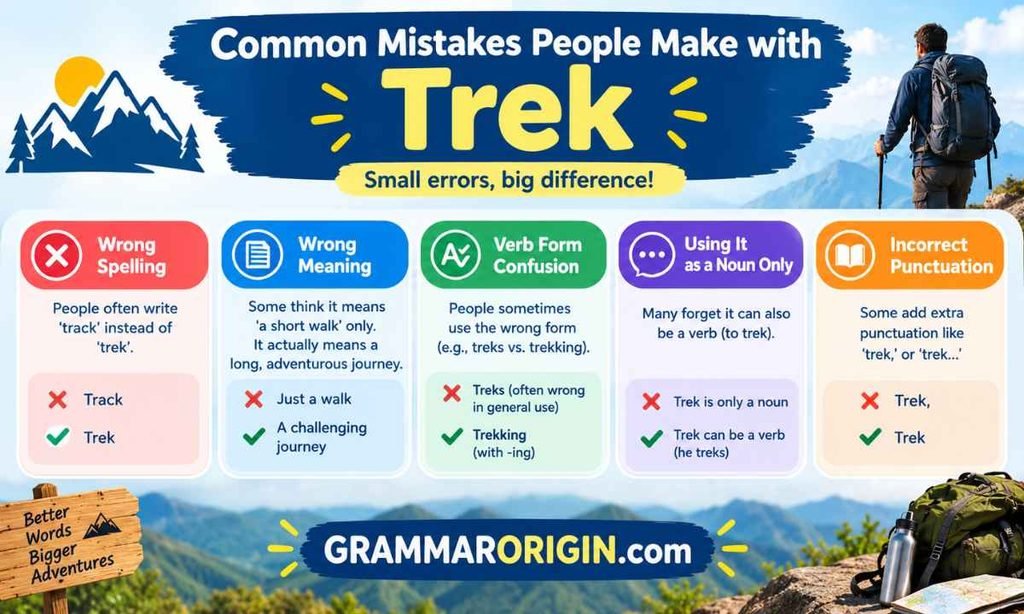
The biggest mistake is the treck or trek slip, meaning an added c, but there are a few other slips worth knowing. Most come down to spelling forms or to tone.
Example: “We had a trek of two weeks” reads fine, but “a treck” doesn’t.
Most common errors:
- Writing treck instead of trek
- Writing “trecked” or “trecking” instead of trekked and trekking
- Writing “treked” with one k instead of trekked
- Using trek in a formal report for a short, easy walk
- Confusing the general word with the Trek bike brand or Star Trek
Example: The past tense is trekked, with two ks.
Example of incorrect usage:
The sentence “We treck through the forest every summer” has the wrong spelling.
Example: We treck through the forest every summer.
Better version:
The fix is to drop the c, and to use a past or present form that fits. Here’s the corrected line.
Example: We trek through the forest every summer.
Which Spelling Should You Use? Treck or Trek?
Use trek every time you mean a long, hard journey. When you face the treck or trek choice, the only time you write treck is when you’re copying a proper name exactly.
Example: The route guide describes a five-day trek in the Alps.
Always use:
Use trek, treks, trekked, trekking and trekker in ordinary writing. These forms are correct in American, British, Australian and Canadian English.
Example: We booked a trekking holiday in Nepal.
Never use:
Never use treck, trecked or trecking for the everyday word. They look like typos and can lower your credibility.
Example: Avoid writing “treck tomorrow” in a travel post.
When to use “trek”
Use trek for long, effortful journeys, hiking trips, concert tours and playful exaggeration. It fits emails, blogs, essays, captions and academic writing.
Skip it for a two-minute walk in formal writing, since the effort doesn’t match.
Example: The three-day trek ended at a mountain village.
Trek in Pop Culture and Branding
Pop culture and business have made the word trek very familiar. Both keep the standard spelling, which helps people remember it.
Example: You see trek on bike shops, gear stores and TV listings.
Example influence:
Star Trek and Trek bicycles both use the standard spelling, so they reinforce it each time someone sees the name. Outdoor gear brands also lean on trek to signal adventure.
A brand can change how you feel about a word, but it doesn’t change how a dictionary spells it.
Example: A store called Trek spells the word the same way a dictionary does.
Trek vs Star Trek (Important Distinction)
Trek is an everyday English word, and Star Trek is the name of a science fiction franchise. One is common, the other is a proper noun.
Example: A hiker takes a trek, while a fan watches Star Trek.
Trek (general word)
The general word is lowercase in normal sentences and can be a noun or a verb. It has nothing to do with space unless the writer says so.
Example: We went on a long trek through the woods.
Star Trek (proper noun)
Star Trek is a title, so it’s capitalized and refers to a specific franchise. It debuted on television in 1966, and its name plays on the idea of a long journey.
Example: She quoted a line from Star Trek at dinner.
Why confusion happens
People see Trek in a title and assume the word only belongs to that world. In fact, the word came first, and the franchise borrowed its familiar meaning.
Example: When someone says “the trek was long,” they aren’t talking about the show.
Usage Trends and Language Behavior
Trek is the standard spelling in edited writing, and treck shows up mostly as a typo or a name. That’s what dictionaries, news writing and brand names all suggest.
This section describes the treck or trek pattern without inventing numbers.
Example: Recent news stories about hikes, commutes and tours all spell it trek.
What we consistently observe:
Three patterns show up again and again:
- Dictionaries list trek and its forms, and don’t list treck as a variant
- News and travel writing use trek for hikes, tours and long commutes
- Treck appears mainly in typos, usernames and a few brand names
Example: Merriam-Webster’s recent news examples pair trek with concert tours and hiking routes.
Why this matters for SEO and writing
Correct spelling helps readers trust you, and it helps search engines understand your page. A misspelled keyword can also send readers to the wrong results.
If you want real numbers, Google Trends lets you compare the two spellings yourself.
Example: A blog title with trek matches what readers actually search for.
Case Study: How Misspellings Affect Search Results
Misspellings often cost pages some visibility, though results vary by query, location and search history. Treat this case study as an illustrative scenario, not measured data.
Example: A hiking blog that writes treck may look less polished than one that writes trek.
Scenario:
Imagine two hiking blogs that publish guides to the same mountain route. One title uses trek, and the other uses treck.
Example: “Beginner Trek Guide” and “Beginner Treck Guide” cover the same trail.
What happens:
Search engines often treat a likely typo as a misspelling and may show results for the correct word instead. A query with treck can also surface pages about a company named Treck, Inc., which has nothing to do with hiking.
Example: A search for “mountain treck tips” may show results for trek instead.
Insight:
The lesson of the treck or trek test is simple: readers and search engines both look for trek. Writing the standard word keeps your page aligned with what people expect.
Example: Use trek in your title, headings and captions.
Quick Comparison Table: Treck vs Trek
Trek is the correct word, and treck is a misspelling that only appears as a name in a few cases. This treck or trek table sums up the differences.
| Feature | Trek | Treck |
| Dictionary status | Standard word | Not listed as a variant |
| Part of speech | Noun and verb | None in standard English |
| Meaning | Long, difficult journey | None for the everyday word |
| Past tense | Trekked | Not applicable |
| Where it appears | Everyday writing, news, brands | Typos, Treck, Inc., usernames |
| Use in formal writing | Correct | Incorrect |
Example: In a report, write trek, and keep treck only for an exact company name.
Treck or trek synonym
Treck has no synonyms because it isn’t a word, so every synonym belongs to trek. Choose one based on how hard, long and organized the trip was.
- Journey for general travel
- Hike for a walk in nature
- Trudge for a slow, heavy walk
- March for steady, purposeful walking
- Expedition for an organized trip with a goal
- Slog for a tiring, dull effort
Example: They trudged home after a long day, but the mountain route was a real trek.
Trek bikes
Trek bikes are bicycles made by Trek Bicycle Corporation, and the brand name is spelled with no c. The word is a proper noun in that case, so it’s capitalized.
The company was founded in 1976 by Dick Burke and Bevil Hogg in Waterloo, Wisconsin, where its headquarters remains today. Searching for “treck bikes” is a misspelling of that brand.
Trekking bikes are a separate idea: a bike category built for touring and long rides. That name comes from the everyday word.
Example: She rode her Trek road bike on a weekend trek through the hills.
Frequently Asked Questions
What does “treck” mean?
Treck has no meaning in standard English because it’s a misspelling of trek. It appears as a company name (Treck, Inc.) and as an older Dutch spelling, but not as an English word.
How do you spell trek or treck?
The correct spelling is trek: t-r-e-k. In the treck or trek question, trek is the only form dictionaries accept.
Is it “trekking” or “trek”?
Both are correct. Trek is the base form, and trekking is the -ing form, as in “we went trekking.” Never write “trecking.”
What does “treck” mean in slang?
Treck has no slang meaning. If you see it in a post or a message, the writer almost certainly meant trek.
What is the past tense of trek?
The past tense is trekked, with two ks. The same doubling gives trekking.
Is treck a British or American spelling?
Neither. Trek is standard in both British and American English, and treck is treated as an error in both.
Final Thoughts
The answer to the treck or trek question never changes: use trek. It’s the standard spelling in every major variety of English, and it works as a noun, a verb and a playful exaggeration.
Remember the two-k forms trekked and trekking, and save treck for exact company names. If you keep those two rules in mind, your writing will look clean and confident.

Muhammad Waqas is an English language teacher and grammar expert with over 8 years of experience helping students and professionals improve their writing skills. He specializes in English grammar, vocabulary, communication, and practical language learning. Through GrammarOrigin, Waqas shares clear, easy-to-understand content that helps readers write and speak English with confidence.