
Gauging interest is the correct, standard spelling. Gaging interest is a rare variant that mostly shows up in technical writing, and most readers will take it for a typo.
This guide to gauging interest vs gaging interest explains where each spelling comes from, when “gage” is legitimately right, and how to measure interest once the word is sorted.
The Short Answer Readers Actually Want
Write “gauging interest.” Gauging interest is the form dictionaries lead with and the one readers expect in emails, reports, and research.
“Gaging” isn’t a made-up word, though. Merriam-Webster records gage as a variant spelling of gauge, verb included, but notes that this variant turns up mostly in informal sources and not often. It’s less “wrong” than “unexpected,” and unexpected spelling makes readers pause.
Example: “We’re gauging interest in a weekend coding workshop before we book a venue.”
Gauging vs Gaging — The Real Linguistic Difference
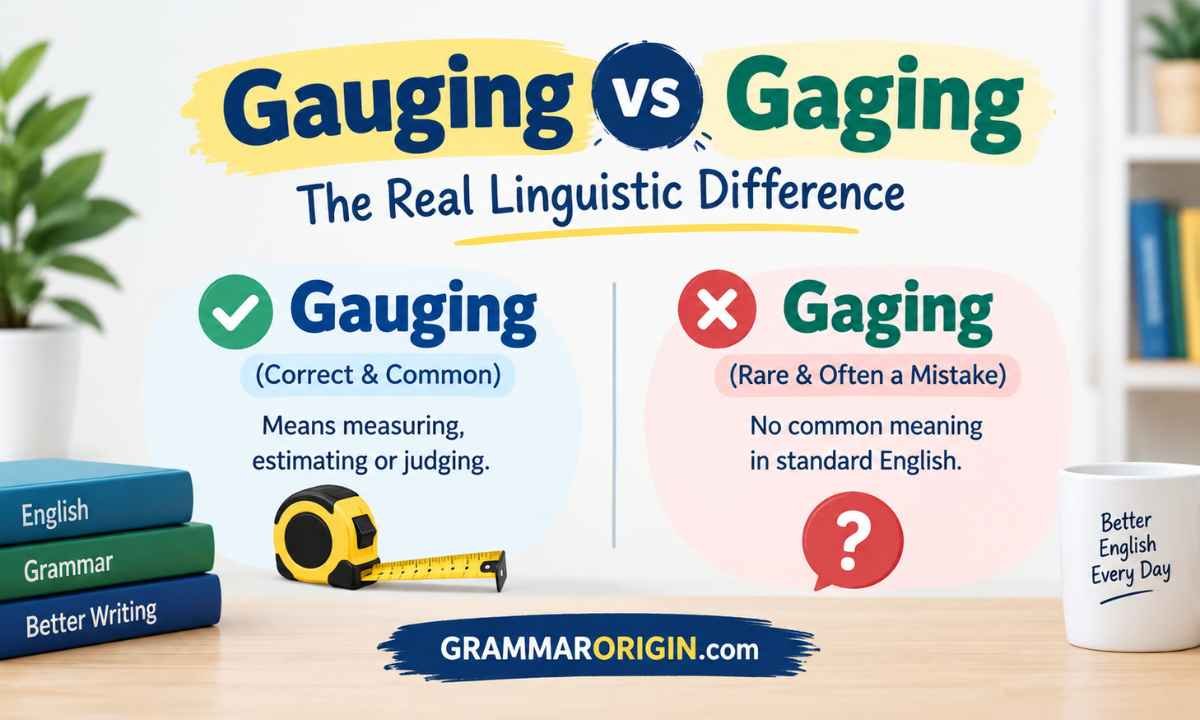
Gauging is the -ing form of the verb gauge. Gaging is the -ing form of gage, and that word has two separate identities: an old term for a pledge, and a variant spelling of gauge.
So this isn’t one word right and one word invented. It’s a dominant spelling and a specialist spelling that sound exactly alike.
Example: A marketer writes about gauging demand for a new app. A machinist writes about gaging the bore of an engine part.
Gauge — Definition and Meaning
As a verb, gauge means to measure or estimate, often something you can’t read off a scale. As a noun, it’s an instrument or a standard of measurement.
The verb runs gauge, gauges, gauged, gauging. People have used it figuratively for judging moods and reactions since the 1580s, which is why gauging interest sounds so natural.
Example: “The fuel gauge showed a quarter tank” (noun). “She gauged the room’s mood before pitching the idea” (verb).
Gage — Definition and Meaning
Gage is either a pledge or security, or a variant spelling of gauge used mainly in technical fields. The pledge sense is old and no longer common in everyday English.
You can still see the pledge meaning inside “mortgage” and “engage,” and in the phrase “throw down the gage.” The technical sense lives on in terms like gage blocks and gage pins.
Example: “The knight threw down his gage.” Or: “The lab calibrated the gage pins before inspection.”
Direct Comparison
The quickest way to separate them is by job: gauge measures in general English, while gage is either a pledge or a technical spelling.
| Gauge | Gage (pledge) | Gage (variant of gauge) | |
| Core meaning | Measure, estimate, or a measuring standard | Security, pledge, challenge token | Same as gauge, in technical usage |
| Where you’ll see it | Business, news, everyday writing | Historical texts, fiction | Engineering, manufacturing, electronics |
| Safe for “interest”? | Yes | No | Rarely, and only in specialist house styles |
Example: “Gauge customer interest” reads normally. “Gage customer interest” makes most readers stop and reread.
Why “Gaging Interest” Feels Plausible (But Usually Isn’t)
It feels plausible because it’s a real spelling that sounds identical to the standard one. It usually isn’t right because, in writing about people and demand, almost nobody uses it.
Four habits keep the mistake alive, and they stack on top of each other.
Example: A draft says “we’re gaging interest in a group trip.” Nothing looks broken, and that’s exactly why it survives editing.
Visual Similarity
The two spellings differ by one letter. Readers skim by word shape, so a missing “u” slips past quickly.
Example: Read “gauging” and “gaging” side by side at full speed, and they blur.
Autocorrect Behavior
Spellcheckers ask whether a word exists, not whether it’s the usual choice. Because gage and gaging appear in dictionaries, many tools won’t underline them.
Example: You type “gaging interest,” no red line appears, and you send the email feeling fine.
Historical Overlap
Older English spelled the measuring word both ways. Merriam-Webster notes that in the 15th century, gauge and gage appeared with roughly equal frequency, and gauge only became the general preference in the late 19th century.
Example: A writer skims an old railway document that says “narrow-gage” and assumes both spellings are equally modern.
Cognitive Shortcut
Writers reason from sound: “they’re pronounced the same, so they’re interchangeable.” That logic is the same trap as their/there, except here one option is a genuine variant, which makes the trap harder to spot.
Example: “It sounds right, so it must be right” is how “gaging” ends up in a product announcement.
Etymology Without the Academic Fog
Both words reached English through French, but from different French words with different jobs. One was about measuring, the other about pledging.
Example: Think of a tax inspector measuring barrels versus a knight handing over a pledge. Same era, different business.
Origins of Gauge
Gauge comes from Anglo-French and Old North French, where it meant a gauging rod, a stick used to check size and capacity. The Online Etymology Dictionary says the deeper origin is unknown, with a Frankish measuring-rod word as one possibility.
The verb sense of measuring exactly showed up in English in the mid-1400s.
Example: A cask inspector uses a gauging rod to check how much a barrel holds.
Origins of Gage
Gage comes from Old French gage, meaning security or pledge, and its verb gager meant to guarantee, promise, or bet. English took it up around 1400 as “to deposit as security.”
That’s the same root sitting inside “engage,” which originally meant to pledge yourself.
Example: A borrower leaves a valuable ring as a gage until the debt is paid.
Why Divergence Matters
Middle English used both spellings for the measuring word, so the split wasn’t logical. It was convention: gauge won in general writing, and gage survived in specialist fields.
That’s why the rule for gauging interest is about audience, not about one spelling being “more real.”
Example: A general-audience blog says “gauge.” A tooling catalog for machinists may print “gage.” Both follow their readers.
Also Read This Principal or Principle: Difference, Examples & Easy Tricks
Modern English Reality — What Dictionaries and Style Guides Show
Dictionaries treat gauge as the standard spelling and gage as either a fading pledge word or a variant. Nothing in that evidence gives a reason to prefer gaging interest over gauging interest.
Merriam-Webster also says most modern uses of gage come from technical industries such as mechanical engineering, manufacturing, and electronics, and that those uses are global. Etymonline quotes the same idea from Barnhart: in American English, gage is found only in technical uses.
| Source | What it tells you |
| Merriam-Webster | Two gages exist; gauge preferred for general use since the late 19th century |
| Etymonline | Both spellings go back to Middle English; American gage is technical |
| Cambridge and Collins | List gauge for judging things like feelings and interest |
Example: Search any major dictionary for “gauge interest,” and you’ll find gauge, not gage, in the entries and examples.
“Gauging Interest” — Why It Became the Default
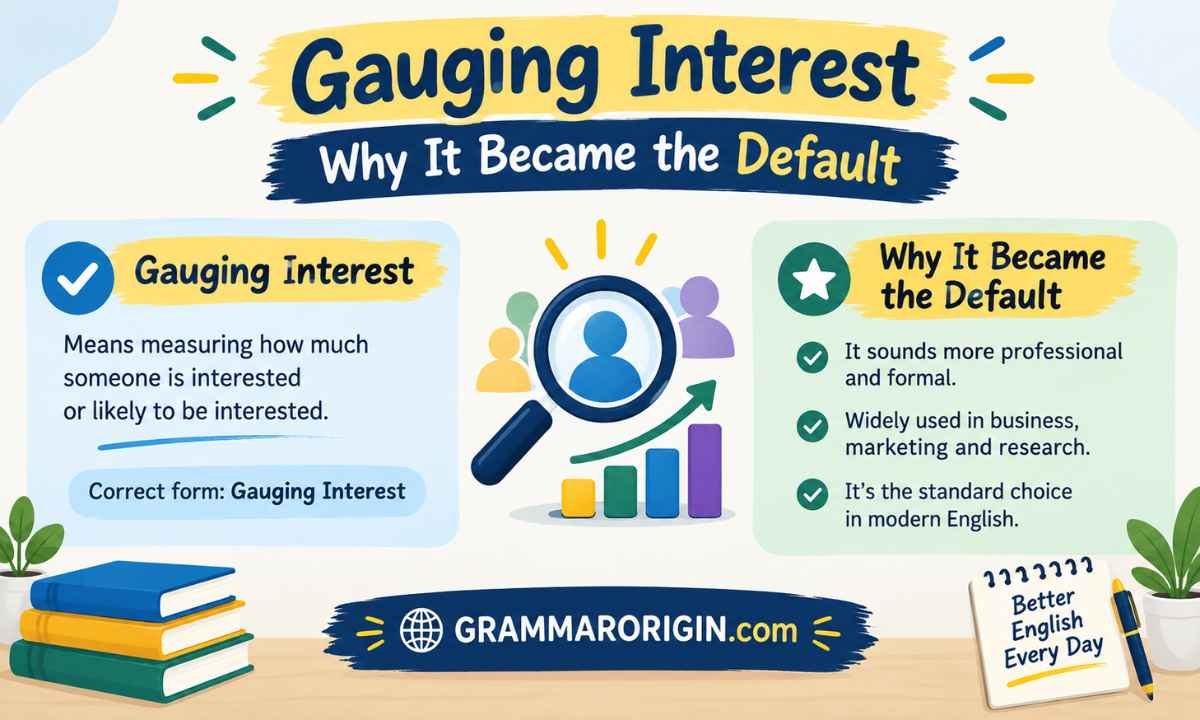
Gauging interest became the default because gauge already meant “measure something you can’t see directly,” and interest fits that description perfectly. Four reasons keep it there.
Example: “Before building anything, the founders spent two weeks gauging interest with a waitlist page.”
Semantic Precision
Interest is a hidden quantity, and gauging interest means inferring it. You infer it from replies, clicks, and body language, and gauge is the verb people already use for that kind of inference.
Example: “Her questions during the demo helped him gauge how serious she was.”
Reader Expectation
Readers have seen “gauging interest” thousands of times, so they process it without effort. Any other spelling adds a tiny bump.
Example: A subject line reading “Gauging interest: spring hiking group” gets understood at a glance.
Communication Efficiency
When the spelling matches expectation, the reader’s attention goes to your message instead of your word choice. That matters most in short texts like subject lines and posts.
Example: “Quick poll: gauging interest in a Friday start time” works because nothing distracts from “Friday.”
Industry Adoption
Product teams, researchers, event planners, and investors all use the phrase in the same form. Shared usage makes it the safe, searchable choice.
Example: A venture firm’s note says investors are “gauging interest” before the round closes.
When “Gage” Can Be Technically Correct
Gage is correct when you mean a pledge, when you’re quoting or naming something that uses that spelling, or when writing inside a field that standardizes on it. It doesn’t stretch to gauging interest in general writing.
Example: “Gage R&R” in a quality report is correct. “Gaging interest” in a party invite isn’t.
Historical Expressions
A few fixed phrases keep the old pledge meaning. “Throw down the gage” means to issue a challenge, and words like “mortgage” and “engage” carry the same root.
Example: “In the ballad, the young lord throws down the gage and calls his rival out.”
Legal or Specialized Usage
Some technical and older legal contexts use gage for a pledge or for measuring tools. You’ll see gage blocks, gage pins, and gage R&R (gauge repeatability and reproducibility) in quality and manufacturing documents, and both “strain gage” and “strain gauge” in engineering.
Example: “The technician logged the gage R&R results for the new fixture.”
Creative or Stylized Writing
Authors can use gage on purpose to sound archaic. The key word is “on purpose”: readers accept a period voice, not a slip.
Example: “She left her ring as a gage and promised to return by spring.”
Side-by-Side Sentence Comparisons
Seeing the spellings in context makes the rule stick. Each pair below shows the standard choice first.
Example: “We’re gauging interest in the new plan.” Not: “We’re gaging interest in the new plan.”
Business Context
Use gauge when you’re assessing demand, buy-in, or appetite inside a company.
Example: Standard: “Sales is gauging interest in the enterprise tier.” Unusual: “Sales is gaging interest in the enterprise tier.”
Market Research
Use gauge when a study measures audience attitudes.
Example: Standard: “The survey gauged consumer interest across three age groups.” Unusual: “The survey gaged consumer interest across three age groups.”
Creative Writing Exception
Use gage when you’re deliberately writing in an older voice and mean a pledge or challenge.
Example: “He tossed his glove down as a gage before the duel.”
Why This Distinction Matters More Than It Seems
One letter won’t sink a message, but it changes how careful the writer appears. Small signals add up when people decide whether to trust you.
Example: Two identical proposals, one with “gaging interest” in the first line. The second reader hesitates before reading on.
Credibility Signals
Readers rarely think “that’s a variant spelling.” They think “typo,” and that impression lingers.
Example: A founder’s investor update with a wobbly key phrase invites the question, “what else is sloppy?”
Professional Interpretation
In workplace writing, standard word choice signals attention to detail. That’s especially true in client-facing copy, where you can’t explain yourself afterward.
Example: A consultant’s deck that says “gauging interest” reads as polished. One with “gaging” gets a margin comment.
SEO Consequences
Search engines can usually match spelling variants, so a variant alone won’t bury a page. But people search both forms, so a good page uses the standard spelling and explains the variant once, clearly, for anyone who typed it.
Example: A blog post titled with the standard spelling and a short “what about gaging?” section covers both searches.
Brand Voice Consistency
Pick the spelling once and use it everywhere: site copy, emails, social posts, support docs. Inconsistency makes a brand feel improvised.
Example: A style guide line: “Always ‘gauge,’ ‘gauged,’ ‘gauging.’ Exception: product names spelled ‘gage.'”
Practical Ways to Gauge Interest in Real-World Scenarios

The best way to gauge interest is to combine what people say with what they actually do. Neither alone tells the full story.
Example: A bakery asks neighbors if they’d like Sunday hours, then also tracks how many stop by on a trial Sunday.
Common Methods for Gauging Interest
Pick a method for gauging interest based on how much certainty you need and how much effort you can spend.
| Method | Good for | Watch out for |
| Surveys | Quick opinions, early ideas | People overstate enthusiasm |
| Behavioral data | Real actions at scale | Needs enough traffic |
| A/B testing | Comparing two options | Needs proper sample size |
| Waitlists and pre-orders | Testing real demand | Sign-ups aren’t purchases |
| Interviews | Understanding why | Small samples |
Example: A startup runs five interviews, then launches a waitlist page to confirm what they heard.
Surveys — Direct Yet Imperfect
Surveys are fast and cheap, but they capture stated interest, which often runs higher than real behavior. People like being polite.
Ask specific questions (“Would you pay $10 a month?”) instead of vague ones (“Do you like this?”).
Example: A course creator surveys 200 subscribers about a new class, then treats the “yes” answers as a ceiling, not a forecast.
Behavioral Data — The Gold Standard
Actions usually beat words: clicks, time spent, repeat visits, and sign-ups show what people do when nobody’s watching. Context still matters, since a click can mean curiosity rather than intent.
Example: A landing page gets 1,000 visits and 80 email sign-ups. That 8% tells you more than 80 friendly comments.
A/B Testing — Controlled Measurement
An A/B test splits your audience between two versions and compares results, so you can see what caused a difference. It works best with enough traffic to avoid reading noise as a signal.
Example: Two headlines for the same event page. Version B gets more registrations, so B goes live.
Also Read This Principal or Principle: Difference, Examples & Easy Tricks
What Strong Analysts Measure When Gauging Interest
Strong analysts treat gauging interest as a layered job, with several signals instead of one number. A page view, a reply, and a purchase each tell a different story.
Example: An analyst reports views, sign-ups, and paid conversions side by side, instead of one headline figure.
Engagement vs Curiosity
Curiosity is a first look. Engagement is sticking around, coming back, or doing something with what they found.
Example: Someone opens your newsletter once (curiosity). Someone clicks every issue for two months (engagement).
Attention vs Intent
Attention means people noticed you. Intent means they’re moving toward a decision, such as booking a demo or paying a deposit.
Example: A viral post brings 50,000 views but nine demo requests. The demos are the clearer signal.
Short-Term vs Durable Signals
A launch-day spike can fade quickly. Steady interest over weeks tells you more about lasting demand.
Example: Sign-ups jump on launch day, then flatten. Weekly returning visitors show what remains.
Key Metrics Often Used
Choose a few metrics that match your goal, rather than tracking everything.
| Metric | What it suggests |
| Click-through rate | Initial appeal of the message |
| Conversion rate | Willingness to act |
| Waitlist sign-up rate | Early demand |
| Reply rate | Personal interest in outreach |
| Retention or return visits | Durable interest |
| Pre-orders or deposits | Strong intent |
Example: For a new product page, a team tracks sign-up rate and return visits, and ignores raw pageviews.
Synonyms That Preserve Natural Flow
Good alternatives to “gauging interest” are assess, measure, evaluate, and test the waters. Each one leans slightly differently, so pick by tone.
- Assess interest: formal, good for reports.
- Measure interest: works when you have actual numbers.
- Test the waters: casual, suggests a low-stakes trial.
- Sound out: conversational, often about people’s opinions.
- Check demand: practical, common in product and sales writing.
- Take the temperature: informal, for a quick read of a room.
Example: “We’re testing the waters on a monthly meetup before committing to a venue.”
Gauge Interest In or On?
Use “gauge interest in” for the topic and “gauge interest among” or “from” for the people. “Interest on” sounds off, because the normal collocation is “interest in.”
“On” works with a different noun: you gauge opinions on a topic, but you gauge interest in it.
Example: “We’re gauging interest in remote work among new hires.” Or: “We’re gauging opinions on remote work.”
Case Example — Business Messaging Done Right
Good messaging about gauging interest gets the spelling right and asks for something specific. The example below shows both problems and fixes.
Example: A team lead wants to know if colleagues would join a lunch-and-learn series.
Problematic Version
Hi all, we’re gaging interest in some kind of training thing. Let us know if you’re into it.
The variant spelling distracts readers, and “some kind of training thing” gives them nothing to respond to. Nobody knows when, how long, or how to reply.
Example: Three people reply “sounds interesting” and nothing gets scheduled.
Improved Version
Hi all, we’re gauging interest in a monthly lunch-and-learn on data basics (45 minutes, Thursdays at noon). If you’d attend, reply “yes” by Friday, and we’ll book the first session.
The spelling is standard, the offer is concrete, and the reply is a single word. Readers can respond in seconds.
Example: Twelve people say “yes” by Friday, and the first session is booked the same day.
Subtle Pitfalls That Even Good Writers Miss
The trickiest errors around gauging interest come from overthinking. Rare usage looks impressive, and “fixing” the wrong thing creates new mistakes.
Example: A writer sees “gage” in a technical PDF and decides it’s the “correct” spelling for everything.
False Authority from Rare Usage
Seeing gage in a manual or an old text doesn’t make it right for a marketing email. Context decides.
Example: “The machinist’s manual says gage, so our newsletter should too” mixes two audiences.
Over-Correction Errors
Changing every “gage” to “gauge” can damage proper names and standard terms. If a product, standard, or quotation uses gage, leave it as written.
Example: Changing a product called “Gage Block Set” to “Gauge Block Set” in a catalog misquotes the maker.
Regional Variation Myths
A common story says Americans dropped the “u,” the way they did with color and honor. Merriam-Webster’s evidence points elsewhere: gage as a variant is mostly technical, and those technical uses are global, not just American.
Example: A UK engineer and a US engineer may both write “gage pins” in a shared spec.
How to Spell Gauging Interest
Gauging interest starts with G-A-U-G-I-N-G: drop the silent “e” from gauge, add “-ing,” and keep the “a-u” pair. Common misspellings are “guaging,” “gaugeing,” and the variant “gaging.”
A simple check: “gauging” has the same letters as “gauge,” minus the final “e.” If the “au” is gone, you’ve drifted into the variant.
Example: “We’re gauging interest” (correct). “We’re guaging interest” (incorrect).
Gauging Pronunciation
Say the first word of gauging interest as “GAY-jing,” /ˈɡeɪdʒɪŋ/, with the first syllable rhyming with “page.” It rhymes with “staging” and “paging.”
Gauge and gage sound the same, so pronunciation won’t tell you which spelling to use. Only the written rule does.
Example: “We’re GAY-jing interest in the new class” is spoken the same way whichever spelling you type.
Frequently Asked Questions
Is it gauging interest or gaging interest?
Gauging interest is the standard, correct choice. Gaging interest is a rare variant spelling, so “gauging interest vs gaging interest” comes down to using the first form in nearly all writing.
Is gaging interest ever correct?
Rarely. It can appear where a field, house style, or quoted source uses “gage,” but in normal business or academic writing, readers will likely see it as a typo.
Is “gaging” a real word?
Yes. Merriam-Webster records gage as a variant of gauge and as a separate pledge word. It just isn’t the usual spelling for measuring interest.
Do gauge and gage sound the same?
Yes, both are pronounced like “gayj.” That’s why the wrong spelling is easy to type without noticing.
Is it “gauge interest in” or “gauge interest on”?
Use “in.” “Gauge interest in the project” is standard, while “on” fits nouns like opinions or views.
What’s a good synonym for gauging interest?
Assess interest, measure interest, test the waters, and sound out are all solid alternatives. Choose by tone: “assess” for formal writing, “test the waters” for casual.
How do you avoid mixing up gauging interest and gaging interest?
Default to “gauge,” “gauged,” and “gauging” unless you’re quoting a technical term or a pledge. When in doubt, choose the spelling your readers already expect.
Summary
The gauging interest vs gaging interest question has a simple working answer: use “gauging.” It’s the standard spelling, and readers won’t stumble over it.
“Gage” still has a real place as a pledge word and a technical spelling, and knowing that keeps you from over-correcting. Get the word right, then focus on measuring interest well.

Muhammad Waqas is an English language teacher and grammar expert with over 8 years of experience helping students and professionals improve their writing skills. He specializes in English grammar, vocabulary, communication, and practical language learning. Through GrammarOrigin, Waqas shares clear, easy-to-understand content that helps readers write and speak English with confidence.