
Recurring means something keeps coming back; reoccurring means it simply happens again. The recurring vs. reoccurring mix-up catches plenty of careful writers, because both words are real and both look right.
Here’s what’s ahead: what each word means, where they overlap, and which one fits phrases like recurring payment, recurring meeting, and recurring dream. There’s also a ten-second decision guide near the end.
Recurring vs. Reoccurring: Quick Difference
Use recurring for things that return repeatedly or follow a pattern, and reoccurring for something that happens again, even if it’s just once more. When you’re unsure, recurring is the safer pick.
The recurring vs. reoccurring gap is one of emphasis, not correctness. Think of recurring as a loop and reoccurring as a replay: a recurring bill lands every month, while a reoccurring bug crept back after you thought it was dead.
Example: The recurring invoice goes out on the first of the month. The leak reoccurred after the repair.
What Does Recurring Mean?
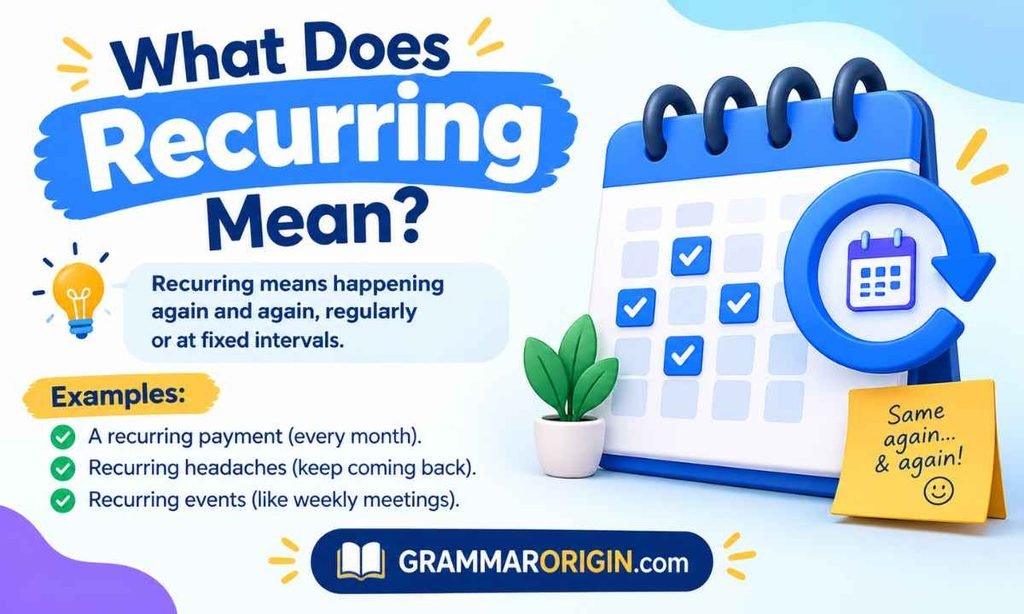
Recurring describes something that happens again and again, usually with a rhythm you can expect. It comes from the verb recur, which traces back to a Latin word meaning “to run back.”
In everyday English, it signals repetition that’s more than coincidence. You’d use it for whatever keeps showing up in your calendar, your inbox, or your thoughts.
Example: A recurring complaint in the survey was slow check-in.
Recurring Definition
Recurring is an adjective meaning happening repeatedly or at intervals. It’s the present participle of recur, doing double duty as a descriptive word.
Dictionary entries tend to bundle two ideas into it: the thing happens more than once, and it keeps returning. Both ideas live inside the word.
Example: She has a recurring appointment with her accountant every quarter.
Recurring Examples
Recurring fits anything that comes around more than once: bills, themes, characters, headaches, deadlines. The common thread is repetition you can see, even when the timing isn’t perfect.
A recurring role on a TV series, a recurring bug in a codebase, a recurring monthly donation. Different worlds, same idea.
Example: The sitcom’s recurring neighbor shows up whenever someone’s trying to nap.
Recurring in Different Contexts
Context decides how recurring reads. In finance it points to a schedule, in health it points to repeat episodes, and at work it points to routine.
The four contexts below are the ones you’ll run into most. Each shows the same core idea wearing different clothes.
Example: A recurring charge, a recurring cough, and a recurring task all share one trait: they come back.
Recurring Payments
A recurring payment is a charge that repeats automatically on a set schedule, like a subscription or monthly rent. Billing platforms and banks use recurring for this because the schedule is the whole point.
Before you approve one, check the billing date and the cancellation terms. Small subscription charges are easy to forget.
Example: Her gym membership is a recurring payment that renews on the fifth.
Recurring Problems
A recurring problem is an issue that keeps returning, usually because the root cause never got fixed. The patch looked fine; the problem just went quiet for a while.
Support teams spot these fast. If the same ticket reopens every week, you’re not dealing with bad luck.
Example: Slow load times on Mondays became a recurring problem for the web team.
Recurring Symptoms
Recurring symptoms are ones that fade and then come back, like a headache that returns every few weeks. Medical writing often leans toward “recurrent,” but recurring reads naturally in plain language.
This is language guidance, not medical advice. If symptoms keep returning, a clinician is the right person to ask.
Example: He kept a note of his recurring migraines to show his doctor.
Recurring Tasks
A recurring task is a to-do that repeats on a schedule, such as weekly reports or monthly backups. Task managers and calendar apps like Google Calendar and Outlook use recurring because you set the pattern once and let it run.
No more rebuilding the same reminder every Friday.
Example: The recurring task “send timesheets” pops up every Friday at noon.
What Does Reoccurring Mean?
Reoccurring means happening again, whether that’s a second time or another time after a gap, without promising a pattern. It’s built from re- plus occur.
Where recurring hints at a loop, reoccurring just points back to one more occurrence. That’s why it often shows up when someone’s describing a single return.
Example: The error was fixed on Tuesday, but it reoccurred on Thursday.
Reoccurring Definition
Reoccurring is the adjective form of the verb reoccur, which means to occur again. The Oxford English Dictionary defines reoccur in terms of recur, so the two sit very close together.
The word is legitimate. It just feels narrower than recurring.
Example: A reoccurring glitch appeared right after the update.
Reoccurring Examples
Reoccurring works when something shows up again and you want to stress the return, not the rhythm. Think weather, errors, and one-off comebacks.
It turns up more in casual and workplace writing than in polished publications.
Example: The power cut reoccurred after midnight, just as the repair crew left.
When to Use Reoccurring
Use reoccurring when something happened again and the sentence says nothing about a schedule or pattern. If “happened once more” fits the sentence, you’re in reoccurring territory.
Some editors still swap it for recurring, so check your house style before you publish.
Example: We hoped the flooding wouldn’t reoccur after the repairs.
Also Read This Shinning vs Shining: Which Spelling Is Correct? Meaning & Examples
Recur vs. Reoccur: Verb Forms Explained
Recur and reoccur are the verbs behind the two adjectives, and recur is the more established of the pair. Both mean “to happen again.”
The forms line up neatly: recur, recurs, recurred, recurring, and reoccur, reoccurs, reoccurred, reoccurring. The final r doubles before -ed and -ing, which trips up plenty of spellers.
Example: The fever recurred twice last month. The typo reoccurred in the second draft.
Recurring vs. Reoccurring: Key Differences
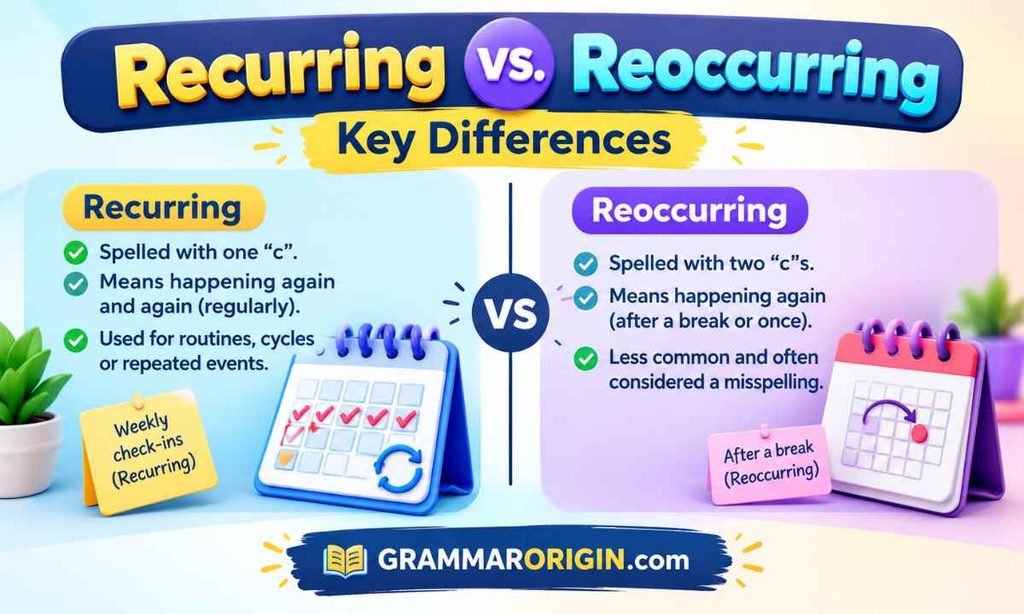
The real differences are pattern, regularity, and how strongly each word suggests repetition. Neither word is a grammar mistake.
Recurring leans on rhythm, while reoccurring leans on the return itself. Everything else follows from that.
Example: A recurring meeting happens weekly. A reoccurring outage happened again last night.
Frequency and Pattern
Recurring suggests repeated returns, often with a rhythm, while reoccurring only says something happened again. One implies a series; the other, a second act.
Count the returns. Three or more with a beat? Recurring. One comeback? Reoccurring fits.
Example: The recurring pop-up appears at every login. The pop-up reoccurred once after the patch.
Regular vs. Irregular Repetition
Recurring leans toward regular, predictable repetition, while reoccurring covers irregular or one-off returns. There’s a catch, though: recurring doesn’t demand a clock.
A recurring nightmare has no schedule at all. It’s the repetition that counts, not the timetable.
Example: The recurring standup runs daily at ten. The reoccurring leak showed up whenever it rained.
Meaning Overlap
Both words mean “happening again,” so in plenty of sentences either one works. The overlap is big enough that most readers won’t blink.
When the sentence doesn’t hinge on a pattern, go with whichever sounds more natural, which is usually recurring.
Example: The hum came back after the fix, so it was a recurring (or reoccurring) problem.
Recurring vs. Reoccurring Examples
The clearest examples pair recurring with patterns and reoccurring with a single return. Seeing them side by side makes the difference click.
- The recurring subscription charges $9 every month.
- Betrayal is a recurring theme in the novel.
- A recurring calendar event repeats every Tuesday.
- A reoccurring rattle started after the repair.
- The reoccurring glitch showed up again after the reboot.
- The storm’s reoccurring winds picked up after dark.
Example: Compare “recurring bill” with “reoccurring glitch”: one repeats on a schedule, the other just came back.
Examples Where Both Words Work
Both words work when a sentence only says something came back, with no pattern attached. These are the safest spots to use either one.
- The smell in the basement was recurring (or reoccurring).
- It was a recurring (or reoccurring) hiccup in the app.
- She worried about a recurring (or reoccurring) cough.
Example: The recurring (or reoccurring) hiccup in the app drove testers up the wall.
Recurring vs. Reoccurring in Common Phrases
In set phrases, recurring is the standard choice, and reoccurring tends to turn up in looser, less settled uses. Readers recognize the recurring versions instantly.
The four pairs below show how that plays out in the phrases people search for most.
Example: “Recurring payment” sounds right. “Reoccurring payment” sounds slightly off, even to people who can’t say why.
Recurring Payment vs. Reoccurring Payment
Recurring payment is the standard term. Reoccurring payment turns up online, but it isn’t what billing pages and payment platforms use.
If you’re writing for customers, match the wording on your checkout page and help docs. Consistency builds trust.
Example: Turn off your recurring payment before the renewal date.
Recurring Problem vs. Reoccurring Problem
Recurring problem is the natural phrase for an issue that keeps coming back. Reoccurring problem works for a single return, but it reads less smoothly.
Example: Late deliveries were a recurring problem all spring.
Recurring Event vs. Reoccurring Event
Recurring event is the standard calendar phrase for something that repeats on a schedule. Reoccurring event is understood, but it’s less common.
Calendar apps label repeating items “recurring,” so that’s the wording readers expect.
Example: The book club is a recurring event on the second Thursday of each month.
Recurring Dream vs. Reoccurring Dream
Recurring dream is the established phrase for a dream you keep having. Reoccurring dream shows up in casual writing, but it’s rarer.
“Recurring nightmare” follows the same pattern, and it’s by far the usual pairing.
Example: He’s had the same recurring dream about missing a train for years.
Recurring Theme, Character and Decimal: Other Common Uses
Recurring also appears in literature, television, and math: recurring theme, recurring character, recurring decimal. In all three, it signals something that keeps coming back across a work or a number.
“Recurring decimal” is the usual British English term, while Americans typically say “repeating decimal.” Same idea, different label.
Example: One-third written as 0.333… is a recurring decimal in British English.
Is Recurring or Reoccurring More Common?
Recurring is more common, by a wide margin. You’ll meet it far more often in news, business writing, and everyday speech.
Set phrases do much of the work: recurring revenue, recurring payment, recurring theme. Once a phrase locks in, people keep using it, and Grammarly’s usage guidance also names recurring as the more common word.
Example: Earnings reports talk about recurring revenue, not reoccurring revenue.
Is Reoccurring a Word?
Yes, reoccurring is a word. Dictionaries such as Merriam-Webster list it, and it means “happening again.”
It isn’t wrong, just narrower and less common than recurring. Some editors swap it out on sight, which is why you’ll sometimes see it flagged in edits.
Example: “The glitch reoccurred” is a correct sentence, even if “recurred” is smoother.
Recurrence vs. Reoccurrence
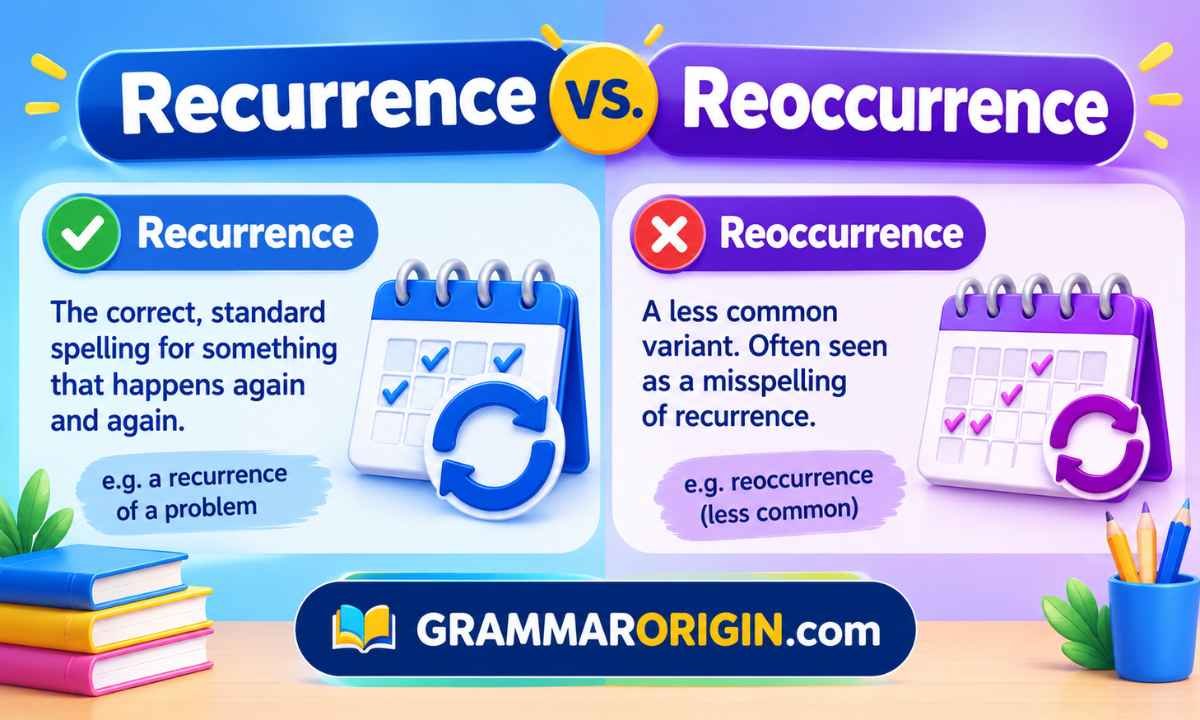
Recurrence is the standard noun for a return, while reoccurrence exists but is rarer. If you need a noun, recurrence is the safer choice.
You’ll see it in phrases like “recurrence rate” and “recurrence of the outage.” Reoccurrence turns up now and then, mostly in informal writing.
Example: The team added monitoring to prevent a recurrence of the outage.
Recurring vs. Reoccurring: Which One Should You Use?
Default to recurring, and switch to reoccurring only when you mean a single return and the sentence reads naturally. That rule covers almost every case.
Writing for a wide audience? Recurring also spares your readers a moment of doubt.
Example: “Send a recurring reminder” beats “send a reoccurring reminder” every time.
Use Recurring When:
Use recurring when something repeats or follows a pattern, and reach for it in set phrases too.
- The event follows a schedule, like meetings, bills, or tasks
- You’re using a set phrase, like recurring revenue or recurring theme
- You’re writing formally or for a broad audience
- You’re not sure which word fits
Example: The recurring Sunday call keeps the family in touch.
Use Reoccurring When:
Use reoccurring when something happened again and no pattern is implied.
- A single return after a gap
- A specific past incident
- Casual or conversational writing
Example: The warning light reoccurred on the drive home.
A Simple Memory Trick
Picture a calendar entry for recurring and a replay button for reoccurring. Recurring repeats on a loop; reoccurring plays once more.
If you can picture the calendar entry, write recurring. If all you can picture is a replay, write reoccurring.
Example: The recurring Friday meeting is a calendar entry. The reoccurring echo on the call was a replay.
Common Mistakes to Avoid
Most slip-ups come from treating the two words as perfect twins or from choosing by spelling alone. A handful of habits cause nearly all of them.
Example: “The meeting is reoccurring every week” should read “recurring.”
Assuming They Have Exactly the Same Meaning
They overlap, but they don’t weigh the same. Recurring stresses repetition; reoccurring stresses the return.
Example: “The reoccurring weekly standup” reads better as “the recurring weekly standup.”
Using Reoccurring Everywhere
Swapping in reoccurring for every case makes writing sound off, especially in set phrases. Readers expect recurring revenue and recurring payment.
Example: “Reoccurring revenue” would make a finance reader pause.
Assuming Recurring Always Means a Fixed Schedule
Recurring doesn’t need a clock. A recurring dream or a recurring worry has no timetable at all.
Example: A recurring thought about a missed deadline can show up at any hour.
Assuming Reoccurring Is Incorrect
Reoccurring isn’t an error. It’s just less common and a bit narrower.
Example: “The alarm reoccurred at noon” is grammatically fine.
Choosing Based Only on Spelling
Both words look right, so spelling can’t settle it. Choose by meaning: pattern, or single return.
Example: Ask “Does it repeat on a pattern?” before you write either word.
A Practical Comparison: Recurring vs. Reoccurring
At a glance, recurring signals repetition or a pattern, and reoccurring signals that something happened again. The table sums up the differences.
| Feature | Recurring | Reoccurring |
| Core meaning | Happening repeatedly or at intervals | Happening again |
| Pattern implied? | Often | No |
| Typical use | Payments, meetings, themes, revenue | One-off returns, casual writing |
| How common | Much more common | Less common |
| Set phrases | Recurring payment, recurring revenue, recurring dream | Rarely settled |
| Matching noun | Recurrence | Reoccurrence (rarer) |
| Safe default? | Yes | Only when a single return is meant |
Example: “Recurring revenue” is the phrase. “Reoccurring” would be the rare exception.
Recurring vs. Reoccurring: Usage and Style
In formal and professional writing, lean on recurring and use reoccurring sparingly. If your house style guide takes a side, it gets the final word.
Consistency matters more than the word you pick. If your site says recurring everywhere, don’t switch halfway down a page.
Example: An editor’s margin note might read: “Use recurring here.”
Style Tip for Clear Writing
Try the swap test. If “again and again” fits, write recurring; if “once more” fits, reoccurring is fine.
Reading the sentence aloud helps too. Whichever version sounds natural usually is.
Example: “The reminder pops up again and again” calls for recurring. “The glitch came back once more” allows reoccurring.
Recurring vs. Reoccurring: Quick Decision Guide
Run through four questions and you’ll have your answer in about ten seconds. Start at the top and stop at the first yes.
- Is it a set phrase, like recurring payment, recurring revenue, or recurring meeting? Use recurring.
- Does it repeat on a pattern or schedule? Use recurring.
- Did it come back just once, with no pattern implied? Reoccurring works, though recurring is still safe.
- Still unsure? Use recurring.
Example: A monthly invoice hits rule 2, so it’s a recurring invoice. A glitch that came back once hits rule 3, so a reoccurring glitch is fine.
Also Read This Shinning vs Shining: Which Spelling Is Correct? Meaning & Examples
Recurring vs reoccurring synonym
Good synonyms for recurring include repeating, periodic, regular, cyclical, and persistent. For reoccurring, try returning, resurfacing, repeated, or simply “happening again.”
Synonyms aren’t perfect swaps. Persistent suggests something that won’t go away, while periodic suggests a steady beat, so check the fit.
Example: Swap recurring for periodic in “periodic backups,” and reoccurring for resurfacing in “the resurfacing rumor.”
Recurring vs reoccurring revenue
Recurring revenue is the standard finance term for income that repeats predictably, like subscriptions and retainers. “Reoccurring revenue” appears now and then, but it isn’t the phrase investors and analysts use.
Businesses track it as monthly recurring revenue (MRR) or annual recurring revenue (ARR), because predictable income is easier to plan around. Repeat sales aren’t automatically recurring revenue, though: a customer who buys twice hasn’t agreed to pay again.
Example: A SaaS company with 500 customers on monthly plans earns recurring revenue. A shop whose customers happen to return doesn’t, necessarily.
Summary
The recurring vs. reoccurring choice comes down to emphasis. Recurring signals repetition or a pattern, while reoccurring says something happened again.
Default to recurring, especially in set phrases like recurring payment and recurring revenue. Save reoccurring for a single return, and you’ll rarely go wrong.
Frequently Asked Questions
Is it a recurring or reoccurring meeting?
It’s a recurring meeting. That’s the standard phrase for a meeting on a repeating schedule, and calendar apps like Google Calendar and Outlook use it.
What does reoccurring mean?
Reoccurring means happening again. It’s a valid word, but it’s narrower than recurring and doesn’t promise a pattern, as in “the bug reoccurred after the update.”
Is recurring the same as repeating?
Close, but not identical. Recurring means coming back after a gap, while repeating can describe something that happens back to back, like a repeating pattern in a design.
What is another word for “recurring”?
Repeating, periodic, regular, cyclical, persistent, and habitual are common choices. Pick by nuance: periodic implies a steady rhythm, while persistent implies something that won’t quit.
Is the recurring vs. reoccurring difference a strict grammar rule?
No. The recurring vs. reoccurring split is a matter of usage and emphasis, not a hard grammar rule. Recurring is the safer default, and reoccurring isn’t an error.
Should I write recurring payment or reoccurring payment?
Write recurring payment. It’s the standard wording on billing pages and subscription settings, and it’s what your readers will recognize at a glance.

Muhammad Waqas is an English language teacher and grammar expert with over 8 years of experience helping students and professionals improve their writing skills. He specializes in English grammar, vocabulary, communication, and practical language learning. Through GrammarOrigin, Waqas shares clear, easy-to-understand content that helps readers write and speak English with confidence.