
Shinning vs shining is an easy call: shining is the correct spelling for light, glow, and excellence. Shinning is a real word too, but it belongs to a different verb and means something else entirely.
This guide covers what each word means, where each one appears, and how to pronounce them. You’ll also get the spelling rule behind the extra n, plus clear examples with the sun, a star, and a few common phrases.
Shinning vs Shining: The Quick Answer
Use shining for anything that glows, gives off light, or stands out as excellent. Use shinning only for the verb “shin,” which means to climb by gripping with your arms and legs.
Here’s the easy way to settle shinning vs shining. The verb “shine” becomes shining. The verb “shin” becomes shinning. Shine vs shin is the whole story: different verbs, different spellings.
| Word | Comes from | Meaning |
| shining | shine | giving off light, or excellent |
| shinning | shin | climbing by gripping with arms and legs |
Example: The sun is shining, and a boy is shinning up the flagpole.
What Does Shining Actually Mean
Shining means giving off or reflecting light, and it also describes something outstanding. It’s the present participle of the verb “shine,” and it works as an adjective too.
A simple shining definition: giving out light, or being excellent in a way people admire.
You’ll meet it in three jobs. As part of a verb, it follows a helper word, as in “the lamp is shining.” As an adjective, it sits before a noun, as in “shining eyes.”
As a gerund, it acts like a noun, as in “the shining of the lamp.” In each job, the shining meaning stays close to light, brightness, or excellence, which keeps shinning vs shining easy to sort out.
Example: Her shining eyes lit up the room.
Common Phrases That Use Shining
Shining shows up in many idioms and set phrases, and every one of them points to light or excellence. Every phrase here settles the shinning or shining question the same way, with one n.
| Phrase | What it means |
| shining star | a bright star, or a person who stands out |
| shining example | a perfect model of good behavior |
| shining light | someone who inspires others |
| knight in shining armor | a rescuer, often in romance |
| shining reputation | an excellent, spotless name |
| keep shining | keep doing well and stay positive |
| shining bright | glowing strongly, or doing very well |
Example: Maya is a shining example of how steady practice pays off.
The Shining and Other Famous Uses
The best-known use is the title The Shining, Stephen King’s 1977 novel and Stanley Kubrick’s 1980 film of the same name. Both titles use one n.
People often search for “The Shinning” by mistake, which is the same shinning or shining slip this guide covers. The correct title is always The Shining. The word also appears in fairy-tale language, where a knight arrives in shining armor.
Example: We watched The Shining on a rainy Sunday.
What Does Shinning Actually Mean
Shinning is the present participle of the verb “shin,” and it most often means climbing by gripping with your hands, arms, and legs. It’s a real word, but it’s rare.
Merriam-Webster lists the verb forms as shinned and shinning. Its senses include climbing by shinnying, moving forward fast on foot, and kicking or striking someone on the shins.
Collins describes the climbing sense as gripping with the hands and legs to haul yourself up a pole or tree.
Cambridge Dictionary spells the verb with a doubled n and notes shinny as a US variant. Webster’s New World gives the same climbing sense. Every shinning definition here ties the word to the shin, the legs, or climbing.
The verb grows out of the noun “shin,” the front part of your lower leg, which sits over the shinbone.
The shinning meaning is narrow and physical, so it rarely fits a sentence about light. Knowing this makes shinning vs shining much clearer: one word is about light, the other is about gripping and climbing.
Example: The campers were shinning up the rope to ring the bell.
Where You’ll Actually See Shinning
You’ll mostly see shinning in writing about climbing, such as gym ropes, flagpoles, trees, and ship masts. It can also appear in sports talk about kicks to the shin.
It’s uncommon in everyday English. Some older dictionaries even mark the climbing sense as informal. So when readers meet “shinning” online, they’re usually looking at a typo for shining.
You might spot it in a few places:
- gym class lessons on rope climbing
- adventure stories about trees, cliffs, and masts
- sports reports about kicks to the shin
A quick test settles shinning or shining in seconds. If a person is gripping something and pulling upward, shinning might be right. If something glows or looks great, you need shining.
Example: The sailor was shinning up the mast to fix the flag.
Why Do People Mix Up Shinning and Shining
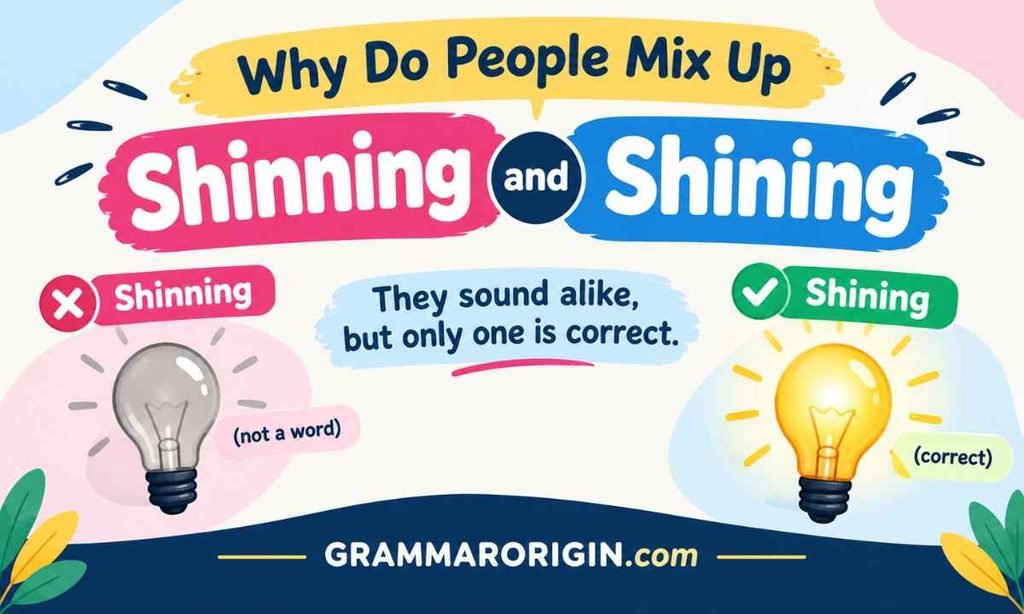
People mix them up because of a doubling habit and a similar sound. Many common verbs double their last letter before -ing, so writers assume “shine” does too.
Think of run and running, or stop and stopping. After seeing that pattern again and again, it feels natural to write “shinning.” But “shine” ends in a silent e, which follows a different rule.
Fast typing and spell-check slips make shinning or shining harder to spot. Autocorrect can also swap one for the other without you noticing. And since “shin” and “shine” look like cousins, the two spellings blur together.
Example: Incorrect: The moon is shinning tonight. Correct: The moon is shining tonight.
How to Pronounce Shining and Shinning
Shining sounds like “SHY-ning,” and shinning sounds like “SHIN-ning.” The vowel is the giveaway: a long vowel in shining, a short vowel in shinning.
In IPA, shining is /ˈʃaɪnɪŋ/ and shinning is /ˈʃɪnɪŋ/. If you can say “shy” in the first syllable, you want one n. If you say “shin” like the leg part, you want two.
This is one reason the shinning vs shining spelling rule makes sense. The doubled n signals the short vowel.
Example: Say “shy” aloud, then write shining with a single n.
Shining vs Shinning: Side-by-Side Comparison
Shining describes light or excellence and comes from “shine.” Shinning describes climbing and comes from “shin.” Shining vs shinning is really a choice between two separate verbs.
| Feature | Shining | Shinning |
| Base verb | shine | shin |
| Main meaning | giving off light; excellent | climbing by gripping; other physical senses |
| Part of speech | participle, adjective | participle |
| Sounds like | SHY-ning | SHIN-ning |
| How common | very common | rare |
| Example | The stars are shining. | He was shinning up the pole. |
Example: A shining trophy sat beside a rope that kids had been shinning up.
Shining and Shinning Word Forms
Each verb has its own set of forms, and they don’t overlap. Shine gives you shines, shining, and shone or shined. Shin gives you shins, shinned, and shinning.
| Form | Shine (light) | Shin (climbing) |
| Base | shine | shin |
| Third person | shines | shins |
| -ing form | shining | shinning |
| Past | shone or shined | shinned |
Example: The lamp shines all night, and the boy shins up the tree.
Also Read This Vendor vs Vender: Which Spelling Is Correct? Meaning & Examples
Real-World Examples of Correct Usage
Real sentences show the shinning vs shining pattern quickly. Light and praise take shining, while climbing takes shinning.
Examples with shining:
- The sun was shining on the lake.
- Her shining record earned her a promotion.
- The children’s faces were shining with excitement.
- Our team’s shining moment came in the final minute.
- Stars were shining over the quiet desert road.
- A shining new bridge opened downtown.
Examples with shinning:
- He kept shinning up the pole until he reached the top.
- The scouts took turns shinning up a tree to hang the flag.
- The cadets practiced shinning up ropes in training.
- The player was cautioned for shinning an opponent, meaning he kicked the other player’s shin.
A Quick Case Study: How One Typo Changes a Sentence’s Meaning
One extra n can turn a sentence about light into one about climbing. Picture a small shop that writes “a shinning silver pendant” on its product page.
A reader may pause, wonder if it’s a typo, and trust the shop a little less.
The same thing happens in a story: “The lantern was shinning on the wall” makes the reader picture a lantern climbing up the wall. One small letter is all that separates shinning vs shining in the reader’s mind.
| Typo | What the reader may picture | Fix |
| a shinning pendant | a typo that hurts trust | a shining pendant |
| The lantern was shinning | a lantern climbing | The lantern was shining |
| a shinning record | a careless spelling | a shining record |
Example: Fixing one letter changed “a shinning career” into “a shining career.”
Grammar Rule Recap: Why Consonant Doubling Matters
Short verbs that end in one vowel plus one consonant double the consonant before -ing. Verbs that end in a silent e drop the e and add -ing. That’s why shin becomes shinning and shine becomes shining.
Teachers call this the CVC pattern, short for consonant, vowel, consonant. The verb “shin” fits it, and “shine” doesn’t. That’s the rule behind shinning vs shining.
The doubled consonant protects the short vowel sound. Compare hop and hope, or tap and tape: hop becomes hopping, hope becomes hoping. Shin and shine follow the same split.
So the extra n in shinning vs shining isn’t a random mistake. It’s the rule, applied to the wrong verb.
Example: Hop becomes hopping, hope becomes hoping, shin becomes shinning, and shine becomes shining.
Shone or Shined? Past Tense of Shine
Both are accepted. Shone is common when something gives off light, and shined is common when someone polishes something.
Common usage guidance runs like this: the sun shone all day, but he shined his shoes. In American English, shined is sometimes used for both senses, so you may see either.
Neither past form takes a doubled n, which keeps shinning vs shining apart in the past tense too. The only doubled form belongs to the other verb, since the past of shin is shinned.
Example: The moon shone brightly, and she shined her boots.
Other Words People Confuse With Shining
The usual mix-ups are shiny, shinny, shone, shined, and shin. Each has its own place, so it helps to see them next to shinning vs shining.
| Word | Meaning | Quick note |
| shiny | glossy and reflecting light | describes a surface |
| shinny | a variant of shin, meaning to climb | mainly American |
| shone | past tense of shine | giving off light |
| shined | past tense of shine | polishing or buffing |
| shin | front of the lower leg | also the base verb |
Example: The shiny floor was shining under the lights.
Shining vs Shiny
Shining describes light being given off or something excellent, while shiny describes a smooth surface that reflects light. A shining star glows, and a shiny coin gleams.
You can often swap them in casual talk, but the meanings lean different ways.
Example: The shiny car sat under a shining moon.
Shining star or shinning star
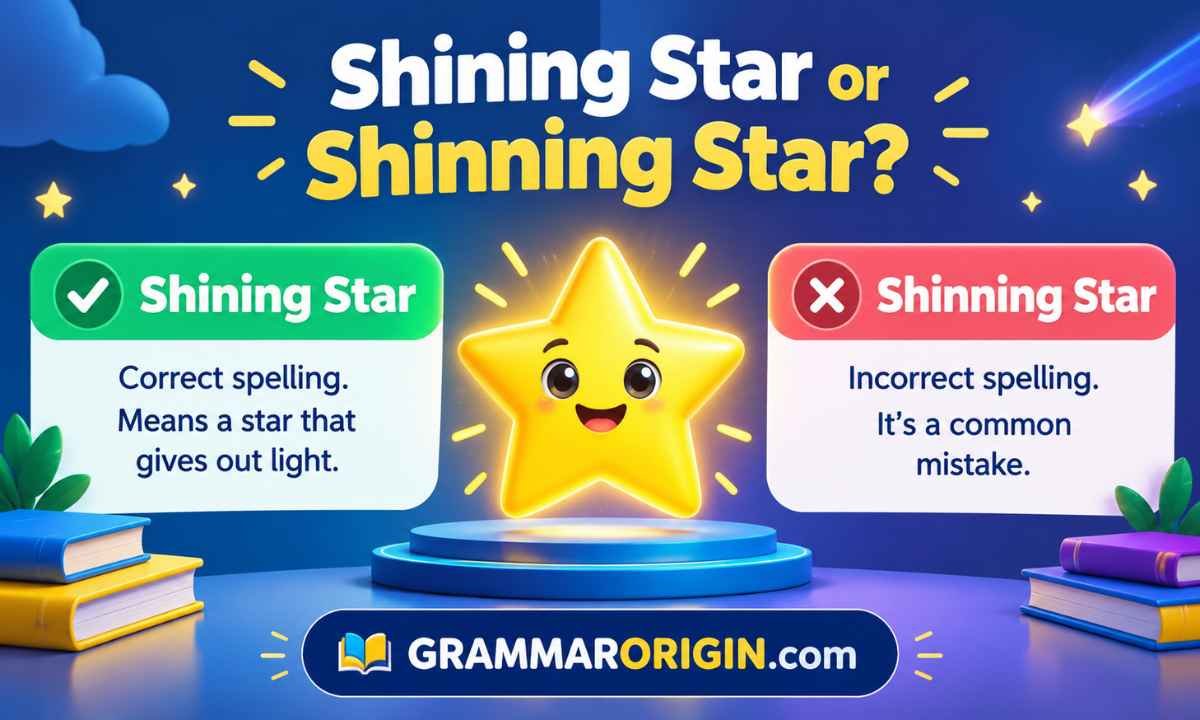
Shining star is correct. It means a bright star, or a person who stands out. A “shinning star” would suggest a star climbing something, which isn’t what anyone means.
People use the phrase for talented students, rising actors, and team leaders. It also appears in birthday cards and school awards. In shinning vs shining, the star phrase always takes one n.
Example: Priya was the shining star of the school play.
Also Read This Vendor vs Vender: Which Spelling Is Correct? Meaning & Examples
Shinning or shining sun
“The sun is shining” is the correct form. The sun gives off light, so the verb “shine” applies, and the -ing form is shining.
In the shinning or shining sun question, the answer never changes. For past events, use shone: “The sun shone all afternoon.” The compound word sunshine also takes no doubled n.
Example: The sun was shining all morning, and it shone again the next day.
Summary
Shinning vs shining comes down to two different verbs. Shining comes from shine and means light or excellence, while shinning comes from shin and means climbing.
Use shining almost every time, even when shinning or shining feels like a coin flip. Keep shinning for climbing talk, and check the sound: “shy” means one n.
Frequently Asked Questions
What does shinning mean?
Shinning is the present participle of the verb “shin.” It mostly means climbing by gripping with your arms and legs, though dictionaries also list moving fast on foot and kicking someone on the shin.
What does shinin mean?
“Shinin” is an informal spelling of shining with the g dropped, often written “shinin'” in song lyrics and dialogue. It isn’t standard spelling, so use shining in formal writing.
Can I say “keep shining”?
Yes. “Keep shining” is correct and widely used. It means keep doing well or keep being bright, and it uses the standard spelling with one n.
Is it correct to say the sun is shining?
Yes. The sun gives off light, so “the sun is shining” is correct. In shinning vs shining, the sun always gets shining, and “the sun is shinning” is a common typo.
Is shinning a real word?
Yes, shinning is a real word, but it comes from “shin,” not “shine.” In shinning vs shining, only shining fits light, glow, and excellence.
Is it shone or shined?
Both are accepted. Shone is common for giving off light, as in “the sun shone.” Shined is common for polishing, as in “she shined her shoes.”

Muhammad Waqas is an English language teacher and grammar expert with over 8 years of experience helping students and professionals improve their writing skills. He specializes in English grammar, vocabulary, communication, and practical language learning. Through GrammarOrigin, Waqas shares clear, easy-to-understand content that helps readers write and speak English with confidence.