
Emasculate is the correct word, and demasculate is a nonstandard spelling you should avoid. Standard dictionaries list emasculate and don’t treat the “d” version as normal English.
This guide on emasculate vs demasculate covers the meaning, origin, pronunciation, examples, and the mistakes writers make most. By the end, you’ll know exactly which word fits your sentence.
Quick Answer
Emasculate is the right word. Demasculate isn’t standard English, so editors and teachers will usually mark it wrong.
When you face emasculate vs demasculate in formal writing, pick emasculate every time. A few open word lists, such as Wiktionary, do record demasculate as a rare synonym. That still doesn’t make it safe for essays, articles, or business writing.
Use emasculate when you mean:
- to take away someone’s strength, power, or confidence
- to make a rule, plan, or group less effective
- to remove male traits, which is the older, literal sense
Quick check: The senator warned that the amendment would emasculate the bill.
Meaning of “Emasculate”
Emasculate is a verb that means to take away strength, force, or power. Dictionaries also list an older, literal meaning that involves castration.
Most people use it figuratively today. A law can be emasculated by last-minute changes, and a manager can emasculate a good plan by cutting its key parts.
Merriam-Webster points out that the word suggests removing the very thing that gave something its force. What’s left still exists, but it can’t do much.
Common meanings
Here’s what you’ll find in most dictionaries:
- To weaken or reduce effectiveness. This is the most common modern use, and it works for laws, plans, speeches, and organizations.
- To make a man feel less powerful or less masculine. This sense is about personal identity, so it’s the touchiest one.
- To castrate. This is the literal, formal, and older meaning. You’ll rarely see it outside medical, farming, or historical writing.
Sense one and sense two side by side:
The court’s ruling could emasculate the original law.
His boss’s constant criticism left him feeling emasculated.
Etymology of Emasculate
Emasculate comes from Latin. Oxford places it in the early 1600s, and Merriam-Webster records its first known use in 1607.
The Latin verb emasculare is built from e- (out, away) plus masculus (male). That’s the key to settling emasculate vs demasculate for good.
Break it down: e- (away) + masculus (male) = emasculate.
This also explains the mix-up. The e- at the front already carries the idea of removal, so adding “de-” is like saying “un-undo.” The meaning is already inside the word.
Emasculate Word Forms
Emasculate is a regular verb, so its forms are easy. It’s often used in the passive voice, as in “the law was emasculated.”
| Form | Word | Quick example |
| Base form | emasculate | Changes like these emasculate a bill. |
| Third person | emasculates | The ruling emasculates the rule. |
| Past tense | emasculated | They emasculated the proposal. |
| Past participle | emasculated | The plan was emasculated by edits. |
| -ing form | emasculating | He called it an emasculating defeat. |
| Noun | emasculation | The emasculation of the council worried voters. |
An older adjective use, as in “an emasculate style,” shows up in some dictionaries. Modern writers almost always say emasculated instead.
Also Read This Isle or Aisle? Difference, Examples & Easy Memory Tricks
Example Sentences
These sentences show the word in different settings: politics, work, editing, and personal life. Notice how most of them are about power or influence, not bodies.
- The new rule could emasculate the city council’s power to approve budgets.
- Constant interruptions can emasculate a team leader’s authority in meetings.
- The editor cut so many details that the final report was emasculated.
- Critics said the court’s decision would emasculate the original law.
- Heavy censorship emasculated the film’s message.
- He felt emasculated when his ideas were ignored in every meeting.
The last one is the personal sense, and it’s the kind of line that can land harder with readers. That’s worth keeping in mind when you pick your examples.
Botany and Animal Sense
In plant breeding, to emasculate a flower means to remove its pollen-producing parts. Merriam-Webster lists this as a separate sense.
Breeders do it before cross-pollination so the flower can’t pollinate itself.
Plant breeders emasculate the flower first, then add pollen from a different plant.
The animal sense is the older, literal one. Today, writers usually say “neuter” or “castrate” because they’re clearer and less loaded.
What About “Demasculate”?
Demasculate isn’t a standard English word, so treat it as a mistake. Most readers will see it as a typo or a slip.
People assume it should exist because English often uses “de-” to reverse things, like deactivate, defrost, and decode. That pattern feels natural.
Wrong: The merger will demasculate the board.
Wiktionary does list it as a rare synonym of emasculate. But it isn’t treated as normal in the dictionaries most editors rely on, so skip it.
Why the confusion happens
The mix-up usually comes from a few small habits. Together, they push writers toward the wrong spelling.
- The “de-” pattern. Prefixes that mean “remove” are everywhere, so “de-” feels right.
- Fast speech. Said quickly, the opening sound of emasculate can blur, and some listeners hear a “d.”
- A real cousin word. Demasculinize exists, and the brain blends the two.
- Typing slips and autocorrect. One extra letter is easy to miss while editing.
The mental shortcut: de- + masculine = demasculate (wrong). The actual word: e- + masculus = emasculate (right).
Demasculate vs Demasculinize
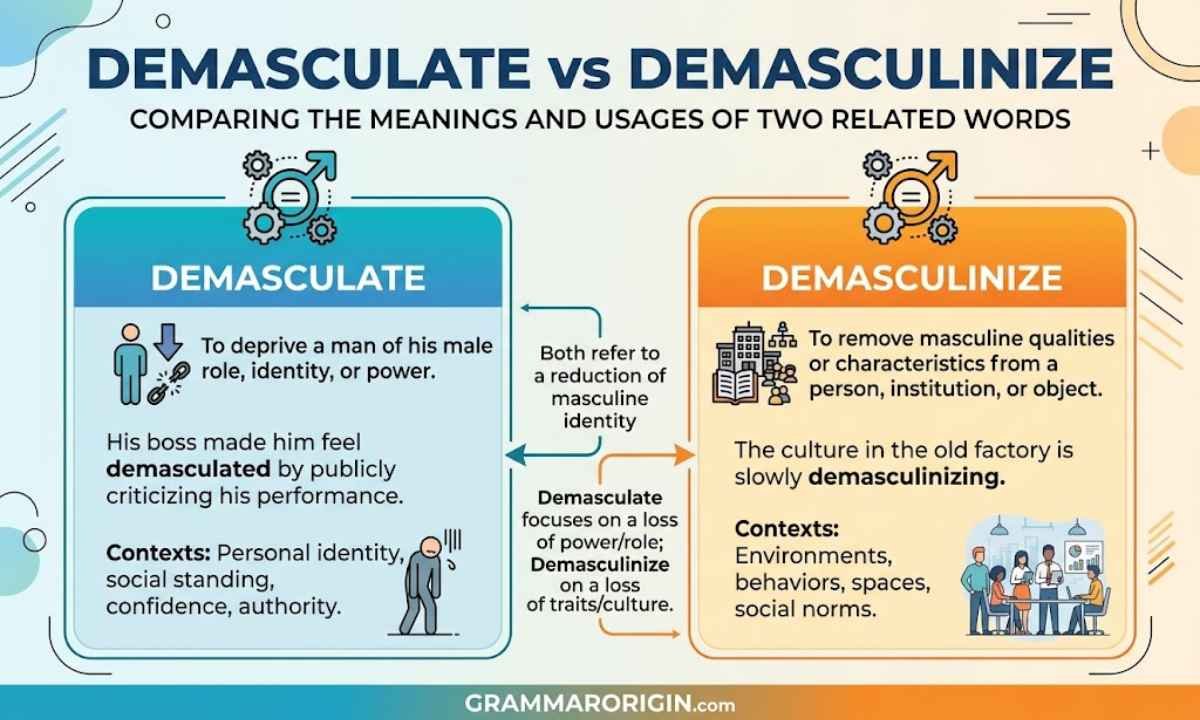
Demasculinize (demasculinise in British English) is a real but rare word. Thesaurus databases list it as another way to say castrate or remove masculine traits.
It sounds clinical, and you won’t need it often. Demasculate, on the other hand, is just a garbled version that lacks standard support.
Some studies look at how certain chemicals might demasculinize young fish.
If you want a “remove masculine traits” word and emasculate feels too loaded, demasculinize is the safer real option. Just make sure the context fits, since most readers won’t know it.
Emasculate vs Demasculate (Comparison)
Here’s the quick side-by-side view of emasculate vs demasculate. Use it as a reference when you’re editing.
Right fit: The cuts will emasculate the program, not demasculate it.
| Feature | Emasculate | Demasculate |
| Standard English | Yes | No |
| Dictionary support | Listed by Merriam-Webster, Oxford, and Dictionary.com | Appears only as a rare variant in open word lists |
| Meaning | To weaken, drain power, or (literally) castrate | No standard meaning |
| Typical use | Politics, law, business, journalism, history | Mostly seen as a spelling mistake |
| Real related words | emasculated, emasculation | demasculinize, demasculinise |
| Safe for formal writing | Yes | No |
The takeaway is simple. In any serious piece of writing, emasculate wins.
Common Mistakes People Make
Writers trip over this word in three main ways. Each one is easy to fix once you spot it.
1. Writing “Demasculate”
The biggest mistake is typing demasculate when you mean emasculate. The fix is a one-word swap.
Wrong: The new policy will demasculate the department.
Right: The new policy will emasculate the department.
This is the exact slip that makes the emasculate vs demasculate search so common. A quick find-and-replace before you publish can catch it.
2. Using It Too Literally
In modern writing, emasculate is almost always figurative. Use it for a loss of power or authority, not for a physical act, unless that’s truly what you mean.
When the word describes a person’s feelings, it can sound like a comment about gender. Keep that in mind before you choose it.
Safe use: The audit emasculated the oversight team’s powers.
3. Confusing It with Similar Words
Weaken, undermine, and diminish are close, but they aren’t identical. Emasculate is stronger because it suggests stripping out something essential.
Using it for a small problem makes your sentence sound dramatic.
- Too strong: The typo emasculated my email.
- Better fit: The typo weakened my email’s message.
Emasculate vs Effeminate vs Castrate
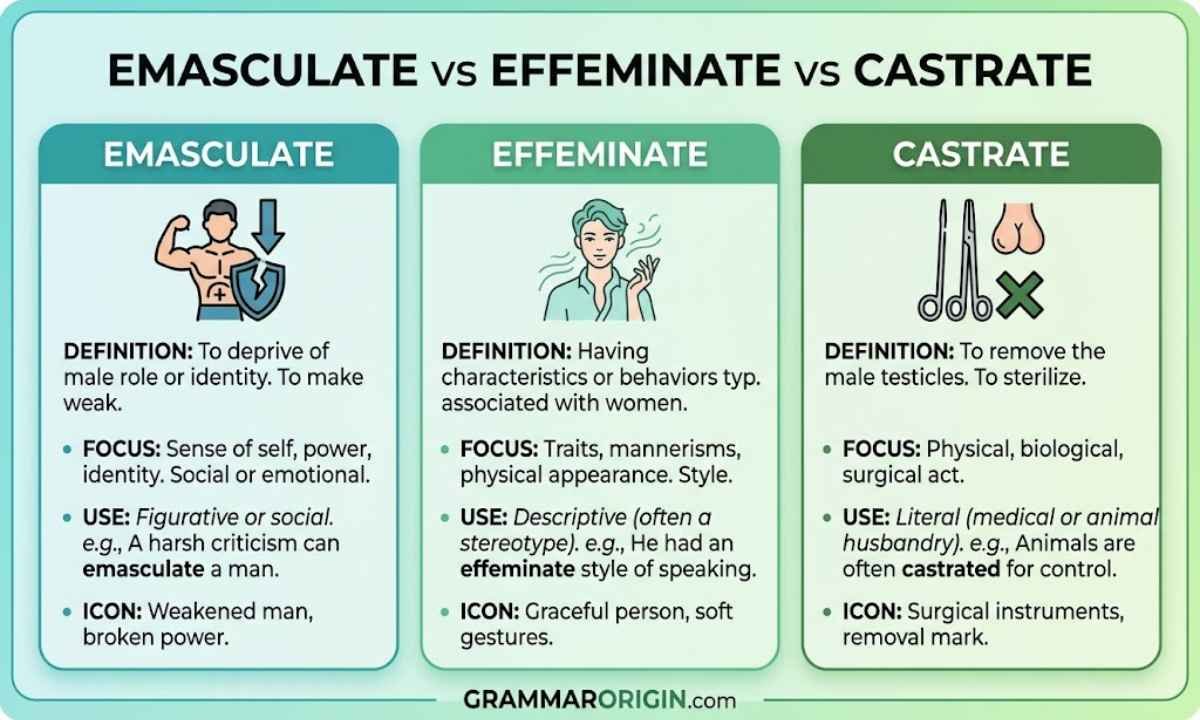
Emasculate describes an action: taking away strength. Effeminate describes how a man is seen, usually as having womanlike traits, and many editors avoid it because it can read as an insult. Castrate is the literal medical or farm word.
Vocabulary.com also notes that treating strength and being female as opposites can be insulting to women. That’s another reason to choose your words with care.
The rule change would emasculate the committee.
Older books often call a weak ruler effeminate, a term most modern editors skip.
The vet will castrate the young bull next month.
Also Read This Isle or Aisle? Difference, Examples & Easy Memory Tricks
Synonyms and Related Words
Weaken and undermine are the safest swaps for most sentences. Pick the one that matches the thing being drained: power, trust, strength, or effect.
Merriam-Webster separates a few close words. Unnerve means a sudden loss of courage. Enervate means slow weakening, often from comfort. Unman means a loss of nerve or manly spirit.
Strong Synonyms
- Weaken
- Undermine
- Diminish
- Reduce
- Neutralize
- Sap
- Cripple
The scandal began to undermine the mayor’s support.
Related Phrases
- Loss of authority
- Reduction of power
- Weakening influence
- Draining confidence
- Removing effectiveness
The change led to a clear loss of authority for the manager.
American vs British English Usage
Both American and British English spell it emasculate. There’s no color/colour style split here.
The only change shows up in the rare related word: demasculinize in American English and demasculinise in British English.
| Word | American English | British English |
| Verb | emasculate | emasculate |
| Noun | emasculation | emasculation |
| Rare related verb | demasculinize | demasculinise |
A writer in London and a writer in Chicago would both say the cuts could emasculate the council.
When Should You Use “Emasculate”?
Once you’ve settled emasculate vs demasculate, the next question is where the word fits. Use emasculate in formal, analytical, or opinion writing when you mean “strip something of its force.” It pairs best with things like a law, a bill, an authority, a reform, or a message.
The word isn’t wrong in everyday talk. It just sounds heavy, so it fits best where readers expect strong language.
Good contexts
- Academic discussions
- Political commentary
- Leadership analysis
- Business writing
- Opinion articles
- Legal and policy writing
- Historical discussions
Some analysts argue that the reforms may emasculate the central committee.
Example contexts
Here are a few real-world settings, each with a line you could adapt:
- Policy debates: Opponents say the new tax rules emasculate local budgets.
- Leadership analysis: Micromanaging can emasculate a capable team.
- Organizational changes: The restructuring emasculated the research department.
- Historical discussions: The treaty emasculated the old kingdom’s army.
When You Should Avoid the Word
Skip emasculate when you’re talking about a real person’s feelings, identity, or private life. Skip it in casual chat and sensitive talks too.
The word ties strength to manhood, so it can come across as hurtful or as a stereotype. A milder word usually does the job without the risk.
Instead of this: Her comments emasculated him.
Try this: Her comments embarrassed him in front of the team.
Practical Writing Tips
Three habits will keep your writing clean when you use this word. They’re easy to remember and quick to apply.
Keep it metaphorical
Aim the word at laws, plans, offices, and powers. Avoid using it to describe bodies.
The reform emasculated the agency’s ability to investigate.
Use it sparingly
One strong use per article is plenty. If you repeat it, it starts to sound dramatic.
The reforms did emasculate the board. Other changes simply cut its budget.
Replace when needed
If the tone feels too harsh, swap in a softer verb.
- Original: The edits emasculated the speech.
- Softer: The edits softened the speech.
You can also try weaken, undermine, or diminish, depending on what the sentence needs.
Demasculate pronunciation
Demasculate isn’t a standard word, so it has no official pronunciation. People who say it usually go with “dee-MAS-kyuh-late,” copying the pattern of words like demasculinize.
The correct word, emasculate, is said “ih-MAS-kyuh-layt.” Vocabulary.com shows /ɪˈmæskjəleɪt/, and Wiktionary notes that some speakers open with a long “ee” sound. The stress falls on the second syllable, and the ending rhymes with “late.”
Say it slowly: e-MAS-cu-late.
The first sound is a short vowel, not a “d.” That small detail is the easiest way to keep emasculate vs demasculate straight in your head.
emasculate synonym
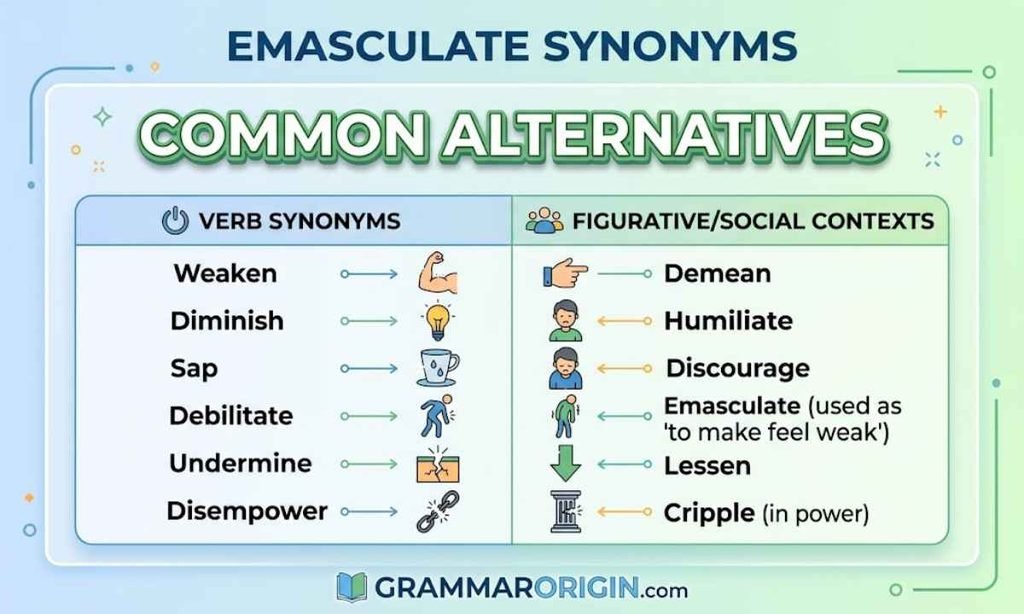
The best quick synonyms for emasculate are weaken and undermine. For stronger cases, you can use sap or cripple.
The right pick depends on what’s being drained, so match the verb to the situation:
The new filter will water down the report.
| Situation | Best synonym |
| A law or rule | weaken, water down |
| Authority or power | undermine |
| Confidence | shake, deflate |
| A message or speech | soften, dilute |
| Literal, medical, or farm use | castrate, neuter |
Summary
Emasculate vs demasculate has a clear winner. Emasculate is the standard verb for taking away strength, power, or effectiveness, while demasculate is a nonstandard form you can skip.
Keep the word figurative, use it with care around people, and reach for weaken or undermine when the tone feels too sharp.
Frequently Asked Questions
Is there a female version of emasculation?
No standard dictionary word works as an exact female version. Some people informally use “defeminize” or “defeminization,” but those aren’t common dictionary terms.
What does the word “demasculate” mean?
Demasculate has no standard meaning because it isn’t a standard word. People who use it almost always mean emasculate.
What is emasculating behavior?
Emasculating behavior is behavior that makes a man feel less capable, powerful, or respected. Public mockery, constant put-downs, and ignoring someone’s decisions are common examples.
Is emasculate offensive?
It can be, depending on how you use it. In policy and business writing, it’s mostly figurative and widely accepted.
When it’s aimed at a person, it can sound like a gender insult. In that case, a word like undermine is safer.
Is emasculate a verb or an adjective?
Emasculate is mainly a transitive verb, as in “the bill was emasculated.” A few dictionaries also list a rare, older adjective use.
Today, most writers use the form emasculated when they want an adjective, as in “an emasculated law.”

Muhammad Waqas is an English language teacher and grammar expert with over 8 years of experience helping students and professionals improve their writing skills. He specializes in English grammar, vocabulary, communication, and practical language learning. Through GrammarOrigin, Waqas shares clear, easy-to-understand content that helps readers write and speak English with confidence.