
Elegy vs eulogy comes down to this: an elegy is a mournful poem, and a eulogy is a funeral speech. Both deal with death, but one mourns in verse while the other honors someone out loud.
This guide covers meanings, word origins, pronunciation, real examples, and the mistakes people make most. You’ll also see where epitaphs and obituaries fit, so you can pick the right word every time.
Quick Answer: Elegy vs Eulogy
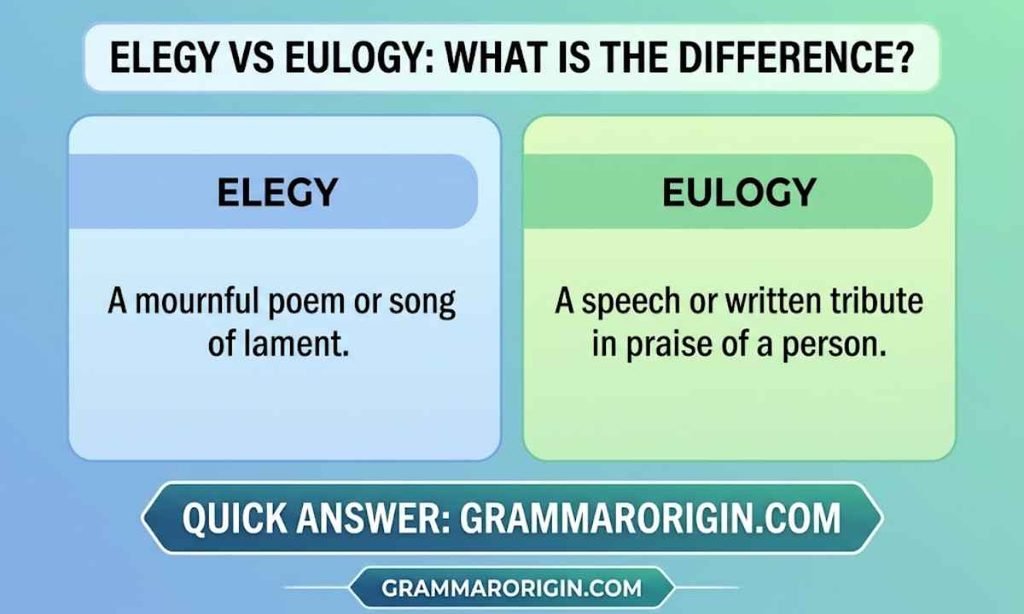
An elegy is a poem, song, or piece of music that mourns a loss. A eulogy is a speech, or sometimes a written tribute, that praises someone, usually at a funeral or memorial.
Here’s a quick test. Ask yourself whether the piece mainly laments or mainly praises. Lament points to an elegy, and praise points to a eulogy.
Elegy: a poet mourns a lost friend in quiet, careful verse.
Eulogy: a daughter steps up to the podium and tells stories about her mother.
Elegy vs eulogy is easier to remember with one line: mourn with an elegy, praise with a eulogy.
What Is an Elegy?
An elegy is a poem, song, or instrumental piece that mourns someone who has died. Some elegies also grieve a lost way of life, or the fact that every person eventually dies.
Many classic elegies follow a loose path. They begin in sorrow, move to praise for the person, and end with a small step toward comfort. The speaker talks to the reader, not to a crowded room. In the elegy vs eulogy contest, the elegy is the quieter, more private voice.
Gray’s famous poem is a good case. His elegy from 1751 mourns ordinary villagers buried in a country churchyard.
Key Features of an Elegy
A good elegy is slow, personal, and built for reading or listening rather than performing. In any elegy vs eulogy check, these traits usually mark the elegy:
- Usually a poem, though it can also be a song, a musical piece, or a thoughtful essay
- A quiet, mournful mood that stays with the loss
- A pull from grief toward acceptance, even if it never fully arrives
- No fixed script, so the writer can shape it however the feeling demands
- A subject that can be one person, a group, or something that’s gone for good
The poet’s elegy moved slowly from sorrow toward acceptance.
Examples of Elegy
Some of the best-known elegies in English come from poets who lost someone close, or someone the whole country mourned. Here are a few:
- Thomas Gray’s elegy about a country churchyard, published in 1751
- Walt Whitman’s elegy “O Captain! My Captain!”, written after Abraham Lincoln died
- Shelley’s elegy Adonais, written for the poet John Keats
- Tennyson’s elegy In Memoriam, written for his friend Arthur Hallam
- Milton’s elegy Lycidas, written for a fellow student who drowned
Everyday elegies count too. A poem for a late grandparent, a mourning song, or a slow piece of music all fit.
Every example above also settles elegy vs eulogy questions quickly, because each one mourns instead of praising.
Simple Example Sentence
Use “elegy” as a noun for a work of mourning. It names the piece itself, not the act of speaking it.
After her grandfather died, Mina wrote an elegy about his garden.
The cellist closed the concert with a quiet elegy.
What Is a Eulogy?
A eulogy is a speech that honors someone who has died, usually delivered at a funeral or memorial service. It can also be a written tribute.
A family member, friend, or coworker typically gives it. They share stories, describe the person’s character, and say what they meant to the people in the room.
The word has a second, broader sense too: high praise for a person or thing, whether or not anyone has died. That use is less common.
This is where elegy vs eulogy splits cleanly: a eulogy is made for a room, not a page.
Eulogy: a retired teacher is remembered in a five-minute talk full of classroom stories.
Key Features of a Eulogy
A eulogy is shaped for the ear. It’s meant to be spoken to a room of people who are grieving together. In elegy vs eulogy terms, these traits point to the eulogy:
- Delivered aloud at a funeral, memorial, or celebration of life
- Built around stories, habits, and moments that show who the person was
- Warm and respectful, and often lighter than an elegy
- A clear beginning, middle, and end, so listeners can follow along
- Usually written down first, then read or spoken to the audience
His eulogy made the whole room laugh and cry within a minute.
Examples of Eulogy
You’ll hear a eulogy at nearly every funeral, and sometimes in public life when a well-known person dies. Each of these shows elegy vs eulogy in action, since the goal is praise, not lament. Typical cases include:
- A son speaking about his father in front of family and friends
- Oprah Winfrey’s eulogy at Rosa Parks’s funeral
- A coworker sharing memories at a memorial service
- A short written eulogy printed in the funeral program
Simple Example Sentence
Use “eulogy” for the tribute itself. People usually say they “give,” “deliver,” or “write” one.
She delivered a heartfelt eulogy for her best friend.
The family asked him to write the eulogy because he knew Dad’s stories best.
Also Read This Emasculate vs Demasculate: Which Word Is Correct?
Word Origin: Greek Roots and the “eu” Memory Trick
The two words come from different Greek roots, and that’s exactly why a memory trick works. The elegy vs eulogy mix-up partly comes from how alike the spellings look. Elegy traces back to Greek elegeia, while eulogy comes from Greek eulogia, which means praise.
In ancient Greece, elegeia named verse written in elegiac couplets, where a long line of verse is followed by a shorter one. Over time, the word became tied to lament, and English picked it up in that sense.
Eulogia is built from eu, meaning good, and logos, meaning word. So a eulogy is literally “good words” about someone.
Eulogy equals good words.
Elegy equals sorrowful verse.
Next time you hesitate, look for the “eu.” If you’re speaking good words about a person, you’re giving a eulogy.
Elegy vs Eulogy: Side-by-Side Comparison
The table below shows where elegy vs eulogy differs most: form, purpose, tone, setting, and audience. After that, a quick example shows both at work.
| Feature | Elegy | Eulogy |
| Usual form | Poem, song, or musical piece | Speech or written tribute |
| Main job | Mourn and reflect on a loss | Praise and remember a life |
| Tone | Sorrowful, quiet, thoughtful | Warm, respectful, sometimes funny |
| Where you find it | Books, poetry readings, concerts | Funerals and memorial services |
| Who it’s for | Readers and listeners | People gathered to say goodbye |
| Greek root | elegeia | eulogia (praise) |
| Related adjective or verb | elegiac | eulogize |
One loss can produce both. A poet might publish an elegy months later, while the family chooses a eulogy for the service itself.
When to Use Elegy vs Eulogy
Elegy vs eulogy choices get simple once you know your goal. Use an elegy when you want to mourn through poetry or writing, and use a eulogy when you’re standing up to honor someone in person. The right pick depends on your goal and your audience.
If you’re unsure, think about who will hear or read it. A room full of mourners needs a eulogy, while a reader with a quiet moment is better served by an elegy.
Use an Elegy When:
In an elegy vs eulogy decision, an elegy wins when the goal is to put grief into carefully chosen words.
- You’re writing a poem or other literary piece about loss
- You want to process your own grief on the page
- The piece will be read, published, or set to music
- You’re mourning something larger than one person, like a lost place or time
Example: She wrote an elegy for the old family farm after it was sold.
Use a Eulogy When:
A eulogy wins the elegy vs eulogy decision whenever you’re speaking in front of people who knew and loved the person.
- You’ve been asked to speak at a funeral or memorial
- You want to share stories that show who they were
- You hope to comfort the people around you
- You need something that lasts a few minutes, not a full poem
Example: At the memorial, Carlos gave a eulogy about his uncle’s terrible jokes and huge heart.
Common Mistakes to Avoid
Most elegy vs eulogy slip-ups happen because the two words look and sound alike. Four mistakes show up again and again, and each one is easy to fix.
1. Using “Elegy” for a Speech
A speech given at a funeral is a eulogy, not an elegy. Calling it an elegy is the most common mix-up.
Wrong: He gave a moving elegy at the funeral.
Right: He gave a moving eulogy at the funeral.
There’s one fair exception. If someone reads a mourning poem aloud at the service, saying they “read an elegy” is perfectly correct.
2. Thinking Both Are Always Sad
Not quite. Elegies lean sorrowful, but eulogies often mix tears with laughter.
Many people hope a eulogy feels like the person, and some of the best ones include a funny story. An elegy, by contrast, rarely turns playful.
A good eulogy can make a grieving room smile.
3. Assuming They Are Interchangeable
They share an occasion, but they don’t share a job. One mourns in a written form, and the other praises in a spoken one.
Treating elegy vs eulogy as a swap can confuse readers, especially in formal writing, programs, or event announcements.
Wrong: The funeral program listed an elegy by the best man.
Right: The funeral program listed a eulogy by the best man.
4. Overlooking Context
The setting usually tells you which word fits. Check where the piece appears and how it’s delivered before you pick.
A funeral program says “Eulogy.” A poetry reading says “Elegy.” Picking the wrong label in a program, an essay, or a caption can look careless.
Elegy vs Eulogy in Real-Life Context
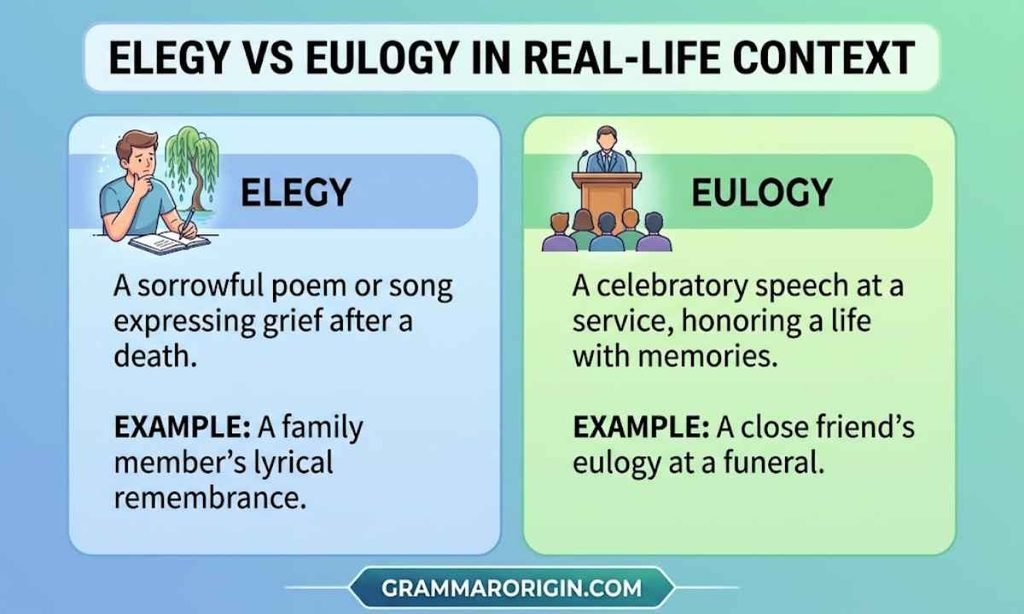
Elegy vs eulogy is mostly about where you meet the piece. Look at where it lives and how it reaches people. If it’s a poem on a page, it’s probably an elegy, and if it’s a talk at a service, it’s a eulogy.
- A poet publishes a mourning poem after a public figure dies: elegy
- A daughter speaks at her mother’s funeral: eulogy
- A composer writes a slow piece for a late teacher: elegy
- A manager honors a retired colleague at a memorial: eulogy
Some services use both. A poem might open the ceremony, and a speaker follows with a eulogy that tells the person’s story.
American vs British English Differences
There’s no spelling difference in elegy vs eulogy. Both words are written the same way in American and British English, and the plurals are elegies and eulogies.
The only small variation is the verb. Americans usually write eulogize, while British writers often use eulogise. Both are accepted.
The mayor will eulogize him on Friday.
The vicar will eulogise him on Friday.
Meaning and usage stay the same on both sides of the Atlantic.
Elegy and Eulogy Pronunciation
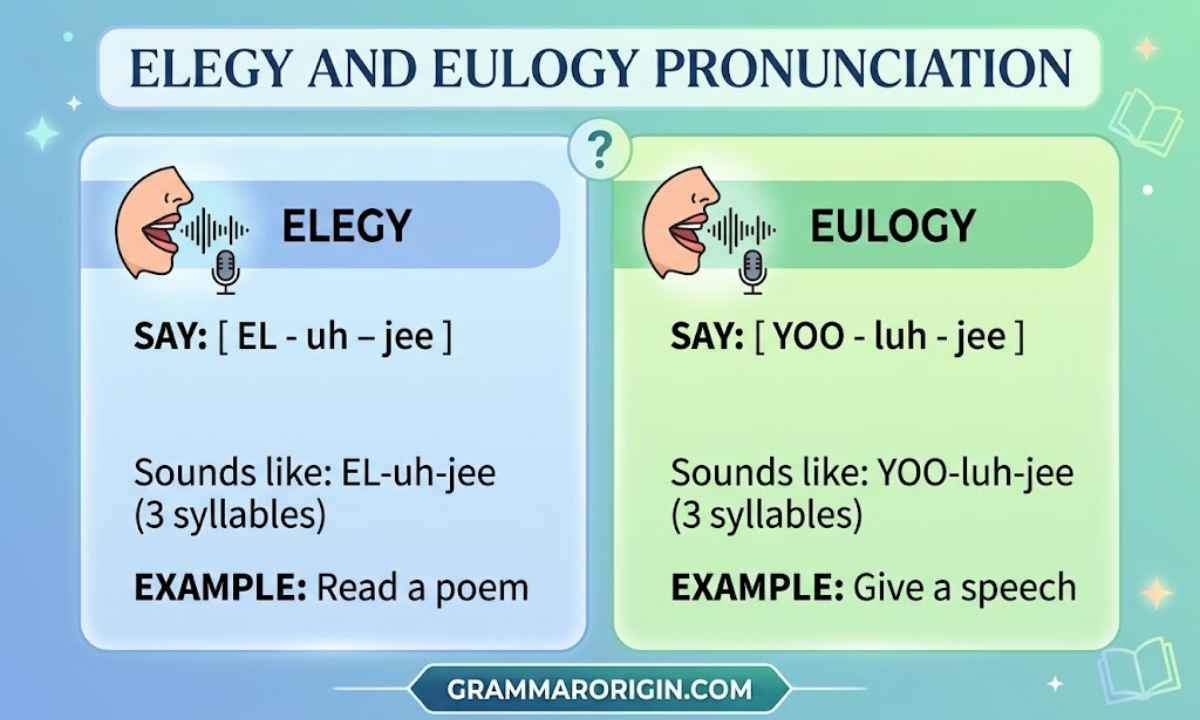
Say elegy as EL-uh-jee and eulogy as YOO-luh-jee. In IPA, they’re /ˈɛlɪdʒi/ and /ˈjuːlədʒi/.
In elegy vs eulogy, the first sounds differ, which is helpful. Elegy begins with a short “eh,” while eulogy begins with a “yoo” sound.
That “yoo” sound also explains the articles. You say “an elegy” but “a eulogy,” because eulogy starts with a consonant sound.
She read an elegy at the gallery opening.
He gave a eulogy at the service.
Also Read This Emasculate vs Demasculate: Which Word Is Correct?
Related Words and Synonyms (LSI Keywords)
Several nearby words show up in elegy vs eulogy conversations. None of them is an exact swap for elegy or eulogy. Each one differs a little:
- Tribute: any act or statement that shows respect, spoken or written
- Funeral address: a speech given at a funeral, close to a eulogy
- Lament: a passionate expression of grief, often in song or verse
- Dirge: a slow, mournful song played or sung at a funeral
- Requiem: music or a service for the dead
- Ode: a poem addressed to a person or thing, often in praise
- Remembrance: the act of recalling someone with care
- Commemoration: a ceremony or marker that honors a person or event
- Mourning poem: a plain-language way to describe an elegy
- Funeral tribute: flowers, words, or gestures that honor the deceased
You’ll also meet a few word forms: elegiac (adjective), eulogize (verb), and eulogist (the person who delivers one).
elegy vs eulogy meaning
The elegy meaning and the eulogy meaning split on one point: an elegy laments, and a eulogy praises. That single contrast explains most of what separates the two.
An elegy is a mournful poem, song, or musical composition, usually about someone who died or about loss in general. A eulogy is a formal tribute, most often a funeral speech, and in a broader sense it can mean high praise.
Elegy means a poem of mourning.
Eulogy means words of praise for someone.
Trusted dictionaries agree. Oxford describes an elegy as a serious poem that laments the dead, and Merriam-Webster treats a eulogy as a formal tribute, most often a funeral speech. Wiktionary’s usage note sums it up the same way: lament versus praise.
The dictionary meanings behind elegy vs eulogy also show why people confuse them. Both belong to the world of grief, but they do very different work inside it.
elegy vs eulogy vs epitaph
An epitaph is a short inscription on a gravestone or memorial. It’s the shortest of the three, often just a line or two.
The three words mix in conversation because they all honor the dead, which is why elegy vs eulogy trips people up. They differ in length, form, and place:
| Word | What it is | Length | Where you find it |
| Elegy | A poem or song of mourning | Short to long | Books, readings, concerts |
| Eulogy | A tribute speech | A few minutes | Funerals and memorials |
| Epitaph | A brief inscription | One line or two | Gravestones and plaques |
Two more neighbors are worth knowing. An obituary is a news notice that announces a death and sums up the person’s life, and a dirge is a slow mourning song.
Elegy vs eulogy vs epitaph is easy to sort by size: an epitaph is a line, an elegy is a poem, and a eulogy is a speech.
Epitaph: the stone simply read, “Beloved by all who knew him.”
Final Thoughts
Elegy vs eulogy is really a question of purpose. An elegy mourns, usually in poetry or music, and a eulogy praises, usually in a speech at a funeral.
Keep the “eu” trick in mind, think about your audience, and match the word to the setting. Do that, and you’ll use both words correctly every time.
Frequently Asked Questions
What is the difference between an elegy and a eulogy?
An elegy is a poem or song that mourns a loss, while a eulogy is a speech that honors a person’s life. Elegy vs eulogy mostly differs in form and purpose: one is literary and reflective, the other is spoken and celebratory.
What is the core distinction between an elegy and a eulogy?
The core distinction in elegy vs eulogy is lament versus praise. An elegy expresses sorrow, while a eulogy celebrates what the person stood for.
When is it appropriate to use an elegy versus a eulogy?
For elegy vs eulogy, use an elegy when you’re writing a poem, song, or reflective piece about loss. Use a eulogy when you’re speaking at a funeral or memorial to honor someone in front of others.
Is an obituary the same as a eulogy?
No. An obituary is a notice that announces a death and gives a short life summary, usually in print or online. A eulogy is a tribute that people speak or read at a service.
How do I write a eulogy for a loved one?
Start with one clear idea about who they were, then pick two or three short stories that prove it. Write the way you speak, keep it to about five minutes, and read it aloud once before the service.
How do professional writers approach elegy vs eulogy composition?
They start by deciding the job of the piece: to mourn or to praise.
Poets writing an elegy tend to focus on images, rhythm, and a light touch, and they often revise slowly. Speechwriters shaping a eulogy write for the ear, using short sentences, a few vivid stories, and a clear arc.
What is the typical structure of an elegy poem?
Many elegies move through three stages: lament, praise, and comfort. The poem opens with grief, turns to remembering what made the person special, and ends with some comfort or acceptance. Not every elegy follows this path, since the form is flexible.

Muhammad Waqas is an English language teacher and grammar expert with over 8 years of experience helping students and professionals improve their writing skills. He specializes in English grammar, vocabulary, communication, and practical language learning. Through GrammarOrigin, Waqas shares clear, easy-to-understand content that helps readers write and speak English with confidence.