
Infront or in front? The correct spelling is in front, always written as two separate words. “Infront” isn’t a standard English word, even though it’s a very common typo.
This guide gives you the rule, clear examples, and the small differences between in front, in front of, and at the front of. By the end, you’ll know exactly which one to type.
Quick Answer
Write in front as two words. Writing it as one word is a spelling mistake in standard English.
Right: The taxi stopped in front of the hotel.
Wrong: The taxi stopped infront of the hotel.
So in the infront or in front question, there’s only one winner. If you mean “ahead of” or “before” in position, keep a space between the two words.
What Does “In Front” Mean?
In front means ahead of something or someone. It can describe a physical position, or being in someone’s presence.
The phrase works on its own as an adverb, as in “the people in front.” It also sits inside the longer preposition “in front of” when a noun follows. Knowing this makes the infront or in front choice much easier.
The people in front couldn’t see the screen.
There was a tall fence in front of the school.
Please don’t argue in front of the kids.
Simple Meaning:
In front simply means “ahead of” in position. Close synonyms are ahead of, before, and facing.
The opposite is behind, or at the back. In the infront or in front debate, meaning never changes the spelling.
The bus is in front, and the van is behind it.
Examples of “In Front” in Sentences
These examples show how in front works with people, places, and objects. Each one keeps the words apart.
- The car is parked in front of the house.
- She stood in front of the mirror and fixed her tie.
- There’s a long line in front of the store.
- He spoke in front of a large audience without any notes.
- Don’t stand in front of the TV.
- A cyclist rode in front while the others followed.
That’s true whether you’re texting a friend, writing an email, or finishing an essay. The infront or in front rule never changes.
In Front vs In Front Of
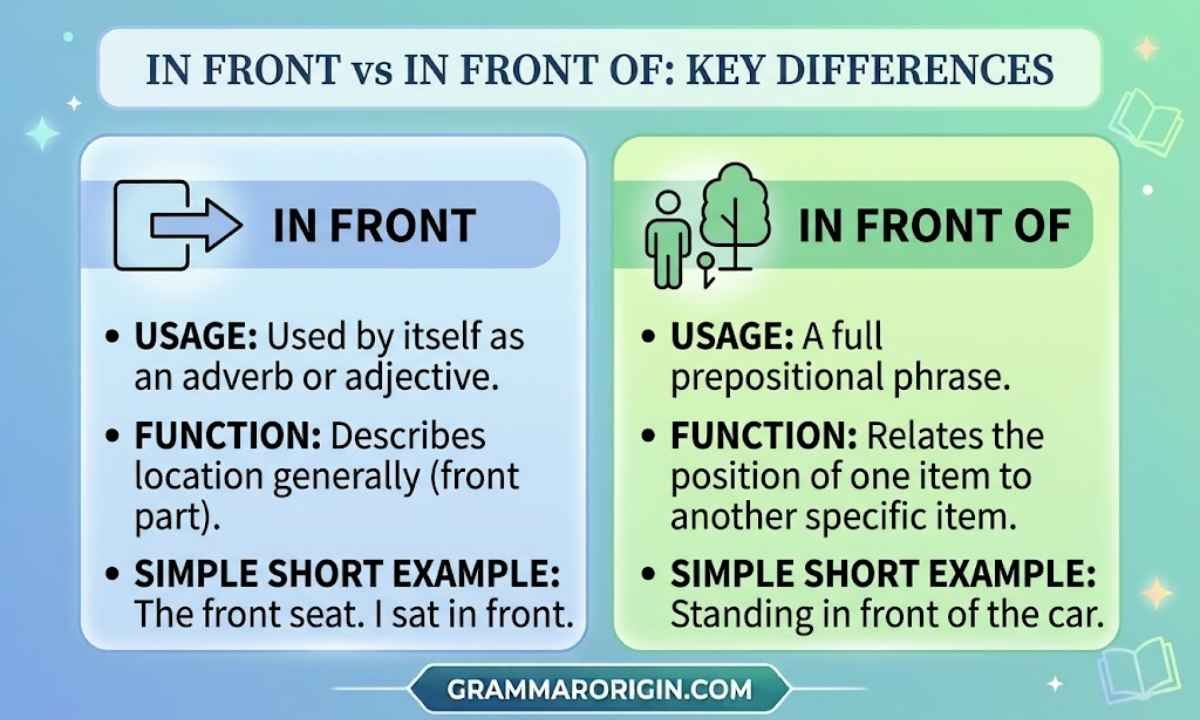
In front can stand alone as an adverb, while in front of needs a noun or pronoun after it. In front of is a preposition.
Oxford Learner’s Dictionary lists in front as an adverb and in front of as a preposition. That’s why the second one always needs an object. This split is the part of infront or in front that surprises most learners.
Go in front, and I’ll follow you.
She stood in front of him.
A common slip is dropping the “of.” You can’t say “in front me” or “in front the house.” Say in front of me and in front of the house instead.
Why “Infront” Is Incorrect
Infront is incorrect because English writes this phrase as two words. Dictionaries such as Oxford Learner’s record in front as a two-word form, and they don’t treat infront as an accepted variant.
So why does the infront or in front mix-up happen so often? A few simple reasons explain it:
- It sounds like one word when you say it quickly.
- English has many one-word forms like inside, into, and within, so it feels normal.
- Fast typing on a phone can skip the space.
- Autocorrect doesn’t always flag it.
Wrong: She sat infront of me in class.
Right: She sat in front of me in class.
In an email, a school paper, or a work document, the one-word spelling can look careless. It’s an easy fix, and it makes your writing look polished.
In Front vs Infront Comparison Table
The infront or in front table shows that in front is the only standard form. Infront doesn’t meet any of the tests.
| Feature | In Front | Infront |
| Standard spelling | Yes | No |
| Listed as a standard entry | Yes, as an adverb and in “in front of” | No |
| Part of speech | Adverb, or part of the preposition “in front of” | Not a recognized word |
| Safe for emails, essays, and exams | Yes | No |
| Example | Sit in front of me. | Sit infront of me (wrong). |
There’s no everyday situation where infront or in front gives you two correct options. Only the two-word version works.
Common Mistakes People Make
Three mistakes cause most of the infront or in front trouble: joining the words, mixing in front of with opposite, and swapping it with at the front. Each one is easy to fix.
1. Writing It as One Word
The fix is simple: always put a space between in and front. The same goes for the longer form, so “infront of” is also wrong. This is the core of the infront or in front problem, and it’s the easiest one to fix.
Wrong: Park the car infront of the gate.
Right: Park the car in front of the gate.
2. Confusing “In Front Of” With “Opposite”
In front of means directly before or ahead of something. Opposite means on the other side, facing it.
The cafe is opposite the station, across the road.
The cafe is in front of the station, right at its entrance.
Mixing these up can send someone to the wrong side of the street. It’s a different issue from infront or in front, but it trips up the same learners.
Also Read This Elegy vs Eulogy: What Is the Difference? Meaning & Examples
3. Mixing It With “At the Front”
At the front usually points to the leading part of a group or space. In front of compares one thing’s position with another’s. People searching infront or in front often mix this one up too.
She stood at the front of the queue.
The bike is in front of the shop.
In Front vs At The Front – What’s the Difference?
In front of means ahead of something, often outside it. At the front of means in the leading or forward part of something, like a line, a class, or a plane.
The British Council explains that at the front fits groups such as a queue, a crowd, or a race.
It also notes that we say at the front of a room, even though a room is a closed space. At the front is also much more common than in the front. This goes beyond infront or in front, but it clears up the next most common doubt.
In Front Of
In front of means directly ahead of someone or something, or in someone’s presence. It’s the pick when one thing sits before another.
A taxi stopped in front of the hotel, just outside the doors.
He sat in front of me during the meeting.
At The Front Of
At the front of means in the leading or forward part of a group or space. It’s a place within something, not a spot ahead of it.
Examples are a line, a classroom, or an aircraft cabin.
She sits at the front of the classroom.
There are emergency exits at the front of the plane and at the back.
In Front vs In the Front (Of)
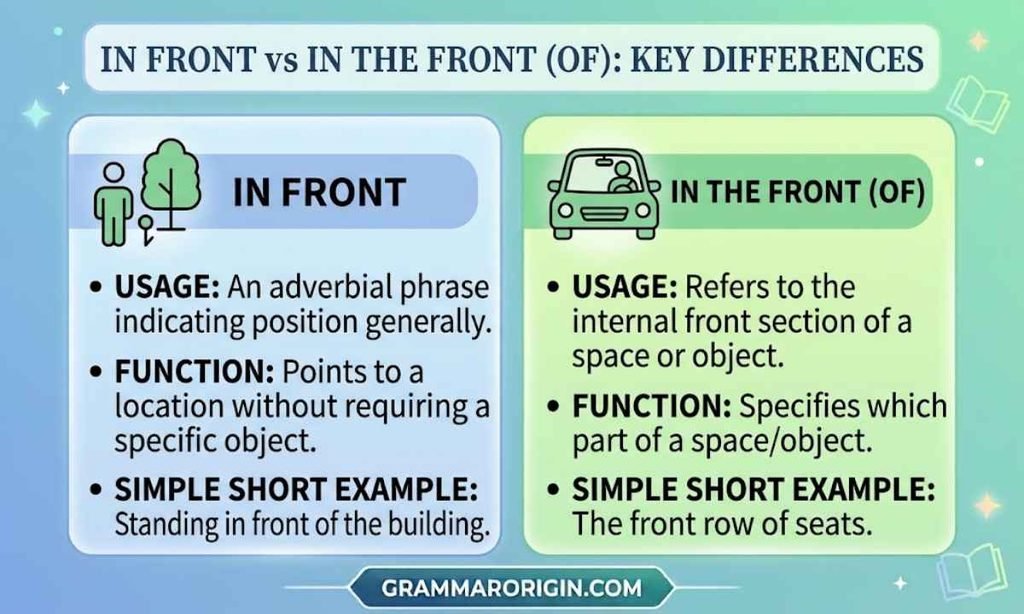
In the front means inside the forward part of something, usually a closed space like a car. In front means ahead of something.
Both phrases are correct, but they point to different places. One keeps you inside the space, and the other puts you ahead of it. It’s a second layer of the infront or in front topic that many guides skip.
The kids sat in the front of the car.
A bike was parked in front of the car.
For rooms and groups, most speakers choose at the front instead of in the front.
American vs British English Any Difference?
No. American and British English both write in front, and infront is wrong in both.
The one small gap is the phrase “in back of,” which is mostly American. British writers usually say behind or at the back of.
American: The parking lot is in back of the store.
British: The car park is behind the shop.
Australia, Canada, and every other English-speaking region follow the same rule for in front. That makes the infront or in front choice easy anywhere.
Also Read This Elegy vs Eulogy: What Is the Difference? Meaning & Examples
Grammar Rule Behind “In Front”
In front is a preposition (in) plus a noun (front), so it needs a space. In front of works as a compound preposition, like ahead of or because of.
You’ll see the same two-word pattern in many everyday phrases:
- in back
- in line
- in charge
- in place
- in spite of
None of these join into one word, and in front doesn’t either. Once you see the grammar, the infront or in front question answers itself.
The teacher is in front of the class.
She’s in charge of the project.
Memory Trick to Never Forget
Treat front as its own word. You already say the front door, the front seat, and the front of the house, so front clearly stands alone.
Here’s a quick way to lock it in. Leave a gap in front, just like you’d leave a gap in front of the car ahead of you on the road.
You’d never write “incharge” or “inplace,” so don’t write “infront” either. Use this trick every time the infront or in front doubt shows up.
Gap: keep a space in front of the word front.
Is “Infront” Ever Correct?
Not in standard English. The only places you’ll see it as one word are names and brands.
One real example is Infront Sports & Media, a sports marketing company based in Zug, Switzerland. Its name is a brand choice and has nothing to do with the spelling of the phrase. So in the infront or in front test, brands are the only exception.
Usernames, hashtags, and product names can also use the one-word form. In normal sentences, it’s still a typo, even in casual texting.
Infront Sports & Media is based in Zug, Switzerland.
Please wait in front of the building.
in front of or infront of
In front of is correct, and infront of is not. Keep all three words separate and in order.
The “of” matters too. When a noun or pronoun follows, you need the full in front of.
Right: He stood in front of the class.
Wrong: He stood infront of the class.
Wrong: He stood in front the class.
Think of in front of as one unit made of three separate words. It’s the same answer as infront or in front: the spaced version wins.
Infront vs Upfront vs Up Front
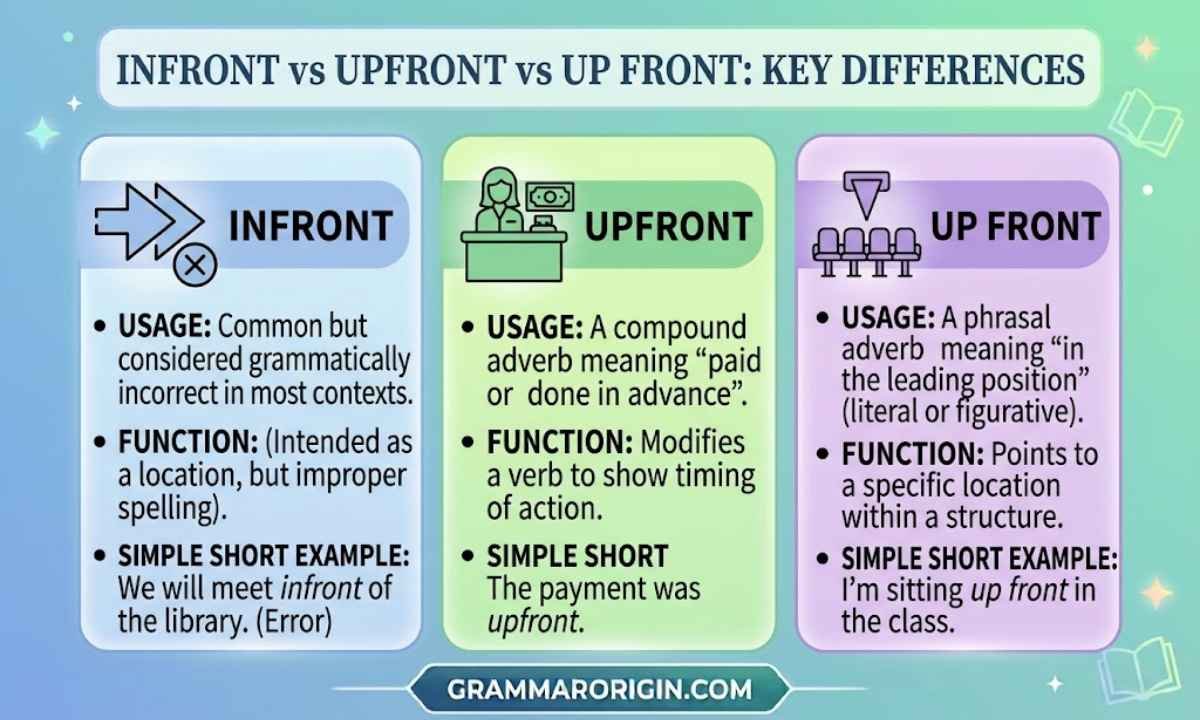
Upfront and up front are real, but they mean something different from in front. In front is about position, while upfront and up front are about honesty or timing.
Oxford Learner’s Dictionary lists up front as an informal phrase, and “cash up front” is a common example. As one word, upfront can mean honest and direct, or paid in advance.
She was upfront about the price.
You’ll need to pay a deposit up front.
The striker plays up front.
So infront isn’t a typo for upfront. That’s why upfront is the one real word people sometimes confuse in the infront or in front debate. If you mean ahead of something, use in front.
Quick Practice Sentences
Pick the right choice for each blank: in front of, at the front of, in the front of, or upfront.
- The dog sat ____ the door.
- She always sits ____ the class.
- The kids rode ____ the car.
- Please be ____ about the cost.
- Don’t talk about that ____ the children.
Answers:
- in front of
- at the front of
- in the front of
- upfront
- in front of
If you wrote infront for any of them, you now know the fix. Each answer follows the infront or in front rule you just learned.
Final Thoughts
Infront or in front is an easy call: in front is the only correct spelling, and infront is a typo. Keep the space, and keep the “of” when a noun follows.
Remember that front is its own word, and match at the front of or in the front to the situation. Whenever the infront or in front doubt returns, picture the gap. Your writing will stay clean everywhere.
Frequently Asked Questions
Is infront one word or two?
It’s two words: in front. The infront or in front question has one answer, because the one-word spelling isn’t standard English.
Is it infront of or in front of?
It’s in front of, which settles the infront or in front question for this form too. Keep all three words separate, and don’t drop the “of” before a noun or pronoun.
Can I say “in front” without “of”?
Yes, when no noun follows. For example, you can say “the people in front” or “go in front.” If a noun comes next, add “of.”
What is the difference between in front and in the front?
In front means ahead of something. In the front means inside the forward part of something, like a car or a bus.
Is infront ever correct?
Not in standard English. It appears only in brand names, such as Infront Sports & Media, and in usernames or hashtags. Even in the infront or in front debate, those are the only exceptions.
What is the opposite of in front?
The opposite is behind. You can also say at the back, or in back of in American English.

Muhammad Waqas is an English language teacher and grammar expert with over 8 years of experience helping students and professionals improve their writing skills. He specializes in English grammar, vocabulary, communication, and practical language learning. Through GrammarOrigin, Waqas shares clear, easy-to-understand content that helps readers write and speak English with confidence.