
Ingrained is the spelling to use. Engrained is a real but much rarer variant of the same word, so it isn’t a different term. When you’re torn between ingrained or engrained, go with the first.
This guide covers what dictionaries like Merriam-Webster actually say, where the word came from, and how to use it for habits, culture, and even stubborn grime. You’ll also see which slip-ups really matter and which don’t.
Quick Answer
Ingrained is the standard spelling and the one to pick. Engrained is a recognized variant, but it’s less common, and editors tend to change it.
Here’s the short version:
- For essays, reports, emails, and anything someone else edits, ingrained or engrained is settled: use ingrained.
- Treat engrained as a minority spelling, not a typo and not a safe bet.
- Both versions mean the same thing: worked in so deeply that it’s hard to change or remove.
Example: “Punctuality is ingrained in how this team works.” Write it with an e and the meaning survives, but most careful readers will notice.
Short on time? Settle the ingrained or engrained question by writing ingrained and moving on.
What Does “Ingrained” Mean?
Ingrained describes something that has sunk in so far that it’s now part of a person, a group, or a material. It covers habits and beliefs, but also stains and dyes, and that holds for ingrained or engrained alike.
Simple Definition
Think of ingrained as “worked deep into the character or the fabric of something.” Merriam-Webster splits it into two senses: one about attitudes and instincts, the other about material like wood or fiber.
The common thread is depth. Anything shallow doesn’t qualify. You’d have to dig to get an ingrained thing out.
Example: A cook’s habit of tasting before serving is ingrained. A coffee ring soaked into the grain of an old oak table is ingrained too.
Examples
Here are four everyday sentences that settle ingrained or engrained by example, from work habits to household mess.
Example 1: Years in customer service left her with an ingrained habit of saying “thanks for waiting.”
Example 2: Distrust of pop-up ads is ingrained in anyone who grew up on the early internet.
Example 3: Respect for deadlines was ingrained in the newsroom long before he arrived.
Example 4: The garage floor had oil ingrained so deeply that scrubbing barely helped.
engrained or ingrained
Whichever order you ask it in, the answer is the same: ingrained. You’ve probably seen both in print, which is why “engrained or ingrained” keeps coming up as a question.
The two forms are one word with one meaning and one history. Only one of them is the default.
Example: A writer types, “The rule is engrained in our culture.” A copy editor changes it to “ingrained” without a second thought.
What About “Engrained”?
Engrained is a legitimate spelling variant of ingrained, not a separate word. Merriam-Webster lists it as the less common form, which is exactly how most writers should treat it.
Key Points
- In the ingrained or engrained pair, it’s the same word with the same meaning, just spelled with an e.
- It follows the pattern of inquire and enquire, where in- and en- trade places.
- The verb (engrain) and the adverb (engrainedly) carry the same minority status.
- Editors often switch it to ingrained, so it can cost you some polish.
Example: Say you submit a report that uses “engrained.” No dictionary will call it wrong, but a style-conscious editor may still fix it.
Example (not recommended)
Using engrained isn’t a grammar error, but in the ingrained or engrained choice it’s the weaker one. It tends to stand out for the wrong reasons.
Example:
- Not recommended: “Suspicion of outsiders was engrained in the town.”
- Preferred: “Suspicion of outsiders was ingrained in the town.”
The fix costs one letter and removes any doubt.
Is “Engrained” Actually Wrong? What Dictionaries Say
No. In the ingrained or engrained pairing, dictionaries record engrained as a variant, so calling it a misspelling is too strong. “Rare” is the fairer label, and “avoid it in formal work” is the sensible rule.
Merriam-Webster files it under ingrained as the less common spelling. Other references call it an acceptable variant too, but the main entry always sits with ingrained. If your employer or publisher has a house style guide, check that first, then a dictionary like the Oxford English Dictionary, Cambridge Dictionary, or Collins.
Example: A client says, “Follow Merriam-Webster’s first spelling.” That settles it: ingrained.
Literal vs Figurative Meaning: Ingrained Dirt vs Ingrained Habits
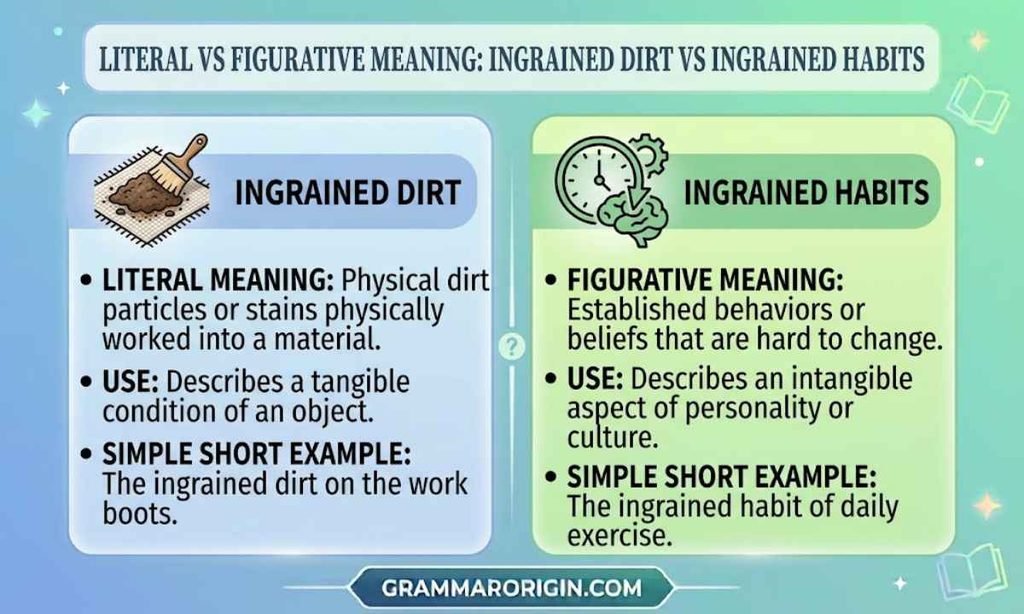
Ingrained works two ways. Figuratively, it covers habits, beliefs, and attitudes. Literally, it covers ingrained grime, stains, and dye worked into a material.
The literal sense is the older picture, since the word started in dyeing. Some writers save engrained for grime and ingrained for ideas, but dictionaries don’t back that as a rule, so skip the distinction when you’re weighing ingrained or engrained.
Example: Figurative: “A cautious approach to money is ingrained in her.” Literal: “Years of paint work left color ingrained in his fingertips.” Textile terms even use “ingrain” for yarn dyed before it’s spun.
Also Read This Infront or In Front? Correct Spelling, Meaning & Examples
Ingrained vs Engrained: Key Differences
In meaning, ingrained vs engrained makes no difference. In usage, ingrained is the standard form and engrained is the rare one.
| Feature | Ingrained | Engrained |
| Status | Standard spelling | Less common variant |
| Meaning | Deep-seated, or worked into a surface | Same |
| Dictionary treatment | Main entry (Merriam-Webster) | Listed as a variant under ingrained |
| Frequency in print | Far higher | Much lower |
| Verb | ingrain | engrain |
| Adverb | ingrainedly | engrainedly |
| Safe for formal writing | Yes | Risky, since editors often change it |
| Best choice | Almost always | Only when quoting or matching a source |
The real gap is reader reaction, not definition. Ingrained passes without a glance, while engrained makes some readers pause.
Example: “Ingrained fear” and “engrained fear” mean exactly the same thing, but only the first one sails through a strict proofread.
Why Is “Ingrained” More Popular?
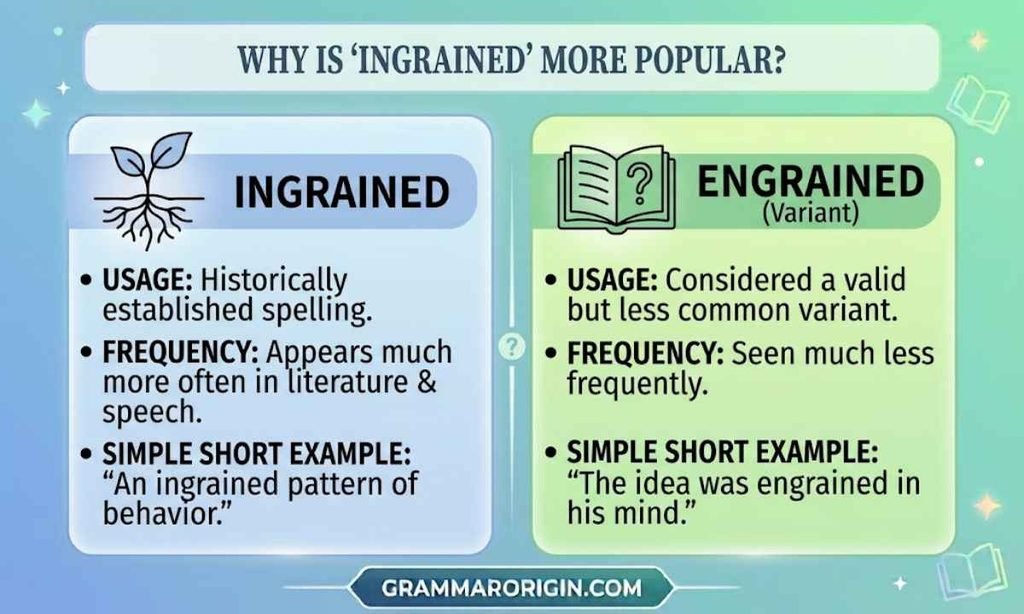
Ingrained is more popular because it’s the older, main dictionary spelling, and publishers keep reinforcing it. Merriam-Webster traces its first known use to 1599.
Every edited article, book, and press release picks the dominant spelling, which nudges it further ahead. The usage samples Merriam-Webster shows from outlets like the New York Times, Southern Living, and Forbes all use ingrained.
Why do people still reach for the e? Words like enquire, encase, and engrave start the same way, so engrained can feel right by analogy. In the ingrained or engrained contest, though, habit and editing favor the i.
Example: You’ll see “deeply ingrained” all over news features. “Deeply engrained” is the one that makes you look twice. A Google Ngram Viewer search lets you compare the two yourself.
Origin of “Ingrained”: From Dyed Fiber to Deep Habits
The word’s etymology starts in the dye shop. “In grain” described color that soaked all the way through cloth instead of sitting on top, and over time the image moved from fabric to character.
“Grain” pointed to dye first and to the texture of fiber later. The jump from “color that won’t wash out” to “habit that won’t wash out” feels natural, and it’s the same picture behind ingrained or engrained.
Example: A cloth dyed in grain kept its color wash after wash. A belief ingrained in someone holds on just as stubbornly.
American vs British English Differences
Ingrained is the safe choice in both American English and British English. This isn’t a color/colour-style split, because neither side treats engrained as the main spelling.
Merriam-Webster, an American dictionary, calls engrained the less common form. One usage guide suggests British readers may react less sharply to it than Americans do, though it still advises ingrained. So the ingrained or engrained choice doesn’t flip across the Atlantic.
Example: A Manchester magazine and a Chicago newsroom would both print “ingrained prejudice.”
Word Forms: Ingrain, Ingrained, Ingraining, Ingrainedly
Ingrain is a transitive verb, ingrained is its past participle and also an adjective, ingraining is the -ing form, and ingrainedly is a rare adverb. Each one has an engrain twin, so the ingrained or engrained choice carries through every form, including ingrain vs engrain.
- ingrain, ingrains (verb): “Good teachers ingrain curiosity.”
- ingrained (past participle and adjective): “an ingrained habit”
- ingraining (-ing form): “Repetition keeps ingraining the pattern.”
- ingrainedly (adverb): rare, and mostly seen in formal writing.
Example: “The coach ingrained the warm-up routine, and it’s now an ingrained part of practice.”
Common Mistakes to Avoid
Most mistakes around ingrained or engrained are small, but four come up again and again. Each takes seconds to fix.
1. Using “engrained” in formal writing
It isn’t banned, but it’s the form editors usually change. In academic, business, or published work, choose ingrained.
Example: Draft: “The bias is engrained in the hiring process.” Fixed: “The bias is ingrained in the hiring process.”
2. Confusing it with “engrave”
Engrave means to cut a design into a hard surface, while ingrained describes something worked into a person or material. They’re different words, and engrained isn’t a blend of the two.
The e in engrained comes from the same in-/en- swap you see in inquire and enquire. The phrase “engraved in memory” is its own idiom and suggests a sharp imprint, not a habit.
So engrained vs engraved isn’t a spelling choice at all. They’re two different words.
Example: “The date is engraved in my memory” points to a vivid recollection. “Early rising is ingrained in my routine” points to a habit.
Also Read This Infront or In Front? Correct Spelling, Meaning & Examples
3. Overusing the word
Ingrained packs a punch, so repeating it dulls the effect. Rotate in deep-seated, entrenched, or deep-rooted when the sentence allows.
Example: Instead of “ingrained habit, ingrained belief, ingrained bias,” try “a habit, a deep-seated belief, an entrenched bias.”
4. Mixing it up with “ingrown”
Ingrown means growing inward, as in an ingrown toenail, while ingrained means worked in deeply. The two look alike but aren’t related.
Example: An ingrown toenail is a body problem. An ingrained habit is a behavior one.
Real-Life Usage Examples
Ingrained fits wherever something has become automatic or stubborn. These four settings show where the ingrained or engrained question comes up most.
Personal Habits
Personal habits are the most common home for the word.
Example: “Locking the door and checking it twice is so ingrained that I do it half-asleep.”
Habits turn ingrained through repetition. After enough rounds, you stop deciding and just do.
Cultural Context
In a cultural setting, ingrained describes customs and values a community passes along without thinking about them.
Writers usually pair it with “in”: ingrained in the culture, ingrained in society. Example: “Taking shoes off at the door is ingrained in many South Asian homes.”
Professional Setting
At work, ingrained marks practices and instincts a team has absorbed through training.
Example: “On the surgical team, double-checking the patient’s name is ingrained.” Positive routines like this are exactly where the word shines.
Emotional Patterns
Emotionally, ingrained points to reactions that have turned automatic over time. They can still shift with awareness and practice.
Example: “Assuming a short text means anger was an ingrained reflex for him.”
When Should You Use “Ingrained”?
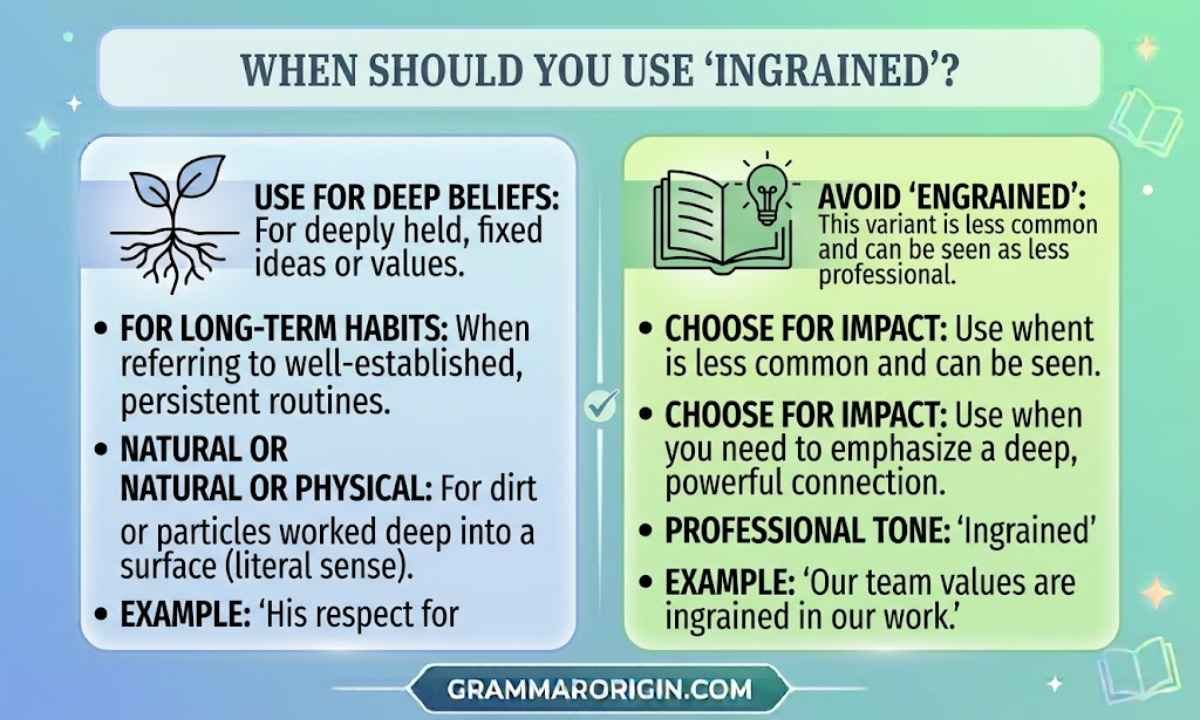
Use ingrained when something has been absorbed or repeated until it’s automatic, or when it has soaked into a material and won’t shift easily. If it’s shallow or recent, pick another word.
Best Contexts
- Habits, routines, and ingrained behavior that no longer need thought
- Beliefs, biases, and attitudes
- Workplace culture and training
- Stains, dye, and dirt in wood, fabric, or flooring
Example: “The safety protocol is ingrained” fits a training context, while “the stain is ingrained” fits a rug.
Ingrained in, into or with: Which Preposition?
“Ingrained in” is the most common pairing for the adjective. “Ingrained into” suits the verb, and “ingrained with” is rarer. Prepositions tend to come up right after the ingrained or engrained question.
Example:
- Adjective: “Teamwork is ingrained in the department.”
- Verb: “She ingrained the checklist into the new hires.”
- Verb with “with”: “The coach ingrained her players with discipline.”
Think of “in” as a state and “into” as the action of putting something there.
is it engrained or ingrained
It’s ingrained. Anywhere a reader might judge your polish, such as reports, cover letters, and assignments, the standard spelling removes doubt.
Example: “Attention to quality is ingrained in how I work” reads cleanly on a résumé. The e version could distract a hiring manager.
is it ingrained or engrained
Still ingrained, and there’s a quick trick to prove it. Ingrain is literally “in” plus “grain,” which also matches where the word came from.
Example: Before you hit send, picture the word as in + grain + ed. If your spelling starts with the “in,” you’ve got it right.
Synonyms and Related Words
Close synonyms for ingrained or engrained are deep-seated, deep-rooted, entrenched, and firmly established. Instilled, innate, and inherent are related, but each leans a different way.
- Deep-seated and deep-rooted: sitting far below the surface.
- Entrenched: dug in and hard to dislodge, often about systems or policies.
- Instilled: put there through teaching or repetition.
- Innate and inherent: present by nature, not learned.
The last pair is the trap. Ingrained suggests something acquired and absorbed, while innate suggests it was always there.
Example: An entrenched policy, an instilled value, an innate talent, an ingrained habit.
Final Thoughts
Ingrained or engrained? Pick ingrained. It’s the main entry in Merriam-Webster, the form editors expect, and the one that works in American and British writing alike.
Engrained is a real variant, so spotting it isn’t a disaster. Next time ingrained or engrained stalls you mid-sentence, the “in grain” trick settles it.
Frequently Asked Questions
What does the word “ingrained” mean?
Ingrained means worked in so deeply that it’s become part of a person or material and is hard to remove. It’s usually said as in-GRAYND.
What is the difference between engraved and ingrained?
Engraved means carved or cut into a hard surface, while ingrained means worked deeply into character, habit, or material. They’re separate words with different meanings.
What does the word “ingrain” mean?
The ingrain meaning is simple: to work something deeply into a person, group, or material. Its forms are ingrains, ingrained, and ingraining.
Is it engraved or ingrained in my mind?
Both can work, but they say different things. “Engraved in my mind” suggests a sharp, lasting memory, while “ingrained in my mind” suggests a belief or habit absorbed over time.
Is “engrained” a real word?
Yes. In the ingrained or engrained pair, engrained is a recognized variant spelling, and Merriam-Webster lists it as the less common one.
Should I write ingrained or engrained in formal writing?
Write ingrained. When you choose between ingrained or engrained for a report or paper, the standard spelling avoids any raised eyebrows.

Muhammad Waqas is an English language teacher and grammar expert with over 8 years of experience helping students and professionals improve their writing skills. He specializes in English grammar, vocabulary, communication, and practical language learning. Through GrammarOrigin, Waqas shares clear, easy-to-understand content that helps readers write and speak English with confidence.