
Use exception. Acception is an obsolete word that mostly turns up as a typo for it, so in the acception vs exception question, exception wins almost every time.
This guide covers what each word means, where they come from, why writers swap them, and how to check yourself in a few seconds. A short quiz at the end lets you test what stuck.
Content Scope:
This page settles the acception vs exception question, then covers the neighboring words that cause the trouble: accept, except, and acceptance. You’ll also get word origins, pronunciation, real-world mistakes, and a memory trick.
Here’s the sort of line it helps you get right: Refunds are final, with no exceptions. One wrong prefix and a policy line starts to look like a typo.
Quick Answer:
Write exception unless you’re quoting an old text. It’s the standard noun for a case that falls outside a rule, and every major dictionary treats it as ordinary modern English.
Acception is a different animal. It’s an obsolete English word that once covered acceptance, favoritism, and the accepted sense of a word, and the Century Dictionary marks it as obsolete. For acception vs exception, that makes the choice almost never a close call.
For a quick gut check, try this one: Every seat is reserved, with one exception: the front row. The writer means “left out,” so exception is the only fit.
What Does “Exception” Mean?
An exception is a case that doesn’t follow the rule covering everything else. It’s a noun, and it’s the word to reach for whenever something gets left out of a group or a general statement.
Admission is free on Sundays, with one exception: the winter gala.
The core idea is exclusion. A rule draws a pattern, and the exception is whatever steps outside it, whether that’s a day on the calendar, a student in a class, or a line of code that fails.
Simple Definition:
Think of an exception as the odd one out. A general statement is true of nearly everything, and the exception is whatever it fails to cover.
Most cats avoid baths, but this one is a happy exception.
A single exception doesn’t cancel the rule, either. It just marks the edge of it.
Examples of “Exception”
You’ll meet exception in everyday talk, in rules and contracts, and in code. Each example below comes from one of those worlds.
Every flight on the board was delayed, and the last one to Dubai was the only exception. That’s everyday speech: someone sets up a pattern, then breaks it.
Tenants may keep pets, with the exception of dogs over 25 kilograms. Leases and policies lean on “with the exception of” to carve a limit out of a general permission.
When the script divided by zero, Python raised an exception and stopped. In programming, an exception is an error event that interrupts normal flow until the code handles it.
Common Phrases With “Exception”
Six phrases cover most real-world uses of the word, and one of them has a meaning that surprises people.
- Make an exception: allow someone to skip the rule this once.
- With the exception of: leaving out a named person or item.
- Without exception: applying to every single case.
- No exceptions: a firm warning that the rule won’t bend.
- An exception to the rule: a case that doesn’t fit the general pattern.
- Take exception to: object to something or be offended by it, which is a different idea from excluding it.
“We don’t usually refund sale items, but we’ll make an exception this time.”
The last phrase is the odd one. She took exception to the tone of the email means the tone bothered her, not that she left it out.
What Does “Acception” Mean?
Acception is a real but obsolete English word, and it doesn’t mean what exception means. It comes from the Latin acceptio, “a receiving,” and it covered acceptance, special treatment, and the accepted sense of a word.
You’ll mostly run into it in historical dictionaries. The Century Dictionary, as reproduced on Wordnik, flags it as obsolete and links it to “acceptation,” the received meaning of a word.
An illustrative sentence from that older world: a clerk in the 1300s might write about the acception of a gift when he simply meant the gift was accepted.
Definition of “Acception”
Across the historical record, acception carries three senses, and none of them is the “left out of a rule” idea.
- Acceptance or approval. The oldest sense, recorded in 14th-century legal French in the Anglo-Norman Dictionary.
- Favoritism or special treatment. This one survives in the phrase acception of persons, meaning bias toward someone because of who they are.
- The received meaning of a word. The Century Dictionary ties acception to “acceptation,” and modern writers just say “sense” or “meaning.”
Dictionaries split these differently, but all three trace back to the idea of receiving.
Also Read This Ingrained or Engrained: Correct Spelling, Meaning & Examples
Example of “Acception” (Linguistic Use)
Linguists and historians use acception to point to one recorded sense of a word.
In its legal acception, “consideration” means something of value exchanged to make a contract binding.
Here acception stands in for “sense.” A modern editor would probably swap in “sense” or “meaning,” and that’s the safer habit in your own writing too. The favoritism meaning looks different on the page: The charter forbade any acception of persons.
Important Note
Acception isn’t an alternate spelling of acceptance, and it isn’t an alternate spelling of exception. It’s a separate, older word.
Her acceptance of the offer arrived on Friday. That’s the form you want for agreeing to something.
The Anglo-Norman Dictionary even remarks that some passages may be read as exception with a swapped prefix. If that’s right, the acception vs exception mix-up is centuries old, not a product of autocorrect.
Etymology: Where Do These Words Come From?
Both words come from Latin and the verb capere, “to take.” Only the prefix changes: ex- means “out,” and ac- (a form of ad-) means “toward.”
Exceptio, a taking out, gave English exception. Acceptio, a receiving, gave it acception, and the same verb family produced accept and acceptance.
That’s why one word is about leaving something out and the other once covered taking something in. The acception vs exception split is really an out-versus-in split.
The route into English ran through Anglo-Norman, where the Anglo-Norman Dictionary shows accepcion in legal writing from the 1300s. Modern French kept acception for the sense of a word, so French-speaking writers sometimes carry it into English by habit.
Acception vs Exception: Side-by-Side Comparison
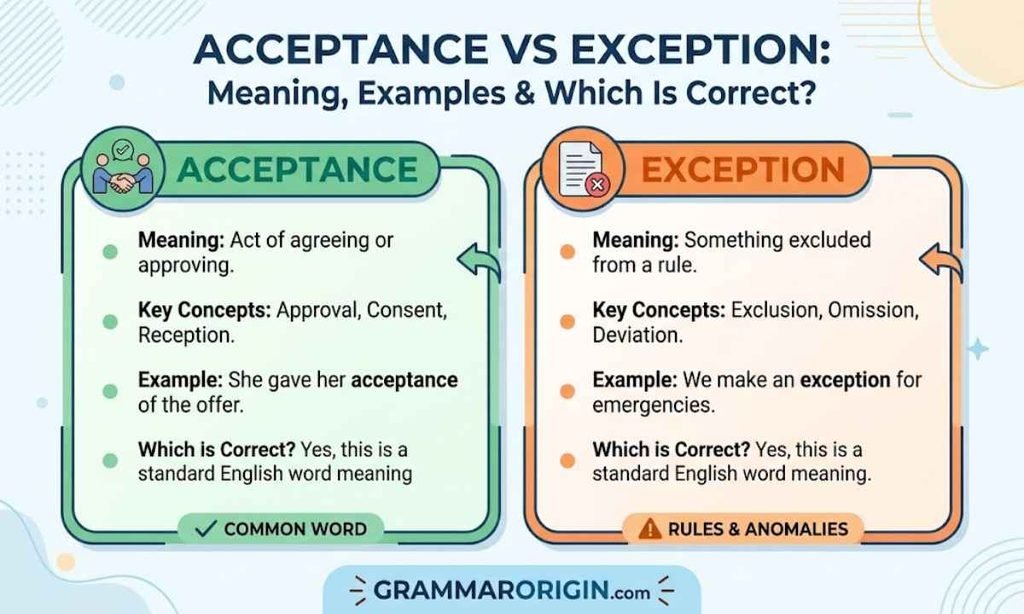
Exception is a living, common noun for something outside a rule, while acception is an obsolete noun about receiving, favoring, or a word’s accepted sense. The table lines them up.
| Feature | Acception | Exception |
| Part of speech | Noun | Noun |
| Status today | Obsolete in English | Standard and common |
| Core idea | Receiving, favoring, or a word’s accepted sense | Something left out of a rule or group |
| Latin source | acceptio (“a receiving”) | exceptio (“a taking out”) |
| Prefix meaning | ac- (toward) | ex- (out) |
| Where you’ll see it | Old legal and religious texts, historical dictionaries, French | Everyday writing, law, business, programming |
| Typical error | Typed by mistake for exception or acceptance | Mixed up with except or accept |
| Sample phrase | the acception of persons | no exception to the rule |
Try the swap test on a real sentence: The rule covers everyone, with one exception. Put acception in that slot and the meaning collapses, because nothing is being received or favored.
Why People Confuse Acception and Exception
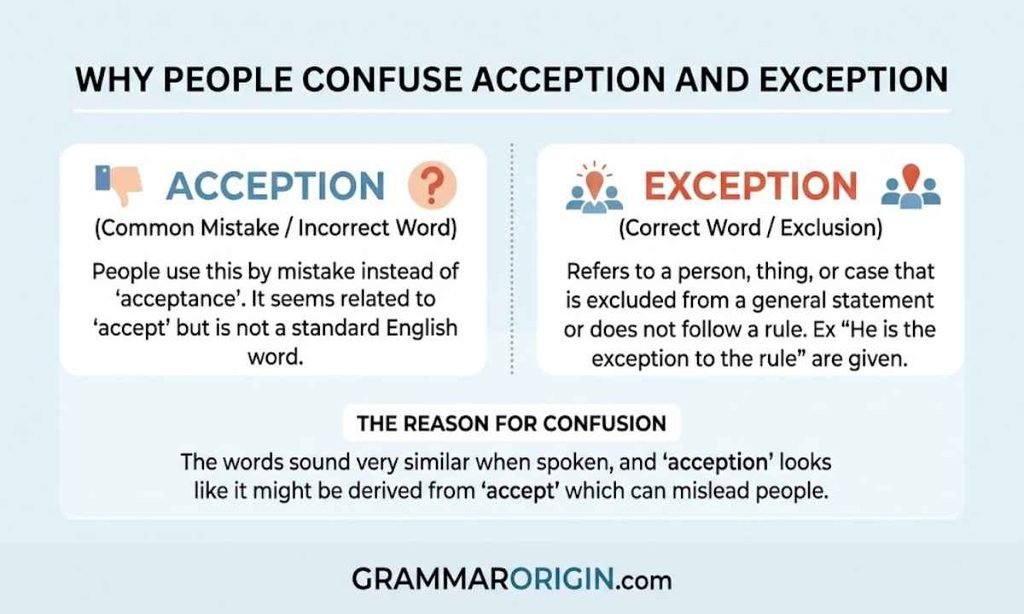
The words look alike, sound alike, and have a third word, acceptance, sitting right between them. Those three overlaps explain nearly every acception vs exception slip.
1. Similar Spelling
The two words share the ending -ception, so only the first two letters set them apart. A hurried typist can swap those letters without noticing.
Mistyped: “We’ll make an acception this once.” Fixed: “We’ll make an exception this once.”
Spell checkers don’t always catch it either, since acception exists in some dictionaries. A word that’s real but obsolete is easy to miss on a proofread.
2. Sound Similarity
Said at normal speed, the two words are nearly identical. Exception is /ɪkˈsɛpʃən/, and acception would come out as roughly /əkˈsɛpʃən/, so the stressed part matches and only a weak first vowel differs.
That’s enough to fool a hurried note-taker. The manager says, “There’s one exception,” and the notes end up reading “one acception.”
3. Confusion With “Acceptance”
Acceptance is the quiet third party in this acception vs exception tangle. It starts like accept, so writers half-remember a spelling that begins “ac-” and ends “-tion,” and acception is what falls out.
She sent her acceptance by email. If you mean agreeing or receiving, that’s the form to use, and nothing else will do.
Accept vs Except vs Exception: Quick Clarification
Accept is a verb meaning to receive or agree to, except means “not including,” and exception is the noun built from except. Add acceptance and you’ve got four words that are easy to scramble.
| Word | Part of speech | Meaning | Example |
| accept | verb | receive, agree to, or take as true | She will accept the offer. |
| except | preposition or conjunction | not including | Everyone came except Sam. |
| exception | noun | a case left out of a rule | Sam was the exception. |
| acceptance | noun | the act of accepting | Her acceptance came by email. |
Notice the families: accept goes with acceptance, and except goes with exception. Acception doesn’t belong to either family in modern English, which is exactly why it looks off.
I accept every item on the list except the last one, the only exception.
Except even works as a rare verb meaning “to leave out,” as in Seniors are excepted from the fee. You’ll seldom need it.
Common Mistakes (And How to Fix Them)
Three slips cause most of the damage: acception typed for exception, acception typed for acceptance, and accept typed for except. Each pair below shows one slip and its fix.
Incorrect:
Free returns on every order, with no acception.
What went wrong: the writer wants a case left out of a rule, and that’s exception.
Correct:
Free returns on every order, with no exceptions.
Now the sentence says what it means: no case is left out.
Incorrect:
The board announced its acception of the new budget.
What went wrong: agreeing to something calls for acceptance.
Correct:
The board announced its acceptance of the new budget.
Acceptance names the act of agreeing, which is what the board did.
Incorrect:
Everyone showed up accept Dan.
What went wrong: accept is a verb, and this sentence needs the word for “not including.”
Correct:
Everyone showed up except Dan.
Except marks who’s left out, so Dan is the one missing.
American vs British English Differences
There aren’t any. Exception, except, accept, and acceptance are spelled and used the same way in American, British, Canadian, Australian, and Indian English.
Acception’s status is shared too: it’s obsolete everywhere, so no region keeps it alive in everyday writing. The new rule applies to everyone, with one exception. That sentence works as written in New York, London, or Sydney.
So the acception vs exception decision never needs localizing. The idiom take exception to travels the same way, and both sides of the Atlantic use it.
Also Read This Ingrained or Engrained: Correct Spelling, Meaning & Examples
When Should You Actually Use “Acception”?
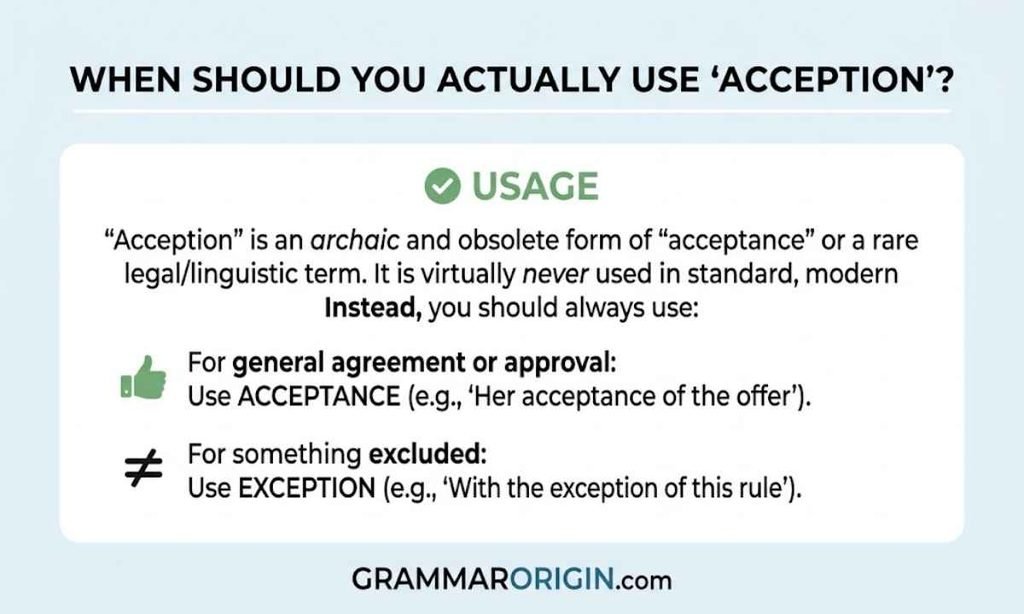
Almost never. Use it only when you’re quoting an older text, discussing the word itself, or writing in French, where it’s still a normal word.
A historian quoting a medieval statute might keep the original wording: “no acception of persons.”
In your own sentences, reach for modern words instead. Use acceptance for agreeing, sense or meaning for a word’s definition, and favoritism or bias for the old acception of persons. And if you’re talking about something left out of a rule, you want exception.
Real-World Usage Scenarios
The choice comes up most in workplace and academic writing, and exception is the right pick in both. One small slip in either place can make careful work look rushed.
In Business Writing
Late fees apply to every account without exception. Policy emails, contracts, and customer replies use the word constantly, so a typo there looks careless to clients.
A friendlier version: We can make an exception for first-time customers. Typing acception in either line reads as a slip, not a style choice, and that’s the acception vs exception error readers notice fastest.
In Academic Writing
Academic writing uses exception for data and arguments, and acception only when the paper is about old word senses or historical texts.
With the exception of two outliers, the sample followed the expected trend. That’s the everyday academic use. A paper on medieval law might also discuss the acception of persons, but the writer should gloss it for readers.
Synonyms and Related Words
Exception has plenty of synonyms, plus a few relatives that look similar but mean something different.
Synonyms for Exception
- Anomaly: something that deviates from what’s expected, common in science.
- Outlier: a data point far from the others.
- Irregularity: a break in a pattern.
- Deviation: a departure from a standard.
- Special case: a situation handled separately from the general rule.
- Exemption: official release from a rule or duty.
- Exclusion: the act of leaving something out.
The trend held, apart from one outlier in week six.
Related Words
Related words come from the same Latin family or from the same-sounding pair, so they’re worth knowing apart.
- Except: excluding.
- Exceptional: unusually good, or forming an exception.
- Exceptionally: to an unusual degree.
- Exceptionable: open to objection.
- Unexceptionable: beyond objection, and easy to confuse with exceptional.
- Accept and acceptance: receiving or agreeing.
- Acceptation: a rare word for a word’s accepted meaning, the modern cousin of acception.
The food was exceptional. Here the word means outstanding, not “left out,” which is why it sits under related words rather than synonyms.
Quick Memory Trick
Ask one question: is something being left out? If yes, write exception. Three quick checks back that up.
- The cross-out check. The x in exception looks like a cross through one item on a list. If you’re striking something off, you want exception.
- The swap test. Replace the word with “one case left out.” If the sentence still works, exception is right. Everyone qualifies, with one exception becomes “with one case left out,” and it holds.
- The family check. Accept goes with acceptance, and except goes with exception. If your word fits neither pair, stop and look again.
Run those on any acception vs exception doubt and the answer usually shows up in seconds.
Practice Quiz
Five quick blanks will show whether this stuck, with the answers right below. Try them before you scroll.
- The dress code is strict, with no ______.
- She sent her ______ of the invitation this morning.
- Everyone passed ______ one student.
- In the old statute, the phrase “______ of persons” meant favoritism.
- Please ______ my apologies for the delay.
Answers:
- exception(s): a case left out of a rule.
- acceptance: the act of agreeing.
- except: meaning “not including.”
- acception: the historical favoritism sense, the one spot where it’s actually right.
- accept: to receive.
Final Thoughts
The acception vs exception question comes down to one test: is something being left out of a rule? If so, write exception. If you mean agreeing, write acceptance, and keep acception for old texts.
These words look alike because they share a Latin root and an ending, not because they share a meaning. Check the prefix, run the swap test, and the right word usually shows itself.
Frequently Asked Questions
What is the difference between acception and exception?
Exception is a standard noun for something excluded from a rule, while acception is an obsolete word for receiving, favoring, or a word’s accepted sense. In the acception vs exception choice, modern writing needs exception. They share a Latin root but carry opposite prefixes: ex- (out) and ac- (toward).
What does acception mean?
Acception is an obsolete English noun that meant acceptance, favoritism (as in “acception of persons”), or the received meaning of a word. Today it mostly appears in historical texts and as a typo. In French, acception is still an ordinary word for a word’s sense.
What does it mean to get an exception?
Getting an exception means being allowed to skip a rule that applies to everyone else, like a fee waiver or a deadline extension. In programming, it means the code hit an error that has to be handled. The landlord gave her an exception to the no-pets rule.
Is it correct to say “I can make an exception or acception”?
No. The fixed phrase is “make an exception,” and acception isn’t an alternative to it. In the acception vs exception sense, the second half of that sentence is simply a typo, so “I can make an exception” says everything you need.
Is acception a real word?
Yes, historically. It’s recorded in the Century Dictionary and the Anglo-Norman Dictionary, and it lives on in French, but it’s obsolete in modern English. Use it only when quoting or discussing the word itself.
Is acception the same as acceptance?
No. Acceptance is the current word for agreeing to or receiving something. Acception once overlapped with that sense but is now obsolete, so a modern sentence about agreeing needs acceptance. The team celebrated the acceptance of its bid.

Muhammad Waqas is an English language teacher and grammar expert with over 8 years of experience helping students and professionals improve their writing skills. He specializes in English grammar, vocabulary, communication, and practical language learning. Through GrammarOrigin, Waqas shares clear, easy-to-understand content that helps readers write and speak English with confidence.