
Worse or worst? Use “worse” to compare two things and “worst” for the lowest of three or more. One extra letter changes how many things you’re comparing.
This guide settles the worse or worst question with plain rules, real examples, and a few quick tricks. You’ll also see how the idioms “turn for the worse” and “worst-case scenario” fit in, and why so many writers trip over them.
Quick Answer
Use “worse” when you compare two things, and use “worst” when you pick the lowest of three or more. If you can add “than” after the word, choose worse. If you can add “of all,” choose worst.
When you’re stuck on worse or worst, these three lines show the split:
- This soup is worse than yesterday’s.
- This is the worst soup I’ve ever tasted.
- Her cold took a turn for the worse.
In grammar terms, worse is the comparative form of bad, and worst is the superlative form. The first line compares two soups. The second ranks one soup against every soup you’ve had. The third uses a fixed idiom, which you’ll see again below.
Meaning and Definition of Each Word
“Worse” is the comparative form of “bad,” and “worst” is its superlative form. Both are irregular, so they don’t take the usual -er and -est endings. That’s why the worse or worst choice trips up so many writers. Dictionaries such as Merriam-Webster, Cambridge Dictionary, and the Oxford English Dictionary list them as forms of bad, and both words come from Old English forms.
The pronunciation gap is small, so say them out loud and you’ll hear it. “Worse” rhymes with nurse (/wɜrs/), and “worst” rhymes with first (/wɜrst/).
Turn for the Worse
To take a turn for the worse means a situation gets more serious or more unpleasant than it was before.
Here are two quick examples before the explanation:
- The weather took a turn for the worse by noon.
- His health has taken a turn for the worse.
In this idiom, “worse” works like a noun, as in “a change for the worse.” The phrase talks about movement over time, from fine to not fine, which is why it uses the comparative and never the superlative. Keep that in mind whenever a worse or worst choice shows up inside an idiom.
Worst
“Worst” means the lowest in quality or the most severe among three or more things.
It’s mostly an adjective, but it also works as an adverb and a noun. Most of the time, it follows “the,” which signals a ranking. It’s the word to reach for when your worse or worst decision is about ranking.
- That was the worst traffic I’ve seen all year.
- She’s the worst singer in the group, but the happiest.
Bad, Worse, Worst: Irregular Forms Table
Bad becomes worse and then worst, and none of the three follows the regular pattern. Grammar books call these the degrees of comparison: positive, comparative, and superlative. Regular adjectives just add -er and -est, like tall, taller, tallest. Bad can’t do that.
| Base word | Comparative | Superlative |
| bad | worse | worst |
| good | better | best |
| much / many | more | most |
| little | less | least |
The table shows that bad, worse, worst sits in the same family as good, better, best. Learn one ladder and the other one gets easier. Knowing the ladder removes most worse or worst confusion.
- The weather is bad, but tomorrow will be worse.
- Of all the days this week, Friday was the worst.
Worse and Worst as Adverbs and Nouns
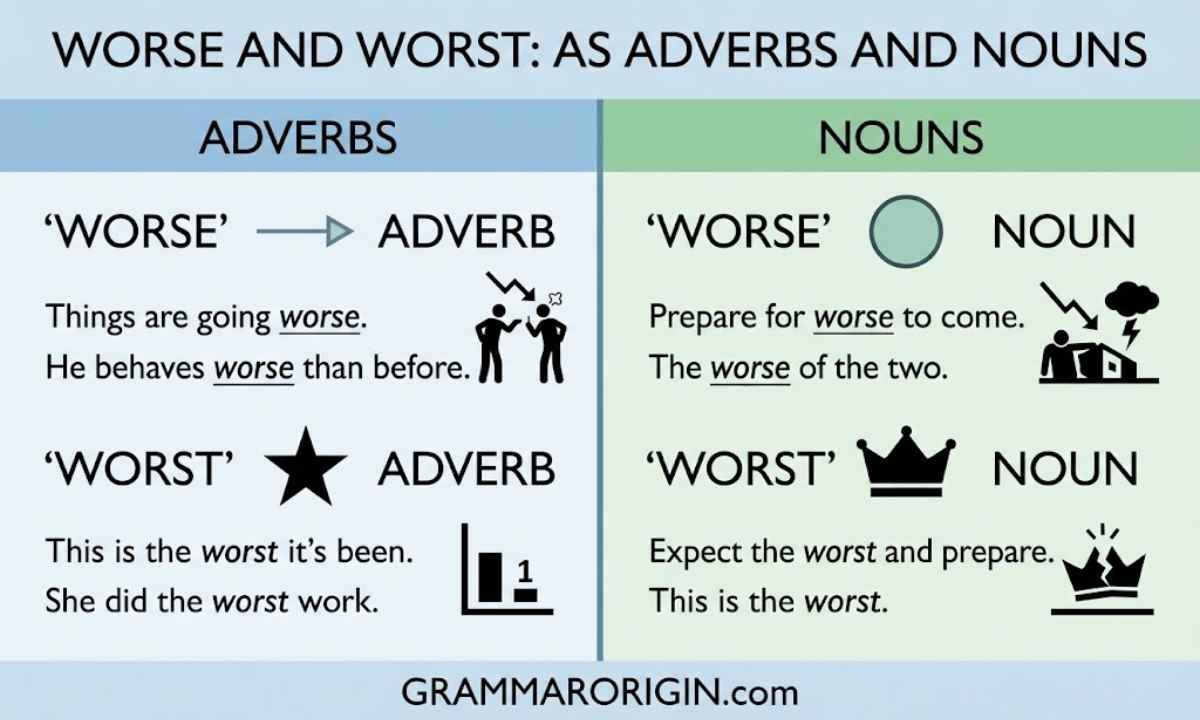
Both words also work as adverbs and nouns, not just adjectives. That surprises many learners, so a few examples help first.
Adverbs first:
- He plays chess worse than I do.
- The coast was worst hit by the storm.
Now as nouns:
- She feared the worst.
- The new schedule changed things for the worse.
- At worst, we’ll be ten minutes late.
As adverbs, they’re the comparative and superlative of “badly.” As nouns, “the worst” names the most unpleasant outcome, while “worse” points to something more unpleasant than before. Keep this in mind, because it’s why a rule like “worse is always an adjective” isn’t safe. A good worse or worst check looks at the whole sentence, not just the word’s job.
Key Differences Between the Words
The key difference is how many things you’re comparing. Worse compares two, and worst picks the extreme from three or more. That’s the heart of every worse or worst question.
Here are the four differences that matter most:
- Degree: “worse” is the comparative, and “worst” is the superlative.
- Signal word: “worse” pairs with “than,” while “worst” pairs with “the,” “of,” or “in.”
- Time: “worse” often shows a change over time (“getting worse”), but “worst” ranks things at one point.
- Idioms: “worse” appears in “turn for the worse,” and “worst” appears in “worst-case scenario.”
Look at how one letter changes the whole sentence:
- Today’s forecast is worse than yesterday’s.
- Today’s forecast is the worst of the week.
Comparison Table
Worse compares two things, while worst picks the lowest of a group. Here’s the worse or worst pair side by side.
| Feature | Worse | Worst |
| Form | Comparative of bad | Superlative of bad |
| Compares | Two things or two states | Three or more things |
| Signal word | than | the, of, in |
| Also works as | Adverb, noun | Adverb, noun |
| Example | My cold is worse than hers. | This is the worst cold I’ve had. |
Examples in Sentences
Full sentences make the pattern easy to spot. Read these out loud, and the right word usually sounds right. Each line answers a small worse or worst question.
Turn for the Worse
Use “turn for the worse” when a person, plan, or situation gets worse over time.
- The patient’s condition took a turn for the worse overnight.
- Talks took a turn for the worse when both sides stopped listening.
- Sales took a turn for the worse after the main client left.
- The road conditions took a turn for the worse as the snow thickened.
All four lines describe a change from better to worse, so the comparative fits. There’s no worse or worst doubt here.
Worst
The word “worst” shows up when something ranks last or hits the lowest point.
- That was the worst movie of the year.
- She had the worst headache of her life.
- Of the three hotels, this one is the worst.
- It was the worst storm the town had seen in decades.
Take a Turn for the Worse: Correct Verb Forms
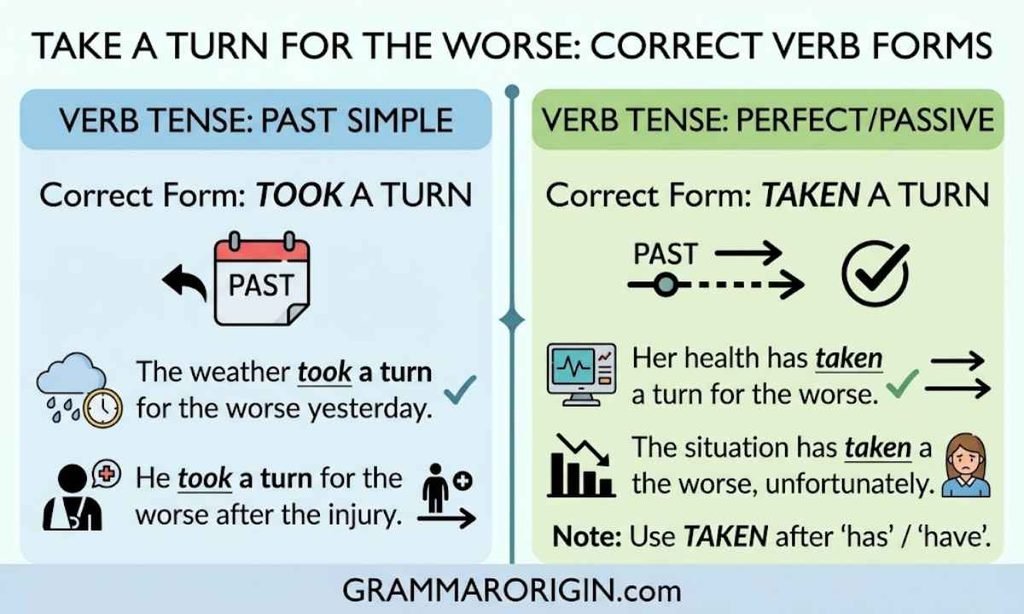
The standard idiom is “take a turn for the worse,” and the verb changes with the tense: take, took, taken. The opposite is “take a turn for the better.” It’s a fixed expression, so the wording stays the same.
Here’s how it looks across tenses:
- Present: His health takes a turn for the worse at night.
- Past: His health took a turn for the worse last week.
- Perfect: His health has taken a turn for the worse.
- Future: His health will take a turn for the worse without rest.
You’ll also see “turn for the worse” used after verbs like “have.” The verb form “turned for the worse” is less common and sounds less natural, so “took a turn for the worse” is the safer choice in clear writing. That settles the idiom side of worse or worst.
Also Read This Acception vs Exception: Meaning, Examples & Which Is Correct
Common Mistakes
Most mistakes come from using worst in a two-way comparison, using worse in a ranking, or mixing up the idioms. These five worse or worst slips show up the most.
Mistake 1. Using “worst” in the idiom.
- Incorrect: His health took a turn for the worst.
- Correct: His health took a turn for the worse.
The idiom talks about a change, so it takes the comparative.
Mistake 2. Using “worse” for a ranking.
The ranking needs “the,” which points to worst:
- Incorrect: Today is the worse day of my life.
- Correct: Today is the worst day of my life.
Mistake 3. Pairing “worst” with “than.”
- Incorrect: This movie is worst than the first one.
- Correct: This movie is worse than the first one.
The word “than” always calls for the comparative.
Mistake 4. Writing “worse case scenario.”
The standard phrase is worst-case scenario. “Worse case” only works when you compare two cases.
- Incorrect: Plan for the worse case scenario.
- Correct: Plan for the worst-case scenario.
Mistake 5. Double marking.
Words like “more worse” and “worser” are nonstandard today, because “worse” already means “more bad.”
- Incorrect: It got more worse every day.
- Correct: It got worse every day.
Tips to Remember the Difference
A few small tricks make worse or worst easy to sort. Pick the one that sticks for you.
1. The “st” trick. Worst ends in “st,” just like best, most, and least. All of them point to an extreme.
- This is the worst and the best I’ve seen in one day.
2. The “than” test. If “than” fits after the word, write worse.
Try it here:
- Her day was worse than mine. (than fits)
- Her day was the worst of all. (than doesn’t fit)
3. The count test. Two things means worse. Three or more means worst. It’s the fastest fix for a worse or worst doubt.
- Between tea and coffee, tea is worse for me.
- Among tea, coffee, and juice, juice is the worst for me.
4. The “better” mirror. “Worse” mirrors “better,” and both end in e. “Worst” mirrors “best,” and both end in st. So “for the worse” matches “for the better.”
Worse Than vs Worst Of: The Quick Test
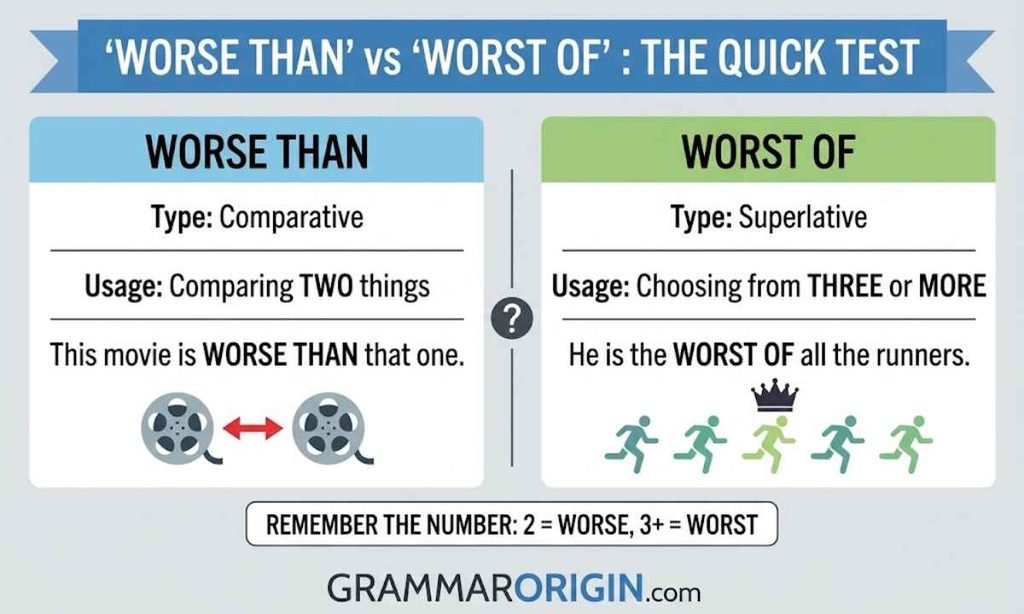
If you can add “than,” use worse. If you can add “of all” or “in the group,” use worst. This one test fixes most worse or worst mix-ups in under five seconds.
- This road is worse than the highway.
- This is the worst road in the county.
- Of all my homework, math was the worst.
There’s one wrinkle. Sometimes the “than” part is understood and left out, as in “Things got worse.” Nothing is being ranked there, so “worse” is still right. Ask yourself whether you’re comparing two states or choosing an extreme, and the answer follows.
When to Use Each Word
Use “worse” for two-way comparisons and for change over time, and use “worst” for the extreme. The idiom keeps the comparative. Your meaning decides every worse or worst choice.
Also Read This Acception vs Exception: Meaning, Examples & Which Is Correct
Use “Turn for the Worse” When:
Use it for a decline that happens over time.
- A person’s health gets worse.
- The weather turns bad.
- A project, deal, or plan starts to fail.
Two quick examples:
- The talks took a turn for the worse on Friday.
- Her mood took a turn for the worse after the call.
Use “Worst” When:
Use it when something ranks last or reaches the lowest point.
- You’re ranking three or more options.
- You’re describing the most severe case.
- You’re naming the lowest quality in a group.
For example:
- Of all the options, this plan is the worst of all.
- That’s the worst advice I’ve ever heard.
Grammar Rules
Worse and worst are irregular forms of bad, so they follow their own rules. Here are the four that matter for any worse or worst choice.
1. Worse takes “than.” The comparative sets one thing against another.
- My knee is worse than it was last week.
2. Worst takes “the.” The superlative usually follows “the,” because it picks one extreme.
- This is the worst hour of the day.
3. Don’t double mark. “More worse,” “most worst,” “worser,” and “worstest” are nonstandard. “Worser” shows up in older English, but it isn’t standard today.
- Incorrect: It’s more worse now.
- Correct: It’s worse now.
4. Pick the right intensifier. Use “much,” “far,” or “a lot” with worse. “Very worse” sounds wrong. With worst, “the very worst” is fine.
- The traffic is far worse today.
- It was the very worst day of the trip.
Synonyms or Related Words
Related words depend on the job: adjective, verb, or phrase. They can help you test a worse or worst choice, but they don’t always swap one for one, so check the sentence after you replace a word.
For “worse” (adjective): poorer, inferior, lesser, less favorable.
For “worst”: lowest, poorest, most severe, least favorable.
For “turn for the worse”: downturn, setback, decline, go downhill, take a bad turn.
For the verb idea of getting worse: worsen, decline, deteriorate. These go with “get worse,” not with the adjective itself.
Common related phrases include “from bad to worse,” “worse off,” “none the worse,” “worse for wear,” “for better or for worse,” and “the worst of both worlds.”
- Things went from bad to worse after the storm.
- It was the worst of both worlds.
is it worse or worst
Use “worse” when you compare two things, and use “worst” when you pick the lowest of three or more. That’s the whole answer to the worse or worst question.
Count the items first. Then check for “than.”
- Is a cold or a flu worse? (two things)
- Which is the worst: a cold, a flu, or food poisoning? (three things)
Idioms are the exception to the counting trick, because they’re fixed. “Turn for the worse” always keeps worse, and “worst-case scenario” always keeps worst.
worst case or worse case
“Worst case” is the standard form, and the full phrase is “worst-case scenario.” It means the most unfavorable outcome you can imagine. This phrase causes plenty of worse or worst mix-ups.
Add a hyphen when it comes before a noun, as in “a worst-case scenario.” Skip the hyphen when it stands alone, as in “in the worst case.”
- Plan for the worst-case scenario.
- In the worst case, the flight gets canceled.
“Worse case” is correct only when you compare two cases. For example, between two options, one is the worse case:
- Between the two plans, the second is the worse case.
The same logic works for “best-case scenario,” where “best” always wins.
If Worse Comes to Worst or If Worst Comes to Worst
Both versions are in use, and both mean “if the worst possible thing happens.” Usage guides list the two forms, so neither one is an error.
Since it’s an idiom, people don’t parse it word by word. Pick one version and stay consistent across your page. If you write for a publication, check its style guide first. It’s the one spot where the worse or worst rule bends.
- If worse comes to worst, we’ll sleep in the car.
- If worst comes to worst, we’ll sleep in the car.
worst or worse
Whichever order you type it in, the rule stays the same: worse for two, worst for three or more.
Many people search “worst or worse” when they’re mid-sentence and need a fast answer. A short pair of questions shows the difference:
- Which is worse, a cold or a flu?
- Which is the worst: a cold, a flu, or food poisoning?
If you’re still unsure about worse or worst, run the “than” test one more time. It rarely fails.
Final Thoughts
The worse or worst choice comes down to a count. Two things call for “worse,” and three or more call for “worst.” The idioms keep their own forms: “turn for the worse” and “worst-case scenario.”
Keep the “than” test and the “st” trick handy, and you’ll sort worse or worst in seconds.
Frequently Asked Questions
Is it worse or worst?
Use “worse” to compare two things and “worst” for the lowest of three or more. When you’re unsure about worse or worst, add “than” and see if it fits.
Is it “turn for the worse” or “turn for the worst”?
It’s “turn for the worse.” The standard idiom is “take a turn for the worse.” When worse or worst appears in this idiom, pick worse.
Is it worst-case or worse-case scenario?
It’s “worst-case scenario.” “Worse case” is correct only when comparing two cases.
Is it “if worse comes to worst” or “if worst comes to worst”?
Both versions are used and accepted. Pick one and stay consistent.
Can “worse” and “worst” be adverbs or nouns?
Yes. “Worse” and “worst” can be adverbs (“plays worse”) and nouns (“feared the worst”).
Is “worser” a word?
“Worser” is nonstandard today. Use “worse” instead.

Muhammad Waqas is an English language teacher and grammar expert with over 8 years of experience helping students and professionals improve their writing skills. He specializes in English grammar, vocabulary, communication, and practical language learning. Through GrammarOrigin, Waqas shares clear, easy-to-understand content that helps readers write and speak English with confidence.