
A Lot or Alot comes down to one space: a lot is correct, and alot is a spelling mistake. The phrase is always two words, in the UK, the US and everywhere else English is written.
This guide explains the grammar, the difference from allot, and easy tricks to remember the rule. You’ll also find real examples, stronger alternatives and a true story about how “alot” became an internet joke.
What Does “A Lot” Mean?
A lot means a large amount or number, or very much and very often. It’s two words, an article plus a noun, and it fits almost any kind of sentence.
The same two words can name a quantity, describe how often something happens, or show how big a change is. The next sections show each use.
Examples of “A Lot” in Sentences
Here are four everyday sentences, each using a lot in a slightly different way.
I drink a lot of tea when I work late.
She learned a lot from her first job.
We walk a lot on weekends.
They spent a lot of time fixing the old boat.
Notice how flexible the phrase is. In the first and last lines it names an amount. In the middle lines it shows what you learned and how often you walk.
Quick Meaning Table
The meaning shifts a little with the sentence. This table gives the short version.
| Phrase | Meaning | Example |
| a lot of noise | A large amount | The street had a lot of noise. |
| sleeps a lot | Very often | My dog sleeps a lot. |
| a lot taller | Much more | He’s a lot taller now. |
Is “Alot” a Real Word?
No. Alot isn’t a word in standard English. It’s a misspelling of a lot, and spell checkers flag it right away.
You won’t find it as a normal entry in standard dictionaries, so the dictionary side of the A Lot or Alot question is simple. One newspaper columnist joked that the only time it counts is as a capitalized place name, a town in India.
Right: I like this song a lot.
Wrong: I like this song alot.
Everywhere else, the single-word version is just a typo that looks believable.
Correct vs Incorrect Usage
Only the two-word form is correct. The one-word form with a single l is wrong, and the spelling with two l’s is a different word entirely.
| Version | Correct? | Notes |
| a lot | Yes | Standard English, two words |
| alot | No | Misspelling |
| allot | Yes | A different verb, covered below |
One missing space, or one extra letter, changes everything.
Why So Many People Write “Alot”
Because we say it as one smooth sound, and our eyes then expect one word. That’s why the A Lot or Alot mix-up is so common, and a few other things add to it.
First, the stress falls on “lot”, so “a” gets squeezed into it: uh-LOT. Second, “lot” rarely appears alone, so it feels glued to the “a” in front of it.
Third, real English has a few one-word forms that began as “a” plus a word, such as ahead, aside and awhile. That makes alot look like it belongs to the family, but it doesn’t.
Careful with awhile, too. It’s an adverb (“stay awhile“), while “for a while” is a noun phrase, so that one is a different space question.
The Internet Made It Worse
Fast typing and texting spread the error, because people copy what they see. The more often you see a mistake, the more normal it looks, and the A Lot or Alot confusion keeps growing.
You’ll find the one-word spelling in text messages, social media captions and comment sections. A spell checker or autocorrect often catches it, but not always.
Popular doesn’t mean correct. A typo repeated a million times is still a typo.
The Grammar Behind “A Lot”
A is an indefinite article and lot is a noun, so the pair is a noun phrase that stays two words. That’s the whole rule behind A Lot or Alot.
Grammar books call the phrase a quantifier when it shows an amount. It can also work as an adverb (“it helps a lot“) or as a pronoun (“I learned a lot“).
Breaking It Down
Here’s how the parts work in a sentence.
| Part | Job | Example |
| a | Indefinite article | a lot of friends |
| lot | Noun | a lot of friends |
| a lot | Quantifier, adverb or pronoun | I laughed a lot. |
Think of other article-plus-noun phrases, like “a pile” or “a stack”. You’d never merge those, and the same logic keeps a lot apart.
Other Meanings of “Lot”: Land, Auctions and Parking Lots
Lot also means a piece of land, an item sold at an auction, or a share of something. That’s why it can stand alone as a noun, and why it needs its own space.
You see the land meaning in parking lot and vacant lot. At an auction, each item up for sale is a lot, as in “Lot 14 is a set of antique chairs.”
The older idea of a share comes from drawing lots, an old way of making a choice. It lives on in phrases like “a person’s lot in life.”
“A Lot” vs “Allot” Explained Clearly
A lot means a large amount. Allot is a verb that means to give out a share. They sound almost the same, but they’re different words with different jobs.
Right: She has a lot of free time.
Wrong: She has allot of free time.
If you can swap in “plenty” or “much”, you want a lot. If you can swap in “assign” or “hand out”, you want allot.
Meaning of “Allot”
Allot means to hand out or set aside a share of something, such as time, money or tasks. Common synonyms are assign, distribute and set aside.
The two words are even cousins. Allotting something once meant giving it out by lot, so the idea of a share sits inside both.
Examples of “Allot”
The coach will allot each player ten minutes on the field.
The council allotted more space to the weekend market.
We allot one evening a week to cleaning.
In each sentence, someone is giving out a share of time or space, which is the clue that you need allot.
Side-by-Side Comparison
The table below puts the two words side by side, so the A Lot or Alot confusion is easier to sort out.
| Word | Part of speech | Meaning | Example |
| a lot | Noun phrase, adverb or pronoun | A large amount | We saved a lot of money. |
| allot | Verb | To give out a share | They allot funds each spring. |
Autocorrect sometimes swaps one for the other without warning, so read your sentence once more before you send it.
A Lot vs Allot Pronunciation
They’re said almost the same way: uh-LOT. Only the spelling and the sentence tell them apart.
In American English both are close to /əˈlɑːt/, and in British English both are close to /əˈlɒt/. When you speak, context does the work. When you write, spelling does.
I’ll allot the seats.
I have a lot of seats.
Two sentences, one sound, two meanings.
Allot Verb Forms: Allotted, Allotting and Allotment
Allot doubles its t before an ending: allotted and allotting. The noun allotment is the share that gets handed out.
The t doubles because the stress falls on the last syllable and the word ends in a single vowel plus a consonant. The verb admit works the same way: admitted, admitting.
| Form | Example |
| allot | We allot two hours for review. |
| allots | She allots the tasks each morning. |
| allotted | He allotted extra time for questions. |
| allotting | They’re allotting rooms to the guests. |
| allotment | Each family got an allotment of land. |
When to Use “A Lot” in Sentences
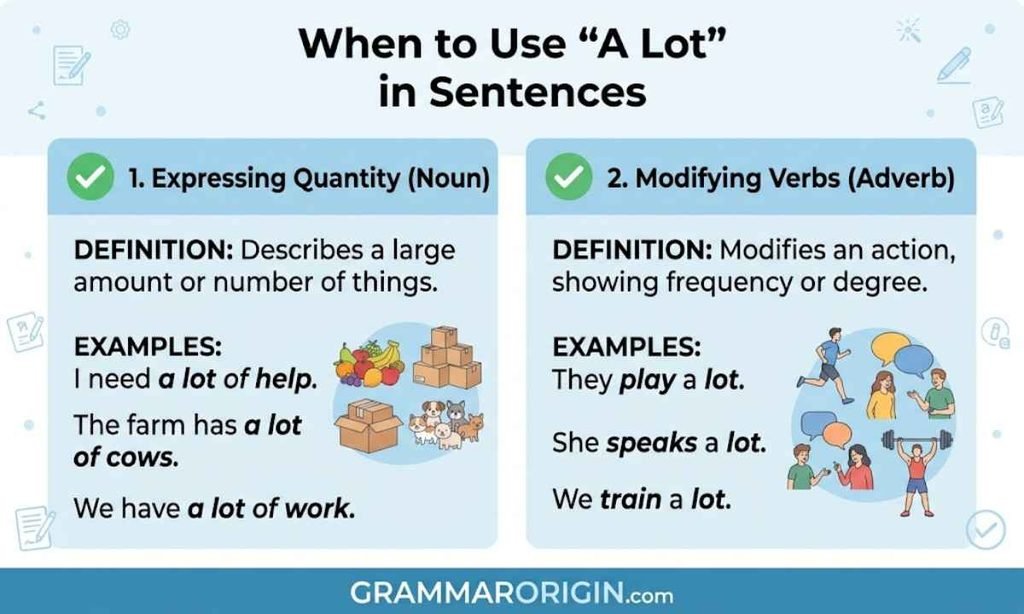
Use a lot with plural nouns, with uncountable nouns, and as an adverb after a verb. Each use keeps the two-word spelling.
Let’s go through them one at a time.
Using “A Lot” With Countable Nouns
Countable nouns are things you can count one by one, like chairs, ideas or neighbors. With them, a lot of means a large number.
Because the noun is plural, the verb is plural too: “A lot of neighbors are coming.”
Examples
We sold a lot of tickets.
She owns a lot of hats.
They received a lot of applications.
Using “A Lot” With Uncountable Nouns
Uncountable nouns are measured as a mass, such as water, patience or noise. With them, a lot of means a large amount.
The job needs a lot of patience, and it sounds natural because patience can’t be counted in ones and twos.
Examples
He drinks a lot of water.
The class gained a lot of confidence.
There was a lot of noise outside.
Read More Worse or Worst: Which Is Correct? Meaning, Rules & Examples
Using “A Lot” as an Adverb Phrase
When a lot follows a verb or sits before a comparison, it works as an adverb. It describes how often or how much.
I laugh a lot around my cousins. That’s frequency.
She feels a lot better today. That’s degree.
Examples
My brother travels a lot for work.
The new route is a lot faster.
They argue a lot online.
“A Lot of” With Verbs: Singular or Plural?
Match the verb to the noun after of. A plural noun takes a plural verb, and an uncountable noun takes a singular verb.
A lot of people are waiting outside.
A lot of time is wasted in meetings.
When a lot stands alone as a pronoun, it takes a singular verb: “A lot has changed since then.”
“A Lot” vs “Lots of” vs “Plenty of”
All three mean a large amount. A lot of is the neutral choice, lots of is more casual, and plenty of suggests more than enough.
We have a lot of options.
We have lots of options, so don’t worry.
We have plenty of options to choose from.
In formal writing, pick a lot of or a more exact word. Save lots of for friendly, relaxed writing.
Why Professional Writers Sometimes Avoid “A Lot”
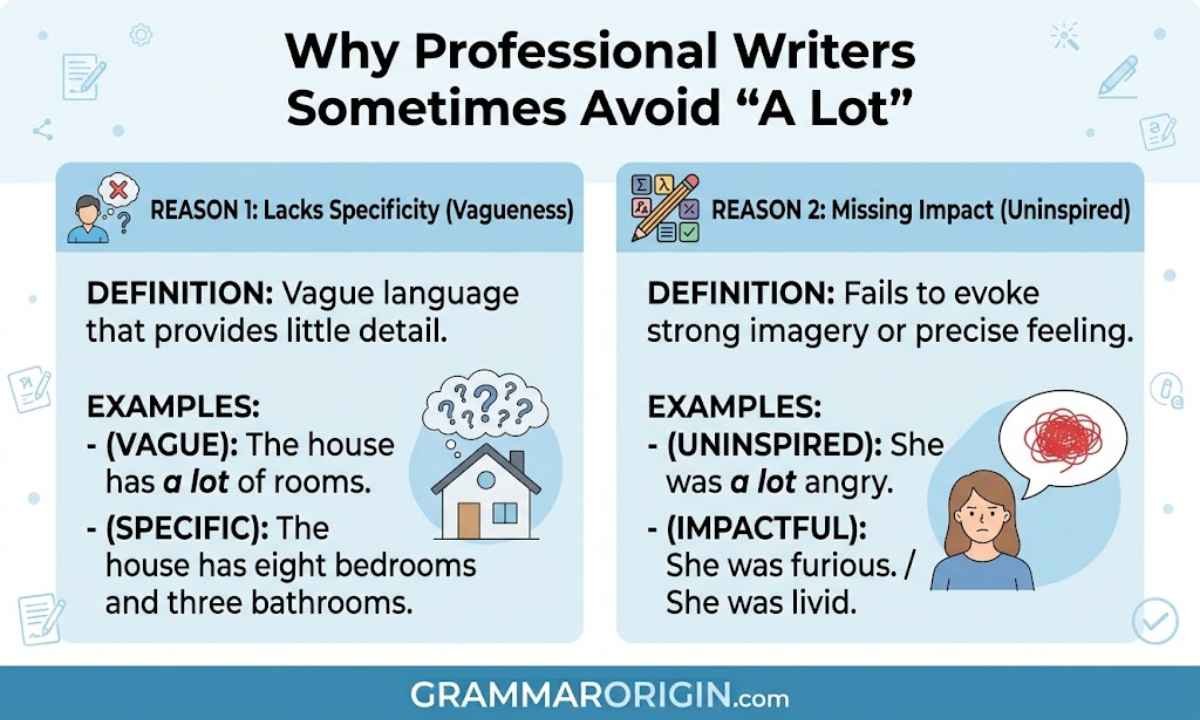
Because it’s vague. In reports and essays, an exact word says more than a lot does, so editors often swap it out.
Vague: The study found a lot of problems.
Exact: The study found twelve problems.
Using it isn’t an error. It just doesn’t tell the reader how much.
Better Alternatives Depending on Context
Match the replacement to what you really mean. The table shows common swaps.
| Casual phrase | Stronger choice |
| a lot of customers | many customers |
| a lot of noise | constant noise |
| a lot of data | extensive data |
| a lot cheaper | far cheaper |
| a lot of help | real support |
Don’t ban the phrase completely. Too much editing can make writing sound stiff, and a natural voice matters too.
Common Mistakes Writers Make With “A Lot”
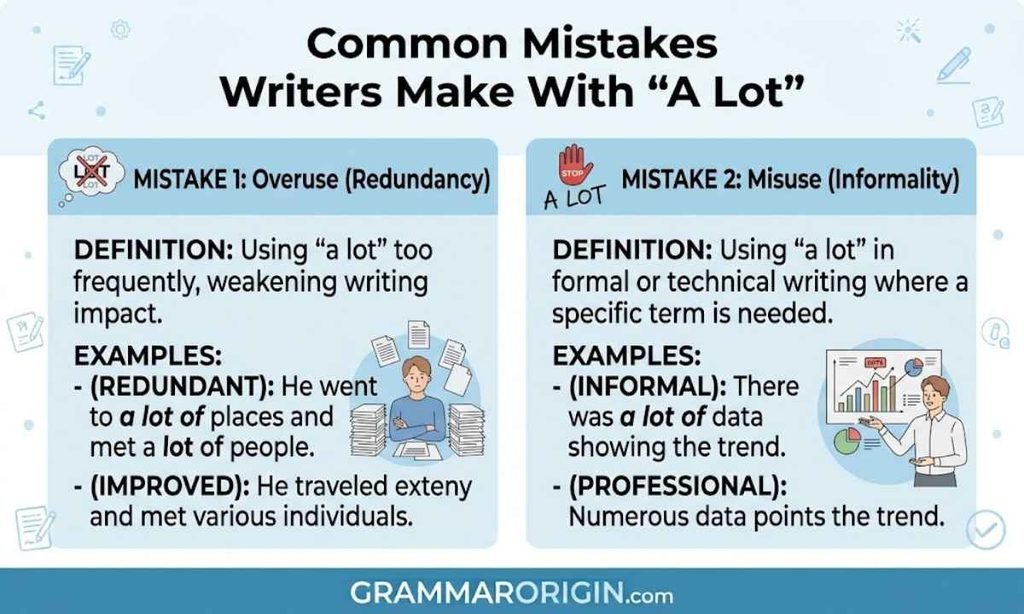
The big three are writing it as one word, mixing it up with allot, and using it too often. All three are easy to fix.
Combining the Words
The most common mistake in A Lot or Alot is gluing the words together. The fix is to put the space back.
Wrong: Thanks for alot of help.
Right: Thanks for a lot of help.
Confusing It With “Allot”
Some writers type the verb when they mean the phrase, often because of autocorrect.
Wrong: We have allot of choices.
Right: We have a lot of choices.
Overusing “A Lot”
Repeating the phrase makes sentences flat. Vary the wording and your writing gets more lively.
Example of Weak Writing
She has a lot of ideas, a lot of energy and plans for a lot of projects.
Improved Version
She brims with ideas and energy, and she has plans for several projects.
Same meaning, with more rhythm and no repeats.
Using It in Highly Formal Writing
In formal writing, use an exact word where you can. Words like considerable, substantial and extensive sound more precise.
Casual: There was a lot of support for the plan.
Formal: There was considerable support for the plan.
Is “Alot” Ever Acceptable?
Not in standard writing. It only appears on purpose, in jokes, memes or a character’s texting style.
Some writers use it for fun, and that’s fine in a casual post. It still isn’t correct English, and it should never appear in an essay, email to a client or job application.
Fiction and Stylized Writing
In fiction, a writer may spell it alot on purpose to show how a character types. That’s a style choice, not a mistake.
“sooo tired, alot of homework lol,” Mia texted.
The error shows Mia’s voice. In your own professional writing, the same spelling would just look careless.
How Teachers and Editors Treat “Alot”
They mark it as an error every time. Editors read for patterns, so a misspelled common word stands out quickly. Getting A Lot or Alot right is an easy way to avoid that.
Some teachers go further. One English teacher says she puts it on a banned-words list and asks students to search for it before turning in a paper.
Why Correct Spelling Improves Credibility
Readers judge how careful you are by the small things. Clean spelling signals that you checked your work.
One slip rarely ruins a piece, but repeated slips add up. Readers start to wonder what else you missed.
Academic and Business Standards
Schools and workplaces expect a lot with a space in essays, emails, reports, resumes and applications. There’s no exception for informal business writing either.
When in doubt, read your sentence aloud and check the space before sending.
Easy Tricks to Remember “A Lot”
Think of a lot as two separate words, just like a car or a bunch. These three tricks settle A Lot or Alot for good.
The “A Car” Trick
You’d never write acar or acup, so don’t write alot.
I parked a car in the lot.
I saw a lot of cars in the lot.
The article “a” always stays apart from the noun after it.
The “A Bunch” Comparison
If you wouldn’t write abunch or alittle, you shouldn’t write alot. All three are the same pattern.
Right: We bought a bunch of grapes.
Right: We bought a little juice.
Right: We bought a lot of snacks.
Visual Memory Trick
Picture a parking lot. “A” and “lot” each take their own space, and there’s a gap between them.
a lot
If you can see the gap in your mind, you’ll write it on the page.
Real-World Examples of “A Lot” in Everyday English
A lot appears in every kind of writing, from emails to ads. Here are samples by setting.
In Emails
I got a lot of replies after the first message went out.
In Business Communication
The new feature saved us a lot of time this quarter.
In Casual Conversation
I think about that movie a lot.
In Academic Contexts
The team gathered a lot of survey data before writing the report.
In Marketing
Shoppers read a lot more reviews before they buy online.
You’ll hear and read the phrase many times a day, which is exactly why the spelling confusion sticks around.
“A Lot” in American vs British English
No difference. In A Lot or Alot, both American and British English choose a lot, and neither accepts alot. This isn’t a case like color and colour.
Spelling pairs such as organize and organise do split by region. This one doesn’t.
British speakers often say lots of or “the lot” more freely, but the spelling of a lot stays the same on both sides of the Atlantic.
We’ve got a lot of work to do.
That sentence is correct in London, New York and Sydney.
Why This Tiny Grammar Rule Actually Matters
Because tiny spelling slips make readers doubt the rest of your writing. Most people scan, so a small error can break their focus.
A missing space looks small, but it affects how professional, trustworthy and polished your writing feels. Getting A Lot or Alot right is a small step with a real payoff.
SEO and Content Quality
Clean writing helps readers trust a page and stay on it. Search engines can usually read around a typo, but a misspelled word in a title or heading looks careless to the people you want to reach.
Good content quality comes from accuracy, clear structure and readable sentences. Getting a lot right is a small part of that.
Case Study: How Small Grammar Errors Affect Perception
A real example is Allie Brosh’s comic about “alot”, which turned a common spelling error into an internet joke. It shows how noticeable a tiny mistake can be.
Brosh started her blog Hyperbole and a Half in 2009. Her comic “The Alot Is Better Than You at Everything” appeared on April 13, 2010, and it introduced an imaginary creature called the Alot.
NPR’s Fresh Air later described the a lot versus alot mix-up as one of her favorite grammatical mistakes, and her first book came out in October 2013.
The lesson from the A Lot or Alot story is simple. Readers do notice this spelling, and some notice it so strongly that it becomes a joke. If your goal is to be taken seriously, the safest choice is the two-word spelling.
Read More Worse or Worst: Which Is Correct? Meaning, Rules & Examples
Better Alternatives to “A Lot” for Stronger Writing
Pick the word that matches what you mean: a number, how often, or how strong. Each type has its own swaps.
Quantity Alternatives
| Instead of | Use |
| a lot of questions | many questions |
| a lot of rain | heavy rain |
| a lot of space | plenty of space |
| a lot of items | dozens of items |
Frequency Alternatives
| Instead of | Use |
| visits a lot | visits often |
| calls a lot | calls regularly |
| worries a lot | worries constantly |
| reads a lot | reads every day |
Intensity Alternatives
| Instead of | Use |
| a lot hotter | far hotter |
| a lot easier | much easier |
| a lot louder | noticeably louder |
Mix these in where they fit, and keep a lot where it sounds natural.
Quotes About Clear Writing and Grammar
Two short, well-known writing rules explain why exact words beat vague ones. Both are easy to apply to this topic.
William Strunk Jr. and E. B. White, in The Elements of Style, gave this advice: “Omit needless words.”
That’s a good test for a sentence full of vague amounts. If a lot of adds nothing, cut it or use an exact number.
George Orwell, in his essay “Politics and the English Language,” wrote: “Never use a long word where a short one will do.”
A lot is short and plain, so it’s often fine. The goal isn’t to fancy up your writing, only to be clear and correct.
Thanks alot or a lot
It’s thanks a lot, always two words. In this phrase a lot works as an adverb meaning very much.
Right: Thanks a lot for the ride home.
Wrong: Thanks alot for the ride home.
Tone changes the feeling, though. Said warmly, thanks a lot is real gratitude. Said with a flat voice after something goes wrong, it can be sarcastic.
Thanks a lot for spilling coffee on my notes.
If you want a different phrase, try “thanks so much” or “thanks a bunch.”
Summary
The A Lot or Alot question has one answer: a lot, two words, with a space between them. Alot is a typo, and allot is a separate verb about giving out shares.
Remember the parking lot picture, and keep the “a” apart from the noun. A quick check before you send takes one second and keeps your writing clean.
Frequently Asked Questions
A lot or alot: which one is correct?
It’s a lot, written as two words. Alot is a spelling mistake.
Is alot a word?
No. Alot isn’t a word in standard English. It’s a common misspelling of a lot.
What is the difference between a lot and allot?
A lot means a large amount. Allot is a verb that means to give out a share.
Is it thanks alot or thanks a lot?
It’s thanks a lot. Here a lot is an adverb that means very much.
Is “a lot of” singular or plural?
It depends on the noun after of. Say “a lot of people are” and “a lot of time is.”
Can I use “a lot” in formal writing?
Yes, but an exact word is often stronger. Try many, several, considerable or an exact number.

Muhammad Waqas is an English language teacher and grammar expert with over 8 years of experience helping students and professionals improve their writing skills. He specializes in English grammar, vocabulary, communication, and practical language learning. Through GrammarOrigin, Waqas shares clear, easy-to-understand content that helps readers write and speak English with confidence.