
Use family’s for something that belongs to one family, and families when you mean more than one. The apostrophe is the only thing separating them.
Choosing between family’s or families trips up native speakers too, because the two words sound exactly alike. This guide gives you the rules, real examples, and quick checks so you never second-guess it again.
Quick Answer
Family’s is the possessive form and points to one family. Families is the plain plural and means more than one family.
Example: The family’s house is on the corner, and the families next door share a fence.
There’s also a third form, families’ (apostrophe after the s), which shows that several families own something together.
Meaning and Definition of Family’s or Families
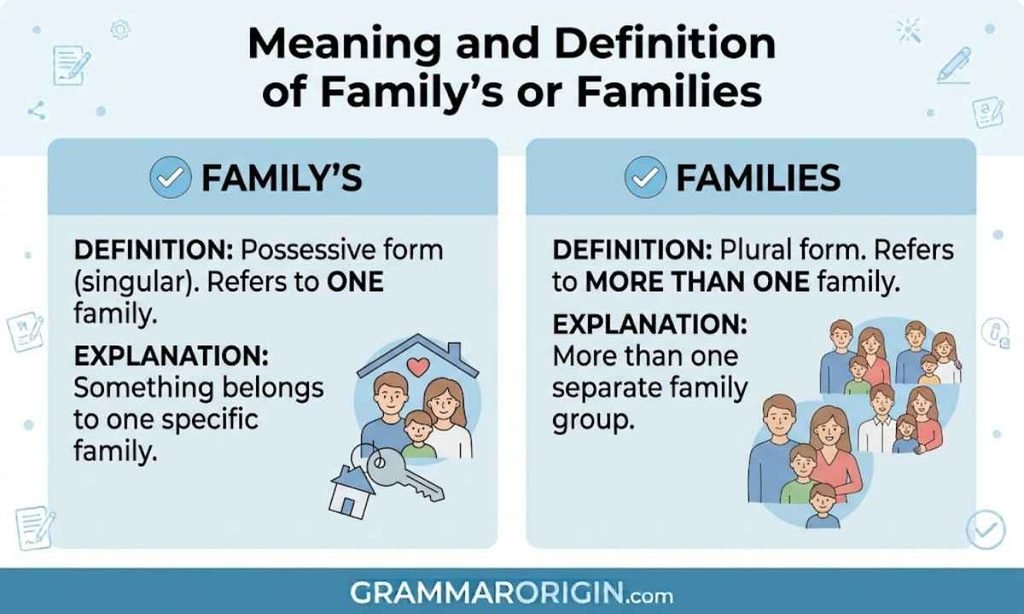
Family’s is the possessive of family, while families is its plural. Both grow out of the same noun, but they do very different jobs in a sentence.
Example: The family’s recipe is famous, and many families have asked for a copy.
1. Family’s
Family’s shows that something belongs to, or is connected with, one family. You build it by adding an apostrophe and s to the singular noun.
It works for objects, decisions, and qualities alike: the family’s dog, the family’s decision, the family’s reputation.
Example: The family’s reputation in town goes back three generations.
2. Families
Example: Three families share the courtyard behind the building.
Families simply means more than one family. There’s no apostrophe because nothing is being owned.
The spelling follows a standard pattern: when a word ends in a consonant plus y, the y becomes ies. That’s why family turns into families.
Key Differences Between Family’s and Families
The difference comes down to ownership and number. Family’s talks about one family and what it has; families counts several families.
- Job: family’s shows possession, families shows quantity.
- Number: family’s refers to one family, families to two or more.
- Apostrophe: family’s needs one, families doesn’t.
Example: Compare “the family’s tickets” (one family owns them) with “the families’ tickets” (several families own them) and “the families bought tickets” (just a count).
Comparison Table: Family’s vs Families
Here’s the whole picture in one place, including the plural possessive that people often forget.
| Form | Type | What it means | Example |
| Family’s | Singular possessive | Belongs to one family | The family’s car is new. |
| Families | Plural noun | More than one family | Many families live here. |
| Families’ | Plural possessive | Belongs to several families | The families’ gardens are lovely. |
Example: The families’ kids play outside while the family’s dog watches from the porch.
Family’s or Families Pronunciation (Homophones)
Family’s, families, and families’ are pronounced the same way: roughly FAM-uh-leez, or FAM-leez in quick speech. They’re homophones, so your ear can’t tell them apart.
That’s exactly why the mix-up shows up in writing but almost never in conversation. Only spelling carries the meaning.
Example: Say “the family’s house” and “the families house” out loud. They sound identical, so only the apostrophe tells your reader what you mean.
Family’s or Families Possessive
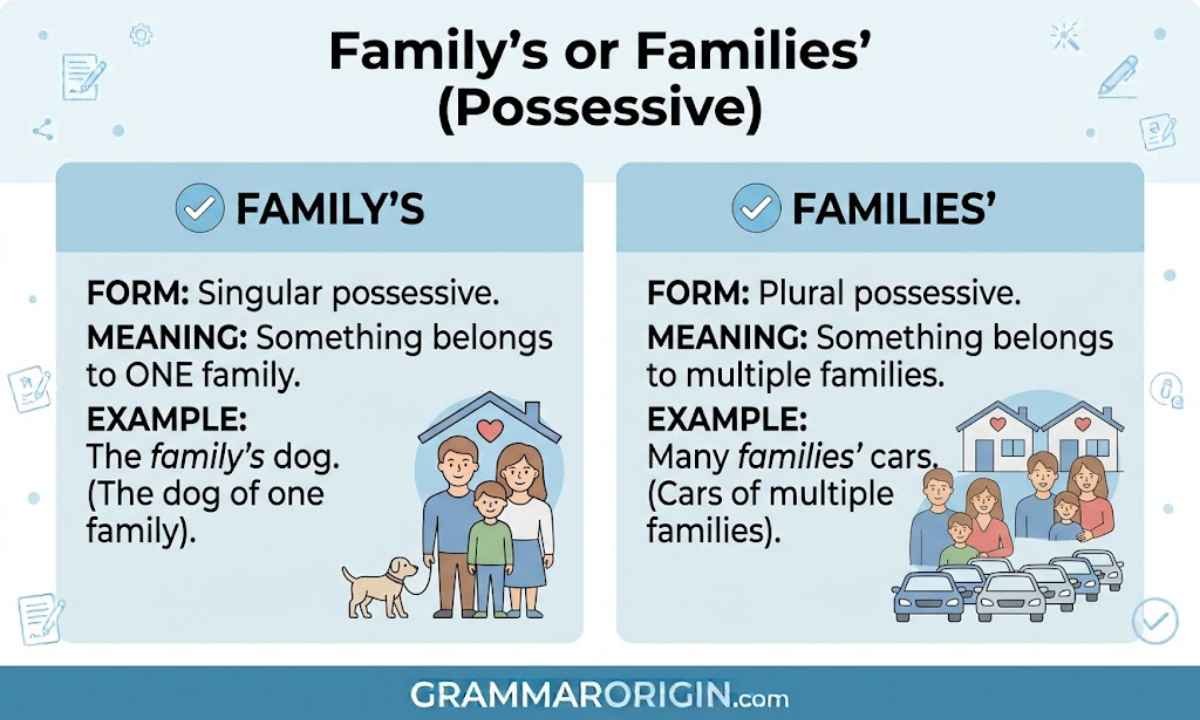
For ownership, use family’s with one family and families’ with several. Plain families, with no apostrophe, never shows possession.
Example: The family’s boat, the families’ boats, and the families on the dock are three different ideas.
Family’s (Singular Possessive)
Family’s shows that one family owns or has something. Add an apostrophe and s to the singular noun.
Example: The family’s garden wins a prize every spring.
Families’ (Plural Possessive)
Families’ shows that several families share or own something. Because families already ends in s, you add only the apostrophe.
Example: The families’ children walk to school together every morning.
Important Note
Example: Wrong: “The families house is blue.” Right: “The families’ house is blue.”
Families on its own can’t be possessive. When you spot a plural noun sitting in front of the thing it owns, an apostrophe is missing.
Quick Rule
One family owns it, write family’s. Several families own it, write families’. You’re only counting families, write families.
Example: “The family’s rule” (one family), “the families’ rule” (several), “two families” (a count).
Family Names: the Smiths’ vs the Smith Family’s
To make a surname plural, add s (the Smiths). To show ownership, add an apostrophe after that s (the Smiths’ house). Never add an apostrophe just to make the name plural.
Names ending in s, x, z, ch, or sh take es first: the Joneses, the Joneses’ garden. You can also write “the Smith family’s house,” which uses the singular possessive because family is singular.
Example: “The Garcias’ porch light is on” means the whole household owns that porch.
Family’s as a Contraction (Family Is / Family Has)
Example: “The family’s moving next week” means the family is moving. “The family’s already left” means the family has already left.
Sometimes the ‘s after family has nothing to do with ownership. It’s a shortened “is” or “has.”
Expand it to check. If “family is” or “family has” fits the sentence, it’s a contraction. If “of the family” fits, it’s a possessive.
Is it “Sorry for Your Family’s Loss” or “Families Loss”?
Say “sorry for your family’s loss.” It’s correct when you’re speaking to one person about their family, and “families loss” is wrong because it drops the apostrophe.
Example: “I’m so sorry for your family’s loss” fits a card, a text, or a quiet moment at a funeral.
Correct Usage
“Sorry for your family’s loss” is correct for one person or one family. Use “your families’ loss” only when you’re writing to people from several different families, like a shared community message.
Example: A message to several grieving households can say “We’re sorry for your families’ loss,” because the loss is shared across all of them.
Incorrect Usage
“Sorry for your families loss” and “sorry for your families’s loss” are both incorrect. The first lacks the apostrophe, and the second adds a needless extra s.
Example: Wrong: “We’re sorry for your families loss.” Right: “We’re sorry for your family’s loss.”
Simple Explanation
The loss belongs to the family, so you need the possessive form. If it’s one family, that’s family’s.
A quick test helps: rewrite it as “the loss of the family.” If that makes sense, you need the apostrophe.
Example: “The loss of your family” becomes “your family’s loss.”
Example Sentences
These sentences all use family’s correctly, because the loss belongs to one family.
- Example: We were heartbroken to hear about your family’s loss.
- Example: Please accept my sincere condolences on your family’s loss.
- Example: The whole team shares in your family’s loss today.
- Example: Our hearts go out to you and your family’s loss this week.
Examples in Sentences (Family’s or Families)
Family’s appears when one family owns something. Families appears when you’re counting or talking about family groups in general.
Example: Her family’s bakery sits between two shops run by other families.
Using Family’s (Possessive)
Use family’s whenever one family owns, has, or is linked to the thing that follows.
Example:
- The family’s vacation was cut short by the storm.
- My friend’s family’s business opened a second branch.
- The family’s dinner was ready by six.
- The family’s history is carved into the old stone wall.
- Everyone admired the family’s kindness after the flood.
Using Families (Plural)
Use families when you mean more than one family and nothing belongs to them.
Example:
- Several families moved into the area last year.
- Families often gather for holidays.
- Many families prefer quiet streets.
- Different families keep different customs.
- Families lined up early for the festival.
Family’s or Families Quiz – Test Your Grammar Skills
Pick family’s, families, or families’ to fill each blank. It takes about a minute and covers all three forms.
Example: “The ____ car is parked outside.” The answer is family’s, because one family owns the car.
Quick Quiz Idea
Fill each blank with family’s, families, or families’, then check your answers underneath.
Example:
- The ____ dog barks at every visitor.
- Several ____ attended the school fair.
- Both ____ cars were parked in the driveway.
- The ____ moving to a new city next month. (Hint: it’s a contraction.)
- I was sorry to hear about your ____ loss.
- Many ____ prefer to travel in summer.
Answers: 1. family’s. 2. families. 3. families’. 4. family’s (family is). 5. family’s. 6. families.
Common Mistakes (Family’s or Families)
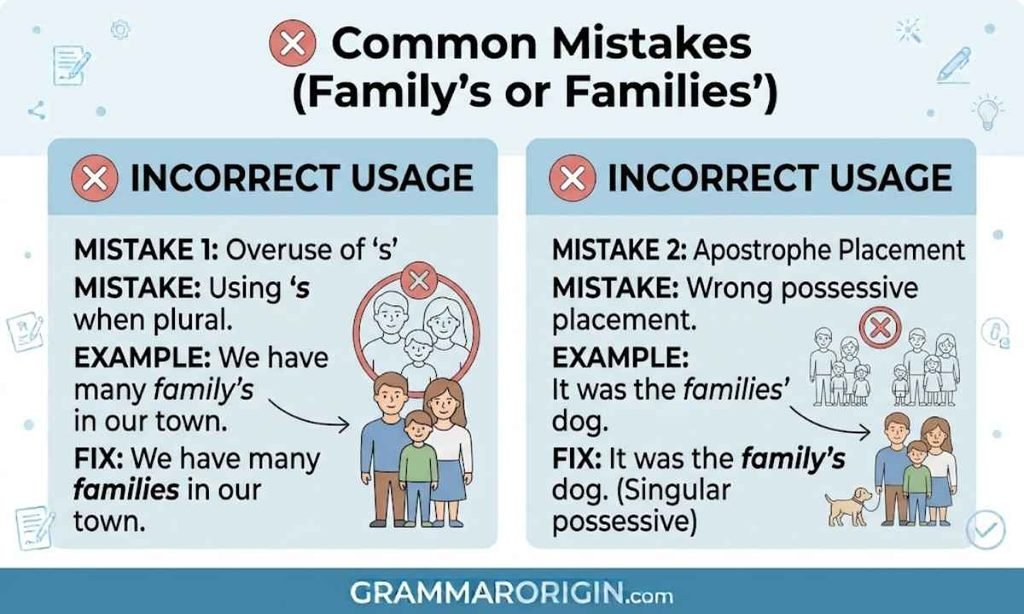
Most errors come from adding an apostrophe to a plain plural or leaving it off a possessive. A few come from plain misspelling.
Example: “Many family’s came” adds an apostrophe where none belongs; “many families came” is correct.
Incorrect vs Correct
Each wrong sentence below breaks one simple rule, listed in the last column.
| Incorrect | Correct | Why |
| Many family’s attended the event. | Many families attended the event. | Plural, no ownership |
| The families car is new. | The family’s car is new. | One family owns it |
| All family’s traditions differ. | All families’ traditions differ. | Several families own them |
| Familys | Families | Consonant + y becomes ies |
| Families’s | Families’ | Plural ending in s takes only an apostrophe |
| Sorry for your families loss | Sorry for your family’s loss | Loss belongs to one family |
Example: Wrong: “The familys’ houses are close.” Right: “The families’ houses are close.”
Important Note: Families’ (Plural Possessive)
Families’ shows that something belongs to several families. The apostrophe goes after the s, never before it.
Example: The families’ meeting starts at noon.
Our Families or Our Family – What’s the Correct Usage?
Use our family for one family unit and our families for more than one. Both are correct, but they point to different things.
Example: Our family loves camping, but our families rarely agree on where to go.
Our Family (Singular Meaning)
Our family describes one household or one group of relatives you share. The word is treated as a single unit.
Example: Our family eats dinner together every Sunday.
Our Families (Plural Meaning)
Our families works when each person in the group belongs to a different family. Think of two friends, or a couple meeting each other’s relatives.
Example: Our families are meeting for the first time at the wedding.
Quick Difference
Example: “Our family is close” talks about one group. “Our families are close” talks about two or more.
One unit is our family. Several units are our families.
Simple Tip
Ask yourself how many families you’re really talking about. If the answer is one, write family. If it’s two or more, write families.
Example: Two coworkers say “our families” when they plan a joint picnic, because each has their own.
Is “Family” Singular or Plural?
Family is singular in form. American English usually pairs it with a singular verb, while British English often allows a plural verb when the members act as individuals.
Example: “My family is close” is the standard American choice. “My family are all coming for dinner” is common in British English.
Both are acceptable in their regions. Just stay consistent inside one piece of writing.
Read More A Lot or Alot Explained: Correct Spelling, Meaning & Examples
Remember the Difference (Family’s or Families)
Three quick checks settle most doubts: look for the apostrophe, ask a question, and swap the word. Each takes a second.
Example: In “the family’s plans,” you can see the apostrophe and know one family owns the plans.
1. Look for the Apostrophe
An apostrophe before the s usually signals ownership of one family. No apostrophe means a plain plural.
Example: “The family’s room” has ownership. “Two families” doesn’t.
2. Ask a Question
Ask whether something belongs to the family, or how many families you mean. The answer points straight to the right form.
Example: “Whose car?” The family’s. “How many groups?” Two families.
3. Replace with Another Word
Swap family with team or dogs. If “team’s” or “teams” fits the sentence the same way, you’ve picked the right form.
Example: “The family’s rules” becomes “the team’s rules,” and “many families” becomes “many teams.” Both swaps work.
Your Families: Meaning and Usage Explained
Your families means more than one family connected to the people you’re addressing. Use it when you’re writing to a group.
Example: “Thank you and your families for joining us today.”
Meaning of “Your Families”
It’s the plural of your family, used when several people each have their own. It treats the group as a set of separate households.
Example: “We hope you and your families stay safe this season.”
When to Use “Your Families”
Use it in school notices, company emails, and community messages that go to many readers at once. Skip it when you’re talking to just one person about one household.
Example: A principal writing to all parents says “your families,” while a friend texting one person says “your family.”
Examples in Sentences
Your families works in greetings, announcements, and thank-you notes aimed at a group.
Example:
- I hope your families are doing well during the holidays.
- We welcome you and your families to the open day.
- Please share this message with your families.
- Your families’ support made this possible.
Important Note
Your family and your families are different. The first points to one household, the second to several.
Example: “Your family’s support” (one household) versus “your families’ support” (several households).
When to Use Each Word (Family’s or Families)
Use family’s for ownership by one family and families for a plain plural. Add the apostrophe after the s when several families share something.
Example: “The family’s car,” “the families next door,” and “the families’ street party” show all three.
Use “Family’s” When:
Choose family’s when the sentence involves ownership by one family, or a shortened “is” or “has.”
- one family owns, has, or is linked to something
- the ‘s can be swapped for “of the family”
- the ‘s stands for “is” or “has”
Example: The family’s plans changed at the last minute.
Use “Families” When:
Choose families when you’re simply counting or generalizing, with nothing owned.
- you mean two or more families
- nothing in the sentence belongs to them
- you’re speaking about families in general
Example: Families need safe places to play.
Family’s or Families Examples
Family’s carries ownership while families carries number. These fresh sentences show each form in a different setting.
Example: The family’s cabin sleeps eight, so two families can share it.
Family’s (Possessive Form)
Family’s in its possessive form always sits before the thing the family owns or has.
Example: The family’s lawyer reviewed the contract before dinner. She respected her family’s traditions, and the family’s decision was final.
Read More A Lot or Alot Explained: Correct Spelling, Meaning & Examples
Families (Plural Form)
Families is just the plural. These sentences show it counting or generalizing.
Example: Families from three villages joined the clean-up. Many families now work from home.
Quick Tip
When you’re unsure, read the sentence with “of the family” in place of the ‘s. If it fits, you need family’s.
Example: “The car of the family” becomes “the family’s car.”
Grammar Rules (Family’s or Families)
Three rules cover everything: possessive, plural, and plural possessive. Learn them once and they work for nearly every noun.
Example: Family → family’s → families → families’.
1. Possessive Rule
Add an apostrophe and s to a singular noun to show ownership. Family becomes family’s.
Example: The family’s motto hangs above the door.
2. Plural Rule
When a noun ends in a consonant plus y, change the y to ies. Family becomes families.
Words ending in a vowel plus y simply take s, such as boys, days, and keys.
Example: Baby becomes babies, but toy becomes toys.
3. Plural Possessive Rule
Add only an apostrophe to a plural noun that already ends in s. Families becomes families’.
Irregular plurals that don’t end in s take ‘s instead, like children’s and women’s.
Example: The families’ rights were discussed at the town hall.
Synonyms or Related Words (Family’s or Families)
Household, relatives, kin, and clan can stand in for family in some sentences, but none is an exact twin. Each carries its own shade of meaning.
- Household: people living under one roof, related or not
- Relatives: family members, usually the wider circle
- Kin / kinfolk: blood or marriage relations, a bit old-fashioned
- Next of kin: the closest relative, used in legal and medical settings
- Loved ones: warm and general, common in condolence messages
- Clan: a large extended family or tight-knit group
Example: The household’s budget is separate from the relatives’ gifts, and both differ from the family’s savings.
Is It “Sorry for Your Family’s or Families Loss”?
Write “sorry for your family’s loss” when one family is grieving. Switch to “your families’ loss” only when you’re addressing several families together.
If you want to avoid the question entirely, “I’m sorry for your loss” works in every situation.
Example: A card to a single friend says “your family’s loss,” while a notice to a whole neighborhood says “your families’ loss.”
Summary
The choice between family’s or families comes down to one question: does the word show ownership or count families? Family’s belongs to one family, families counts several, and families’ belongs to several.
Check for the apostrophe, ask how many families are involved, and you’ll pick the right form every time.
Frequently Asked Questions
What’s the difference between family’s and families?
Family’s shows that something belongs to one family, while families means more than one family. The first is possessive and the second is a plain plural.
Family’s or families: which one shows possession?
Family’s shows possession for one family, and families’ shows it for several. Families without an apostrophe never shows ownership.
Can “families” ever show possession?
Only with an apostrophe after the s, which makes it families’. Without that mark it’s just a plural noun.
Is it “sorry for your family’s loss” or “families loss”?
It’s “sorry for your family’s loss.” “Families loss” is incorrect because it’s missing the apostrophe that shows the loss belongs to the family.
What does “families'” mean?
Families’ means something belongs to more than one family. The apostrophe goes after the s because the plural already ends in s.
Is “family’s” always possessive?
No. Family’s can also be a contraction of “family is” or “family has,” as in “the family’s arriving soon.”

Muhammad Waqas is an English language teacher and grammar expert with over 8 years of experience helping students and professionals improve their writing skills. He specializes in English grammar, vocabulary, communication, and practical language learning. Through GrammarOrigin, Waqas shares clear, easy-to-understand content that helps readers write and speak English with confidence.