
Salvadoran is the standard spelling, and Salvadorian is a listed variant. If you’re stuck between Salvadoran or Salvadorian in an essay, news story, or email, pick Salvadoran and you’re covered.
This guide shows what Merriam-Webster, Collins, and Salvadoran writers say about the correct spelling. You’ll also get Salvadorean, how to say each word, and where each spelling fits.
Salvadoran or Salvadorian – Quick Answer
Use Salvadoran. It’s the spelling dictionaries list first, and most editors expect it. Salvadorian and Salvadorean are real variants, not typos.
Think of Salvadoran or Salvadorian as a ranking, not a pass-or-fail test. Merriam-Webster lists Salvadoran first, then Salvadorean, then Salvadorian as another variant. Collins and Vocabulary also give Salvadorian its own entry. In casual writing, you won’t be wrong. In formal writing, the first-listed spelling is the safer pick.
Example: “The Salvadoran minister arrived on Monday” works in any setting. With Salvadorian, most readers won’t mind, but an editor may change it.
What Does “Salvadoran” Mean?
Example: She is a Salvadoran (noun) who roasts Salvadoran coffee (adjective).
Salvadoran means “from El Salvador.” It works as a noun and as an adjective. As a noun, it names a person. As an adjective, it describes anything linked to the country, like its coffee, its music, or its laws.
Salvadoran is a demonym, which is simply the word for people from a place. The plural is Salvadorans. Always use a capital S, because it’s a nationality. The online dictionary Vocabulary gives the same meaning.
What Does “Salvadorian” Mean?
Salvadorian means exactly the same thing as Salvadoran. That’s why Salvadoran or Salvadorian is a question about spelling, never about meaning.
Collins lists Salvadorian as both a noun and an adjective. Its example sentences come from real news stories, so you will see the word in print now and then. Wikipedia says Salvadorian is not the academic standard, but many English-speaking Salvadorans use it every day. It also shows up on shop signs across the US.
Example: My Salvadorian grandmother still keeps a jar of curtido on the kitchen counter.
Salvadoran or Salvadorian – Quick Comparison
Salvadoran or Salvadorian? The meaning is the same, but the standing is different. Salvadoran is the preferred form, and Salvadorean and Salvadorian are accepted variants.
| Salvadoran | Salvadorean | Salvadorian | |
| Meaning | From El Salvador | Same | Same |
| Dictionary standing | Listed first in Merriam-Webster | Variant in Merriam-Webster, own entry in Vocabulary | Variant in Merriam-Webster, own entries in Collins and Vocabulary |
| Where it lives | News, school, and official writing | Everyday and community writing | Everyday and community writing |
| How it sounds | sal-vuh-DOR-un | sal-vuh-DOR-ee-un | sal-vuh-DOR-ee-un |
| Risk in formal writing | Lowest | An editor may question it | An editor may question it |
Example: Salvadoran voters, Salvadorean voters, and Salvadorian voters are the same people. Only the first spelling is the one a style editor leaves alone.
The Origin of Salvadoran or Salvadorian
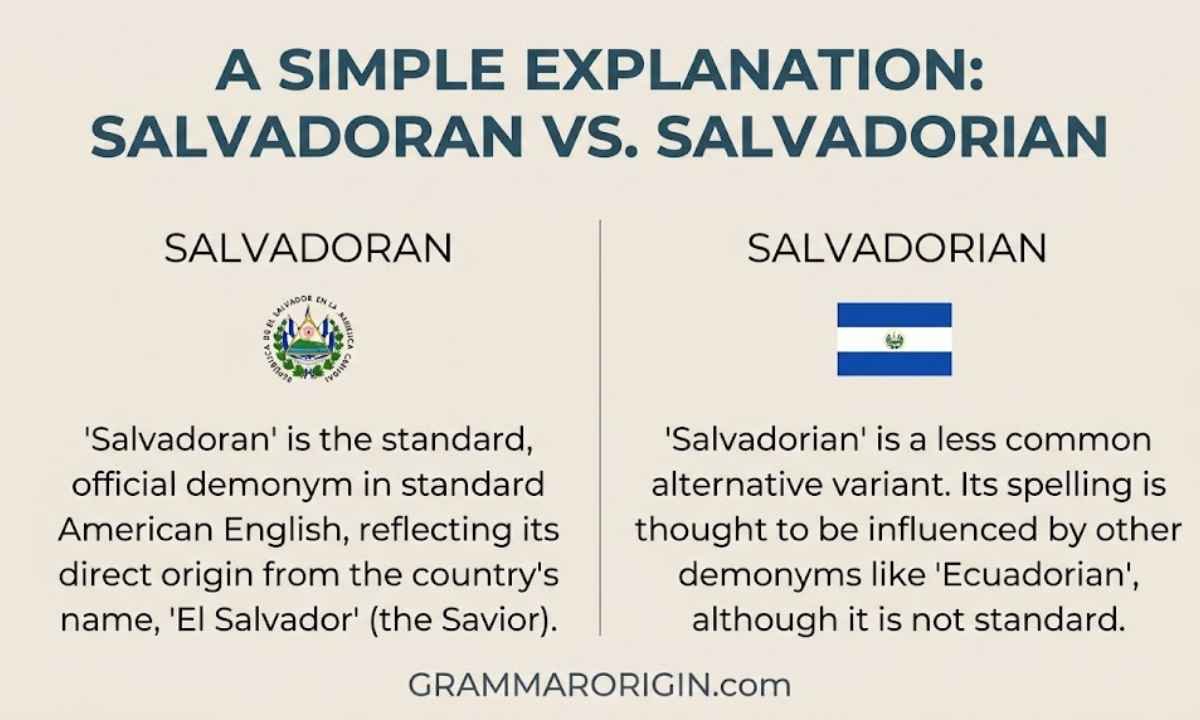
The Salvadoran or Salvadorian split starts with the country’s name. El Salvador is Spanish for “the Savior,” a name that points to Jesus Christ.
Spanish colonists named the region after Jesus Christ, the Savior of the World. The long title was later shortened to El Salvador. Spanish already had a word for the people, salvadoreño. English had to choose how to write it. One path was to shorten the name (Salvadoran). The other was to copy the Spanish sound (Salvadorean, Salvadorian).
Example: Salvador plus -an gives you Salvadoran. The Spanish word salvadoreño, written the way it sounds, gives you Salvadorean or Salvadorian.
How “Salvadoran” Was Formed
Example: Honduras becomes Honduran, and Salvador becomes Salvadoran. The same move gives the same ending.
English took the base word, Salvador, and added -an. That is the most common ending for a demonym. The “El” drops away because it only means “the” in Spanish. This is also why nobody says “the Honduras” before Honduran.
This simple pattern is likely one big reason dictionaries and newsrooms picked it.
Central American Demonyms Pattern
Most of El Salvador’s neighbors in Central America use a plain -an: Guatemalan, Honduran, Nicaraguan, and Costa Rican. Two countries break the pattern. Panama gives Panamanian, and Belize gives Belizean.
Example: Guatemala gives Guatemalan and Nicaragua gives Nicaraguan, but Panama gives Panamanian and Belize gives Belizean.
This mix explains why -ean and -ian endings don’t sound strange to many speakers. Still, the -an group is bigger, and Salvadoran belongs to it.
How “Salvadorian” Appeared
Salvadorian most likely came from people matching the Spanish word salvadoreño by ear and using a familiar -ian ending. Wikipedia makes a similar point. The “ia” and “ea” sounds are closer to the Spanish “ñ” than a plain “an” is.
Nobody knows who first wrote it, so treat this as a strong guess, not a proven fact. It does explain why Salvadoran or Salvadorian became a question at all.
Example: Someone who says “Peruvian” and “Panamanian” all day will easily land on “Salvadorian.”
Read More Related Posts Likeable or Likable: Which Spelling Is Correct? (US vs UK)
British English vs. American English Spelling
American dictionaries lead with Salvadoran. British writing is looser, and both Salvadorean and Salvadorian appear there. Neither country has a spelling law for Salvadoran or Salvadorian.
Example: A UK magazine might use Salvadorean, while a US news service writes Salvadoran. Both are fine. Mixing them in one publication is not.
Collins is a British publisher, and it lists Salvadorian with British pronunciations. Vocabulary lists Salvadorean next to Salvadoran. No British rule picks one winner, so treat it as a house-style choice.
Pronunciation: Salvadoran vs Salvadorean vs Salvadorian
In Salvadoran or Salvadorian, stress the third syllable of every form: sal-vuh-DOR. The ending is the only difference.
Salvadoran ends with a short “-un.” In the UK, the ending can sound a bit clearer, like “-en.” Salvadorean and Salvadorian have one extra beat and end with “-ee-un.”
Example: Say “sal-vuh-DOR-un” for Salvadoran, then “sal-vuh-DOR-ee-un” for the other two. Out loud, Salvadorean and Salvadorian sound the same.
Which Spelling Should You Use?
For Salvadoran or Salvadorian, use Salvadoran. Make an exception only if a style guide, a client, or the person you’re writing about asks for something else. Being consistent matters more than personal taste.
Example: If an editor’s style sheet says Salvadorean, use it every time, even if you’d have chosen Salvadoran.
For American English Users
Go with Salvadoran. In American English, Salvadoran or Salvadorian is not a toss-up. Merriam-Webster lists Salvadoran first, and school and news writing lean on it.
Many US newsrooms follow the AP Stylebook, which uses Webster’s New World College Dictionary for spelling, with Merriam-Webster as backup. No special AP rule for this word turned up in our research, so check the stylebook you have to follow.
Example: “Salvadoran Americans are one of the largest Latino groups in Los Angeles” is clean, standard American writing.
For British English Users
Salvadoran is a safe choice. Salvadorean is fine if your publication already uses it. Either way, stay consistent.
Every British reader will understand Salvadoran. If your outlet has its own style sheet, that sheet comes first.
Example: A British charity report can say “Salvadoran families” or “Salvadorean families,” as long as page 40 matches page 2.
For Global Writing
For a worldwide audience, Salvadoran or Salvadorian is an easy call: choose Salvadoran. Dictionaries list it first, Wikipedia calls it the accepted and most common term, and a Salvadoran-American writer at Remezcla suggests it for school and news writing.
If your readers are Salvadoran themselves, expect to see the variants. Don’t correct how people write their own identity.
Example: A global travel site might use the headline “Salvadoran Coffee Routes Worth the Drive.”
Common Mistakes with Salvadoran or Salvadorian
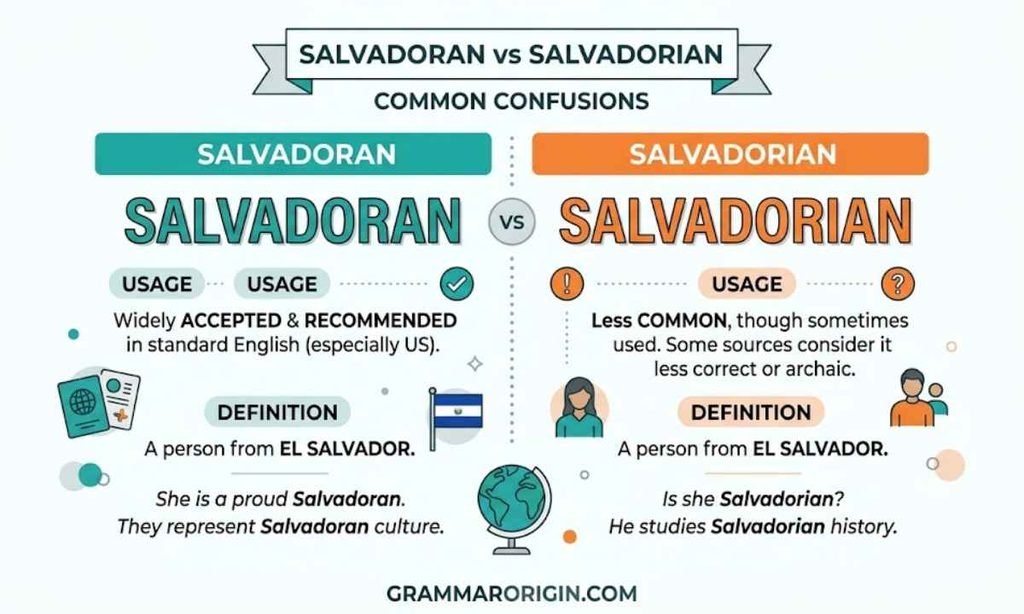
Most slips with Salvadoran or Salvadorian fall into three groups: using the variant in formal writing, switching spellings halfway through, and treating all three as equal. Each one is easy to fix.
Example: A report that starts with “Salvadoran exporters” and ends with “Salvadorian exporters” makes two of the three mistakes at once.
Mistake 1: Using “Salvadorian” in Formal Writing
Salvadorian is not wrong, but it’s the riskier choice in a thesis, a news report, or a business proposal. Remezcla’s advice is clear: for school papers and news articles, use Salvadoran.
There is one exception. If you quote a person or name a group that spells it Salvadorian, copy their spelling exactly.
Example: Risky: “The Salvadorian delegation shared its audit.” Safer: “The Salvadoran delegation shared its audit.”
Mistake 2: Mixing Both Forms in One Article
Example: A blog post that says “Salvadoran culture” in paragraph one and “Salvadorian culture” in paragraph six looks like nobody checked it.
Whichever you pick between Salvadoran or Salvadorian, keep it from the title to the last line. Readers notice mixed spellings faster than they notice a variant.
The only exceptions are direct quotes and proper names, which you copy as written.
Mistake 3: Assuming Both Are Equally Correct
On Salvadoran or Salvadorian, both spellings are in the dictionary, but they don’t carry equal weight. Salvadoran is the first-listed, best-supported choice, and Salvadorian is a variant.
This is different from gray and grey, which mostly split by region. The opposite mistake matters too. Telling someone that Salvadorian is “wrong” for their own identity is both inaccurate and unkind.
Example: “Salvadorian is a variant, so I’ll use Salvadoran in the article” is accurate. “Salvadorian isn’t a real word” is not.
Salvadoran or Salvadorian in Everyday Examples
In every setting, the safe answer to Salvadoran or Salvadorian is Salvadoran. What changes is how much a variant can cost you.
Example: The same neighbor can be “my Salvadoran friend” in a cover letter and “my Salvadorian friend” in a text. Neither one is a disaster.
Emails
Use Salvadoran in any email that reaches a client, a boss, or a stranger. A variant in a formal introduction can look like a slip.
Example: “I’d like to introduce our new Salvadoran partner, who will join Thursday’s call.”
News Writing
Example: “Salvadoran lawmakers extended the budget deadline on Thursday.”
Use Salvadoran in the headline and in the body. Keep it the same in every story, caption, and quote box.
Social Media
Casual posts accept all three, and many Salvadorans use the variants themselves. If you want a polished look, Salvadoran is still the neutral choice.
Example: “Sunday means a Salvadorian breakfast: fried plantains, beans, and a spoon of crema.”
Academic Writing
Example: “This study follows Salvadoran migrants who settled in Maryland after 1990.”
In your own sentences, answer Salvadoran or Salvadorian with Salvadoran. When you cite or quote a source, don’t change its spelling. A journal’s style sheet will settle any doubt.
Travel Blogs
For Salvadoran or Salvadorian in travel writing, Salvadoran works best because it sounds informed without sounding stiff. Readers often plan trips from your page, and a clean, steady spelling builds trust.
Example: “Salvadoran hospitality shows up early: someone offers you coffee before you find your seat.”
Read More Related Posts Likeable or Likable: Which Spelling Is Correct? (US vs UK)
Salvadoran or Salvadorian – Google Trends & Usage Data
Formal writing favors Salvadoran, while everyday and community writing mixes all three spellings. Wikipedia calls Salvadoran the accepted and most common term. It also says Salvadorian and Salvadorean are common among English-speaking Salvadorans.
This guide does not quote exact percentages, because search numbers change all the time. You can check Salvadoran or Salvadorian yourself in two minutes. Google Trends and the Google Books Ngram Viewer both let you compare the spellings side by side.
Example: In Google Trends, search “Salvadoran,” add “Salvadorian” as a comparison, and switch between Worldwide and United States. In the Ngram Viewer, enter both words, turn off case sensitivity, and pick a long date range.
salvadoran or salvadorian reddit
Community threads asking Salvadoran or Salvadorian, Reddit included, are a good gut-check but a weak rulebook. The same split shows up among Salvadoran Americans. Remezcla’s author says most people, even Salvadoran-Americans, use Salvadorian or Salvadorean because it sounds natural. The same author still suggests Salvadoran for school and news writing.
So treat a popular comment as one person’s habit. Check it against a dictionary before you use it in anything formal.
Example: “I’m Salvadorian and that’s how my family spells it” is a statement of identity. “Our style guide says Salvadoran” is a statement of policy. Both can be true at once.
Comparison Table: Salvadoran vs Salvadorian
Settle Salvadoran or Salvadorian by setting: Salvadoran for anything formal, Salvadorean if a house style asks for it, and Salvadorian for a casual voice or when you quote someone.
| Situation | Best choice | Why |
| School paper | Salvadoran | First-listed form, and the usual advice for academic writing |
| News story or press release | Salvadoran | Standard in news, and editors expect it |
| Business email | Salvadoran | Neutral and professional |
| Casual social post | Any of the three | Readers understand all of them |
| Quoting a person or group | Their exact spelling | Quotes and names are not yours to change |
| House style that names Salvadorean | Salvadorean | The style sheet beats general advice |
| Writing in Spanish | salvadoreño / salvadoreña | These are the Spanish forms |
Example: A quote that reads “As a Salvadorian, I felt seen” stays as the speaker said it, even if your own sentences around it say Salvadoran.
Salvadoran indigenous
Salvadoran indigenous peoples are mainly the Nahua-Pipil, the Lenca, and the Cacaopera (also called Kakawira). The 2024 census counted 68,148 people who say they are indigenous. That is about 1.1% of the population, up from 0.2% in the 2007 census.
Example: Salvadoran indigenous communities, like the Pipil near Sonsonate, still keep their own traditions.
In that census count, 43.2% said they are Nahua Pipil, 20.4% said Lenca, and 9.2% said Kakawira (Cacaopera). Another 12.6% did not know which indigenous group they belong to.
Other estimates are higher. Indigenous groups cited by the Minority Rights Group put the number near 10%, or about 600,000 people. The gap shows how much the answer depends on how you count: a census question or community membership.
Most Pipil descend from Nahua-speaking migrants who came from central Mexico. Cultural Survival reports that the Lenca and Cacaopera languages have been declared extinct. It also reports that 38.3% of indigenous people in El Salvador live in extreme poverty.
Salvadoran people
About 6.5 million Salvadorans live in El Salvador, and about 1.4 million more live in the United States, based on the figures Wikipedia gathers. The rest of the diaspora lives in places like Canada, Guatemala, Mexico, Costa Rica, and Europe.
Most Salvadorans are mestizo, which means mixed European and indigenous roots. WorldAtlas gives the share as 86.3% in an older estimate, so treat it as a rough guide.
Example: A second-generation teen in Los Angeles might call themselves a Salvi, an informal word Wikipedia links to Salvadorans born abroad.
The main language is Spanish, and everyday speech often uses vos instead of tú. In Spanish, the word for the people is salvadoreño or salvadoreña. As Wikipedia explains, this word helps explain the -ean and -ian spellings in English.
You may also hear Cuscatleco, a word Wikipedia says is often used for older people born in El Salvador. Food, family, and language are big parts of Salvadoran culture. And Salvadoran Americans often say they don’t agree on one English spelling for themselves.
Summary
Salvadoran or Salvadorian? Salvadoran is the standard, first-listed spelling, and it’s the safe choice for formal writing. Salvadorean and Salvadorian are real variants that live mostly in everyday and community use.
Example: Salvadoran officials, Salvadoran food, and a Salvadoran writer, with the same spelling every time.
Frequently Asked Questions
What do you call a person from El Salvador?
A person from El Salvador is called a Salvadoran (or Salvadorian), while in Spanish it is salvadoreño for a man and salvadoreña for a woman.
Is it Salvadoran or Salvadorian food?
“Salvadoran food” is the standard phrase to use, though “Salvadorian food” is an understood variant.
What do you call a woman from El Salvador?
In English, she is a Salvadoran woman, while in Spanish she is a salvadoreña.
Is Salvadoran a country or a nationality?
Salvadoran is a nationality, whereas the country itself is El Salvador.
Is “El Salvadoran” correct?
No, “El Salvadoran” is incorrect; you should drop the “El” and simply use “Salvadoran.”

Muhammad Waqas is an English language teacher and grammar expert with over 8 years of experience helping students and professionals improve their writing skills. He specializes in English grammar, vocabulary, communication, and practical language learning. Through GrammarOrigin, Waqas shares clear, easy-to-understand content that helps readers write and speak English with confidence.