
Likeable or likable? Both are right: likable is American, likeable is British. The meaning is identical, so the spelling you pick should simply match the readers you’re writing for.
This guide covers where each form came from, what the dictionaries say, and how to stay consistent. You’ll get real examples, a quick memory trick, and answers to the likeable or likable questions people search for most.
Likeable
Likeable is the spelling used in British English and in most places outside North America. It means pleasant, friendly and easy to like. That makes it the British side of the likeable or likable split.
The word is an adjective made from the verb like plus the suffix -able, and it keeps the final e. People in Britain, Ireland, Australia and New Zealand use it by default. Its related forms follow the same pattern: more likeable, most likeable and the opposite, unlikeable.
Example: “Despite his gruff manner, the new coach turned out to be thoroughly likeable.”
Likable
Likable is the standard American spelling. It drops the silent e, the same way lovable, livable and movable do. That’s the other half of the likeable or likable pair.
Example: “She’s the most likable character in the series, even when she’s wrong.”
Merriam-Webster lists likable as the main entry and likeable as a spelling variant. Likeable still shows up in American writing now and then, but likable is the safer choice in the US.
Likeable or Likable – Quick Answer
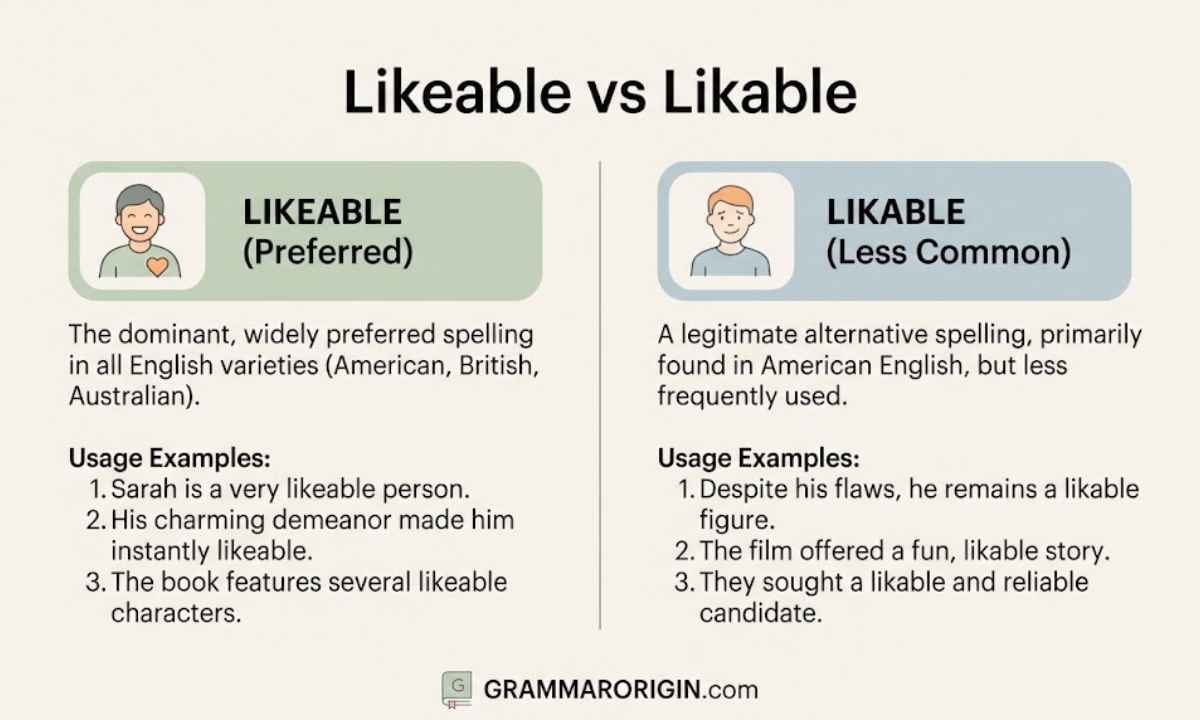
Both spellings are correct, and they mean exactly the same thing. When it comes to likeable or likable, use likable for American readers and likeable for British or international ones.
- American English: likable
- British English: likeable
- Australian and New Zealand English: likeable
- Canadian English: both appear, so follow your style guide
Not sure how to settle likeable or likable? Work through a short order of priority. Follow any style guide you’ve been given, then your audience’s region, then pick one form and stay with it.
Example: A Chicago startup writes “likable” in its product copy, while a Manchester agency writes “likeable” in its own. Both are fine, and neither switches halfway down the page.
The only thing that really looks sloppy with likeable or likable is switching between the two in one piece of writing.
Examples:
The audience decides the spelling, not the topic. Here’s how the likeable or likable choice plays out in everyday publishing.
| Where it’s published | Spelling | Sample sentence |
| US blog or magazine | likable | “The lead is awkward but clearly likable.” |
| UK newspaper or website | likeable | “He comes across as a likeable, slightly awkward host.” |
| Australian or New Zealand outlet | likeable | “Her likeable on-air style won over the breakfast crowd.” |
| Canadian publication | either, so check the house style | “The villain is oddly likable.” |
| Global brand with one English site | pick one and use it everywhere | “Our support team is friendly and likeable.” |
Example: A freelancer who sells articles to a New York magazine and a London paper keeps two versions of each draft. A quick find-and-replace swaps likable and likeable before sending, followed by a skim to make sure nothing else changed.
Choosing or Chosing: Which Spelling Is Correct and How to Use It
Choosing is the only correct spelling. “Chosing” isn’t a word in any kind of English.
People often mix up chose, the past tense, with the -ing form. When you add -ing to choose, the final e drops, so you get choosing. The same thing happens when like becomes liking.
Example: “We’re choosing a likable lead for the role.”
Keep that silent-e habit in mind. It also explains the likeable or likable difference.
The Origin of Likeable / Likable
Both words come from the verb like plus the suffix -able, and likeable is probably the older spelling. Merriam-Webster dates the first known use of likable to 1730.
The etymology is simple. Like comes from Old English, where the verb meant “to please.” The -able ending came through French from Latin and means “able to be.” So likable literally means able to be liked.
Exact dates are hard to pin down for the likeable or likable pair. Grammarist says likeable was in use by about 1700. It also warns that many early “likable” results in scanned books are really misread words like remarkable.
Dictionary.com puts the first recorded use of likable between 1720 and 1730. So the early 1700s is a safe range. Be careful with any site that gives one exact year without a source.
Example: Both spellings come from one recipe. Like + able gives likeable if you keep the e and likable if you drop it.
American writers later chose the shorter form, as they did with color and traveling. Noah Webster’s dictionaries are often credited with spreading that habit. Sources disagree about when the shift happened, so it’s safer not to pin it to one decade.
British English vs American English Spelling
American English usually drops the silent e before -able, and British English usually keeps it. Likeable or likable is just one pair in a bigger pattern.
| American | British |
| likable | likeable |
| lovable | loveable |
| livable | liveable |
| movable | moveable |
| sizable | sizeable |
| ratable | rateable |
Example: A London estate agent might advertise a “liveable” flat, while a New York listing describes a “livable” apartment. Same idea, different spelling.
Some -able words keep the e in both countries. Noticeable, manageable and changeable all keep it, because dropping the e would turn a soft c or g into a hard sound.
These are habits, not strict rules. Grammarist found that American publications still spell it likeable about a third of the time.
Which Spelling Should You Use?
Use the spelling your readers expect: likable for the US, likeable for the UK and most other English-speaking countries. If a style guide applies, it comes first.
- Style guide first. Chicago, for instance, follows Merriam-Webster for spelling. Many publishers and schools have their own sheet. Check AP, APA, MLA, or a dictionary such as Oxford, Cambridge or Collins before you decide.
- Audience next. Look at where most of your readers live. That settles likeable or likable for most projects.
- Consistency always. Use the same spelling in headlines, captions, image descriptions and URLs, not just body text.
Example: A charity with offices in Boston and Bristol keeps one master document. Each office then checks the spelling before anything goes public. That’s the likeable or likable decision made once and used everywhere.
Also Read This Stopping or Stoping: Which Spelling Is Correct? Meaning
Best SEO advice:
Choose the spelling your audience actually types, and use it the same way everywhere. Search engines generally treat the two as variants of one word, so you don’t need both in every heading.
A few habits help:
- Put your main spelling in the title, the H1 and the URL.
- Mention the other form once, naturally, with a phrase like “also spelled likeable.”
- Check your Search Console queries to see which version of likeable or likable brings visitors.
- If you serve both countries, publish separate pages for each and link them with hreflang tags. These tags tell Google which page is meant for which country.
Example: A site for both countries could run a US page built around likable and a UK page built around likeable, linked with hreflang.
How to Remember: Likeable Has an “E” Like England
Likeable keeps the extra E, like England, while likable is the shorter American form. That’s all the memory trick you need for likeable or likable.
Example: Before emailing a CV to a London firm, run a quick “E for England” check and make sure the extra letter is there.
Here’s a second tip. American spellings often cut letters, as in color and theater, so the shorter likable fits the pattern.
Common Mistakes with Likeable / Likable
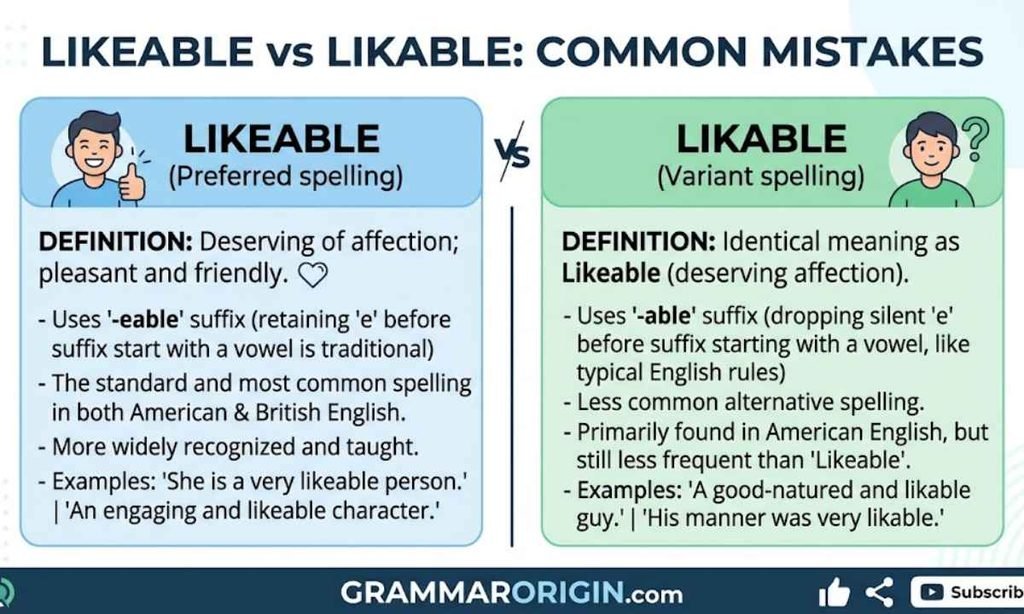
The most common mistake is mixing both spellings in one piece of writing.
Example: A UK launch page that says “likeable” in the headline and “likable” on the sign-up button looks careless, even though both are valid.
Other likeable or likable slips show up again and again:
- Using the American form for British readers, or the British form for American readers, by accident.
- Typos such as likeble, likible or lickable.
- Writing it as like-able with a hyphen, which isn’t standard.
- Using one spelling for the adjective and the other for the noun, such as likable with likeability.
- “Correcting” someone else’s spelling when theirs is just the other regional form.
Likeable / Likable in Everyday Examples
The spelling stays the same in an email, a news story or a post. Only the reader changes. These four examples show the likeable or likable choice in context.
Emails:
In emails, match the reader’s country and keep the subject line, body and sign-off consistent.
Example: “Thanks for meeting the team yesterday. Everyone found you warm and genuinely likable.”
A US recruiter wrote that, so the American form fits. If the same note went to a candidate in London, likeable would be the natural swap.
News Writing:
News copy follows the publication’s house style, so check the style sheet before you file a story.
Most newsrooms use one spelling in every story, headline and caption. A copy editor usually catches any mistakes.
Example: A UK paper might write, “The goalkeeper is a likeable presence in the dressing room.”
Social Media:
On social media, either side of likeable or likable works as long as your bio, captions and replies match.
Example: “Your brand voice doesn’t have to be clever. It has to be likable.”
Short posts are easy to write fast without checking. Read yours once before you publish.
Formal Writing:
In academic and business writing, settle likeable or likable by following the journal, school or company style guide.
Writing about first impressions often uses the nouns likability or likeability, so this choice comes up a lot.
Example: “Participants rated the narrator as more likeable than the antagonist.”
Also Read This Stopping or Stoping: Which Spelling Is Correct? Meaning
Likeable or Likable – Google Trends & Usage Data
British writing leans strongly toward likeable, American writing leans toward likable, and Canadian usage is mixed. The evidence comes from studies of published text and from dictionary entries.
- In current British news publications, Grammarist found likable appears about once for every six instances of likeable.
- In American publications, likeable still turns up about a third of the time.
- On Canadian news sites, both spellings appear about equally often. Grammarist warns that these sites don’t always show real Canadian usage.
- Merriam-Webster lists likable first and likeable as a variant.
Search-volume numbers change every month and differ by country, so check them yourself instead of trusting an old figure. Google Trends lets you compare both words by region, and the likeable or likable gap usually follows the US and UK split described above.
Example: Open the Google Books Ngram Viewer, type “likable,likeable”, and switch between the American English and British English collections. The two lines tell different stories.
Comparison Table: Likeable vs Likable
The likeable or likable difference is only spelling and region. Everything else, from meaning to pronunciation, is the same.
| Feature | Likeable | Likable |
| Spelling | Keeps the silent e | Drops the silent e |
| Where it’s preferred | UK and most places outside North America | United States |
| Dictionary treatment | Variant in Merriam-Webster, alternative form on Dictionary.com | Main entry in Merriam-Webster |
| Noun form | likeability | likability |
| Opposite | unlikeable | unlikable |
| Meaning and sound | Easy to like, same pronunciation | Easy to like, same pronunciation |
| Earliest evidence | In use by about 1700 (Grammarist) | First known use 1730 (Merriam-Webster) |
Example: If you write “likable” in a US report, stay with “likability” and “unlikable” through the whole document.
Likeable person meaning
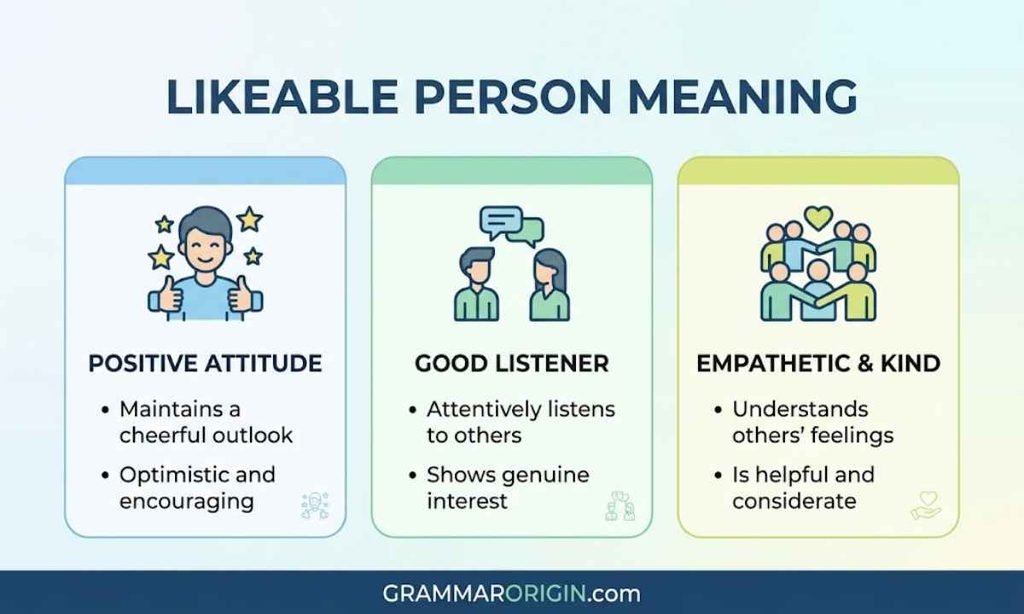
A likeable person is someone others naturally enjoy being around: warm, kind and easy to talk to. The word describes how people feel about someone, not how successful that person is.
Example: “Our new manager is likeable. She remembers names, asks about your weekend and actually listens to the answer.”
Social psychologists often describe first impressions with two ideas, warmth and competence. Likeability is closer to warmth. The word works for fictional characters, pets and even towns, not just people.
Useful synonyms include friendly, charming, pleasant, agreeable and approachable. Antonyms include off-putting, disagreeable and unlikeable.
Unlikable or Unlikeable?
Unlikable is the American spelling and unlikeable is the British one, matching the positive form. Dictionary.com lists both.
Example: “The novel’s unlikable narrator is exactly what makes it gripping.” A UK reviewer would write “unlikeable” in the same sentence.
Critics often use this word for flawed main characters in books and TV shows.
Likability or Likeability?
Likability is the American noun and likeability is the British one, and both mean the quality of being easy to like. Merriam-Webster lists likability under likable, and Dictionary.com also lists likeability.
Dictionaries also record rarer nouns such as likableness and likeableness, but people rarely use them.
Example: “The survey measured each candidate’s likability alongside experience.”
Final Thoughts
Likeable or likable comes down to who your readers are. Use likable for American readers and likeable for British and international ones.
Pick one form of likeable or likable. Use it for the adjective, the noun and the opposite, and keep it the same from start to finish. Readers will notice the consistency before they notice the extra E.
Frequently Asked Questions
Is it likeable or likable?
Both likeable and likable are correct spellings of the same adjective. Likable is the American spelling and likeable is the British one.
Do likeable and likable mean the same thing?
Yes, likeable and likable mean the same thing. Both describe someone or something that’s pleasant and easy to like, and both sound the same.
Which spelling does American English prefer?
American English prefers likable. Merriam-Webster lists it as the main entry, though likeable still appears in US publications about a third of the time.
Is likeable or likable better for SEO?
Neither spelling has a built-in advantage. Search engines generally read them as variants of one word, so use the spelling your audience types and keep it consistent.
What is the opposite of likable?
The opposite of likable is unlikable in American English and unlikeable in British English. Related words include disagreeable and off-putting.
Can I use both spellings in one article?
Only when you’re comparing them, as this guide does. In normal writing, choose one so the likeable or likable question never distracts your reader.

Muhammad Waqas is an English language teacher and grammar expert with over 8 years of experience helping students and professionals improve their writing skills. He specializes in English grammar, vocabulary, communication, and practical language learning. Through GrammarOrigin, Waqas shares clear, easy-to-understand content that helps readers write and speak English with confidence.