
Baptised or baptized? Both are correct. Baptised is the British spelling and baptized is the American one, and they mean exactly the same thing.
So the only real question is who you’re writing for. This guide covers the meaning, the history behind the two spellings, how they split by country, and quick tricks so you never second-guess yourself.
Quick Answer
For baptised or baptized, use baptised for British, Australian and New Zealand readers, and baptized for American and most Canadian readers. Both spellings are correct and mean the same thing, so pick one style and stay consistent through the whole piece.
Example: A London parish newsletter would say, “The twins were baptised on Sunday,” while a Texas church bulletin would say, “The twins were baptized on Sunday.”
Meaning and Definition of Each Word
Baptised or baptized, it’s the same verb in the past tense. To baptise (or baptize) someone is to carry out baptism, the Christian rite of welcoming a person into the faith, traditionally with water.
Example: “The vicar baptised the baby in a small stone church.”
The verb also has a looser, figurative life. A project can be “baptised” with a nickname, and a first brutal week at work can feel like a baptism of fire. Both spellings cover every one of these senses, and neither is more formal than the other.
1. Baptised
Baptised is the British spelling of the past tense of baptise. You’ll see it in UK, Irish, Australian and New Zealand writing.
The -ise ending is the version many British writers picked up through French influence. Parish records and family-history pages in Britain use it constantly.
Example: My grandfather was baptised in the same village church where he later got married.
2. Baptized
Baptized is the American spelling of the same past tense, and most Canadian writers favour it too.
Example: The pastor baptized eleven people in the lake on Saturday morning.
It keeps the -ize ending that goes back to the word’s Greek root. Same verb, same action. Only one letter changes.
Baptised or Baptized Meaning
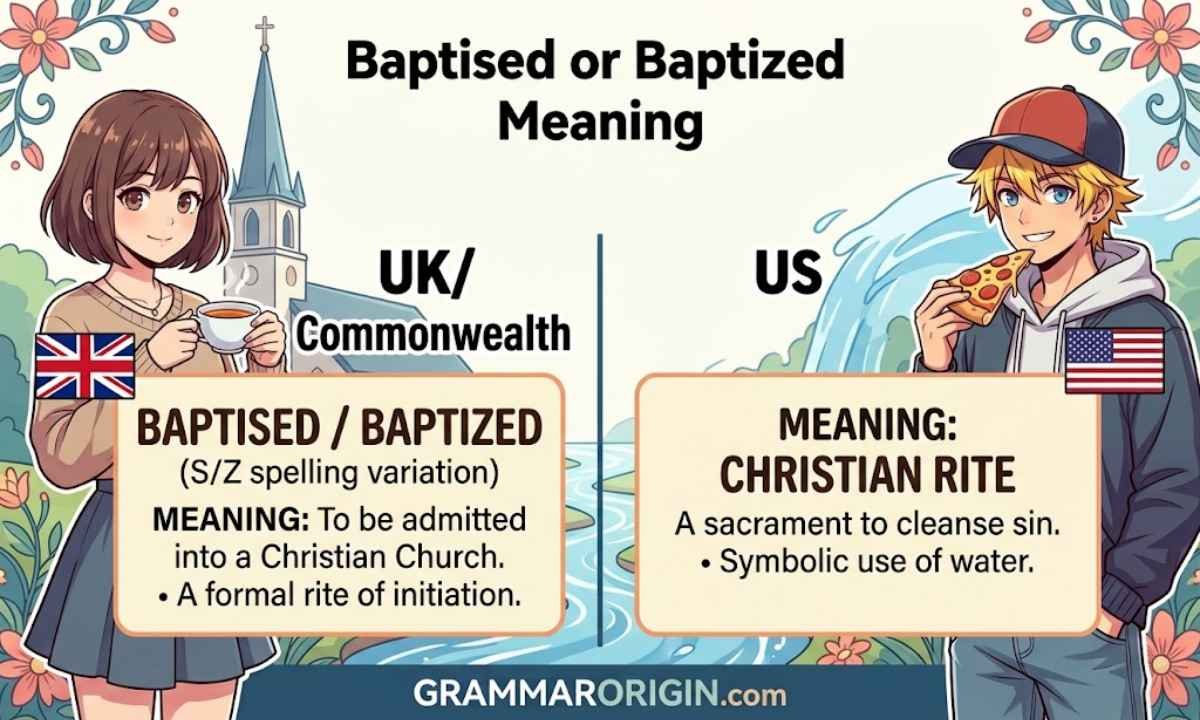
Baptised and baptized have the same meaning: to have gone through baptism, or to have performed it. The spelling tells you which variety of English you’re using, not a different sense.
People often search for baptised or baptized meaning hoping for a hidden distinction. There isn’t one. Dictionaries such as Merriam-Webster and the Cambridge Dictionary list baptise and baptize as spelling variants of one verb, so there’s no formality gap and no religious difference between the two.
Example: “She was baptised in 1998″ and “She was baptized in 1998″ say precisely the same thing.
Origin of Baptize and Baptise (Etymology)
Baptised or baptized, both spellings come from the Greek baptizein, which meant “to dip” or “to immerse.” That’s why the -z- version is the one closest to the original root.
Example: Greek baptizein became Latin baptizare, then Old French batisier, and finally English baptize around the year 1300.
Early Christian baptism involved full immersion in water, so the English word kept that “dip” picture for centuries. The -s- spelling came later, through French habits rather than Greek ones.
Are Baptised and Baptized Pronounced the Same?
Yes, they sound identical. Most speakers say bap-TIZED, /bæpˈtaɪzd/, though some put the stress on the first syllable instead.
Example: Read this aloud: “He was baptised last spring.” Now read it again with baptized. Nobody listening could tell the difference.
Both the s and the z produce the same /z/ sound in this word, so your ear gives you no clue. That’s why the baptised or baptized mix-up is purely a writing problem, and why picking one style before you start is the easiest fix.
Baptised or Baptized UK
For baptised or baptized in the UK, baptised is the usual spelling, but baptized isn’t wrong. Sapling’s usage data shows roughly 71% of UK writing using baptised and about 29% using baptized.
That 29% isn’t all typos. Some British publishers favour -ize spellings as house style, and the best-known example is Oxford spelling. That’s why you’ll still see baptized in UK text now and then.
Example: “The bishop will baptise three adults at Easter,” reads naturally in a British church newsletter.
Key Differences Between the Words
The key difference between baptised or baptized is spelling style, one of the classic British vs American English splits: baptised is British and baptized is American. Everything else stays the same.
- Spelling style: -ise (British) versus -ize (American).
- Meaning: identical in every sense.
- Pronunciation: identical.
- Formality: neither one is more formal.
- Grammar: both are past tense and past participle forms of a regular verb.
Example: “The church baptised forty adults” in a UK report becomes “The church baptized forty adults” in a US report. Nothing else moves.
Baptised or Baptized in Canada and Australia
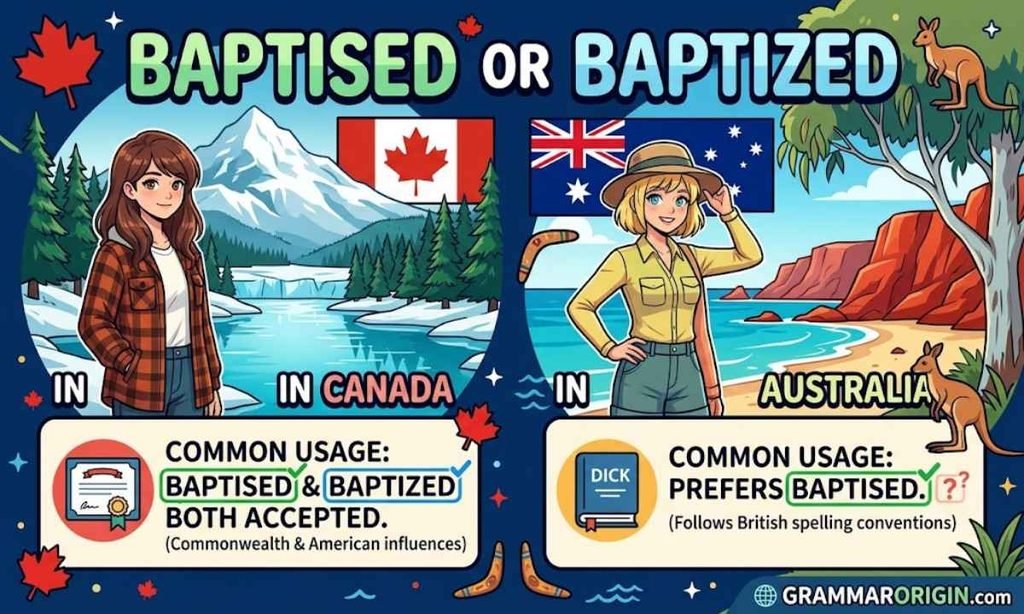
In baptised or baptized usage, Canada leans toward baptized while Australia leans toward baptised. Sapling’s figures put Canada at about 74% baptized and Australia at about 68% baptised.
Example: A Toronto newspaper would likely run “she was baptized as an infant,” while a Sydney paper would more likely run “she was baptised as an infant.”
Canadian spelling blends British and American habits, so it doesn’t fall neatly into either camp. Australian English mostly follows British norms but borrows some American spellings. That’s why the shortcut “Commonwealth means baptised” doesn’t hold up.
Baptised or Baptized by Country
For baptised or baptized, the US, Canada, India and the Philippines lean toward baptized, while the UK, Australia, Ireland and New Zealand lean toward baptised.
| Country | Leans toward | Approximate split |
| United States | Baptized | 84% / 16% |
| Canada | Baptized | 74% / 26% |
| India | Baptized | 71% / 29% |
| Philippines | Baptized | 92% / 8% |
| United Kingdom | Baptised | 71% / 29% |
| Australia | Baptised | 68% / 32% |
| Ireland | Baptised | 60% / 40% |
| New Zealand | Baptised | 60% / 40% |
These percentages come from Sapling’s usage data and shift over time, so treat them as a guide rather than a rule.
Example: A church newsletter in Manila would almost always say “newly baptized members,” while one in Dublin would more often say “newly baptised members.”
Why English Has -ise and -ize Spellings
Baptised or baptized exists because the Greek ending -izein became -ize in English, while French influence nudged some writers toward -ise. According to Etymonline, this variation affects about 200 English verbs.
Example: The British organise and the Americans organize, but both sides write advise, never “advize.”
In Britain, -ise is still the more common choice, even though some respected authorities have long preferred -ize. American English has always favoured -ize.
Noah Webster’s spelling reforms shaped plenty of American spellings, though -ize wasn’t one of his inventions. It’s simply the older Greek-based form.
A handful of verbs, such as advise, surprise, exercise and compromise, end in -ise everywhere, so don’t convert them.
Baptized or Baptised
Typed as baptized or baptised, the answer stays the same: baptized is American and baptised is British. The word order doesn’t matter; your audience does.
Run through three quick questions:
- Who’s reading this?
- Does a style guide or editor already pick one?
- Have I used the same spelling everywhere?
Example: “The chapel has baptized generations of local families” suits a US page. For a UK page, swap in baptised.
Comparison Table
At a glance, baptised or baptized comes down to region.
| Point | Baptised | Baptized |
| Variety of English | British, Australian, NZ | American, mostly Canadian |
| Base verb | Baptise | Baptize |
| Past tense | Baptised | Baptized |
| -ing form | Baptising | Baptizing |
| Third person | Baptises | Baptizes |
| Meaning | Same | Same |
| Memory hook | “S” for British | “Z” for American |
| Sentence | She was baptised at Easter. | She was baptized at Easter. |
Quick check: If your page says “colour” and “organise,” use baptised. If it says “color” and “organize,” use baptized.
Difference between Baptised and Baptized with Examples
The baptised or baptized difference is purely regional, and the clearest way to see it is the same sentence in both spellings.
- UK: She was baptised at eight weeks old. / US: She was baptized at eight weeks old.
- UK: The priest baptised the twins. / US: The pastor baptized the twins.
- UK: They’re baptising the baby on Sunday. / US: They’re baptizing the baby on Sunday.
Read each pair and you’ll notice the sentence structure never changes. Only the s and the z do the work.
Read More Boujee or Bougie? Correct Spelling, Meaning & Difference
Examples in Sentences
Here are everyday baptised or baptized sentences, each spelling in its natural home.
Baptised Examples
Baptised shows up wherever British-style spelling is the norm.
- The child was baptised in a short, quiet ceremony.
- She was baptised shortly after her sister was born.
- They baptised their son in the village church.
- The new members will be baptised at the end of the month.
- He was baptised by the same minister who married his parents.
- The family had lunch together after the baby was baptised.
Notice that every sentence uses a form of be plus the participle, which is how the passive voice works.
Baptized Examples
Baptized shows up wherever American-style spelling is the norm. Here are six real-life patterns.
- The boy was baptized during a large community gathering.
- She was baptized in a lake last summer.
- The pastor baptized new members every month.
- He was baptized as part of a youth programme.
- The baby was baptized on Easter morning.
- Dozens of families were baptized in the river that weekend.
Common Mistakes
The most common baptised or baptized mistake isn’t a wrong spelling at all. It’s mixing the two styles in one piece of writing.
Example: “He was baptised at Saint Mary’s, and she was baptized there too” looks inconsistent even though each spelling is correct on its own.
Most other slips come from the wrong verb form or from the related noun, so a quick final read-through usually catches them.
Incorrect vs Correct
These five slips come up most often, and each one has a simple fix.
| Incorrect | Correct | Why |
| He was baptised at Saint Mary’s, and she was baptized there too. | He was baptised at Saint Mary’s, and she was baptised there too. | Don’t mix styles in one text |
| She was baptise last year. | She was baptised last year. | Past tense needs -ed |
| The baptisim starts at noon. | The baptism starts at noon. | The noun is spelled baptism |
| The ceremony is called a baptise. | The ceremony is called a baptism. | The noun isn’t baptise |
| A British essay saying “baptized” without a reason | A British essay saying “baptised“ | Match the style of the whole document |
Tips to Remember the Difference
Three simple tricks settle baptised or baptized in almost every case.
Example: If you’re writing “colour” and “centre,” your spelling is British, so write baptised.
1: Baptised = “S” for British
Baptised and British both contain an s. Link them in your head and you’ll pick the right one.
Example: A letter to a UK charity: “Many of our members were baptised at the old chapel.”
The s link is a reliable shortcut because it holds for Australian and New Zealand writing as well.
2: Baptized = “Z” for American
Americans call the letter Z “zee,” and baptized has a Z. That’s an easy way to tie the spelling to American English.
The z also points back to the Greek root, so you can think of baptized as the “original letter” version.
Example: A US church flyer: “All newly baptized members are welcome at the lunch.”
3: Audience First
Your readers decide the spelling, not your habits.
Example: If your readers are in Toronto, choose baptized. If they’re in Sydney, choose baptised.
Before you worry about the spelling, decide who’s reading. The audience picks the style, and the style picks the spelling.
When to Use Each Word
Choosing baptised or baptized is easy: use baptised in British-style writing and baptized in American-style writing.
Example: “Our founder was baptised here” fits a UK heritage page, while “Our founder was baptized here” fits a US one.
Use “Baptised” When:
Use baptised whenever the rest of your text follows British conventions. These are the usual spots:
- You’re writing for readers in the UK, Ireland, Australia or New Zealand.
- Your style guide says British English.
- The rest of your page uses spellings like “colour,” “centre” and “organise.”
Example: “Our school was founded by a vicar who was baptised in the village church.”
Use “Baptized” When:
Use baptized whenever the rest of your text follows American conventions. These are the usual spots:
- You’re writing for readers in the US, Canada, India or the Philippines.
- Your style guide says American English.
- The rest of your page uses spellings like “color,” “center” and “organize.”
Example: “She was baptized at the church where her parents met.”
Grammar Rules (If Applicable)
Whichever you choose, baptised or baptized follows the same regular verb pattern. Only the s or z changes.
Example: “They baptise babies on Sundays” (UK) and “They baptize babies on Sundays” (US) are the same sentence in the present tense.
Baptise vs Baptize (Verb Forms)
Baptise and baptize are regular transitive verbs, so the past tense and the past participle are the same form.
| Form | British | American |
| Base | Baptise | Baptize |
| Third person | Baptises | Baptizes |
| Past tense | Baptised | Baptized |
| Past participle | Baptised | Baptized |
| -ing form | Baptising | Baptizing |
Example: “They are baptising the baby on Sunday” (UK). “They are baptizing the baby on Sunday” (US).
Read More Boujee or Bougie? Correct Spelling, Meaning & Difference
Baptism (Noun and Adjective)
The noun is baptism in both British and American English, and the adjective is baptismal. Neither word changes with region.
The same goes for proper nouns. Baptist keeps its spelling everywhere, and so do names like Saint John the Baptist.
Example: The baby wore a white baptismal gown at the baptism.
Synonyms or Related Words
Baptise has no perfect synonym, but a few words overlap with it in specific senses.
Example: The couple christened their daughter at the same church where she was later baptised.
Synonyms for Baptize:
Christen and immerse are the closest matches, depending on the sentence.
- Christen (close, but it also includes naming)
- Immerse (the literal “dip” sense)
- Dub (figurative, “to give a name”)
- Name (figurative)
- Initiate (loosely, in a ritual sense)
Example: The crew dubbed the new boat “Lucky” before it left the dock.
Related words include baptism, baptismal, baptistery and rebaptise (or rebaptize). Words like bless, dedicate and consecrate are about holy occasions, but they aren’t synonyms.
Baptised or baptized in a figurative sense
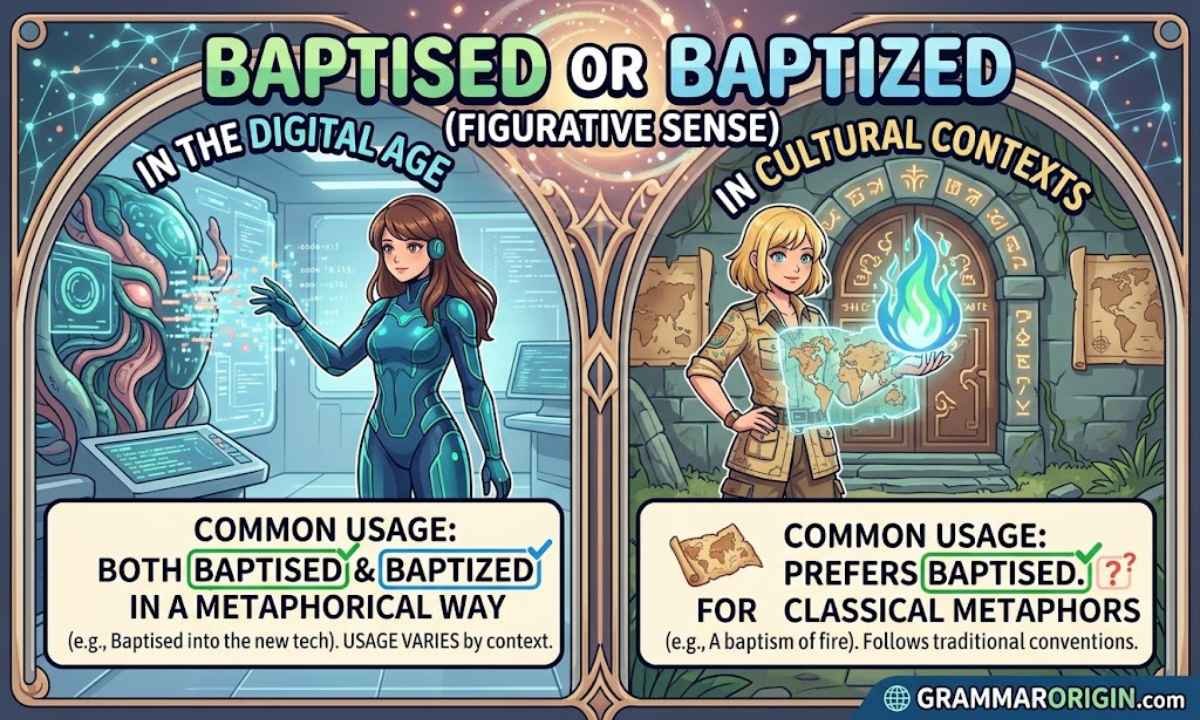
In a figurative sense, to be baptised or baptized means to be named or plunged into something new. Both spellings work, and the choice follows the same UK versus US rule.
Example: The team baptized the project “Phoenix” after the old system crashed.
The best-known idiom is “baptism of fire,” meaning a hard first experience. Here the noun is always spelled baptism, so the s versus z question only comes up if you turn it into a verb, as in “she was baptised by fire on her first shift.”
Baptised vs Christened
Baptise means to perform the religious rite of baptism, while christen means to baptise and give a name, or more loosely, to name something. The two overlap a lot, but they aren’t perfect twins.
In many Christian traditions a baby’s baptism and naming happen at the same service, so people call it a christening. Some traditions practise infant baptism, while others baptise believers later in life, and there the word christening is rarely used.
Example: They christened the ship at the dock, but nobody baptised it.
Summary
Baptised or baptized comes down to one question: who’s reading? Baptised suits British-style writing, baptized suits American-style writing, and the meaning never changes.
The rest is consistency. Pick one spelling at the start, keep it through the whole piece, and you’ll avoid the only real mistake with this word.
Frequently Asked Questions
What’s the difference between baptised and baptized?
There’s no difference in meaning, only in spelling. Baptised is British and baptized is American, so the choice in baptised or baptized depends on your audience.
Is it baptised or baptized in the UK?
Baptised is the usual spelling in the UK, with roughly 71% of UK usage in Sapling’s data. Baptized is still seen, especially where a publisher’s house style prefers -ize.
Which spelling is correct in Canada?
Both are correct, but baptized is more common in Canada, at roughly 74% in Sapling’s data. Canadian English blends British and American habits.
What does baptized mean?
Baptized means having gone through baptism, the Christian rite of welcoming someone into the faith, usually with water. It can also mean “named” or “initiated” in a figurative sense.
Is it baptising or baptizing?
Both are correct. Baptising goes with British spelling and baptizing goes with American spelling, just like baptised and baptized.
Can I use both spellings in the same document?
You shouldn’t. Pick one style and stick with it, because mixing baptised or baptized in one piece looks like an editing slip.
Is baptism spelled differently in British and American English?
No, baptism is spelled the same in both. The s or z only shows up in the verb forms, such as baptise, baptize, baptised and baptized.

Muhammad Waqas is an English language teacher and grammar expert with over 8 years of experience helping students and professionals improve their writing skills. He specializes in English grammar, vocabulary, communication, and practical language learning. Through GrammarOrigin, Waqas shares clear, easy-to-understand content that helps readers write and speak English with confidence.