
Both spellings are correct. Benefited is the US standard, and benefitted is a common British variant, so with benefitted or benefited, your audience decides.
The meaning and the sound stay the same either way. This guide covers pronunciation, the stress rule behind the single t, the -ing forms, and clear examples for the US, UK, Canada, and Australia.
Quick Answer
Benefitted and benefited are both correct past tense forms of the verb benefit. Americans write benefited with one t, while British writers often choose benefitted with two.
Choosing between benefitted or benefited comes down to where your readers live. If you’re writing for readers in one country, match their spelling. If your readers are mixed, benefited tends to be the simpler pick, because it’s standard in the US and also accepted in the UK.
The village benefited from the new road. That sentence works in New York and in Newcastle. The benefitted version works too, though most American readers will see it as a British spelling.
Meaning and Definition of Each Word
Benefited and benefitted mean exactly the same thing. Both are the past tense and past participle of benefit, which means to gain something helpful, like money, support, or a better result. So the benefitted or benefited question is never about meaning.
Benefit has an old root. It traces back to Old French bienfait and Latin benefactum, a “good deed,” built on bene, the Latin word for “well.” That’s why the first half of the word looks like “bene” and not “beni.”
It’s also the same root you see in beneficial and benefactor.
1. Benefited
Benefited is the standard spelling in American English. It has one t before the -ed ending, and you’ll see it in US news, schools, and business writing.
It’s also common outside the US, so it rarely looks wrong to any reader. Grammarly notes that benefited is the more common form in the United States, so in the benefitted or benefited choice, it wins there.
Our small team benefited from a week of rest.
2. Benefitted
Benefitted is the double-t variant, and it’s the form you’re more likely to meet in British writing. Grammarist describes the double t as the preferred spelling in British English.
It means the same as benefited, so it isn’t a mistake. It just signals a British-style spelling. Either side of benefitted or benefited says the same thing.
Shoppers across the county benefitted from the lower prices, and the shop owners did too.
Key Differences Between the Words
The only real difference between benefitted and benefited is one extra t, and that t follows region and style. Meaning, grammar, and pronunciation don’t change.
- Spelling: benefited has one t, and benefitted has two.
- Region: benefited is the US standard, while benefitted is a common British variant.
- Meaning: identical, so you can swap them without changing the message.
- Sound: identical, so nobody can hear which one you wrote.
- Risk: the wrong choice isn’t an error, but it can look out of place in a style-sensitive document.
When you’re torn between benefitted or benefited, think about where your reader lives, not about meaning. A US reader sees benefited as normal. A UK reader sees either one as acceptable, and may expect benefitted.
Comparison Table
Here’s how benefitted or benefited stack up side by side.
| Feature | Benefited | Benefitted |
| Number of t’s | One | Two |
| Main region | United States | United Kingdom (common variant) |
| Part of speech | Past tense and past participle | Past tense and past participle |
| Meaning | Gained an advantage | Gained an advantage |
| Pronunciation | BEN-uh-fit-id | BEN-uh-fit-id |
| -ing form | benefiting | benefitting |
| Accepted in formal writing | Yes | Yes |
| Canada and Australia | Style guide decides | Style guide decides |
| Example | The school benefited from the grant. | The school benefitted from the grant. |
Examples in Sentences
Benefited: Local farmers benefited from the early rain.
Benefitted: Local farmers benefitted from the early rain.
Those two lines show benefitted or benefited doing the same job, and they’re identical in meaning. The difference is the spelling habit of the writer, and nothing else.
More examples, grouped by situation:
- Work: She benefited from a mentor who gave her honest feedback.
- School: Several students benefitted from the extra revision class.
- Health: He’s benefited a lot from sleeping earlier.
- Community: The whole street benefitted when the council fixed the lights.
Benefited or benefitted pronunciation
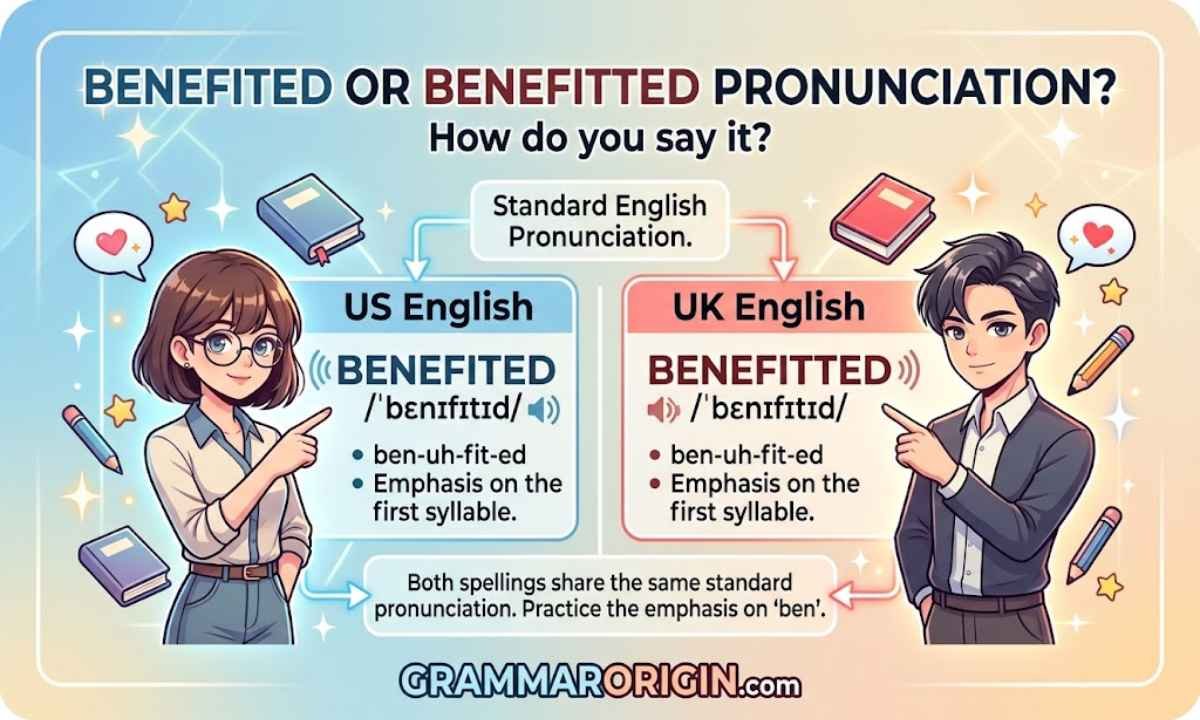
Benefited and benefitted are pronounced exactly the same, roughly BEN-uh-fit-id. Whether you write benefitted or benefited, you say it the same way.
The stress falls on the first syllable, BEN. The IPA is about /ˈbɛnɪfɪtɪd/, with small differences between accents.
Say it in four beats: ben, uh, fit, id. The tt in benefitted doesn’t add a second “t” sound, so a double t is a spelling choice only.
Benefitted or benefited UK
In the UK, both forms are used. Benefitted is common and often preferred, but benefited is also correct, so neither one is a mistake in British English.
Grammarist says the double t is the preferred spelling in British English. Grammarly says both are acceptable, and that benefited is simply more common in the US. Dictionaries like Collins and Oxford Learner’s tend to record both forms.
For a quick check, Cambridge Dictionary is a handy British reference.
So the benefitted or benefited choice in Britain often comes down to house style. A newspaper, a university, or a company may have its own rule, and that rule wins.
Example: The council said local firms benefitted from the new rail link.
Using Benefited (American English)
Use benefited in American English. It’s the standard form in US dictionaries, school writing, news, and business documents, which settles benefitted or benefited for American audiences.
An American editor will often keep benefited and change benefitted to match. So if you’re unsure which of benefitted or benefited a US reader expects, stay with one t.
The new hires benefited from the quiet first week.
The same form works in the present perfect: “The team has benefited from clearer goals.” It also fits questions, like “Who benefited most from the change?”
Using Benefitted (British English)
Use benefitted in British English when you want the British-style double t. It’s an established variant, and many UK writers and editors use it.
It fits best in writing that already follows British spelling, like colour, organise, and travelled. Mixing it with American spellings in the same text looks careless.
Many pupils benefitted from the longer school day, according to the head teacher.
In British-style text, benefitted or benefited can both pass, but benefitted fits the style best. Benefited is not wrong in the UK either, so don’t “correct” it automatically.
More posts Compliment or Complement: Meaning, Difference & Examples (2026)
Benefited or Benefitted in Canada and Australia
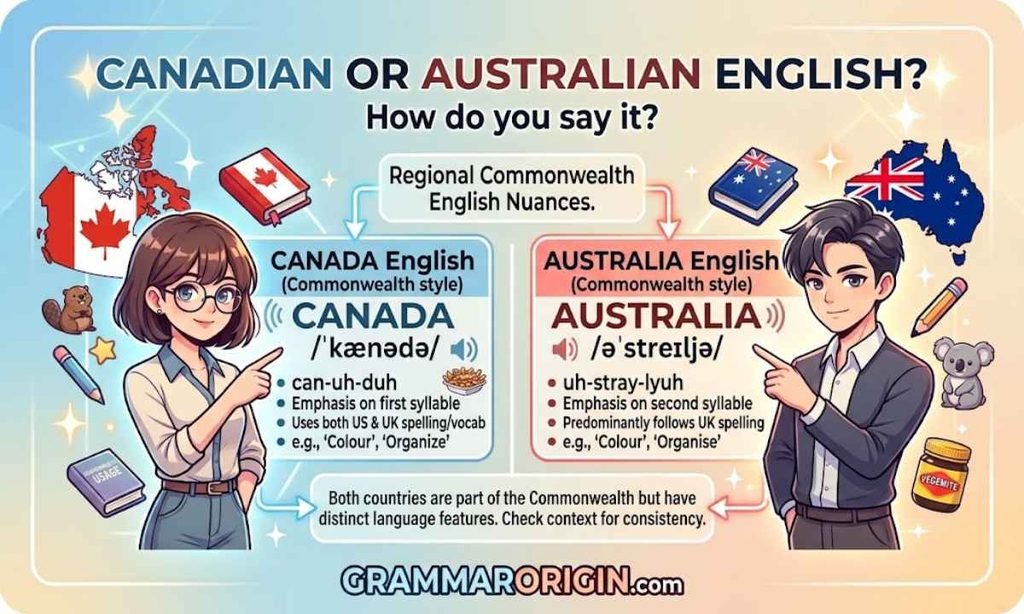
In Canada and Australia, there’s no single fixed rule, so follow the style guide of the publication, school, or employer you’re writing for. Both spellings are understood in both countries, so benefitted or benefited is a style call, not a rule.
These two varieties of English borrow from both sides. Both write travelled and labelled with a double l, like British English, but that habit doesn’t automatically decide benefited or benefitted.
If you have no guide, pick one spelling and stay consistent. Canadian English and Australian English both mix British and American habits, so a quick look at a dictionary helps. Mixing both in one document is the real mistake.
Australian students benefited from the new funding. Canadian students benefitted from it too, depending on the style guide.
Why Benefit Isn’t Doubled in American English
American English doesn’t double the t because the stress in benefit falls on the first syllable, not the last. That’s the same pattern you see in visited and limited, and it’s the logic behind the benefitted or benefited split.
The US rule is simple. You double the last consonant before -ed or -ing only when the stress lands on the final syllable, as in commit to committed, or begin to beginning.
When the stress is earlier, you leave the consonant alone, as in visit to visited, limit to limited, and benefit to benefited.
Some writers pattern benefit on fit, because fit becomes fitted. But fit is a single syllable and stressed, so it follows a different rule.
British English doubles some final consonants more freely, as in travelled and labelled. Some writers also hear a lighter, secondary stress on the last syllable of benefit, which helps explain why benefitted survives. In American English, some say the last syllable is unstressed, so the single t wins.
Benefiting or Benefitting
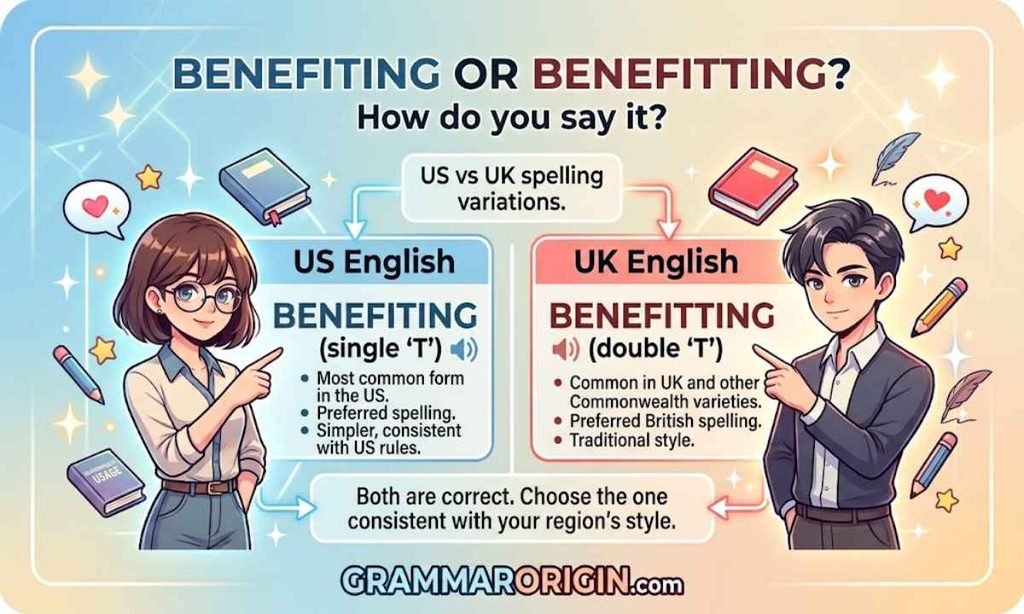
Benefiting is the standard American spelling, and benefitting is the common British variant. It’s the same pattern as benefited and benefitted.
Pick one style for all forms in a piece of writing, the same way you would with benefitted or benefited. If you use benefitted, use benefitting. If you use benefited, use benefiting.
The -ing form works as the present participle, as in “Everyone is benefiting from the new system.” For a quick American check, Merriam-Webster is a good reference.
A British writer might put it this way: “Rural areas are benefitting from faster broadband.” An American writer would write benefiting in the same sentence.
Word Forms Table
This table lists the main forms of benefit, with the US spelling and the common British variant.
| Form | US spelling | British variant | Example |
| Base verb or noun | benefit | benefit | This plan will benefit everyone. |
| Third person | benefits | benefits | It benefits small shops. |
| Past tense | benefited | benefitted | She benefited from the course. |
| Past participle | benefited | benefitted | We’ve benefited from it. |
| -ing form | benefiting | benefitting | He’s benefiting from the rest. |
| Adjective | beneficial | beneficial | A beneficial change. |
| Person who gains | beneficiary | beneficiary | The beneficiary signed the form. |
Common Mistakes
The most common mistakes are misspelling benefit as benifit and mixing the single-t and double-t spellings in one text. A few others come up often.
- Benifit. The second vowel is e, not i. Think bene plus fit.
- Mixing styles. Switching between benefitted or benefited mid-document is the most visible slip. Writing benefited in one paragraph and benefitted in the next looks inconsistent.
- Mismatching -ing forms. Using benefitted with benefiting, or the reverse, breaks the pattern.
- Copying the fit rule. Writing benefitted because fitted has a double t is a guess, not a rule.
- Missing “from.” The usual phrase is “benefit from,” not “benefit of.”
Wrong: She benifited from the training. Right: She benefited from the training.
Wrong: They benefited of the new policy. Right: They benefited from the new policy.
Tips to Remember the Difference
To settle benefitted or benefited fast, treat benefit like visit: you write visited, so you write benefited. That one habit covers the US spelling, and the double t covers the British variant.
- Shorter is American. American spellings often trim letters, like color and center, and benefited is the shorter one too.
- Travelled test. If you already write travelled with two l’s, then benefitted will look natural to you.
- Set your spell checker. Choose English (US) or English (UK) in your word processor so your spelling stays consistent.
- Pick once. Choose one style per document and stay with it.
When you can’t decide on benefitted or benefited, decide on your audience first, and the spelling follows.
More posts Compliment or Complement: Meaning, Difference & Examples (2026)
When to Use Each Word
For benefitted or benefited, use benefited for US audiences and international readers, and use benefitted when you’re following British style. Either is fine in the UK, so house style is the tiebreaker.
Use benefited for:
- US websites, schools, and companies
- Writing for a global or mixed audience
- Academic work that follows US style
Use benefitted for:
- UK publications that use the double t
- British-style company or university guides
- Writing that already uses spellings like colour and organise
Example: A London charity might write that donors benefitted from tax relief, while a New York charity would write benefited.
Grammar Rules (If Applicable)
Benefit is a regular verb, so its simple past and past participle (the form used after has or have) are the same word. Benefitted or benefited follows one pattern: benefited in the US and benefitted in British-style writing.
- Past simple: The team benefited last year.
- Present perfect: The team has benefited from the change.
- With “from”: most often, you benefit from something.
- With an object: you can also say a change benefited people, as in “The tax cut benefited families.”
- Noun use: benefit can be a noun too, as in “a health benefit.”
The suffix -ed attaches directly to benefit in the US pattern. British style adds an extra t first, and that’s the only difference.
Synonyms or Related Words
Close synonyms of benefited include gained, profited, and did well. They don’t always fit every sentence, so check the meaning before you swap.
- Gained from: The students gained from the extra practice.
- Profited from: The shop profited from the festival.
- Thrived: Small farms thrived after the new law.
- Reaped the rewards: They reaped the rewards of years of work.
- Related words: beneficial, beneficiary, benefactor, benefit of the doubt, fringe benefits.
Beneficial describes something helpful, and a beneficiary is the person who receives the benefit. They all share the same Latin root as benefit.
Summary
Benefited and benefitted are both correct, and they mean the same thing. Benefited is the American standard, while benefitted is a common British variant.
So when you wonder about benefitted or benefited, match your audience and stay consistent. If your readers are mixed, benefited is the simple choice.
Frequently Asked Questions
Which is the correct spelling: benifit or benefit?
Benefit is correct, and benifit is a misspelling. The second vowel is e, not i, so think of bene plus fit. The same fix applies to benefited, benefiting, and beneficial.
What does “benefited” mean?
Benefited means gained something helpful, like money, support, or a better result. It’s the past tense of benefit. For example, “The class benefited from the new books.”
Which is correct, benefiting or benefitting?
Both are accepted, just like benefitted or benefited. Benefiting is the US standard, and benefitting is the common British variant. Pick one and use it consistently.
Is “benefited” or “benefitted” the correct spelling in the UK?
Both are used in the UK, so neither is wrong. Benefitted is common and often preferred in British writing, but benefited is also accepted. For benefitted or benefited in a British document, follow the house style.
Is benefitted wrong?
No, benefitted isn’t wrong, and the benefitted or benefited choice is mostly about region. It’s an established variant, especially in British English. In American writing, editors usually change it to benefited.
Is benefited a word?
Yes, benefited is a real word, and in the benefitted or benefited pair it’s the American standard. It’s the past tense and past participle of benefit, and it’s also used in many other countries.

Muhammad Waqas is an English language teacher and grammar expert with over 8 years of experience helping students and professionals improve their writing skills. He specializes in English grammar, vocabulary, communication, and practical language learning. Through GrammarOrigin, Waqas shares clear, easy-to-understand content that helps readers write and speak English with confidence.